How Should Handles Be Integrated Into Large Biscuit Tins for Better Portability

How Should Handles Be Integrated Into Large Biscuit Tins for Better Portability?

Handles do more than change how large biscuit tins are carried; they also affect force distribution on the tin, the gap between the lid and body, stacking height, and the dimensions of the outer shipping carton. For baking companies ordering large biscuit tins, the key challenge is ensuring that tins filled with cookies are easy to lift without compromising the strength of the metal tin or the integrity of the packaging structure. Depending on the size and specific application of the cookie tin, fixed handles, folding handles, or reinforced side-mounted handles can all serve as viable solutions. During the design process, TSING comprehensively considers these requirements and factors in actual load weights and handling conditions to plan the handle’s position, attachment points, and support structure—rather than simply adding a handle to an existing tin.

Determining Handle Structures Based on the Dimensions and Handling Requirements of Large Biscuit Tins

First, it is essential to clarify how the biscuit tins will be handled. For baking companies selling large cookie gift boxes, handling frequency may be a key consideration, whereas for seasonal gift tins, handles may only be used during occasional shipments. These different usage scenarios determine whether a fixed or folding handle design should be adopted, as well as where the handle should be mounted.
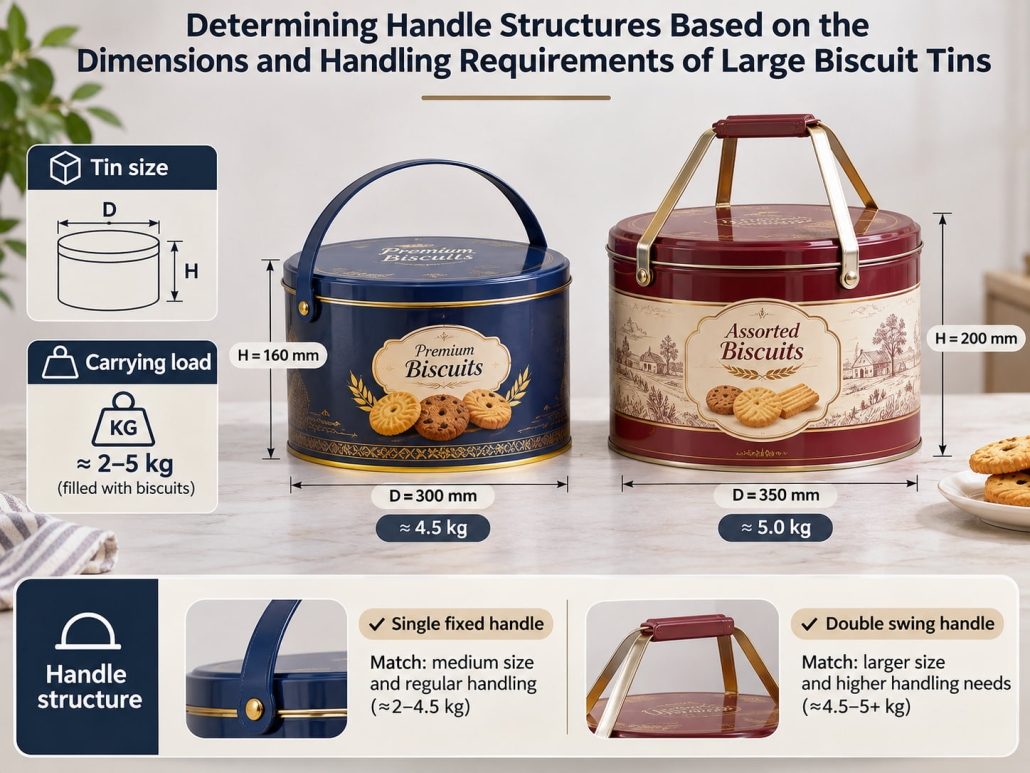
Determining Handle Structures Based on the Dimensions and Handling Requirements of Large Biscuit Tins

Depending on the Application, Large biscuit Tins Can Use Fixed or Folding Handles

Fixed and folding handles each have their own advantages.

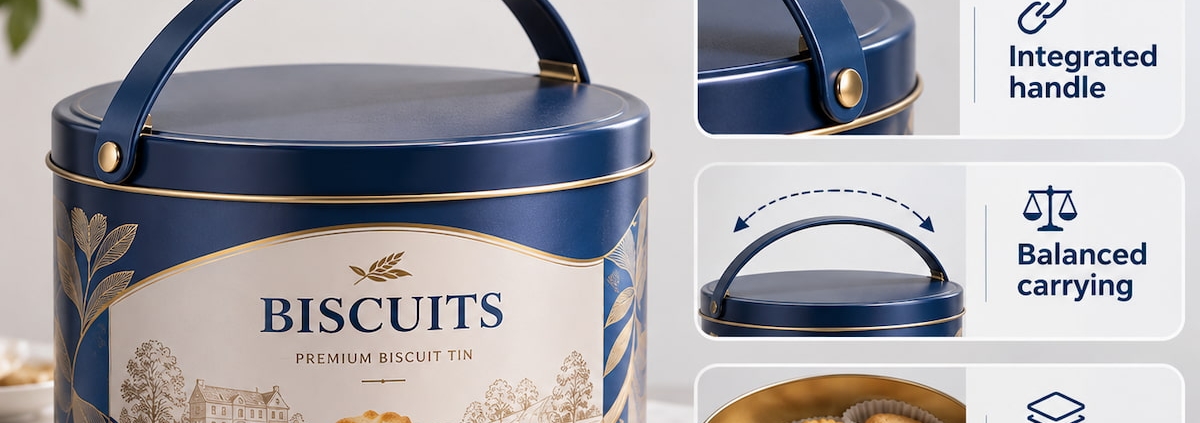
Fixed handles remain upright at all times and are always ready for lifting. They suit large biscuit tins that require frequent handling, or when the handle is an integral part of the gift box’s overall design. However, their fixed height increases the packaging’s external dimensions, which may reduce stacking or packing efficiency.

Folding handles feature a hinge that allows them to lie flat against the lid or body of the tin when not in use. This not only saves storage space but also makes transportation more convenient; however, the hinged structure requires additional clearance and effective control of the moving parts.

Design Factor Fixed Handle Folding Handle
Carrying readiness Always accessible Must be raised before use
Storage space Requires additional height Can fold closer to the tin
Structural complexity Relatively simple Requires pivot connections
Stacking May obstruct stacking Generally easier when folded
Best application Frequent carrying Gift packaging and space-efficient storage

When customizing biscuit tins, TSING selects the appropriate structure based on actual handling frequency, load weight, and packaging requirements.

Large Biscuit Tins: Handle Placement and Grip Design

Considerations Based on the Center of Gravity After Loading

The handle position directly affects how the tin behaves when lifted after filling. For larger rectangular containers, mounting the handle symmetrically on opposite side walls is typically a practical solution. When users lift the container by its handles, the handles distribute the load across two connection points, helping maintain the container’s balance. This arrangement ensures that the center of gravity of the loaded container is roughly directly below the effective lifting line of the handles.

If manufacturers mount the handles directly on a removable lid, the entire load may pass through the joint between the lid and the tin body, potentially lifting or detaching the lid. Unless manufacturers specifically reinforce the lid and its closure mechanism, they should generally mount the handle on the container body when users need to handle heavier loads.

When determining the handle dimensions, we ensure the grip area provides sufficient room for finger movement; at the same time, the handle’s height must allow comfortable lifting without making the entire package appear too tall.

Therefore, during the design process, TSING considers the overall width and height of the tin, the expected load weight, the grip space, and the space required to open the lid. This ensures that the handle not only feels comfortable to grip but also does not hinder the user from opening the lid.
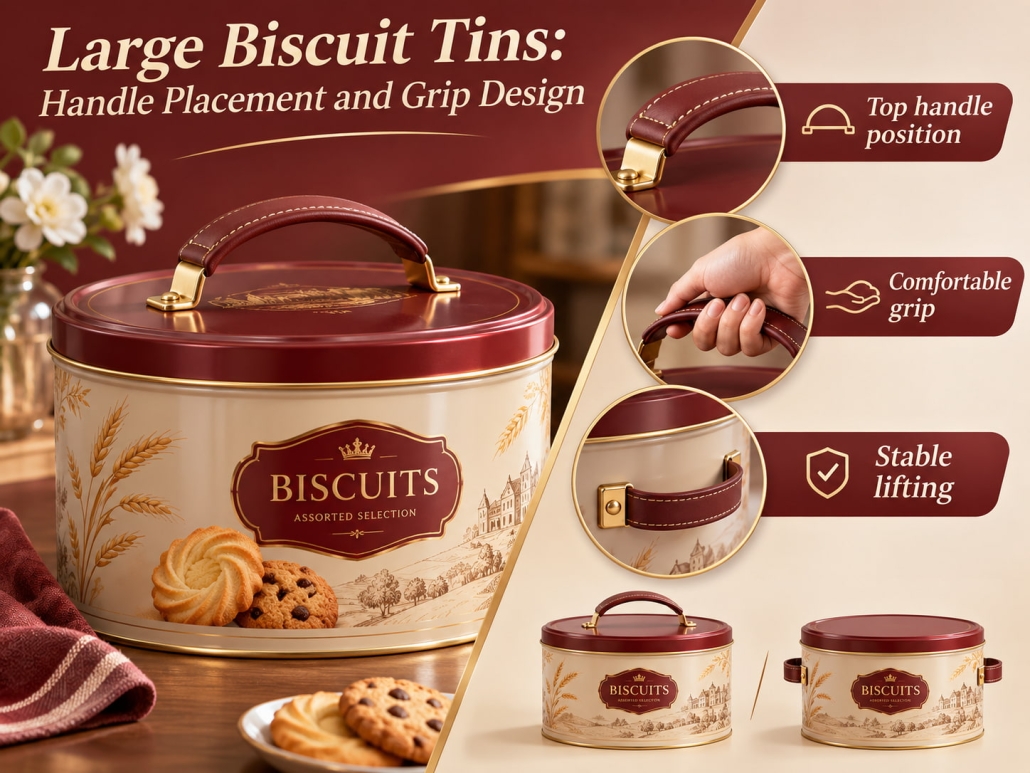
Handle Placement and Grip Design

Reinforcement of Connection Structures and Structural Validation

Once designers determine the handle type and position, their primary challenge is to transfer lifting forces to the metal box without causing local deformation. The connection structure must be sufficiently sturdy while also ensuring the tin’s seal, aesthetic integrity, and durability during transportation.

Reinforcing the Handle Connection Points on Large Biscuit Tins to Distribute the Load

The handle transfers the weight of the filled tin through the grip, pivot point, fasteners, and supporting metal plates.

If stress concentrates in a small area of thin tinplate, repeated lifting may stretch the mounting holes or bend the surrounding tin walls. Therefore, during the design process, we evaluate whether we need additional reinforcement around the connection points.

Our design solutions include:

  • Reinforcement plates: Distribute the load over a wider area of the tin’s walls.
  • Riveted mounting brackets: Provide a mechanical connection for movable or fixed handles.
  • Formed metal lugs: Integrate the mounting structure directly into the tin body, thereby reducing the number of separate components.
  • Mechanical fasteners: Facilitate the assembly or replacement of specific handle components; however, designers must account for internal protrusions and ensure that the components resist loosening.

The selection of a specific design solution depends on the handle’s design requirements and the anticipated load-bearing demands. The core objective is to distribute the load during lifting, preventing the handle from exerting force on only a small, unsupported area of the tinplate.
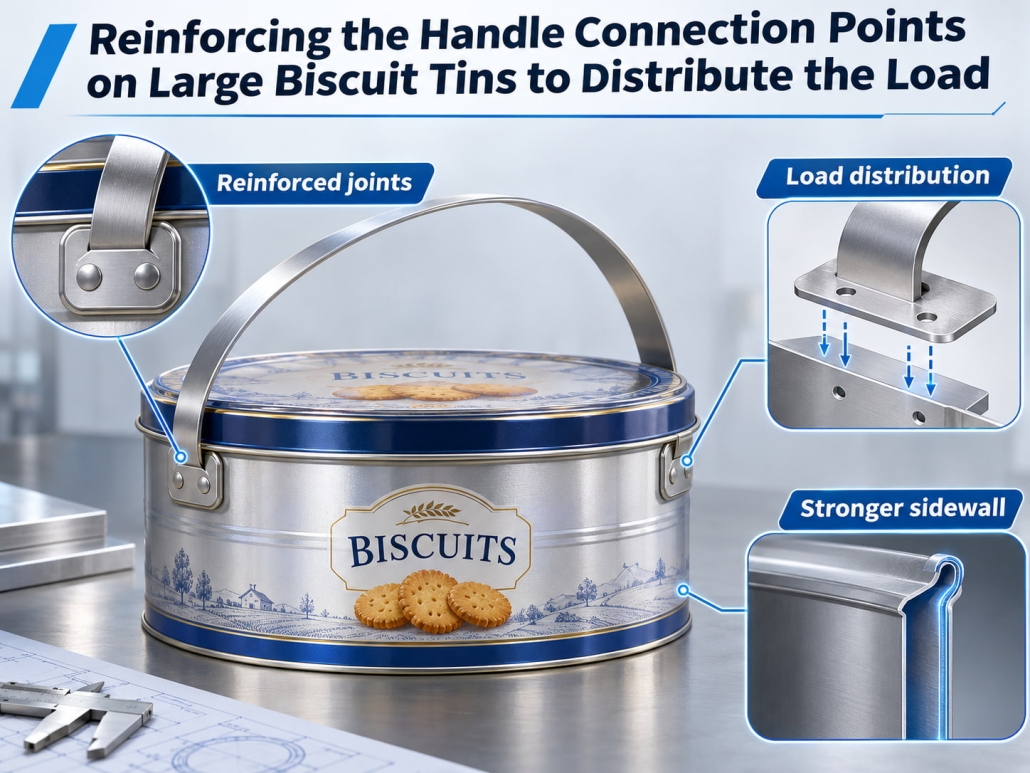
Reinforcing the Handle Connection Points on Large Biscuit Tins to Distribute the Load

Balancing Lid Closure, Stacking Space, and Outer Box Clearance

The handle design should not compromise the tin’s other functions.

For example, while foldable handles appear compact, their connecting brackets must not obstruct lid opening or press against it when folded. Similarly, fixed handles must allow sufficient clearance within the outer carton and should not act as stress points during stacking, which could cause accidental crushing.

For large gift tins, TSING evaluates the clearance relationships in the following three areas:

  • Clearance between the handle and the lid: The handle and its mounting components must not interfere with the latching, removal, or closing of the lid.
  • Clearance between the handle and the stacking space: When folded, the handle should fit within the preset storage area; if the handle remains upright, the stacking plan must account for its height.
  • Clearance between the handle and the outer shipping carton: The outer shipping carton must accommodate the handle, ensuring that external pressure does not cause the handle to bend or transmit excessive force to the tin lid.

The cookie tin should be easy to carry once filled with product, while also allowing for efficient stacking and packing before delivery to the customer. A suitable packaging solution would use a foldable handle with protective padding inside the carton to keep the handle in its intended position throughout transit.
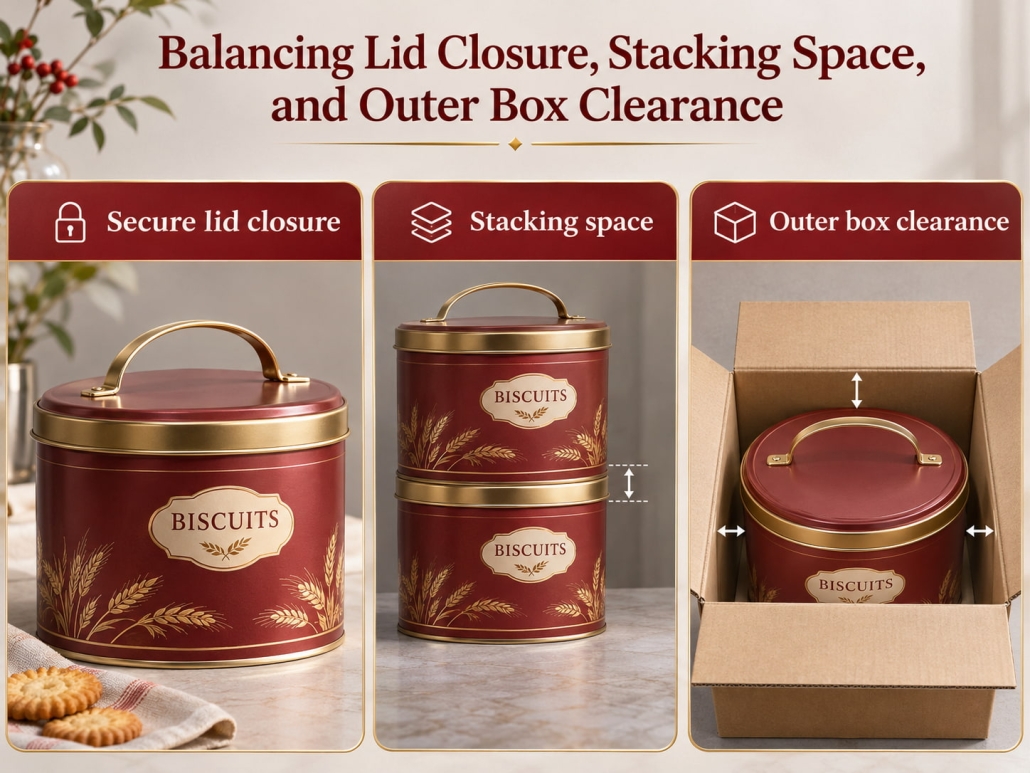
Balancing Lid Closure, Stacking Space, and Outer Box Clearance

Testing Handles and Connections Before Mass Production

A handle that appears sturdy might perform quite differently once workers fill the tin with cookies.

Therefore, we validate the structural integrity using containers filled with the actual product. The test load accounts for the product weight, internal packaging materials, and the conditions under which users expect to carry the tin.

Our evaluation focuses on three key areas:

  1. Connection strength;
  2. Durability under repeated lifting;
  3. Overall packaging performance.

The design process follows this sequence:

Load weight and dimensions → Handle selection → Mounting position → Reinforcement design → Tooling and assembly → Prototype load testing → Carton compatibility → Approval for mass production

Balancing Portability, Structural Strength, and Packaging Efficiency

When designing large biscuit tins with handles, TSING carefully considers factors such as weight when filled, center of gravity, handle mounting position, structural reinforcements, lid clearance, and outer shipping carton dimensions.

We ensure that our large biscuit tins are comfortable for consumers to carry, feature secure handle attachments and tightly fitting lids, and are designed for efficient stacking and transport. By holistically addressing load-bearing capacity, ease of opening, and packaging efficiency, we create large biscuit tins that are both highly practical and portable.


How Should Gold Tin Packaging Be Developed for New Year Gift Sets

How Should Gold Tin Packaging Be Developed for New Year Gift Sets?

New Year’s gift boxes must convey a rich festive atmosphere, the brand’s unique character, and the value of the gifts themselves. While gold alone can create an excellent visual effect, simply applying a gold finish to a tin box is not enough to meet the demands of high-end holiday marketing. The design must not only turn festive elements into printable graphics but also use embossing to create visual depth and incorporate a well-thought-out internal structure to accommodate multiple products. By integrating New Year themes with the tin’s shape, surface finish, internal compartments, and production requirements, we have created an exceptional gold tin packaging solution. The final product not only exudes a distinct New Year festive spirit but also balances practicality in product packing, transportation, retail display, and mass production.

Gold Tin Packaging: Transforming New Year Traditions into Unique Brand Design

Traditional New Year imagery is an excellent starting point, but the challenge lies in striking the right balance in decoration. For example, red and gold are well-known festive color combinations, while lanterns, auspicious clouds, floral patterns, and zodiac elements effectively convey a rich festive atmosphere. However, cramming all these elements haphazardly onto a tin can make the design appear cluttered and weaken the brand’s distinctiveness.

To address this, we recommend establishing a core visual theme and using other decorative elements as accents. This approach creates a clear hierarchy between the brand logo, New Year’s messages, and festive artistic elements.

Gold Tin Packaging Transforming New Year Traditions into Unique Brand Design

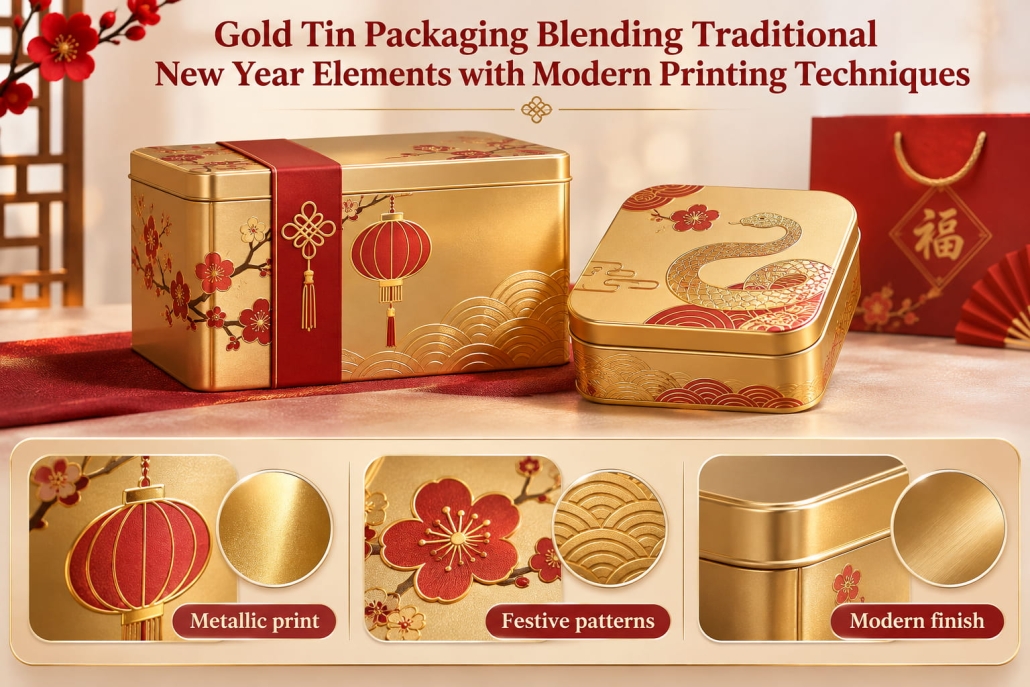
Gold Tin Packaging Blending Traditional New Year Elements with Modern Printing Techniques

The traditional visual language of New Year packaging can be adapted through color, illustration, and graphic composition to align with different brand identities.

For example, a gold New Year tin can feature a warm metallic gold background, complemented by illustrations of red lanterns and delicate cloud patterns. For a more modern design, designers can retain the golden surface while incorporating minimalist Chinese zodiac symbols and geometric patterns, presenting the brand logo in a subtle, understated way.

Printing techniques also influence the final visual presentation. Tinplate has a non-absorbent metal surface, so inks and coatings must cure properly. If the design requires colors to appear as they would on a standard white background, you can apply a white undercoat first; alternatively, you can incorporate exposed metal areas directly into the visual design.

For custom gold tin cans, we offer several common visual design options:

  1. All-gold background: Creates a unified and rich festive atmosphere throughout the packaging.
  2. Gold paired with contrasting colors: Incorporating red, black, or other brand-specific colors improves the design’s recognizability.
  3. Partial metallic effect: Retaining the metallic texture in certain areas while using printed graphics to create the overall visual effect.

Gold Tin Packaging Blending Traditional New Year Elements with Modern Printing Techniques

Using Embossing to Add Visual Depth to Festive Elements

Printing techniques lay the foundation for colors and patterns, while embossing adds a three-dimensional texture that is visible and tangible to the touch.

On New Year’s gift tins, embossing is ideal for elements that need to stand out, such as brand logos, zodiac symbols, key floral motifs, or decorative borders.

A common design approach we use is to combine a minimalist printed background with one or two embossed details. For example, designers can emboss the brand logo in the center of a gold lid printed with red New Year’s motifs. When exposed to light, the raised logo creates a play of light and shadow that contrasts with the surrounding surface, establishing a highly recognizable visual focal point without excessive ornamentation.

However, the depth and placement of the embossing must align with the tinplate‘s structural properties. Therefore, TSING conducts a comprehensive evaluation of the design draft and embossing layout before finalizing the die. This ensures that the festive design remains clear while the metal surface remains suitable for subsequent forming processes.

Using Embossing to Add Visual Depth to Festive Elements

Design based on the products contained in the gift box and their manufacturing requirements

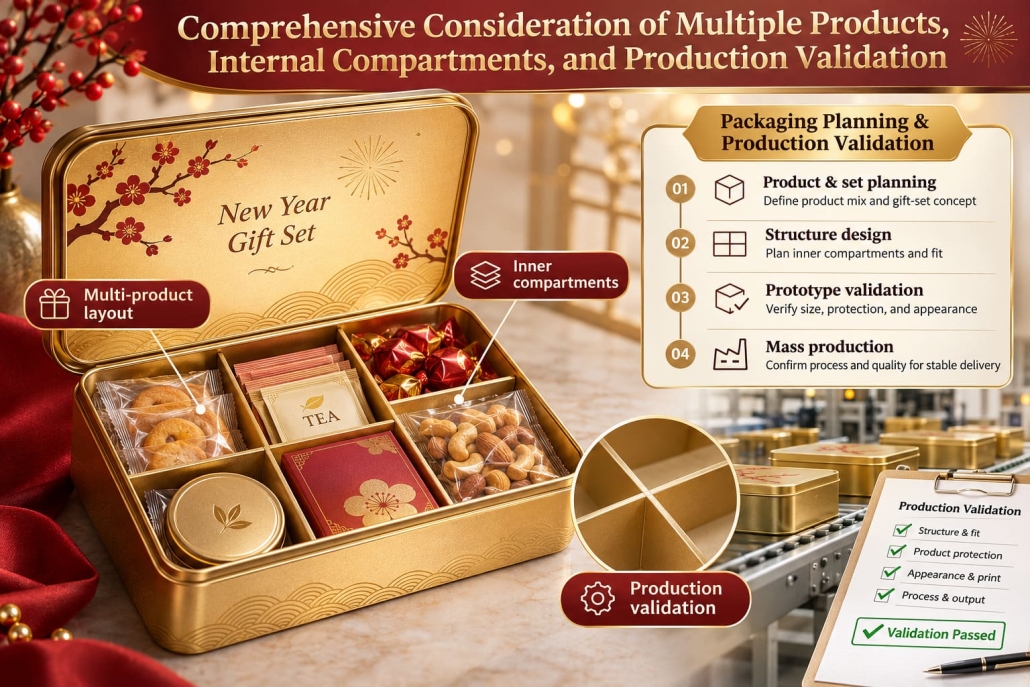
New Year’s gift boxes are typically more complex than individual product packaging. They may contain chocolates, cookies, candies, tea, nuts, or individually wrapped snacks. Because these products vary in size, weight, and protection needs, the internal structure must be planned alongside the exterior design.

Comprehensive Consideration of Multiple Products, Internal Compartments, and Production Validation

The primary consideration is how the products should be arranged when the recipient opens the gift box. We evaluate the product mix and determine whether the packaging requires separate compartments, paper inserts, molded inserts, or removable tiered dividers.

The design of the internal layout takes the following factors into careful consideration:

Product dimensions + quantity + inner tray thickness + necessary clearance + space reserved under the lid

For single-layer chocolate assortments, a shallow rectangular tin is more suitable; whereas for layered displays of tea and candies, a deeper structure may be more ideal.

Additionally, the lid must not compress the products in the upper layers when closed. At the same time, designers should avoid excessive space to prevent the contents or inner trays from shifting during transportation. Once TSING finalizes the internal layout, the company can determine the external dimensions, lid structure, and mold manufacturing requirements. The development process for gold tin gift boxes follows a rigorous and coordinated set of steps:

Gift Box Requirements Analysis → Product Layout Planning → Tin Dimensions Determination → Structural and Mold Design → Printing and Embossing Processes → Forming and Assembly → Physical Sample Approval → Mass Production

Comprehensive Consideration of Multiple Products, Internal Compartments, and Production Validation

Design Integrating Theme, Craftsmanship, and Structure

When customizing gold tin packaging for New Year’s gift boxes, we integrate seasonal visual themes, metallic printing techniques, embossed details, product layout, and the tin’s physical structure.

We treat each gift box as a complete seasonal packaging project: the exterior design is intended to convey a festive atmosphere and highlight the brand image, while the internal structure serves to protect the gifts and optimize display. Through systematic design of these elements and rigorous validation before mass production, these customized tin gift boxes not only achieve the ideal festive aesthetic but also ensure the manufacturing quality expected of high-end New Year’s gift boxes.

Tinplate

What is tinplate?

Tinplate is commonly known as electroplated tin plate, SPTE for English abbreviation, which refers to the cold rolled low carbon sheet steel or steel strip coated with pure tin on both sides, also known as tin iron. Tin mainly plays the role of corrosion prevention and rust prevention, it combines the strength and formability of steel with the corrosion resistance, solder and beautiful appearance of tin in a kind of material, with corrosion resistance, non-toxic, high strength and good ductility characteristics.


Tinplate and its native Bohemia

Bohemia (now part of the Czech Republic and Slovakia) may be unfamiliar, but its history and culture will not be forgotten. In the 5th century, Slavs from the east established the kingdom of Bohemia and developed a splendid culture. The prosperity of Prague is an outstanding representative of this period. This makes Bohemia not only a symbol of fringe, pleats, skirts popular clothing, but also becomes a synonym for freedom, free and unrestrained enthusiasm.

Bohemia is also the origin of tinplate. Since ancient times, the region has been rich in metal and advanced technology, and they know how to use water to engage in machine manufacturing, which makes them to produce tinplate since the 14th century. For a long time, it was the world’s leading producer of tinplate. At that time, tinplate was mainly used to make tableware and drinking utensils.


The characteristics of tinplate

Tinplate is widely used in packaging with the following advantages:

(1) It is light opaque. Light will not only cause poor reaction of food, but also cause changes of protein and amino acid. The light opaque tinplate can better keep vitamin C in the food.

(2) Good sealing.

(3) Tin reduction can reduce the chance of food oxidation

(4) To provide a source of effective iron. Due to the electrochemical action of metal, a small amount of iron will dissolve out of canned food in storage and exist in the sealed canned food in the form of iron bivalent, which is easy to be absorbed by the human body.


Because of these properties, the tin can provides a closed system completely isolated from the environment except for heat. It can be used to contain food and beverage, which can avoid food fission due to light, oxygen and moisture, and avoid food dilution due to aroma through or environmental odor through pollution. Its food storage stability is better than other packaging material, and vitamin C has the highest preservation rate, nutrient retention is also the best.