
Capsule Tins Sealing Guide: Moisture-Proof and Leak-Proof Techniques for Storing Medication Capsules
In the healthcare industry, a single seal failure can expose capsules to moisture, contamination, or oxidation, compromising product safety, shortening shelf life, and potentially leading to costly recalls. Therefore, we believe packaging should be both invisible and indispensable: ensuring drug safety while reflecting your brand. In this guide, we will show you how Tsing’s sealing technology for capsule tins (also known as pharmaceutical tins or capsule tins) provides superior sealing performance for capsules and powdered medications.
The Importance of Sealing Performance for Capsule Tins
Sealing performance determines critical aspects of capsule packaging, including moisture ingress, oxygen exposure, and aroma retention. For pharmaceuticals and health products, these factors directly impact efficacy, dissolution profiles, and patient safety. Compared to many other secondary packaging forms, well-designed capsules or pharmaceutical tins offer significant advantages:
Mechanical Strength: Metal tins resist crushing, puncturing, and rough handling during transportation.
Thermal Stability: Tin cans can withstand a wide range of temperatures during sterilization or transportation.
Reusability and Consumer Trust: Well-sealed tin cans demonstrate quality, encourage reuse, and increase brand touchpoints.
However, metal alone does not guarantee a complete seal. Metal lids can shift, gaps can allow moisture ingress, and seams or welds can become points of failure. Therefore, an integrated sealing strategy is required for metal pharmaceutical packaging: an inner plug or secondary lid, high-performance sealing gaskets, seamless (drawn) can bodies, and a necking/crimping process that ensures a tight fit for the outer lid. This multi-layered sealing approach addresses both visible leaks and microscopic leaks, meeting the sealing control requirements of pharmaceutical clients for capsule containers. In short, sealing is an essential functional requirement for any pharmaceutical-grade capsule tin.
Using an Inner Plug Lid Structure
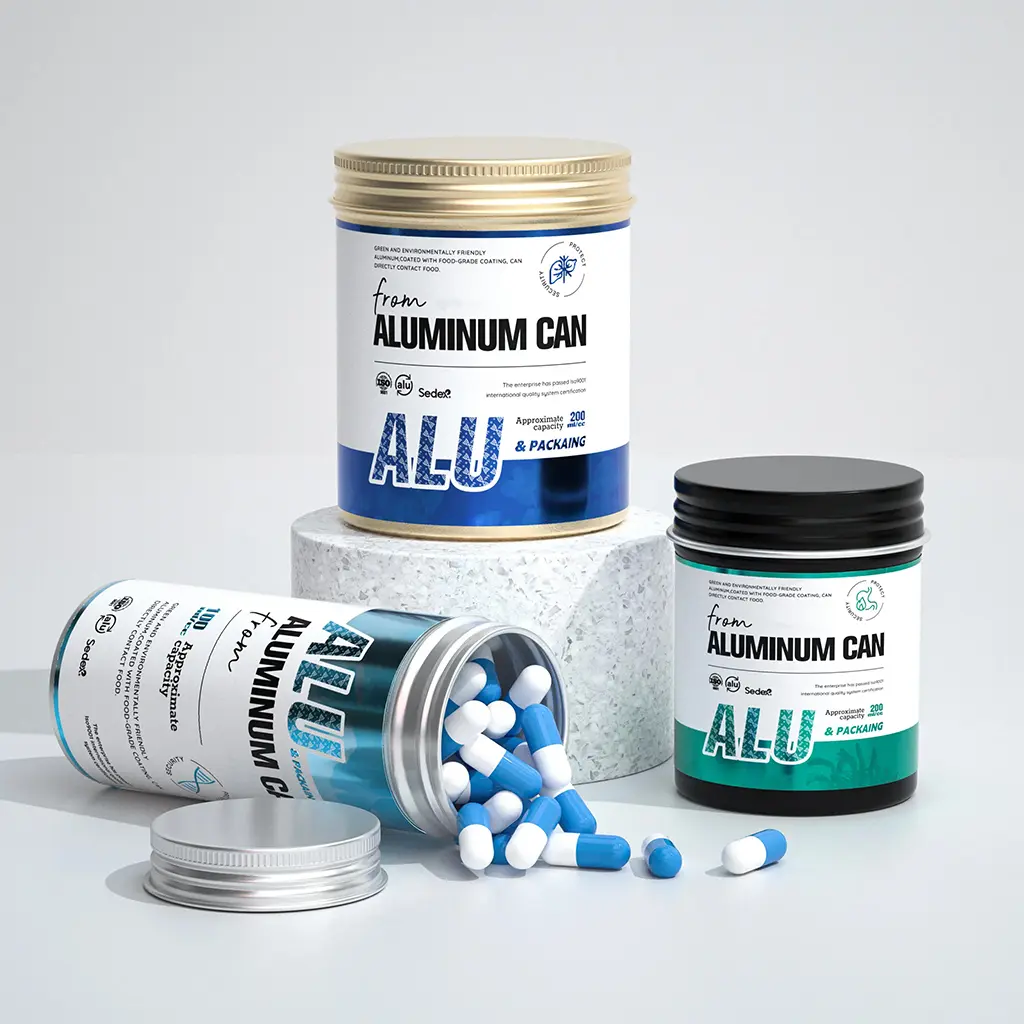
An effective way to lock in aroma and keep moisture out is to use an inner plug lid. Tsing’s high-seal process incorporates a second barrier beneath the metal outer lid: either a plastic inner plug or a second metal lid. Both have their advantages:
1. Plastic Inner Plug (Press-fit or Snap-on):
- Typically molded from food-grade PP, PE, or compatible polymers. A contact surface is formed that conforms to the container’s contour, compressing slightly upon closure to improve friction and reduce micro-gaps.
- A ribbed skirt or washer seat design can be used to increase retention and sealing compression force.
- Advantages: Low cost, customizable geometry, and excellent barrier properties when used in combination with gaskets or O-rings.
2. Auxiliary Metal Inner Lid (Nested or Double-Layer Lid)
- A thin metal disc is located inside the outer lid, forming a second seal.
- It can be pressed into a neck groove or secured with a snap-fit flange.
- Features thermal compatibility (e.g., steam sterilization) and a continuous, metal-to-metal interface that is resistant to permeation.
- Advantages: More suitable for high-temperature processes and ideal for customers seeking an all-metal system without visible plastic.
Both of these inner plug strategies significantly reduce the migration of volatile compounds and slow down moisture ingress. They are essential for highly aromatic nutraceuticals or capsule oils. Furthermore, the inner plugs we use are made from pharmaceutical-grade materials that meet USP (United States Pharmacopeia) standards and are validated to prevent migration or extraction upon contact with the capsule formulation.
Capsule Tin Sealing Gasket Technology
Sealing gaskets are used to provide a direct seal between the lid and the container. The right gasket material can effectively control moisture and oxygen ingress. Tsing’s capsule tin sealing gasket options include PVC gaskets, silicone rings, and EPE liners:
1. PVC Gaskets:
- Good compressibility and cost-effectiveness.
- Performs well in moderate temperature ranges and provides sufficient moisture protection for many capsule products.
- Can be formulated to meet food and drug contact standards (plasticizer-free grades are recommended).
2. Silicone Rings:
- Excellent thermal stability, making them ideal for applications requiring sterilization or high-temperature storage.
- Low compression set, excellent elasticity, and good aging resistance.
- Silicone offers excellent sealing performance for medications containing volatile active ingredients because it maintains sealing pressure over extended periods.
- For compatibility with medications, consider using medical-grade platinum-cured silicone.
3. EPE Gaskets
- Offers excellent shock absorption and moderate sealing performance, with low moisture absorption.
- Economical and lightweight, ideal for consumer-facing cans where the visible “soft-closing” design is beneficial.
- Not suitable for high-temperature sterilization unless specially formulated.
- In practical applications, we typically recommend silicone rings or a hybrid solution (silicone + EPE backing) for capsule tins or pharmaceutical tins, as the elasticity and low water vapor transmission rate of silicone provide a reliable long-term barrier. However, for cost-sensitive applications, we might prefer PVC with other control measures.

Seamless Drawing Process – Eliminating Welding-Related Leaks
One of the main failure modes of metal packaging is seam leakage. Traditional welded or side-seam tins introduce potential defects, stress concentration points, and crevice corrosion areas, affecting packaging integrity. Tsing addresses this issue with a seamless drawing process, where the entire capsule tin is stamped and drawn from a single sheet of tinplate, forming a monolithic can body without welded seams on the bottom or sides.
Key Advantages of Seamless Drawn Capsule Tins:
Structural Continuity: The absence of welded joints eliminates gaps for liquid or powder ingress. This makes the tin can suitable even for containing liquids or hygroscopic fine powders.
Improved Barrier Uniformity: The continuous metal wall exhibits predictable permeability behavior and uniform thermal expansion during sterilization or thermal cycling.
Corrosion Resistance: Welds often present weak points where coatings may fail; the seamless body maintains the integrity of the paint layer and simplifies the application of internal coatings.
Aesthetic and Tactile Quality: Seamless tins look cleaner and feel smoother – crucial for consumer trust in the pharmaceutical and nutraceutical sectors.
This seamless process requires precision molds and deep drawing machines. It also has strict requirements for material selection: the tinplate must possess appropriate tensile strength and elongation to avoid cracking during deep drawing. Tsing’s engineering team optimizes the thickness of the tinplate and the pre-lubrication process to maintain its formability and the adhesion of the internal coating. For capsule or pharmaceutical packaging, seamless tinplate cans significantly reduce the risk of leakage and the formation of micro-channels. Combined with an inner plug and high-performance sealing ring, the resulting capsule containers provide a robust, reliable, and proven solution, even for moisture-sensitive formulations.
Neck-down and crimping – precision sealing for flush fit and friction seal
Even with an inner plug and gasket, external mechanical sealing remains crucial. Necking (reducing the diameter of the can opening) and crimping are two mechanical operations that improve lid retention, achieve a flush fit, and enhance the sealing effectiveness of the friction seal. Tsing employs precision necking and crimping processes tailored explicitly for pharmaceutical tins.
How necking and crimping improve sealing:
Flush lid engagement: The slightly reduced diameter of the neck allows the lid to fit completely and evenly, creating a continuous contact surface. This prevents lid tilting and reduces side gaps.
Increased radial compression: A small inward flange is pressed into the can opening edge, increasing radial pressure when the lid is closed, forcing the gasket to compress evenly and creating a tighter seal.
Tamper-evident: The correct crimp geometry makes the lid more challenging to open accidentally or unintentionally – a worthwhile feature for product security and regulatory requirements.
Improved retention in automated processes: Automatic capping and sealing machines can handle necked/crimped tins more reliably, with consistent torque and minimal slippage.
Creating reliable, high-seal pharmaceutical capsule tins
From the inner plug and high-performance sealing gasket to the seamless drawing process and precision necking and crimping, each of Tsing’s technologies plays a unique role in protecting capsules from moisture, oxygen, and contamination. When these structural solutions are combined with auxiliary preservation measures such as desiccants, nitrogen flushing, and proven quality testing, the capsule tins become a highly reliable packaging option for pharmaceutical and healthcare products.
 Facebook
 Twitter
 Linkedin