
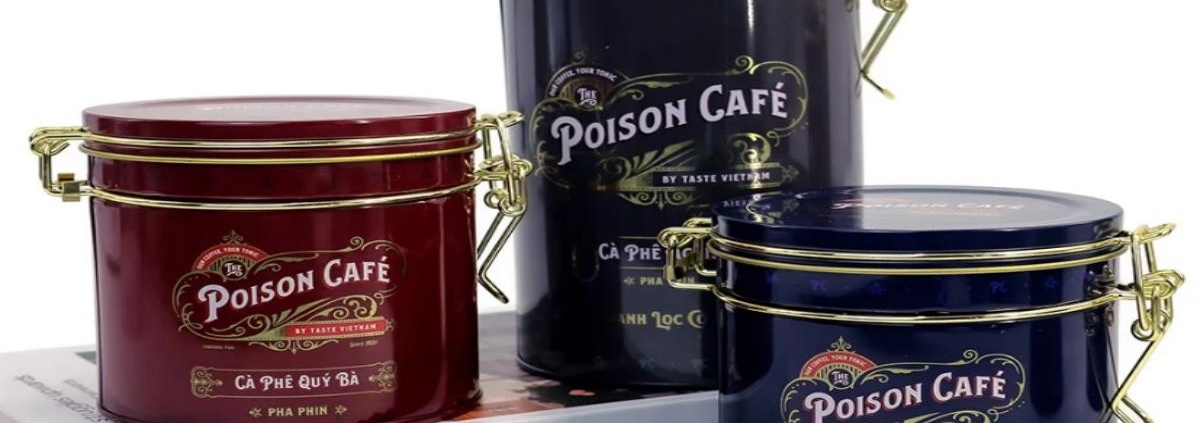
How to solve the problem of low print durability in custom printed coffee tins?
Customers may scratch the coffee tins when placing them on shelves, or sunlight and humidity can cause the labels to fade within weeks. This discrepancy is reflected directly in the initial visual impact compared to the product’s long-term appearance. At Tsing, we have worked with numerous companies to produce thousands of custom printed coffee tins. We understand that print durability is not a single problem, nor does a single solution solve it. Instead, durability is a system property: it depends on material selection, printing technology, surface treatment, curing, mechanical design, and handling during actual use. If you want your custom coffee tins to remain aesthetically pleasing throughout shipping, display, and daily use, you must consider print durability as a carefully designed outcome, not just a benefit.
Reasons for Print Durability Failure in Custom Printed Coffee Tins
Poor print durability in custom coffee tins typically stems from one or more of the following root causes:
Incompatible Substrate or Coating: Coffee tins are often made of tinplate and coated with varnish or powder coating. If the chosen ink system cannot chemically or mechanically bond with this surface, peeling and flaking are likely to occur.
Improper Surface Preparation: Oil, residue, or uneven primer can hinder uniform adhesion. Even tiny contaminants can create weak points, leading to localized scratching.
Insufficient Curing or Crosslinking: Many inks require a controlled curing step. Insufficient curing results in a soft, easily abraded ink film.
Mechanical Stress Concentration: Edges, seams, can lid rings, and embossed areas concentrate friction. Printing in these areas without protection can easily lead to localized wear.
Environmental Exposure: High humidity, salt spray, grease, and UV light can accelerate the degradation of certain inks. If the packaging lacks UV protection and you sell your products in brightly lit store environments or hot climates, the print lifespan will be shortened.
Utilizing Surface Treatment and Primer Coating for Scratch-Resistant Ink Application
If adhesion is half the battle, then surface treatment is the first step in producing a custom printed coffee tin. Proper surface treatment maximizes the chemical bonding between the substrate and the protective ink/varnish layer. During the printing process, we use degreasing baths or controlled solvent wiping to remove grease, fingerprints, and flux residues. For tin-plated sheets, a mild alkaline cleaning followed by deionized water rinsing works well. Corona treatment may also be applied; these treatments increase surface energy and improve the wettability of inks and coatings. For metal substrates with powder coatings or pre-painted surfaces, targeted plasma treatment before printing can significantly improve adhesion, especially for water-based or UV-curing inks.
For primer selection, we choose epoxy or polyester-based primers. They typically have strong adhesion to metals and provide an ideal base for subsequent UV-curing or solvent-based topcoats. Primers can also smooth out microscopic roughness and prevent metal migration. A controlled baking step is then performed, as many primers require this to improve crosslinking and adhesion. We adhere to the temperature/time schedule after primer application to achieve optimal mechanical properties.
Choosing Scratch-Resistant Inks for Custom Printed Coffee Tins
Not all inks are created equal. The chemical composition and printing method of the ink significantly affect scratch resistance, UV resistance, and chemical resistance. The following are the most common inks we use:
UV-curing inks: These inks polymerize rapidly under UV light, typically forming a hard, crosslinked film with excellent abrasion resistance. They are a fantastic choice and our most commonly used option when combined with the appropriate primer and substrate pretreatment. UV inks are more resistant to solvents and finger oils than many solvent-based ink systems.
Solvent-based inks: Traditionally used for metal decoration (offset printing, gravure printing). They can produce vibrant colors and can be used with durable varnishes, but their durability depends on the varnish or topcoat applied after printing.
Water-based inks: Environmentally friendly, but traditionally have poor abrasion resistance. Newer water-based systems have improved performance with the addition of crosslinkers and co-solvents, but typically still require a topcoat to achieve good scratch resistance on coffee tins. Common Printing Processes:
Offset Printing: High resolution, suitable for large-volume production. Using UV inks or solvent-based inks with a protective varnish extends lifespan.
Gravure Printing: Ideal for roll-to-roll printing and mass production; provides even ink coverage. Best used with a varnish or UV coating.
Digital/UV Inkjet: Excellent for variable designs. Modern UV inkjet printing uses UV-curing inks that offer excellent scratch resistance, but proper pretreatment is necessary to ensure adhesion to metal.
Scratch-Resistant Printing Recommendations for Coffee Tins:
Tsing recommends using UV-curing inks on tinplate with a suitable primer for the highest practical wear resistance. If using solvent-based inks, we would recommend a hard, cross-linking topcoat or a bake-cured varnish. We recommend using unmodified water-based inks unless you plan to use a protective coat.
Protective Topcoats and Finishes: Varnishes, Lacquers, and Clear Coatings
Even the best inks require a protective coating. Topcoats enhance mechanical strength, provide UV protection, and act as a chemical barrier, thus preserving color and gloss.
Different Topcoat Options and Advantages:
UV-Curing Varnishes: Cure quickly, forming a hard, durable film. They are particularly compatible with UV inks and digital printing. You can choose from satin, matte, or gloss finishes. UV varnishes with added scratch-resistant additives create a surface resistant to friction and stacking.
Bake-Cured Lacquers: Commonly used for metal can decoration. Bake-cured lacquers undergo a cross-linking reaction during baking, forming a durable film. They typically have excellent edge chip resistance and feel robust and durable during mechanical handling.
Powder Coatings: If the design allows, powder coating the entire tin can in a single pass can achieve very high mechanical strength. However, printing on or embedding printed images into a powder coating requires modifying the process and using special inks, or performing a series of printing steps before the powder cures. Anti-fingerprint and oleophobic coatings: For high-end coffee cans, a thin oleophobic topcoat can reduce visible fingerprints and oil stains, maintaining the print quality. These coatings do not replace scratch resistance, but they can improve perceived durability.
Mechanical design and structural design can also extend print life.
Good printing processes must be combined with meticulous mechanical design. The shape and assembly method of coffee tins affect the durability of the print.
Therefore, in our design, we aim to avoid printing critical patterns in high-friction areas. Areas that come into contact with shelves, other cans, or hands, such as edges, bottom edges, or lid edges, are more prone to wear. Keep the main brand logo away from these areas, or reinforce them with an additional topcoat. Additionally, for lid and seam details, we consider slightly recessing critical printed panels or using raised edges to reduce friction on the printed surface. For embossing and debossing designs, if the embossing position is close to the printed area, we will increase the thickness of the local protective coating, or, if conditions permit, print after forming.
A practical, comprehensive approach to achieving lasting prints
Solving the problem of poor print durability in custom printed coffee tins is not a one-step process, but requires a series of coordinated choices and control measures. First, Tsing will conduct a precise diagnosis, performing adhesion and abrasion resistance tests to understand the failure modes. This is followed by proper surface treatment, selection of durable ink systems, use of appropriate topcoats, and finally, different mechanical designs. This ensures that your custom-printed coffee cans consistently meet your expectations from mass production to the consumer.
 Facebook
 Twitter
 Linkedin