
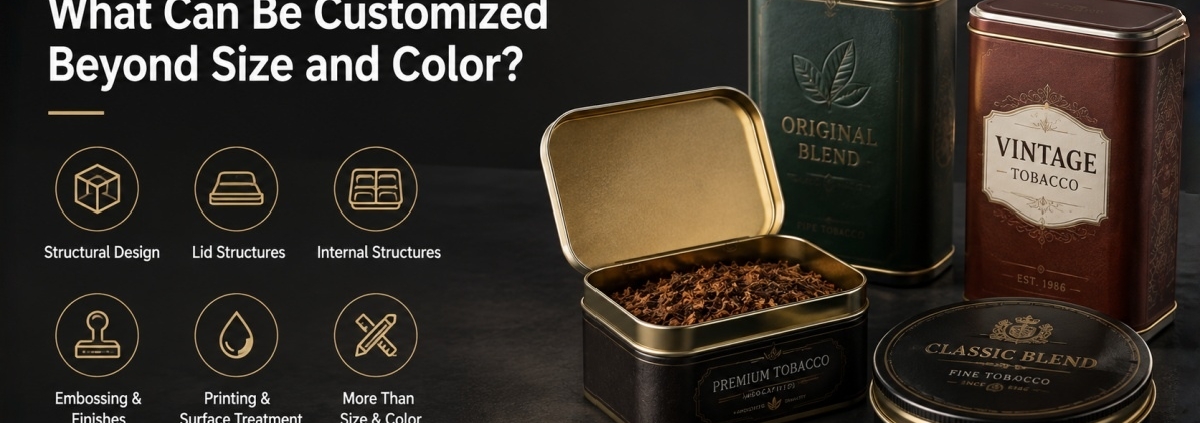
Custom Tobacco Tins: What Can Be Customized Beyond Size and Color?
When it comes to custom tobacco tins, size and color are often the first customization options that come to mind. However, these two factors are merely the starting point for creating a custom tobacco tin. From a manufacturer’s perspective, a complete set of custom tobacco tins typically encompasses structural design, opening mechanisms, internal construction, surface finishes, sealing systems, and production process details.
This is because the function of a tobacco tin extends far beyond simply containing the product. It must accommodate specific tobacco forms, withstand repeated handling and use, and provide a practical user experience. Therefore, in our custom tobacco tin projects, we employ reverse engineering based on the product itself and its intended use. In addition to size and color, key customization options include can structure, lid mechanisms, internal components, embossing techniques, printing technologies, surface treatments, and sealing methods.
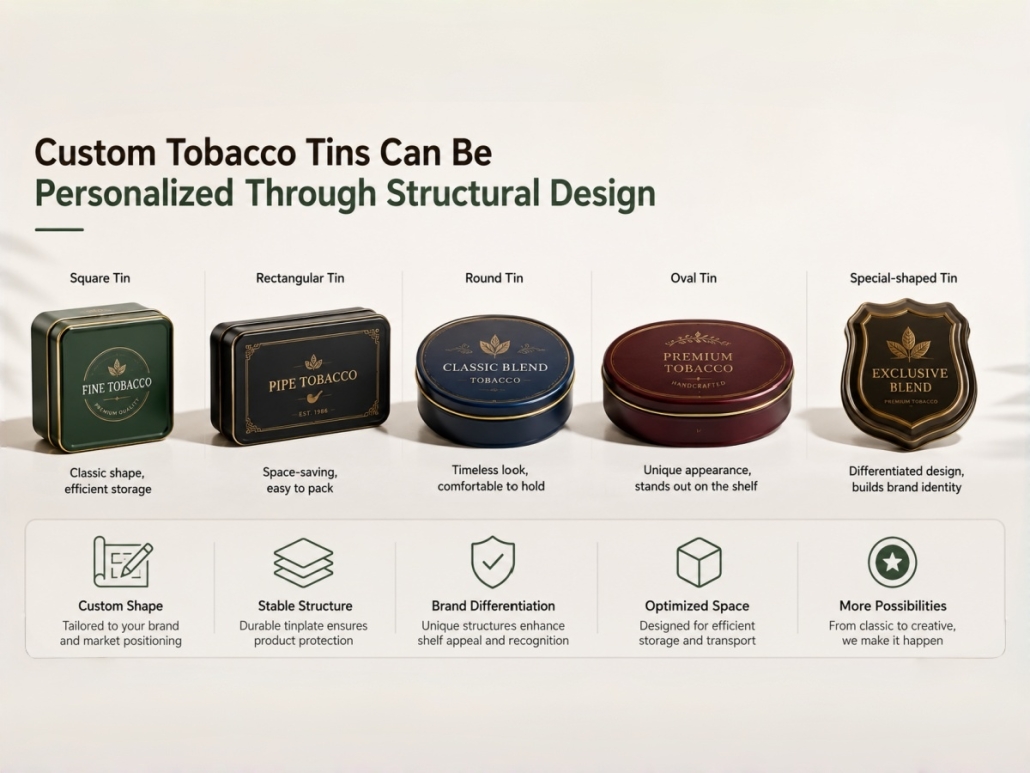
Custom Tobacco Tins Can Be Personalized Through Structural Design
The can structure is one of the most critical design factors in the customization process, as it determines the packaging’s appearance, tactile feel, stacking method, opening mechanism, and suitability for its intended usage environment. In addition to traditional rectangular containers, manufacturers can produce custom tobacco tins in a variety of shapes, such as:
- Round tins
- Square tins
- Oval tins
The choice of shape should be based on the tobacco’s form and the user’s usage scenarios, rather than solely on visual preferences. For example, cigarette tins designed to fit in a pocket typically feature a slim, rectangular design to match the proportions of traditional cigarette packs. In contrast, bulk tobacco tins may require greater depth to accommodate the product while avoiding excessive packaging width.
Structural customization also encompasses details such as corner shapes, can wall height, base construction, and lid proportions. These seemingly minor adjustments can significantly impact the final user experience.
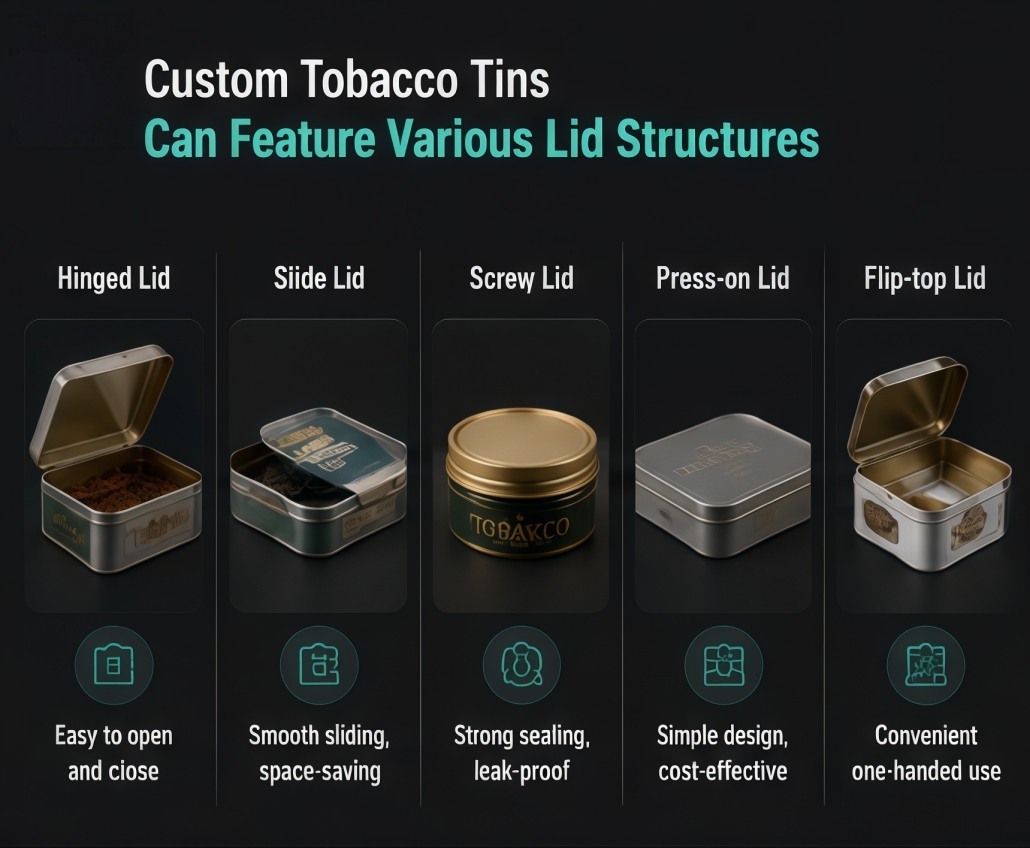
Custom Tobacco Tins Can Feature Various Lid Structures
Lid design is another critical aspect of the customization process.
Common options include:
- Hinged lids
- Slip lids
- Sliding lids
- Lift-off lids
- Double-layer lid structures
Hinged lids are particularly practical for tobacco tins that consumers need to open and close frequently. Since the lid remains attached to the tin body, users do not need to set the lid aside when accessing the tobacco. Slip lids, on the other hand, offer a completely different experience. They enable a compact, smooth opening motion, making them ideal for small, portable tobacco tins.
Custom Tobacco Tins Can Be Equipped with Personalized Internal Structures
Custom design isn’t limited to the exterior. Internal components can also be added to properly organize the product and enhance the user experience. Common internal configurations include:
- Plastic trays
- Metal liners
- Cardboard liners
- Dividers
For example, a tobacco can designed specifically for multiple tobacco varieties can use internal compartments to separate different products. Cigarette cans can also incorporate internal structures to keep cigarettes neatly arranged and minimize shifting during transport. We design these components based on the product’s actual dimensions, rather than forcing it into standard-sized compartments.
Accommodating Products of Different Shapes
Different tobacco products have different packaging requirements. We design corresponding internal configurations for the following products:
| Tobacco Product | Potential Interior Design |
| Cigarettes | Long, narrow cavity or retaining insert |
| Loose tobacco | Deeper open cavity |
| Rolling tobacco | Larger volume compartment |
| Tobacco accessories | Divided internal storage |
| Multi-product sets | Multiple compartments |
This approach not only enhances the sense of order within the container but also increases the perceived value of the packaging. For high-end metal can packaging, a carefully designed internal structure can transform the container into a reusable storage box.
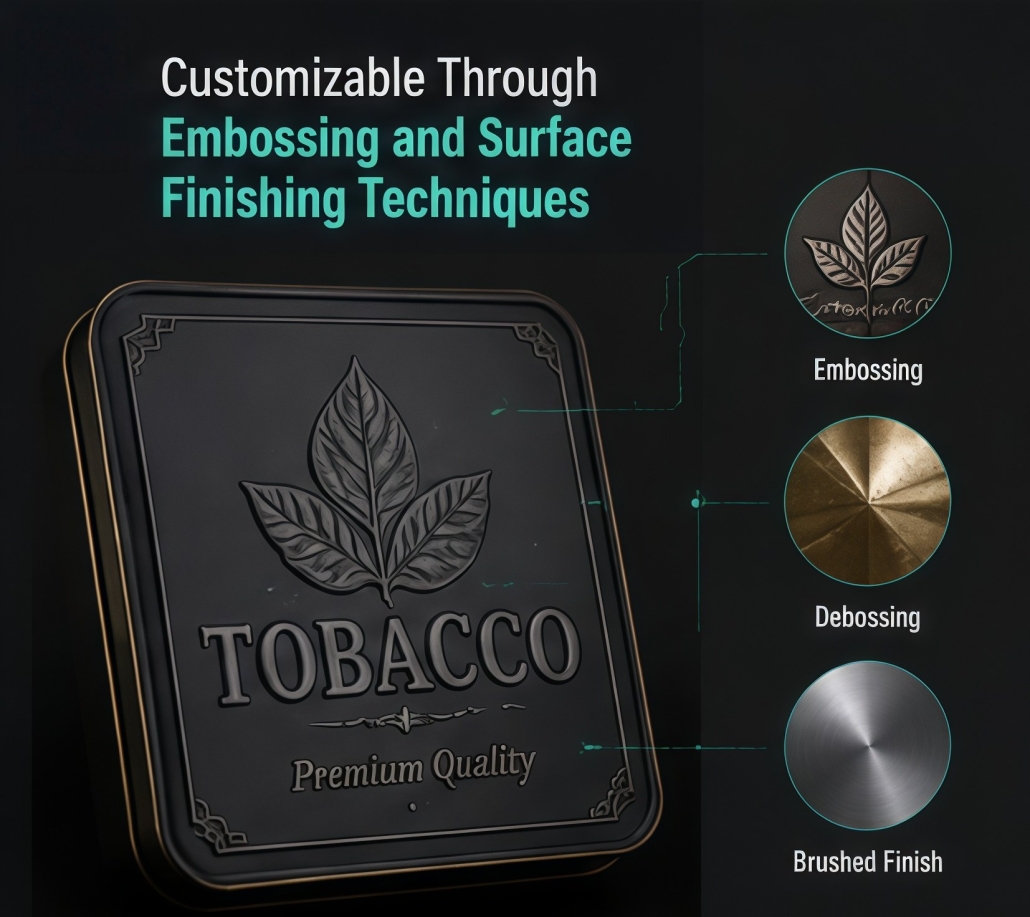
Customizable Through Embossing and Surface Finishing Techniques
Embossing is one of the most effective ways to create a tactile brand experience. In addition to printing logos on the surface, we can also shape the metal itself to create raised patterns.
Elements that can be embossed include:
- Brand logos
- Product names
- Decorative borders
- Patterns
- Symbols
- Typography
Intaglio printing, on the other hand, produces the exact opposite effect by embossing patterns inward. Both techniques can be combined with printing to create visual depth. For example, an embossed logo can be produced first, followed by printing with a contrasting finish to create a distinct visual and tactile difference.
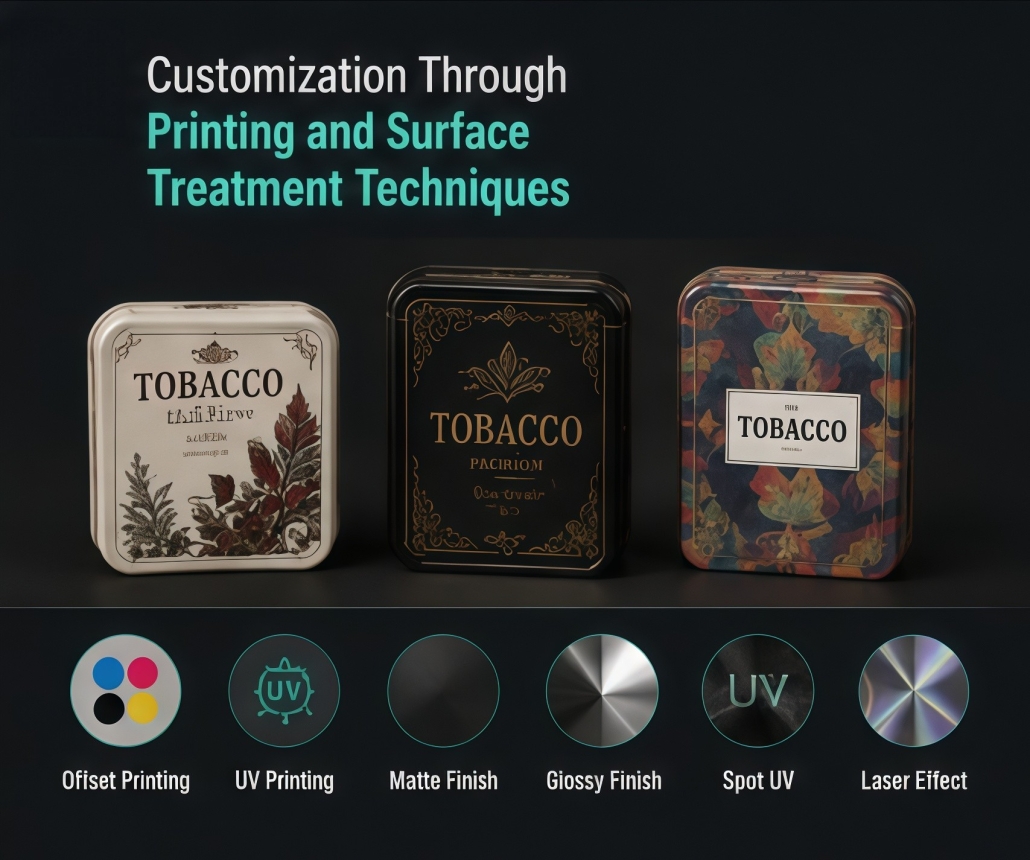
Customization Through Printing and Surface Treatment Techniques
Printing is one of the most intuitive ways to customize. Depending on specific project requirements, we can use the following techniques:
- Offset Printing
- CMYK Printing
- Spot Color Printing
- Metallic Ink
- Combination Printing
When selecting colors, we take into account the metallic properties of tinplate. For example, printing directly onto the metal surface produces a reflective effect, while adding a white undercoat yields more intense and controllable color results. This distinction becomes particularly important when a brand requires strict color consistency across different production batches.
Functional Design of Custom Tobacco Tins
Custom tobacco Tins can also feature various sealing methods, with sealing performance depending on the specific product and packaging structure. For tobacco packaging, we can adjust factors such as lid overlap, friction fit, inner liners, gasket structures, and fit tolerances between the can body and lid.
For applications requiring superior sealing performance, we can also incorporate appropriate gasket or liner systems. Available materials include PVC, silicone, EPE, and other specialty sealing materials. The specific material selection depends on product characteristics, storage conditions, closure design, and relevant packaging requirements. Therefore, when designing custom tobacco cans, we treat the sealing method as an integral part of the overall packaging design, rather than an afterthought.
Personalized Design Based on Brand Value and Production Needs
The most outstanding packaging solutions rarely rely on a single customization feature. Instead, manufacturers organically combine multiple elements to create a comprehensive packaging solution.
For example, a high-end cigarette tin might incorporate the following design elements:
- Slim, rectangular structure
- Hinged lid
- Embossed logo
- Matte black finish
- Metallic-effect printed accents
- Protective varnish coating
- Internal retention structure
Through this combination, brands can create packaging that is both distinctive and functional, while aligning with their market positioning.
The Value of Custom Packaging Goes Far Beyond Size and Color
For custom tin packaging, size and color are merely the basics. Professional manufacturers can customize nearly every key element of the packaging, including shape, lid structure, hinges, opening force, internal construction, embossing techniques, printed patterns, surface finishes, sealing systems, and various functional details. We consistently evaluate these requirements from both the product’s characteristics and the manufacturing process. Before finalizing the design, we comprehensively consider factors such as tobacco form, usage scenarios, aesthetic style, functional requirements, production scale, and tooling needs.


 Facebook
 Twitter
 Linkedin