
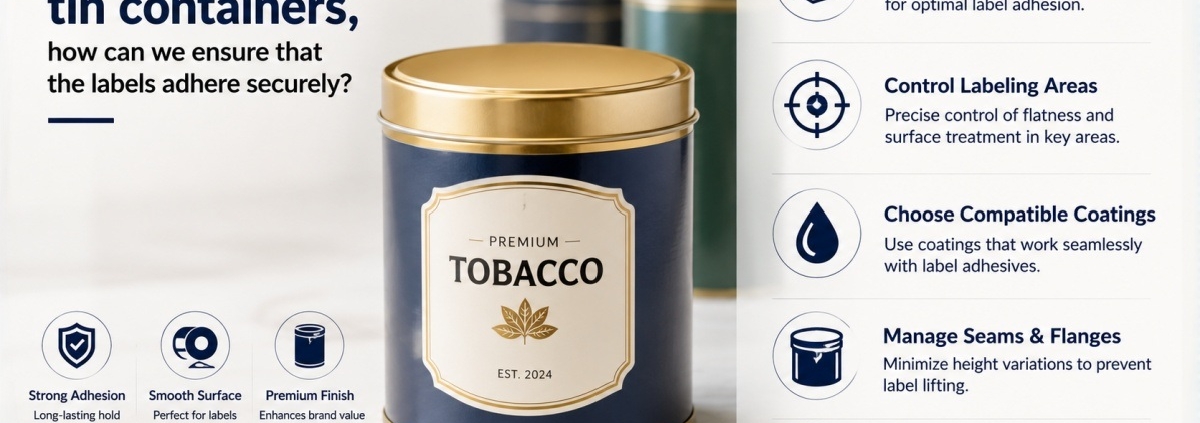
For label-friendly tin containers, how can we ensure that the labels adhere securely?
Many customers order tinplate containers with flawless construction, yet the labels fail to adhere securely during automated labeling. This often indicates poor label adhesion, which can result from insufficient surface cleanliness, improper coating selection, or surface unevenness. When customers report problems such as labels curling at the edges, peeling away from the can body, shifting after application, or falling off during transportation, we conduct a comprehensive review of the entire surface treatment process. Our measures for “label-friendly tin containers” include material preparation, controlled surface treatment, coating selection, curing process control, and dimensional and visual inspections. The goal is to ensure that labels remain firmly adhered throughout every stage—including labeling, handling, transportation, storage, and normal consumer use.
Label-Friendly Tin Containers: How to Create the Ideal Surface
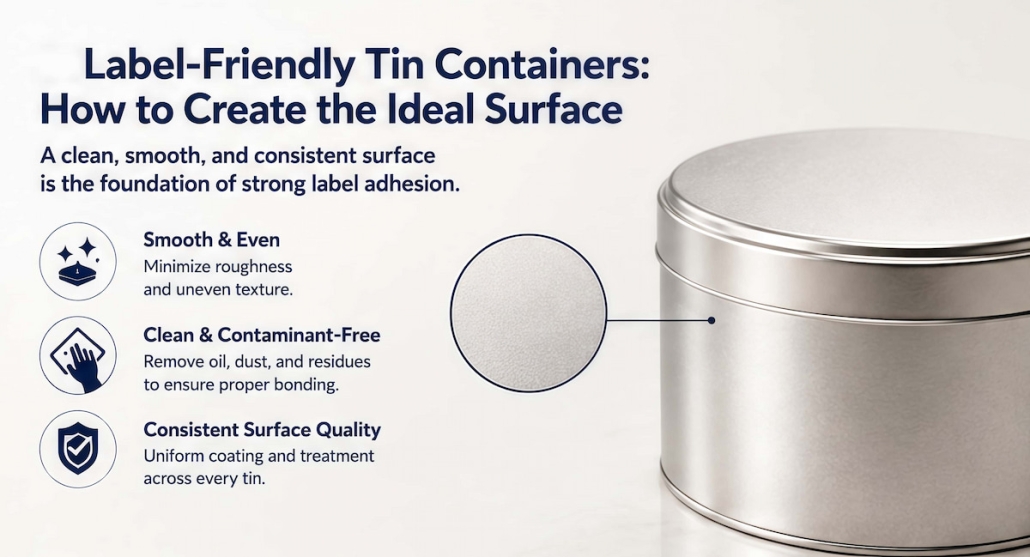
The primary factor in ensuring strong label adhesion is a clean substrate surface. Pressure-sensitive adhesives form a reliable bond only when in contact with a stable surface; exposure to dust, oil, loose particles, or other contaminants significantly compromises adhesion. During tinplate processing, processing oils or residues used to aid handling and forming may remain on the metal sheet’s surface. Although these substances serve a purpose during manufacturing, if they remain in the final labeling area, they will interfere with subsequent labeling.
Therefore, TSING strictly controls the tinplate surface condition throughout production. We pay particular attention to ensuring that the final labeling area is free of the following issues:
- Excessive processing oil
- Dust and loose particles
- Fingerprints left during handling
- Coating residues
- Cleaning agent residues
For label-friendly tin containers, the final surface must be clean enough to ensure the adhesive fully wets the substrate.
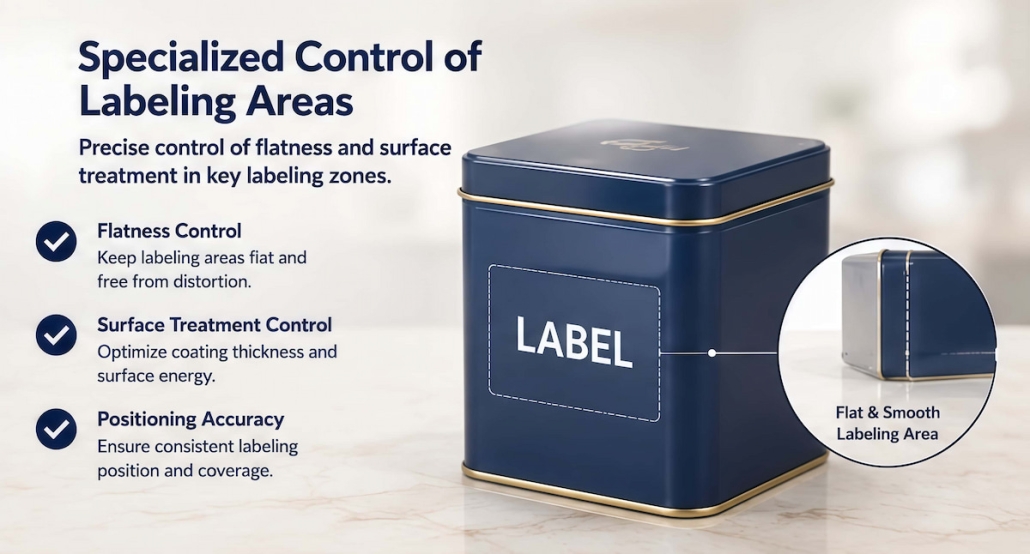
Specialized Control of Labeling Areas for Label-Friendly Tin Container
Surface requirements vary across different parts of a tinplate container. Decorative body sections may feature a thick printing coating, while designated labeling areas require a coating that promotes adhesion. For label-friendly tin containers, we designate specific labeling areas and independently control their surface treatment to distinguish them from other parts of the packaging. For example, customers may require:
- A printed background pattern around the container
- Blank or label-ready areas for variable information
- Subsequent application of barcode labels
- Application of lot number or date labels during secondary packaging
In such cases, applying a uniform, thick decorative coating across the entire surface of the tin can may pose unnecessary adhesion risks.
This is a key principle we follow in tinplate packaging production: surface conditions should be designed and treated based on the customer’s specific post-manufacturing usage requirements.
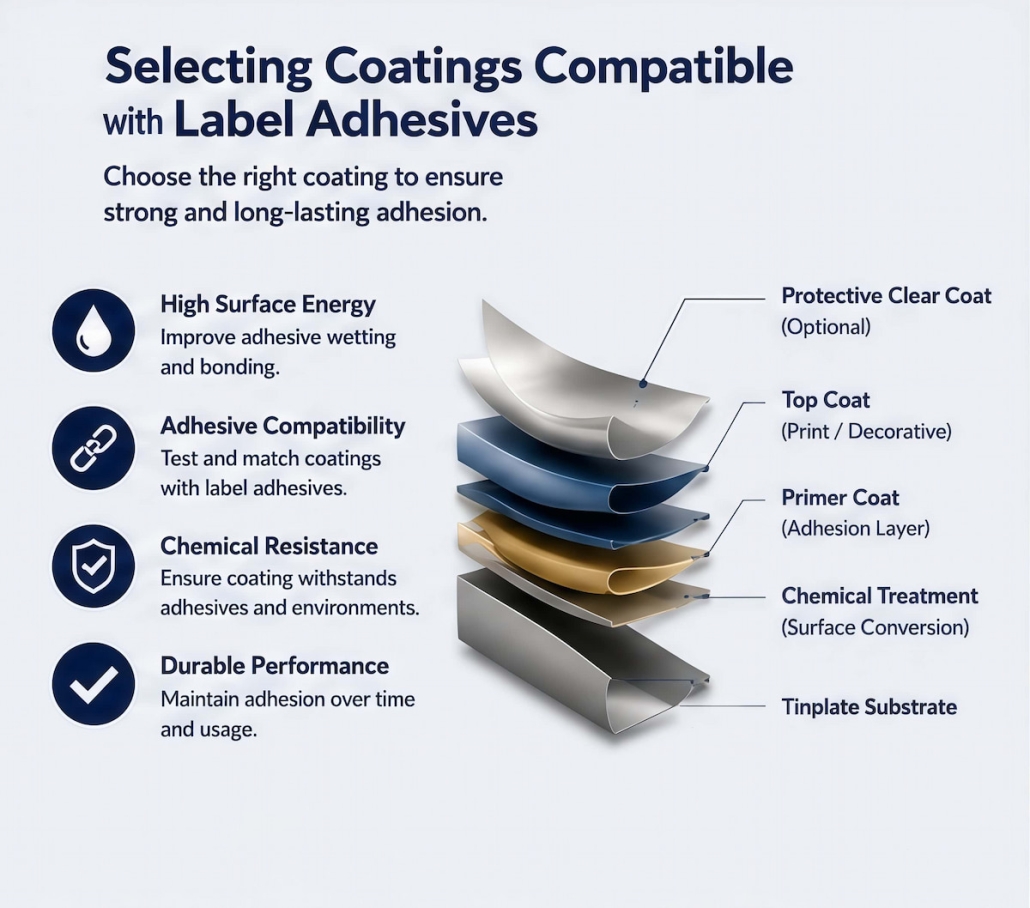
Selecting Coatings Compatible with Label Adhesives for Label-Friendly Tin Containers
Label adhesives interact with the final surface of the tin packaging, not with the tinplate specifications listed on the purchase order. If the final varnish layer is too smooth, contains too many additives, has surface energy below the selected adhesive’s requirements, or is incompatible with the labeling system, the labels will suffer from poor initial tack or inadequate long-term adhesion.
For this reason, when manufacturing tin containers suitable for labeling, TSING thoroughly evaluates the specific labeling application. We consider the following factors:
- Label material
- Chemical composition of the adhesive
- Expected application temperature
- Expected storage temperature
- Required service life of the label
- Surface treatment of the tinplate
- Labeling method (manual or automatic)
Labels with paper facestocks may perform differently from those with synthetic film facestocks; similarly, permanent acrylic adhesives may perform differently from removable adhesives. This is why we consider the tin container and label as a single integrated unit.
Avoid Unnecessary Surface Treatments in the Labeling Area
High-end tinplate packaging often features highly attractive surface finishes, such as heavy matte coatings, high-gloss varnishes, leather-like textures, metallic finishes, or special decorative layers. While these treatments deliver outstanding visual effects, they may not work well with self-adhesive labels.
For a label-friendly tin container, we can simplify the surface treatment of the labeling area when necessary. A practical configuration includes:
| Tin Area | Surface Treatment | Purpose |
| Main decorative panel | Matte or gloss finish | Brand presentation |
| Embossed logo area | Controlled decorative finish | Tactile branding |
| Label panel | Adhesive-compatible coating | Reliable label bonding |
| Bottom panel | Protective coating | Handling and abrasion resistance |
This approach satisfies the brand’s visual customization needs while providing functional flexibility.
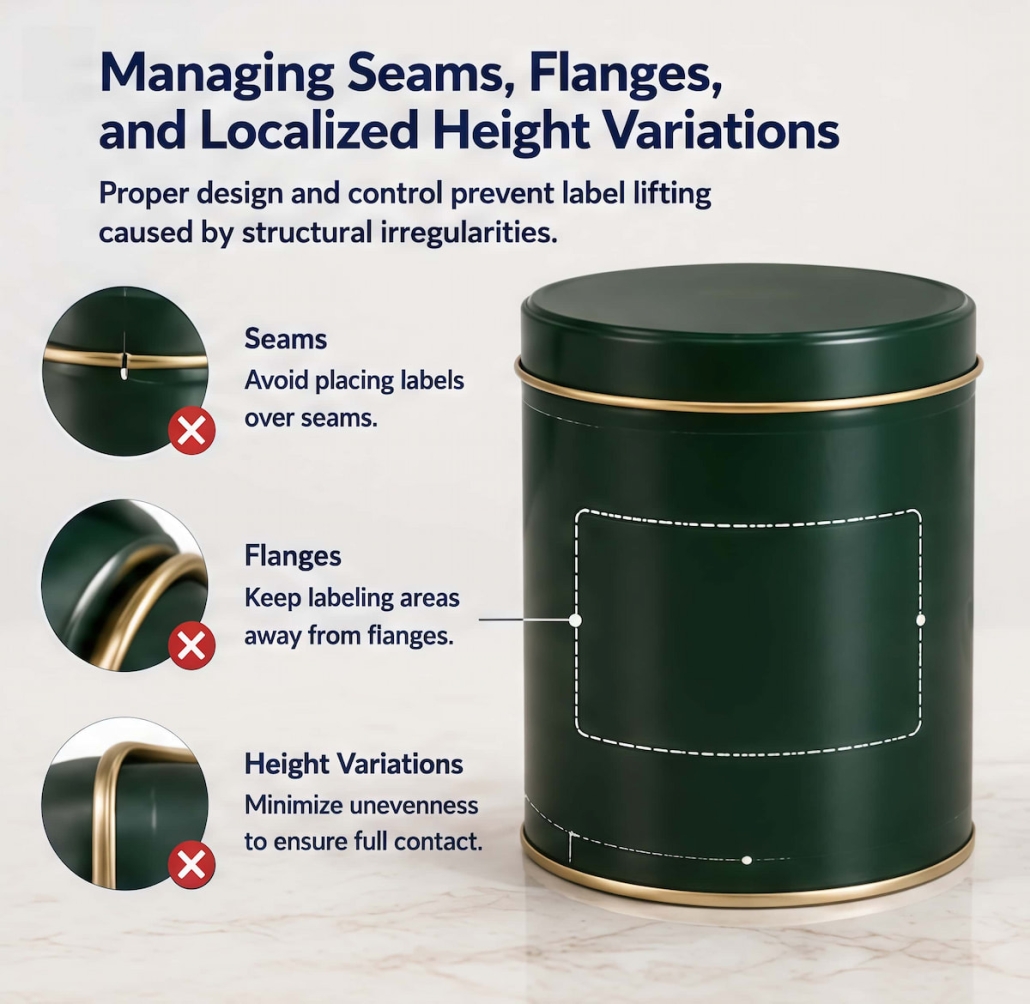
Managing Seams, Flanges, and Localized Height Variations
Labeling failures can also occur when a label spans transitional areas of the container’s structure. If a label covers a flange or crosses a seam, it may cause uneven contact pressure. During transportation and handling, these areas often become points of concentrated mechanical stress.
Therefore, for tinplate containers requiring labeling, we strive to position the label’s primary display area away from the following elements: longitudinal seams, lid flanges, transition zones where the can body shape changes abruptly, and areas with deep embossing or debossing. If a label must span these structural features, we will assess it based on the label’s specific dimensions and adhesive properties; we do not assume it will adhere properly by default.
This engineering approach is particularly important for custom tin packaging, as unconventional shapes are often a core element of the product concept. Unique designs require specialized labeling solutions to ensure reliable label adhesion.
Dedicated Production Process for Label-Friendly Tin Containers
For customers with specific label adhesion requirements, we employ a dedicated production process:
Step 1 — Define Labeling Requirements
We confirm the label dimensions, application location, label material, adhesive type, application method, and distribution environment.
Step 2 — Designing the Labeling Area
We determine the appropriate geometric shape and avoid unnecessary structural features in the bonding zone.
Step 3 — Selecting a Surface Treatment Solution
We select the appropriate combination of tinplate surface treatments, coatings, and surface finishes.
Step 4 — Produce Samples
We produce representative samples using the proposed surface treatment solution.
Step 5 — Perform Labeling
We conduct labeling operations under conditions that simulate actual production environments.
Step 6 — Evaluate Adhesion Performance
We test initial adhesion strength and conduct additional handling or environmental adaptation tests as needed.
Step 7 — Finalizing Production Parameters
Once the labeling solution is validated, we incorporate the relevant surface treatment processes and production parameters into the production specifications.
Points to Confirm Before the Customer Places an Order
Before ordering label-friendly tin containers, we confirm the following five points with the customer:
1. What label material will be used?
Paper, PET, PP, and other label face materials have different characteristics.
2. What type of adhesive is specified?
Permanent, removable, freezer-grade, repositionable, and other types of adhesives each have different requirements.
3. Where will the label be applied?
Flat panels are easier to label than surfaces with extreme curvature or embossed areas.
4. What surface treatment is applied to the labeling area?
Matte, glossy, leather-like, metallic, and other surface treatments may affect adhesive performance.
5. What environmental conditions will the packaging be exposed to?
Temperature, humidity, condensation, shipping conditions, and shelf life all affect long-term adhesion. Clarifying these five questions before production will significantly reduce the risk of label failure.
Co-designing Surface, Structure, and Adhesive Processes
For brands using label-friendly tin containers, strong label adhesion doesn’t come from a single manufacturing technique. Instead, it depends on controlling the entire production process, including the tinplate surface, cleaning process, coating formulation, curing conditions, panel geometry, label material, adhesive, labeling method, and end-use environment.
At TSING, we treat label adhesion as a specific packaging requirement. We can reserve suitable labeling panels, control surface treatment in that area, maintain consistency in the coating process, and validate the final results using the actual labeling systems our customers use. This approach fundamentally resolves common labeling issues such as label corners curling up, peeling, shifting, bubbling, and uneven adhesion.
 Facebook
 Twitter
 Linkedin