

German candle brands Top criteria for buying quality candle tins
German candle brands are renowned for their exquisite candle craftsmanship. Therefore, when they choose candle tins, they emphasize not only a container for scented candles but also a concrete embodiment of brand value, aesthetics, and performance. German manufacturers evaluate their containers against strict standards to ensure each candle tin meets high durability, safety, and aesthetic standards. Therefore, we will outline the key criteria German candle brands use when selecting candle tins, from the perspective of candle jar manufacturers. We will analyze aspects such as material composition, thermal properties, surface finishing, lid, and sealing function, and explore how these factors reflect German craftsmanship
Material selection and thermal conductivity of candle tins
For German candle brands that focus on safety and performance, the choice of base metal directly affects the consistency of candle melting and burning. Candle tins made of high-grade aluminum have excellent thermal conductivity (about 205 W/m·K), which helps to form a uniform melt pool and reduce tunneling. Tinplate is a durable, cost-effective alternative with corrosion resistance while maintaining good heat distribution, especially when paired with an anodized or primed interior.
In addition to conductivity testing, our candle jars undergo rigorous material testing to ensure food-grade compliance and high-temperature resistance. Candle tin manufacturers often require repeated burn tests on prototype samples to measure changes in tin wall temperature and verify that the tin does not deform under continuous heating. This rigorous testing method ensures that each candle jar delivers optimal fragrance distribution, a stable burning rate, and safe operation.

Requirements for durability, surface treatment, and aesthetics of candle tins
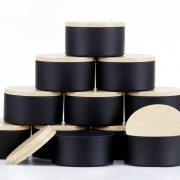
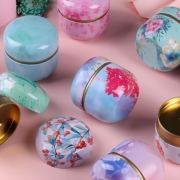
German candle brands do not compromise the candle tins’ visual and tactile quality. Therefore, the durability of candle tin cans is evaluated using scratch resistance, drop impact, and wear tests on selected surface coatings, including high-gloss paint, matte soft-touch coatings, and metal powder coatings. High-quality surface coatings protect the candle during transportation and handling and complement its iconic fragrance, forming a unified brand image. Decorative techniques play a central role in the choice of candle jars: precision screen printing, all-inclusive digital graphics, and custom embossing. German manufacturers often request spot UV or foil decoration to highlight limited edition collections, reinforcing the value proposition of decorated candle jars.

Heat distribution and burning performance
Well-designed candle tins optimize heat transfer to the wax pool, promoting complete melting of the candle from edge to edge, thereby maximizing fragrance release. When sourcing, German candle brands often ask about the candle tin’s wall thickness and bottom geometry to disperse heat inwards and prevent cold spots at the edges. In addition, as candle tin manufacturers, we also test the ability of candle jars to dissipate residual heat after the flame is extinguished; well-designed candle tins cool evenly, extending the candle’s life and protecting the artwork. By conducting these rigorous tests in a dedicated burning laboratory, German candle brands can ensure that the quality candle tins provide continuous fragrance and maintain a safe temperature range.
Lid design, seal integrity, and safety
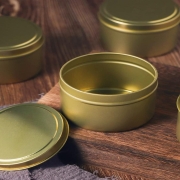
A strong lid design is a key component of a high-quality candle tin, especially for products that are easy to carry or for gifts. German candle brands carefully check lid fit tolerances, aiming for a precise gap of 0.1 to 0.2 mm to prevent wax scent leakage while still allowing easy opening. Some brands integrate silicone gaskets or threaded lids into candle tins to achieve an airtight seal, extend scent longevity, and prevent contamination.
Safety is also critical: round candle tins with lids must resist heat deformation and be securely fastened to prevent accidental detachment. Brands often perform drop tests on fully charred tins to confirm that lids are secure under impact. In the aromatherapy product range, sealed candle jars also maintain the integrity of terpenes, ensuring that therapeutic aromas remain potent.

Sustainability and eco-conscious practices
Most German candle brands prioritize environmental sustainability when selecting candle tins that align with their green philosophy. Recyclable materials such as food-grade tinplate and environmentally friendly coatings with water-based or UV-curing formulas can reduce carbon footprint and VOC emissions. Often, these brands require suppliers to conduct a life-cycle assessment (LCA) to verify the overall environmental impact of the candle tin, from raw material sourcing through end-of-life recycling.
Tsing now uses recyclable materials in candle tins without sacrificing performance and aesthetics. In addition, brands have prioritized reducing packaging weight, thinner metal thickness, and optimized lid design to reduce transportation emissions. By adopting these sustainable candle tins, German candle manufacturers can meet their demand for environmentally friendly products.
Improving quality with German standards
German candle brands follow strict and comprehensive standards when selecting candle tins, including material conductivity and durability testing, fine decoration, lid integrity etc. These brands strive for excellence in thermal performance, appearance treatment, sealing quality, and environmental certification at every stage to meet their expectations for craftsmanship.



 Facebook
 Twitter
 Linkedin
