
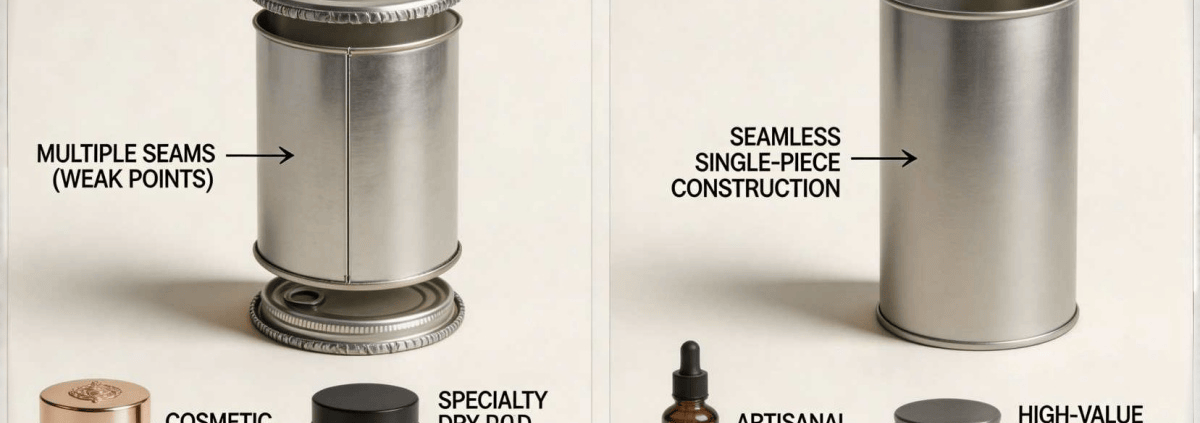
Why are deep-drawn tin cans better suited for packaging fine powders and liquid products?
The forming process of tin cans determines their ability to protect the contents and ensure stability during use. Unlike packaging that relies on multiple assembled components, deep-drawn tin cans are formed from a single sheet of metal. This process creates a smooth, seamless can body with fewer seams and fewer weak points. For products such as fine powders and liquids, packaging with fewer seams and a more stable shape provides superior protection. Deep-drawn metal cans also offer brands greater flexibility in product positioning. Whether it’s high-end cosmetic powders, specialty dry powders, artisanal liquids, or high-value concentrates, all can benefit from this sturdy, durable, and premium-feeling packaging.
Deep-Drawn Tin Cans Reduce Risks at the Source
One of the greatest advantages of the deep-drawn tin can is the reduction in seams. Every seam on the packaging can become a weak point. While this may be inconsequential for some solid products, in powders and liquids, fine particles can escape through gaps, and liquids can seep through seams over time. A seamless or nearly seamless structure minimizes these risks from the outset.
Why Are Deep-Drawn Tin Cans Particularly Effective for Fine Powders?
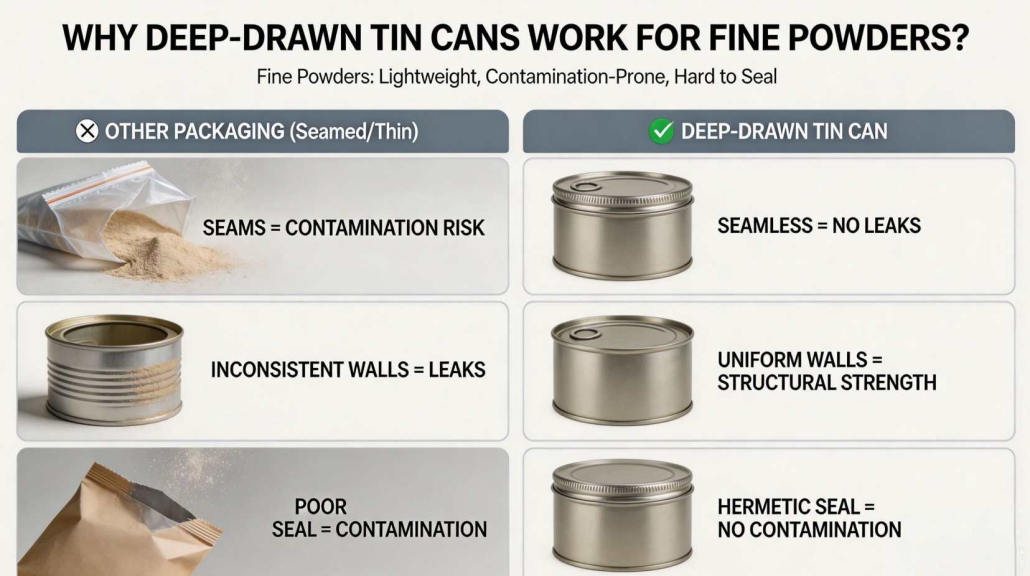
Fine powders are one of the more specialized product categories in the packaging industry. They are lightweight, prone to contamination, and often difficult to seal completely. Additionally, they require extra care during filling and storage. Compared to packaging formats with multiple seams or inconsistent wall thickness, deep-drawn tin cans are more effective at addressing these challenges.
Fine Powders Benefit from a Tighter Seal
Fine powder products are extremely susceptible to packaging defects, even minor ones. If the container has weak corners, an imperfect seal, or unstable side walls, the product is more likely to spill, leak, or absorb moisture. Deep-drawn tin cans help solve this problem because their continuous metal body reduces potential leak points.
This is particularly important for products such as cosmetic powders, specialty food powders, herbs, dry powder supplements, seasoning blends, and other fine-particle substances. These products require more than just simple storage; they need containers that can maintain their appearance, texture, and performance. The deep-drawn structure helps meet all three of these requirements.
The smooth inner walls of deep-drawn tin cans make filling and cleaning more convenient.
Fine powders may leave residue during filling or use. The smooth, deep-drawn inner walls make the cans easier to fill and empty. This is a practical advantage for both manufacturers and end users. It reduces waste during production and enhances customer convenience.
Smoother inner walls also reduce the likelihood of powder accumulating in corners or seams. For fine powders, product residue accumulating in hard-to-reach crevices can affect product appearance and user satisfaction. Deep-drawn metal tins help minimize such issues.
Why Are Deep-Drawn Tin Cans More Reliable for Liquid Products?
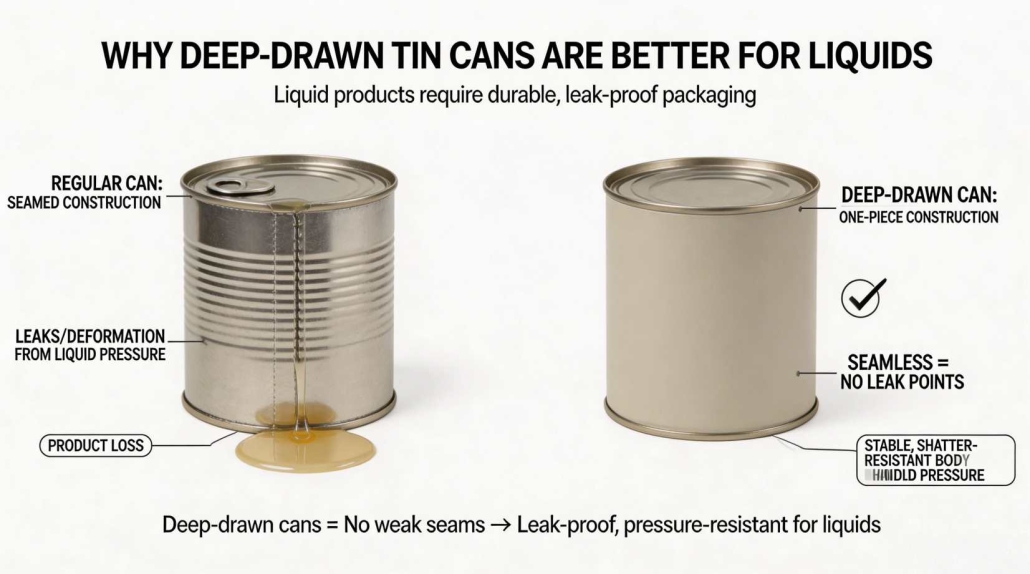
Liquid products place higher demands on packaging performance. They exert constant pressure on the container, lid, and liner. If the packaging is not strong enough, it can lead to leaks, deformation, or product loss. Deep-drawn tin cans are better suited for packaging these products because they form a more stable, shatter-resistant can body.
The Fewer Seams in Deep-Drawn Tin Cans, the Fewer Leak Paths
Liquid products require reliable packaging. Seams, folds, and misaligned joints all increase the risk of leakage. Deep-drawn cans are made from a single piece of metal, thereby reducing these risks. By using a more robust can body, manufacturers can lower the overall risk. This is a significant advantage for many metal cans designed to hold liquids. Deep-drawn tin cans have a more robust body structure, making them easier to control within packaging systems.
Superior structural stability under pressure
The pressure exerted by liquids on packaging differs from that of dry goods. Temperature fluctuations, shaking during transport, and long-term storage all place stress on the container. Deep-drawn tin cans, with their more uniform body, are less prone to deformation and can therefore better withstand these stresses. For products requiring long-term storage or transport across different climates, stable packaging helps protect product integrity and reduces the risk of deformation.
Easier to Use with Internal Coatings and Lining Systems
Liquid products typically require internal coatings or liners that are compatible with the product formulation. Deep-drawn tin cans provide a simpler structural foundation for such products. Because the can body is more uniform, liners can be applied more consistently, reducing interruptions. In sectors such as personal care products, specialty food ingredients, and other liquid products, material compatibility must be strictly controlled. The robust structural base of deep-drawn tin cans supports the internal protective layers. This is one reason deep-drawn metal cans are frequently chosen for packaging high-demand liquid products.
Packaging that Balances Protection, Precision, and Visual Presentation
Compared with many other product types, fine powders and liquids place higher demands on packaging. They require sealing, stability, cleanliness, and reliable visual presentation. Deep-drawn tin cans meet these requirements with their smoother, sturdier, and more uniform structure.
 Facebook
 Twitter
 Linkedin