
Custom Surface Finish Guide for Hinged Lid Stationery Tins: Matte, 3D Embossing & Pantone Color Matching
Proper surface treatment can enhance brand awareness, retail performance, and long-term durability of hinged lid stationery tins. In today’s consumer market, consumers not only focus on product functionality but also value tactile and visual experiences. From a soft-touch matte finish that attracts attention, to precise 3D embossing that adds depth and texture, to accurate Pantone color control and coating durability under daily wear and tear, every detail influences consumers’ perception of product value. For manufacturers producing metal pencil tins with hinged lid, surface treatment must balance aesthetics and engineering feasibility.
Why is surface treatment necessary for hinged lid stationery tins?
Surface treatment is crucial throughout the entire lifespan of a hinged lid stationery tin. Beyond visual appeal, surface treatment quality directly affects ink adhesion, embossing clarity, scratch resistance, and long-term coating stability. Because hinged-lid metal pencil cases are repeatedly opened, removed, and stored in backpacks or desk drawers, the coating must withstand friction, oil, and environmental exposure.
Furthermore, a smooth and well-designed surface improves printing accuracy. Fine lettering, gradient transitions, and intricate illustrations all require consistent surface energy and coating uniformity. Microscopic roughness or uneven coating on the metal surface can lead to variations in color density and clarity. Therefore, brands should treat surface treatment as a fundamental specification rather than an afterthought, thereby enhancing both brand image and product durability.
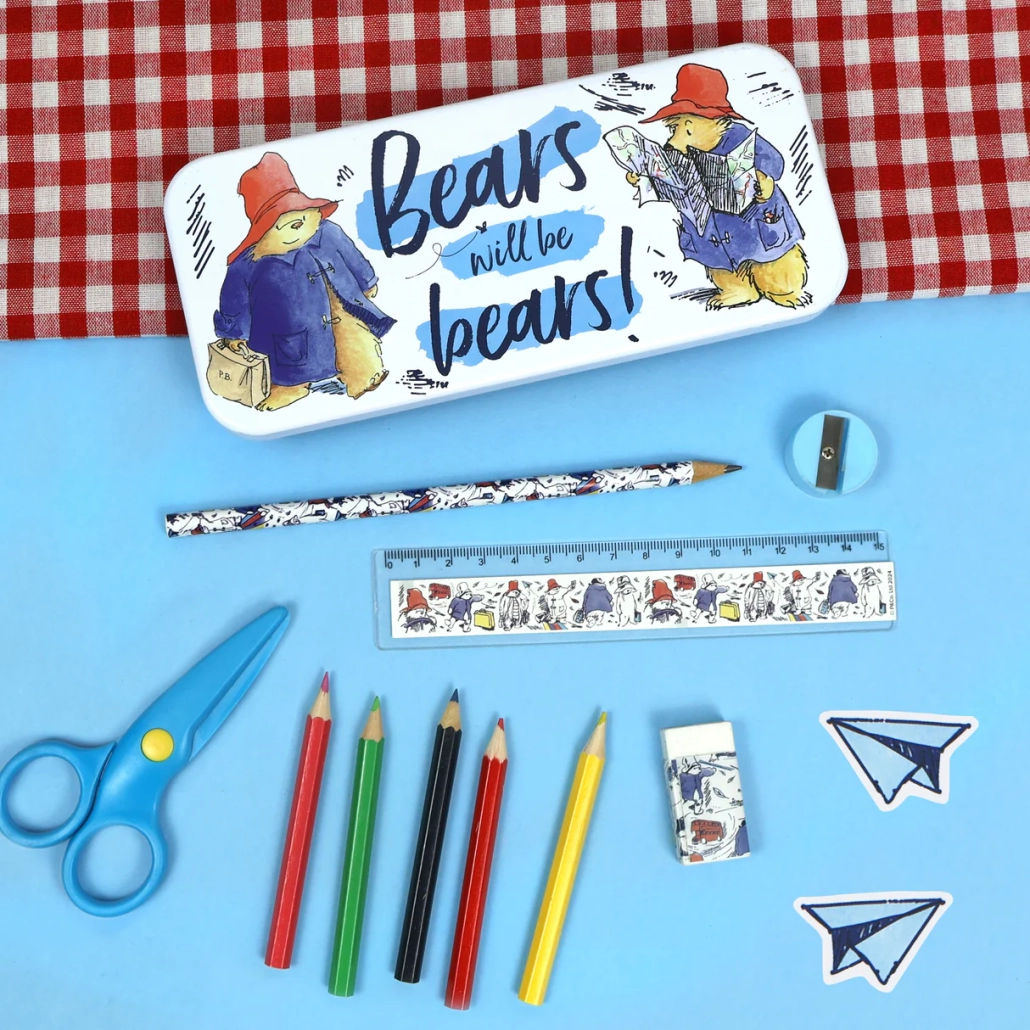
Hinged Lid Pencil Tin with Matte Finish
Matte coatings remain one of the most popular choices for hinged lid stationery tins, especially in high-end or educational product lines. However, “matte” is not a single surface treatment category. Different matte systems offer different tactile, visual, and mechanical properties.
Soft-Touch Matte Coating
Soft matte coatings create a velvety texture, enhancing the product’s luxurious feel. This finish is often used in high-end metal pencil cases with hinged lids, designed as gifts or collectible stationery sets. The soft touch encourages users to touch it and makes it stand out on the shelf. However, these coatings are slightly elastic, so flexibility must be maintained during embossing. In addition, it is recommended to add anti-fingerprint and anti-scratch additives to improve its durability in daily use.
Satin/Standard Matte Varnish
Standard matte varnishes have a lower gloss but offer better abrasion resistance compared to soft-touch coatings. They are generally more cost-effective and better suited for mass production. Satin matte coatings also perform more consistently under repeated rubbing and stacking conditions. When selecting a matte finish for a hinged lid stationery tin, TSING evaluates abrasion-resistance test data, coating thickness, and compatibility with the embossing depth. This ensures the finish meets both aesthetic and functional expectations.
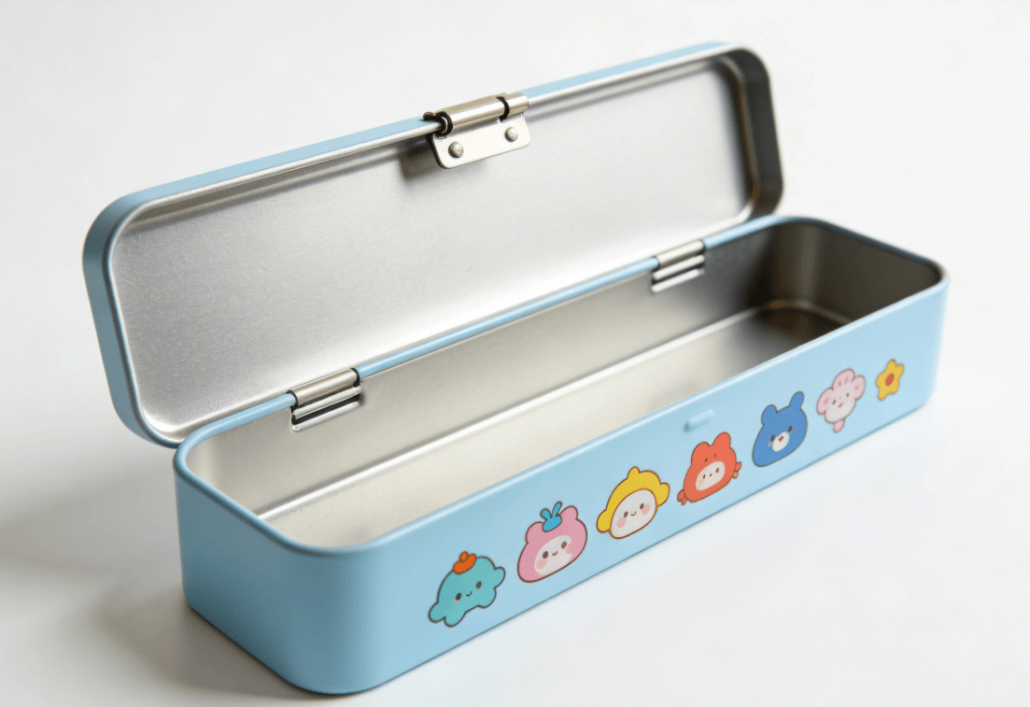
3D Embossing and Gravure Printing for Hinged Lid Pencil Tins
3D embossing adds a three-dimensional feel and tactile difference to hinged lid stationery tins, making them more visually appealing and memorable. Raised logos, patterns, or branding reinforce the product’s premium positioning and create a sense of exquisite craftsmanship. However, embossing processes must be carefully designed to avoid structural or coating issues.
Technical Considerations
Embossing depth should balance visual appeal and manufacturing feasibility. A moderate depth of 0.4 mm to 0.6 mm typically provides a clear outline without putting excessive stress on the material. Excessive embossing depth may affect the lid’s flatness or the alignment of the hinges. Maintaining clearance around the hinge fold is equally essential. Embossing too close to mechanical parts may affect the smoothness of closure or the consistency of hinge torque. Furthermore, the coating’s flexibility must accommodate the material’s stretching during molding to prevent microcracks. Precise embossing-to-print registration tolerances (±0.5 mm) help ensure consistent pattern alignment across production batches.
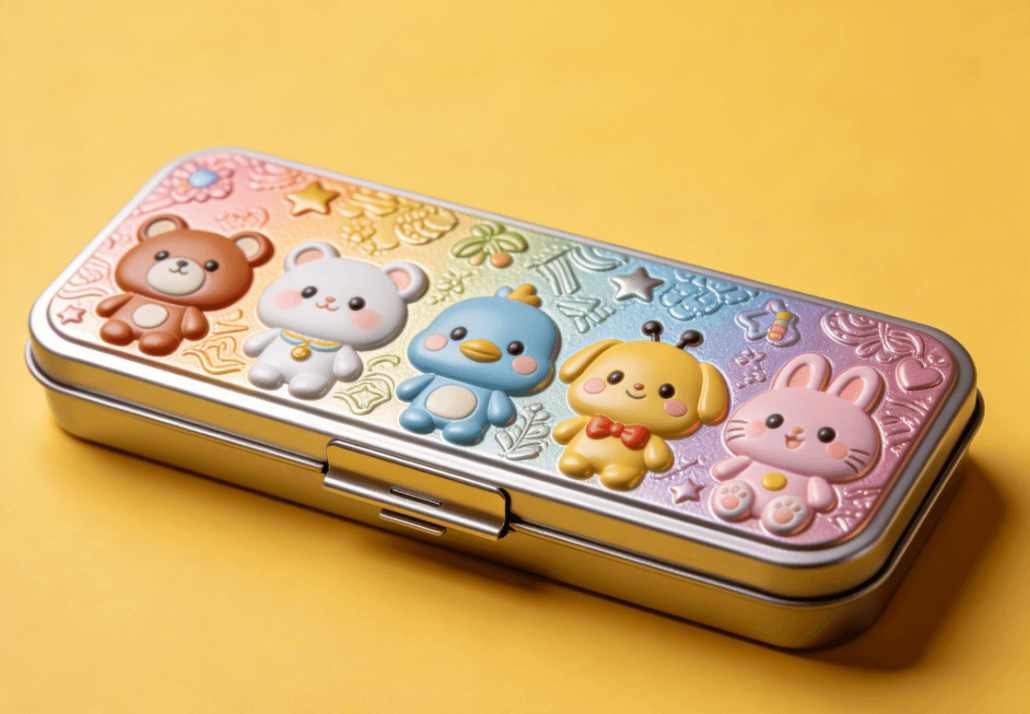
Precise Color Control and Production Execution for Hinged Lid Stationery Tins
Accurate color reproduction is crucial for brand image. Achieving reliable Pantone color matching on hinged lid stationery tins requires rigorous workflow management and measurable quality control standards. Color perception may change after varnishing due to differences in light reflection patterns between metal substrates and paper. Therefore, to ensure consistency, brands should confirm color samples on the actual coated metal surface. Additionally, the reduced color saturation of matte varnishes needs to be considered. Adjustments may be necessary during the ink formulation process to achieve the desired final effect after the topcoat is applied.
Production Process of Smooth-Surface Metal Pencil Tins with Hinged Lid
A standardized production process ensures consistent surface treatment of metal pencil tins with hinged lid. From material preparation to final inspection, every step affects surface quality.
Standard Process
TSING’s process typically includes blanking, cleaning, primer application, printing, varnishing, embossing, hinge assembly, and final inspection. Proper surface treatment ensures coating adhesion and prevents defects such as fisheye or delamination. Quality control tests should include adhesion checks, abrasion resistance assessments, hinge torque verification, embossing checks, and color consistency measurements. Implementing documented checkpoints reduces rework and improves overall production efficiency.
Surface Finishes for More Refined Pencil Cases
The surface treatment of metal pencil tins with hinged lid affects much more than just appearance. Matte coatings can affect feel and durability. 3D embossing can enhance brand image, but requires precision molds and flexible coatings. Pantone color matching requires measurable quality control and strict production standards. When these elements are integrated into a controlled manufacturing process, a metal pencil case with a hinged lid can exhibit superior aesthetics and long-lasting reliability.
 Facebook
 Twitter
 Linkedin