
Application Standards of Food-Grade Inner Lacquer for Edible-Grade Tin Packaging
The performance of food-grade tin packaging depends not only on the strength of its external metal structure; its inner coating also plays an equally important role in ensuring food safety and maintaining product stability. Food contact safety begins on the inside of the packaging. Although tinplate offers excellent mechanical strength, corrosion resistance, and durability, the metal surface itself is not suitable for prolonged direct contact with certain foods. Without proper protection, acidic components, fats, moisture, and other substances in food may react with the metal surface, thereby affecting product quality and packaging reliability.
For this reason, food-grade interior coatings have become a fundamental requirement for food-grade tin packaging. This coating forms a protective barrier between the tinplate substrate and the food contents, preventing direct contact while enhancing corrosion resistance, chemical stability, and overall packaging performance.
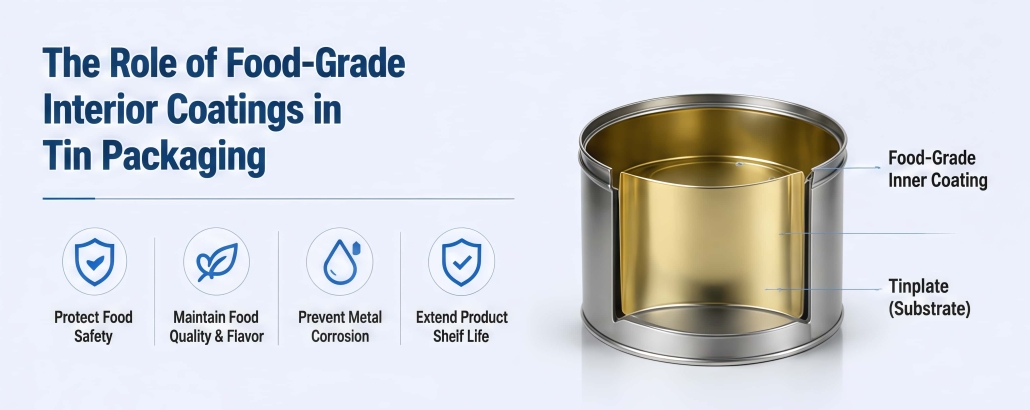
The Role of Food-Grade Interior Coatings in Tin Packaging
Tinplate is the primary material for most food-grade packaging, combining the strength of steel with the corrosion resistance of a tin coating. It offers excellent durability and impact resistance, along with an attractive appearance, making it ideal for foods that require both effective protection and visual appeal.
However, even high-quality tinplate requires an additional protective layer when in direct contact with food. Food-grade inner coatings serve several critical functions:
| Function of Inner Lacquer | Description |
|---|---|
| Food protection | Prevents direct contact between food and metal surfaces |
| Corrosion resistance | Protects tinplate from acidic, salty, or oily food ingredients |
| Flavor preservation | Prevents metallic taste or odor transfer |
| Shelf-life improvement | Helps maintain product quality during storage |
| Packaging durability | Improves resistance against chemical reactions |
For example, tea and coffee products contain natural compounds that may react with unprotected metal surfaces upon prolonged contact. Similarly, candies containing acids, fats, or fruit ingredients require packaging with excellent chemical resistance. By applying a food-grade inner coating, tinplate packaging creates a stable internal environment, thereby protecting both the packaging itself and the food inside.
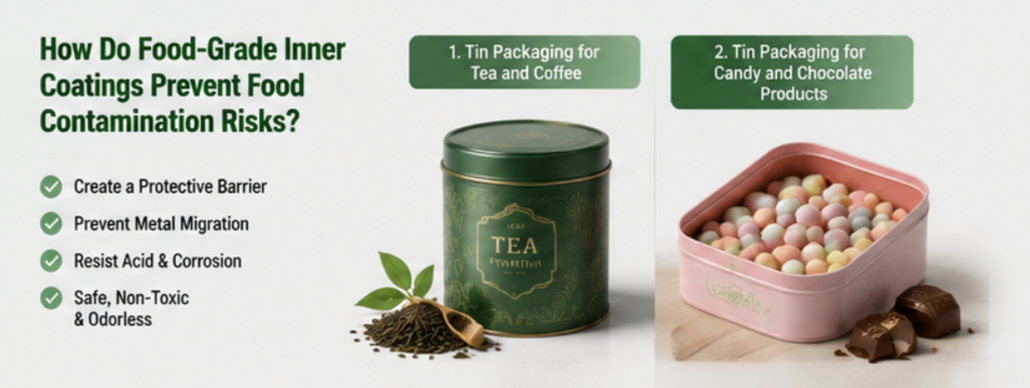
How Do Food-Grade Inner Coatings Prevent Food Contamination Risks?
One of the most important functions of food-grade inner coatings is to prevent adverse interactions between food ingredients and metal materials. Different food categories have different packaging requirements:
Tin Packaging for Tea and Coffee:
Tea and coffee require excellent aroma protection because their volatile flavor compounds are highly susceptible to loss or external environmental influence. For these products, the inner coating helps to:
- Prevent the transfer of metallic off-flavors
- Preserve original aroma characteristics
- Enhance moisture barrier performance
- Ensure long-term storage stability
For premium coffee brands, the combination of an airtight seal and a food-grade inner coating creates a protective environment that helps maintain freshness.
Tin Packaging for Candy and Chocolate Products:
Candy and chocolate products typically contain sugars, fats, dairy ingredients, or acidic flavor compounds, which often pose challenges for packaging materials. An appropriate interior coating system helps:
- Prevent corrosion caused by food ingredients
- Maintain the visual quality of chocolate and candy
- Prevent chemical reactions between the food and the metal
- Enhance product safety during long-term storage
Therefore, selecting the right coating is a critical step when designing custom tin packaging.
Types of Tin Packaging Coatings: Selecting the Right Interior Coating for Different Products
Not all foods are suitable for the same interior coating solution. Professional tin packaging manufacturers select different coating materials based on food characteristics, storage conditions, and customer requirements.
Common types of food-grade interior coatings include:
| Inner Lacquer Type | Main Characteristics | Suitable Applications |
|---|---|---|
| Epoxy phenolic lacquer | Excellent chemical resistance and durability | General food tins, canned products |
| Polyester lacquer | Good flexibility and appearance protection | Snacks, confectionery packaging |
| Acrylic lacquer | High transparency and aesthetic performance | Premium food packaging |
| BPA-NI lacquer systems | Designed for specific regulatory requirements | High-end food applications |
The selection process depends on various factors, including food acidity, oil content, storage temperature, shelf-life requirements, regulatory requirements, and packaging design. Professional tinplate can manufacturers do not simply apply the same standard coating to all products; instead, they first evaluate the interaction between the food and the packaging environment before selecting the most suitable interior coating.
How TSING Ensures the Quality of Food-Grade Inner Coatings for Tin Packaging?
Coating quality directly affects the reliability of food-grade tin packaging. Therefore, we exercise strict control over the entire manufacturing process, from material selection to final inspection. Our production process includes:
1. Inspection of Tin Packaging Materials:
Before production begins, we inspect the tinplate materials to ensure uniform thickness, consistent surface quality, good corrosion resistance, and compatibility with food-grade coating systems.
2. Application of the Inner Coating for Tin Packaging:
During the coating process, we strictly control the following parameters:
- Coating thickness
- Coating uniformity
- Drying temperature
- Adhesion
Uneven coating can create weak spots, thereby reducing protective performance. Therefore, precise control of the coating process is critical.
3. Tin Packaging Quality Inspection
Upon completion of production, we conduct multiple inspections, including:
- Adhesion testing
- Coating appearance inspection
- Chemical resistance testing
- Food contact safety verification
These quality control procedures ensure that the final tin packaging meets customer expectations for both safety and durability.
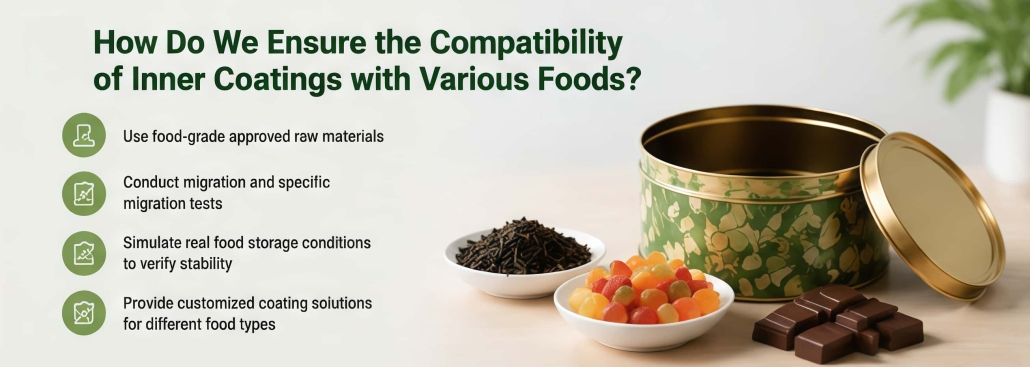
How Do We Ensure the Compatibility of Inner Coatings with Various Foods?
Different foods have different chemical properties, so the inner coatings used in tinplate packaging must be selected based on the specific requirements of each product category. As a professional tinplate container manufacturer, TSING does not use a single coating solution for all food-grade tinplate containers; instead, we first evaluate the interaction between the food and the metal surface before determining the most suitable inner coating system.
For example, acidic products such as fruit candies, candied fruits, and foods containing organic acids require stronger corrosion resistance, and for such applications, we typically select epoxy coatings, polyester coatings, or other food-contact-approved coatings that offer excellent chemical stability.
For dry foods such as tea, coffee, cookies, and candies, the primary function of the interior coating is to prevent direct contact between the food and the tinplate substrate while maintaining the stability of the product’s flavor. The coating must be neutral, odorless, and capable of effectively blocking the migration of fats and oils to avoid affecting the food’s original taste and aroma.
How Are Food-Grade Interior Coatings Applied During Production?
The application process for food-grade interior coatings directly impacts the final quality of tin packaging. We strictly control every stage of production, from tinplate preparation to coating application and final inspection. Unlike ordinary decorative coatings, interior coatings that come into contact with food require precise processing conditions. Coating thickness, curing temperature, and application methods must be strictly controlled to ensure long-term stability.
Tinplate Surface Treatment Before Applying the Interior Coating
Before applying a food-grade coating, manufacturers first pretreat the tinplate surface. The tinplate must undergo the following steps:
1. Cleaning and Degreasing:
Manufacturers remove oil, dust, and production residues from the metal surface to improve coating adhesion.
2. Surface Treatment:
The tinplate surface is appropriately treated to enhance the bond between the metal substrate and the coating.
3. Material Inspection:
Before coating, manufacturers inspect the tinplate for thickness, flatness, and surface quality. A clean and stable substrate is the foundation for producing reliable metal packaging.
Application and Curing Process for the Interior Coating of Tin Packaging
During the coating production process, manufacturers uniformly apply the food-grade coating to the interior surface of the tin containers. This process typically includes:
1. Spray Coating or Roller Coating:
Depending on the structure of the tin can and production requirements, manufacturers use either spray coating or roller coating methods to achieve uniform coverage.
2. High-Temperature Curing:
After coating is complete, the tinplate undergoes a curing process, in which controlled heat is applied to firmly bond the coating to the metal surface. Proper curing ensures strong adhesion, stable chemical properties, a smooth inner surface, and long-term safety for food contact.
Creating Safer, More Reliable Food Tin Cans
Food-grade interior coatings are a critical component of food-grade tin packaging. They form a protective barrier between the food and the tinplate material, helping to maintain food freshness, prevent contamination, and extend shelf life. From selecting the appropriate coating to controlling coating thickness, curing conditions, and quality inspection, every manufacturing step affects the final performance of tin packaging. Different foods require different packaging solutions. Coffee, tea, candy, cookies, and other foods each have their own unique storage requirements, and the right interior coating technology ensures that the packaging is both safe and reliable.
 Facebook
 Twitter
 Linkedin
