
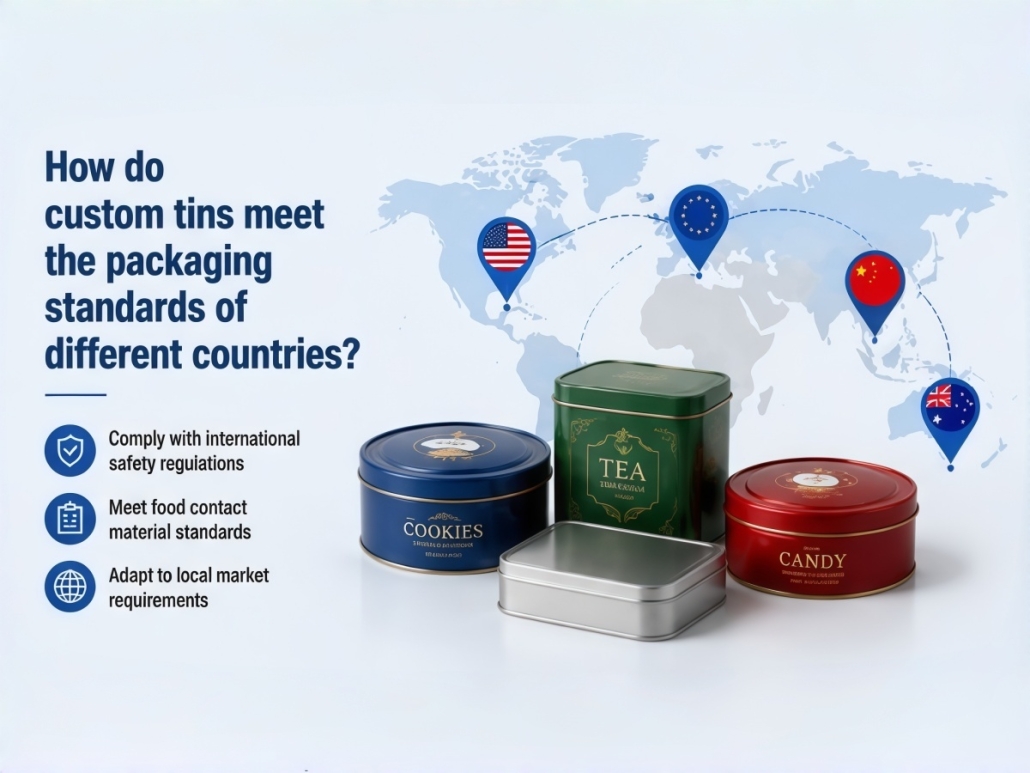
How do custom tins meet the packaging standards of different countries?
When brands expand their products into international markets, packaging is no longer limited to visual design and brand identity; it must also comply with the regulatory requirements of the target market. For products such as cookies, tea, coffee, candy, cosmetics, and gifts, custom tins must meet strict standards regarding material safety, coating performance, labeling, and environmental regulations before entering the global supply chain. For example, food-grade tin packaging exported to the United States must comply with FDA requirements. At the same time, products entering the European market must adhere to EU regulations regarding food contact materials, chemical safety, and sustainability. Therefore, when developing custom tins for global clients, compliance considerations must be integrated throughout the entire production process.
Custom Tins Must Be Made from Compliant Tinplate
The production of compliant custom tins begins with the selection of tinplate material. Tinplate is the primary raw material for most metal tin packaging because it combines excellent strength, corrosion resistance, formability, and recyclability.
However, not all tinplate materials are suitable for every application. When manufacturing food-related packaging, manufacturers must select materials that meet food contact safety requirements. At TSING, we select tinplate based on the product’s end use, taking into account factors such as:
- Food packaging requirements;
- The product’s acidity and oil content;
- Storage conditions;
- Regulatory requirements of the target export market.
The thickness of the tinplate also affects packaging performance. In standard manufacturing applications, most custom tin cans use sheet metal with a thickness ranging from approximately 0.23 mm to 0.30 mm. This thickness range strikes a balance between structural strength, deep-drawing performance, impact resistance, and production efficiency. For high-end packaging projects, TSING can also recommend different material specifications based on specific product requirements.
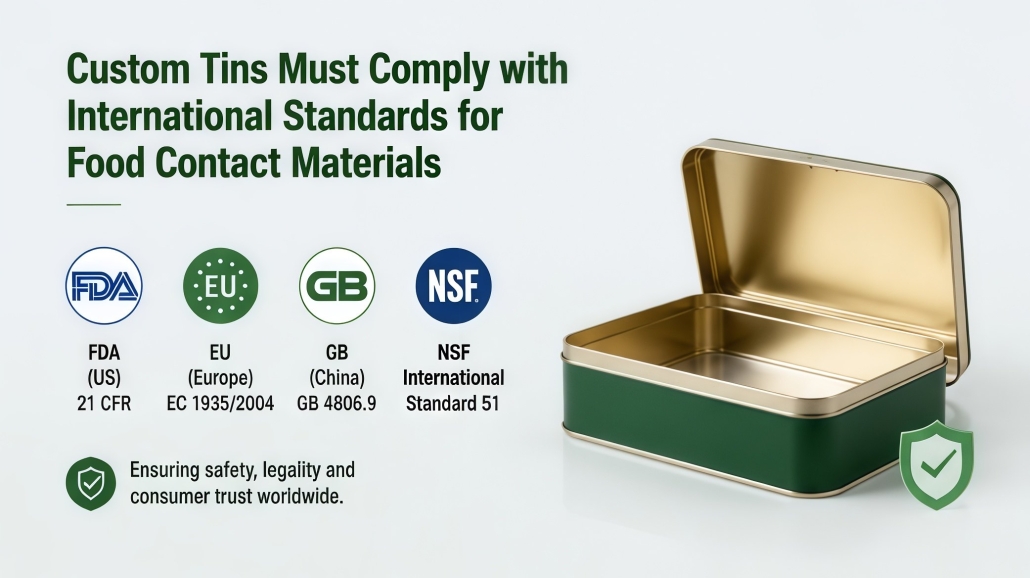
Custom Tins Must Comply with International Standards for Food Contact Materials
Requirements for food contact metal packaging vary by country. The main international food packaging compliance requirements are as follows:
| Market | Main Compliance Considerations |
|---|---|
| United States | FDA food contact regulations, coating safety, migration control |
| European Union | EU food contact material regulations, chemical restrictions |
| Japan | Food Sanitation Act requirements |
| Australia/New Zealand | Food Standards Australia New Zealand (FSANZ) requirements |
| Canada | Health Canada packaging safety requirements |
For example, when manufacturing custom tins for food products, TSING evaluates the following aspects:
Whether the inner coating is suitable for food contact;
Whether the coating composition remains stable during storage;
Whether migration levels comply with market requirements;
Whether the printing materials are suitable for outer packaging;
This process ensures that the final custom tin cans safely protect the product throughout transportation, warehousing, and retail display.
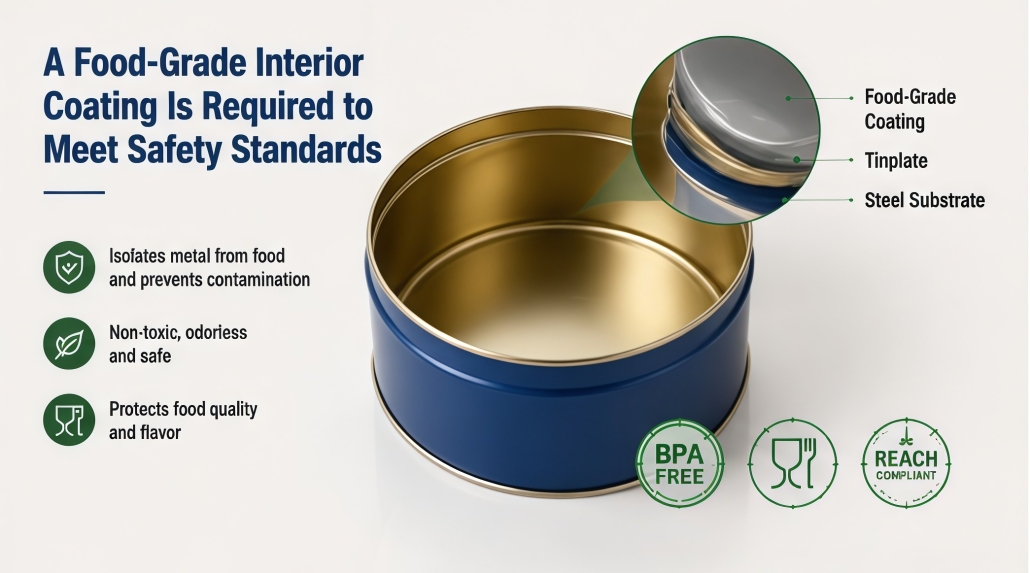
A Food-Grade Interior Coating Is Required to Meet Safety Standards
For food packaging applications, the interior surface of tin cans plays a critical role in ensuring product safety. Although tin-plated steel sheets possess a certain degree of corrosion resistance, direct contact between the metal and certain foods may still result in chemical reactions. Therefore, manufacturers apply a protective coating to the interior of the steel sheets to form a stable barrier layer.
TSING selects the appropriate interior coating based on product characteristics.
Common coating options include:
Epoxy-Phenolic Coating
Applications: General food products, candy packaging, dry snacks.
Advantages:
Excellent adhesion
Good chemical resistance
Stable performance
Food-Grade Transparent Coating
Applications: Tea tins, coffee tins, premium gift packaging.
Advantages:
Preserves the original appearance
Provides protection for food contact
Supports high-end positioning
Specialized Wear-Resistant Coating
Applications: Acidic products, foods with high oil content, and products containing essential oils.
Advantages:
Enhanced chemical resistance
Longer packaging lifespan
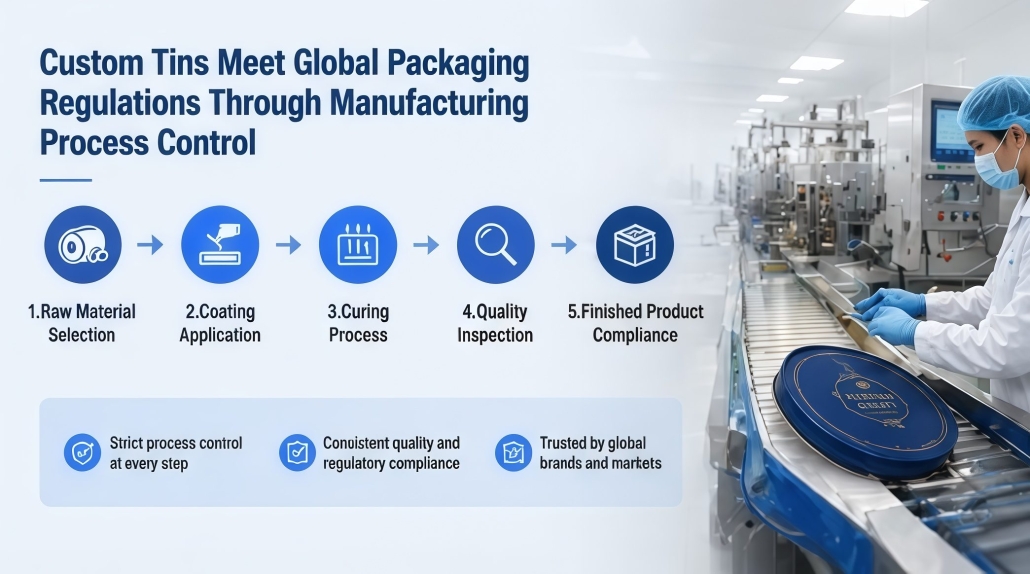
Custom Tins Meet Global Packaging Regulations Through Manufacturing Process Control
To meet international packaging standards, simply selecting compliant materials is not enough. Manufacturing precision also directly determines whether custom tin boxes can pass quality inspections in various countries. As a professional tin box manufacturer, we strictly control every stage of production—from mold development to final inspection—to ensure every custom tin maintains consistent dimensions, sealing performance, and structural strength.
Key manufacturing processes include:
1. Precision Mold Development
Molds determine the basic dimensions and shape of custom tin boxes. For custom projects, TSING develops molds based on the following factors:
- Product size requirements.
- Filling capacity.
- Consumer usage habits.
- Shipping conditions.
- Regional market preferences.
For example, the European market typically favors compact, high-end packaging designs, while the North American market may require large-capacity tin cans to accommodate family-size products. Through precision mold manufacturing, manufacturers can ensure accurate dimensions, smooth edges, consistent lid fit, and good stacking stability.
2. Deep Drawing and Metal Forming Technologies
For certain custom tin can designs, manufacturers employ deep drawing technology to create seamless structures. This process is particularly suitable for pharmaceutical tins, cosmetic tins, and small metal containers that require higher levels of sealing performance. Compared to traditional modular structures, custom tin cans produced via deep drawing have fewer connection points along the can body, thereby reducing the risk of potential leaks.
3. Automated Production and Quality Inspection
Large-scale international orders require strict product consistency. TSING employs automated production lines and inspection processes to control diameter tolerances, height accuracy, lid fit, surface defects, and print quality. Through rigorous process control, custom tin boxes not only meet the quality expectations of different countries but also maintain high production efficiency.
Promoting Global Sustainability Standards Through Recyclable Metal Packaging
Sustainability has become an increasingly important consideration in global packaging decisions. Many countries are introducing stricter environmental regulations to encourage brands to reduce plastic use and adopt recyclable packaging solutions. Compared to many single-use packaging materials, metal cans offer significant environmental advantages.
Custom metal tins are widely regarded as sustainable packaging because tinplate is highly recyclable, sturdy, durable, reusable, and suitable for long-term circulation.
Beautifully designed custom metal cans are often reused by consumers after the original product has been consumed, thereby enhancing the packaging’s value beyond its initial purpose. As global environmental standards continue to rise, metal packaging offers brands a practical solution that balances sustainability with a premium aesthetic.
Custom Tins Provide Reliable Packaging Solutions for the Global Market
For brands entering international markets, selecting the right packaging solution requires careful consideration of safety standards, manufacturing processes, environmental requirements, and consumer expectations. Custom tins can meet the packaging standards of different countries through the following measures:
Selecting tinplate materials that comply with regulatory requirements.
Using food-grade internal coating processes.
Strictly controlling manufacturing precision.
Complying with regional labeling regulations.
Supporting global sustainability goals.
Furthermore, they help brands build trust, enhance market awareness, and create long-term value in the global marketplace.

-180x180.jpg "custom tins (1)")



 Facebook
 Twitter
 Linkedin
