
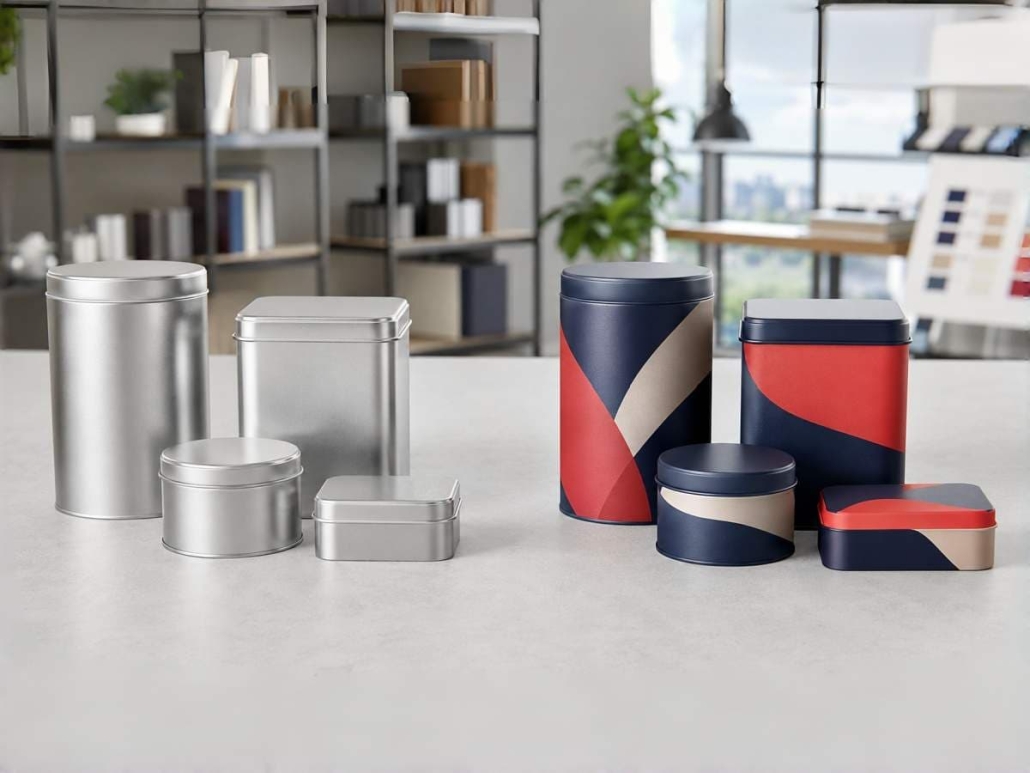
Blank vs Custom Metal Tin Packaging: Which Fits Your Brand Stage Better?
“Should we opt for blank metal tins or purchase fully customized metal tin packing?” This question may seem simple, but the answer is far from being determined solely by budget. A product’s lifecycle, order volume, brand strategy, market positioning, production cycle, and long-term growth goals all influence which packaging solution will deliver the greatest value.
At TSING, we have provided various tin can packaging solutions to clients with diverse needs, and we’ve identified a clear pattern: brands that select packaging appropriate to their current stage of development tend to reduce development costs and achieve the best results. Of course, we do not intend to claim that one option is absolutely superior to the other; rather, we aim to highlight the advantages and trade-offs of each and guide brands in aligning their packaging investments with their current stage of development.
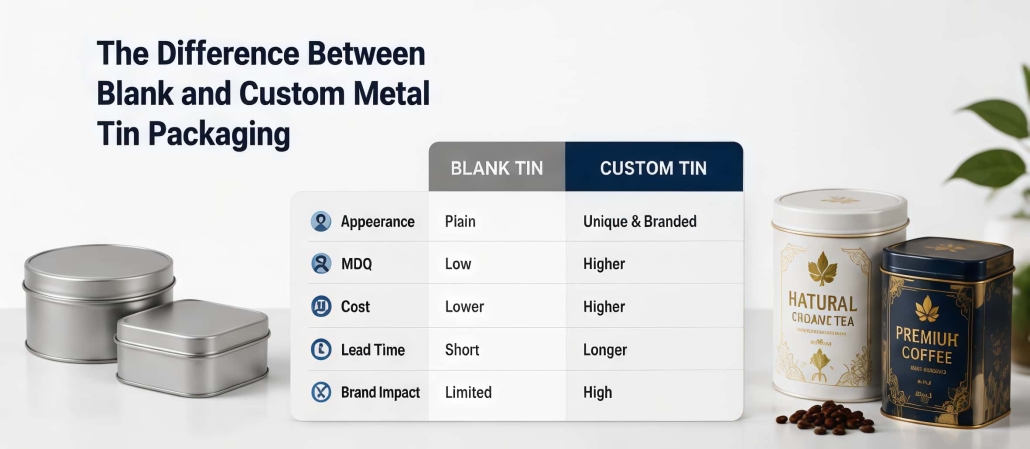
The Difference Between Blank and Custom Metal Tin Packaging
Choosing metal tin packaging is not merely a design decision—it is a business strategy. As a company grows, expands into new markets, and strengthens its brand image, the ideal packaging solution will evolve accordingly.
We typically observe clients’ companies progressing through the following four stages:
| Brand Stage | Typical Business Characteristics | Recommended Metal Tin Packaging |
|---|---|---|
| Startup | Product validation, limited budget, uncertain demand | Blank Metal Tin Packaging |
| Growth | Increasing sales, expanding retail channels | Hybrid customization |
| Established Brand | Stable production, recognizable identity | Fully Custom Metal Tin Packaging |
| Premium Brand | Strong brand equity, global distribution | Fully customized structural and decorative packaging |
Blank tin cans help brands enter the market quickly with minimal upfront investment. In contrast, the value of custom tin cans increases as brand-building and product differentiation become key competitive factors.
Brands should not ask, “Which packaging is better?” but rather, “Which packaging is right for our current stage?”
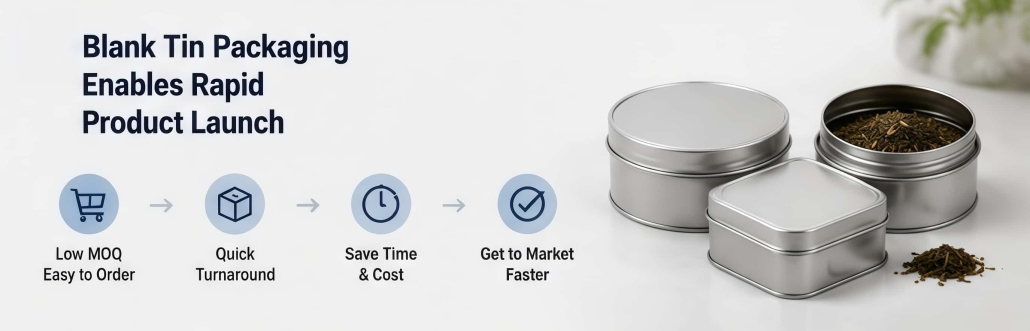
Blank Tin Packaging Enables Rapid Product Launch
For emerging brands, speed is often more critical than uniqueness. “Blank tin packaging” refers to off-the-shelf tin cans produced using existing molds and standard sizes. Since the molds are readily available, there is no need to invest in mold development or structural engineering, and production can begin immediately.
Common styles include:
Round candle tins Coffee tins, Tea tins, Mint candy tins, Cosmetics tins, Food storage tins
Many brands personalize these generic tin cans in the following ways:
For example, an independent coffee roaster partnered with TSING to launch a limited-edition holiday coffee blend. Rather than waiting for fully customized packaging, they chose our generic matte-black coffee can and applied a premium paper label featuring a limited-edition artwork. As a result, production took less than half the time required for custom packaging, allowing them to successfully capitalize on seasonal market demand without compromising the product’s premium look and feel.
For startups and small-batch producers, blank tin packaging minimizes financial risk while maintaining a professional product image.
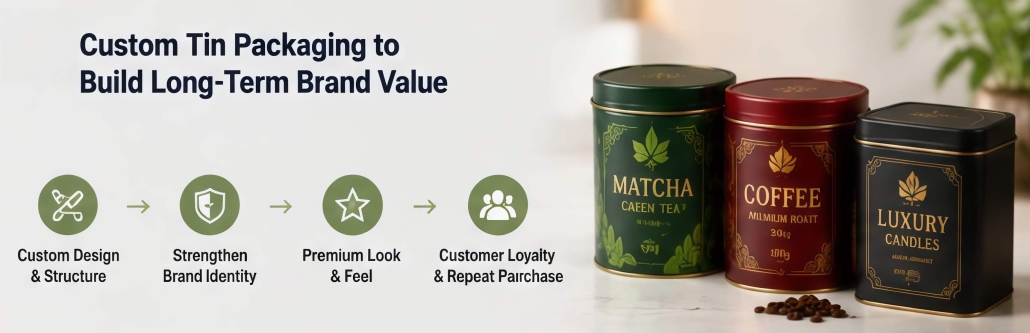
Custom Tin Packaging to Build Long-Term Brand Value
As sales grow, the role of packaging has evolved from a simple protective container to a strategic marketing tool. Unlike blank tin cans, custom tin packaging allows brands to personalize nearly every detail.
These customization options include:
Structural Design: Unique shapes Custom dimensions Custom lid designs Deep-drawn seamless construction
Surface Finishes: CMYK printing Pantone spot colors Matte/Gloss Varnish Metallic Finish Embossing Debossing Spot UV Coating Gold/Silver Foil Stamping
Functional Features: Food-Grade Interior Coating Silicone Sealing Ring PVC or EPE Liner Stackable Design
These diverse customization options transform packaging from a mere container into an extension of the brand experience. Take a high-end tea company as an example: the company switched from using generic tin cans with labels to fully customized embossed tin cans. These custom tins feature Pantone spot colors, a double-layer lid design, and a food-grade interior coating. Retailers reported that the products’ visual appeal on shelves was significantly enhanced, while consumers were more inclined to reuse these tins at home.
Choosing the Right Metal Tin Packaging Leads to Better Sales
One of the biggest misconceptions in the packaging industry is that custom packaging always delivers a higher return on investment. In reality, packaging decisions should align with current business priorities.
| Business Goal | Blank Metal Tin Packaging | Custom Metal Tin Packaging |
|---|---|---|
| Launch quickly | Excellent | Moderate |
| Low upfront investment | Excellent | Lower |
| Small production runs | Excellent | Less suitable |
| Unique brand identity | Limited | Excellent |
| Retail shelf differentiation | Moderate | Excellent |
| Long-term marketing value | Moderate | Excellent |
| Premium pricing strategy | Limited | Excellent |
| Exclusive intellectual property | No | Yes |
For companies still validating market demand, off-the-shelf packaging typically yields a higher return because it reduces inventory risk and preserves cash flow. Conversely, brands preparing for nationwide retail expansion or international distribution typically gain greater long-term value from custom packaging, which enhances brand recognition and improves perceived product quality.
Considerations Beyond Aesthetics in Manufacturing
Many buyers focus primarily on the graphic design of packaging while overlooking the engineering behind successful packaging. As an experienced tin can manufacturer, TSING encourages clients to evaluate several technical factors before making a decision.
Production Lead Time:
Blank tins typically only require scheduling into the production plan. The production cycle for custom tin cans includes structural engineering, mold manufacturing, artwork validation, color proofing, sample approval, and more.
Minimum Order Quantity:
Blank packaging is generally suitable for relatively small production runs, such as 2,000–3,000 units. Custom projects typically become more cost-effective at higher volumes, as mold costs can be spread across more units.
Future Scalability:
Brands anticipating rapid growth should consider whether their current packaging can meet the needs of their future product portfolio. Many successful clients started with blank cans, then gradually transitioned to partially customized packaging, and finally moved to fully customized packaging once demand stabilized. This phased strategy reduces financial risk while supporting the brand’s continued growth.
Selecting Packaging for Current Needs and Future Growth
Blank packaging offers exceptional flexibility, lower investment costs, and faster time-to-market. It enables startups and emerging brands to validate their products, refine their brand identity, and gather market feedback before moving to large-scale customization.
However, as companies establish their market position, expand retail channels, and compete through premium positioning, customized metal tins packaging becomes increasingly valuable. Unique structures, proprietary designs, advanced finishes, and thoughtfully engineered features not only enhance brand recognition but also create lasting competitive advantages. The right packaging should evolve in tandem with the company’s growth—supporting efficient growth today while helping the brand achieve greater differentiation in the future.
 Facebook
 Twitter
 Linkedin
