

Can a Metal Cigarette Case Be Designed to Open With One Hand Without Accidental Opening?
To create a metal cigarette case that can be operated with one hand, two conflicting challenges must be addressed: ensuring the lid opens easily when the user intentionally operates it, while also guaranteeing that the lid remains securely closed during everyday use—such as when the case is squeezed, carried, or placed in a pocket. To achieve this balance, simply adding a hinge or spring is not enough. When designing this type of metal cigarette case, TSING treats the hinge position, opening mechanism, latch engagement, and lid damping as an integrated mechanical system for careful consideration.
This design must ensure users can naturally open the lid with their thumb while preventing accidental activation of the opening mechanism from pressure during everyday handling. Both ease of opening and resistance to accidental opening must be verified through physical prototypes.
Metal Cigarette Case Design Should Separate the Opening Mechanism from the Latching Mechanism
One-handed opening works best when the hinge and latching mechanism each perform independent functions. The hinge controls how the lid rotates, while the latch determines whether the case remains closed. If designers overlook each component’s independent role, they may create a lid that is difficult to open or prone to accidental opening.
For TSING, the starting point was to clarify how users hold the cigarette case, where the thumb naturally rests, and which side the case should open from. These considerations determined the layout of the hinge, the opening button, and the latch contact points.
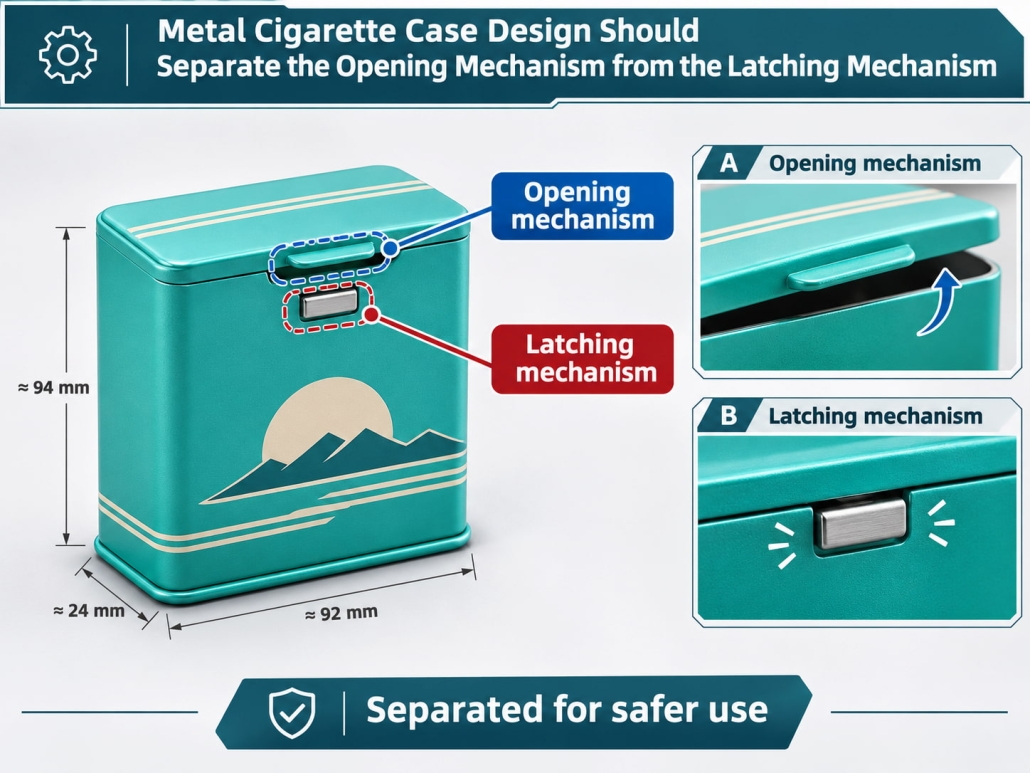
Incorporating a Thumb-Accessible Opening Mechanism and a Sturdy Hinge Structure
For one-handed operation, the most practical solution is typically a hinged lid with an opening mechanism positioned within easy reach of the thumb.
Users should be able to hold the cigarette tin in the palm of their hand and operate the opening mechanism with just their thumb to rotate the lid open, without needing the other hand to assist in lifting the lid.
Based on the cigarette pack’s dimensions and mold design, TSING can evaluate various mechanical solutions:
- Push-button opening: Pressing a recessed button releases the latch, allowing the user to open the lid with a simple thumb motion.
- Slide-to-open mechanism: Sliding a small component unlocks the mechanism and allows users to lift the lid.
- Spring-assisted opening: After the latch is released, a spring helps push the lid open, reducing the force required to open it. The hinge itself also requires careful engineering design.
The specific choice depends on the required opening angle, available space, material thickness, and expected frequency of use.
The core principle of our design is to ensure that the opening mechanism is easy to operate while preventing accidental triggering of the locking mechanism.

Opening Resistance of Metal Cigarette Cases: Striking a Balance Between “Easy to Open” and “Secure Closure”
A one-handed opening mechanism should not require excessive force; however, if the resistance is set too low, it creates another problem: the cigarette tin lid may accidentally pop open during everyday handling.
Therefore, TSING comprehensively considers three related mechanical characteristics during the design process.
| Mechanical Characteristic | Design Requirement |
|---|---|
| Release force | Low enough for comfortable thumb operation |
| Lid opening resistance | Controlled movement without excessive stiffness |
| Closure retention | Strong enough to prevent unintended release |
To the extent permitted by the mechanism, these characteristics should be adjustable independently.
For example, a cigarette pack can be equipped with a button that releases easily with a single press, supplemented by an independent latch to ensure the lid closes securely. This approach offers better control than relying solely on friction between the lid and the pack body (i.e., a “tight fit”) to secure the lid.
Thus, “appropriate resistance” means minimizing the force required for operation as much as possible while ensuring the lid closes reliably and its movement remains controllable.
Preventing Accidental Opening of Metal Cigarette Cases Through “Controlled Opening” and “Physical Protection” Mechanisms
Simply ensuring “easy access” is not enough to create an excellent opening mechanism. During daily use, people may squeeze metal cigarette cases in their pockets, bump them against other items in bags, or remove them frequently. If the opening button is located directly on an exposed surface, ordinary pressure could cause the package to open accidentally.
The solution is to protect the opening mechanism without making “intentional opening” overly cumbersome.
Combining a “Protected Opening Position” with a “Reliable Locking Mechanism”
TSING assesses the risk of accidental opening by comprehensively considering button placement, latch engagement, hinge movement, and the cigarette pack’s external design.
Designing the opening button as “recessed” is a practical solution, as the surrounding metal structure can act as a shield, preventing direct contact with the button. Another option is to use a protected sliding latch or a “two-step” opening mechanism—where the user must first perform a specific movement or press before lifting the lid.
In our design process, we pay close attention to the following details:
- Opening Button Placement: The button should not be positioned where it can be easily touched during normal handling or subjected to external pressure.
- Latch Engagement: The locking mechanism should feature a distinct mechanical engagement structure, rather than relying solely on slight friction to secure the lid.
- Lid Overlap: There should be appropriate overlap between the lid and the box body; this helps maintain alignment and limits unnecessary movement.
- Hinge Stability: Hinges should maintain precise alignment during repeated use to prevent the lid from closing improperly due to gradual misalignment.
These design details distinguish “intentional opening” from “everyday contact.”
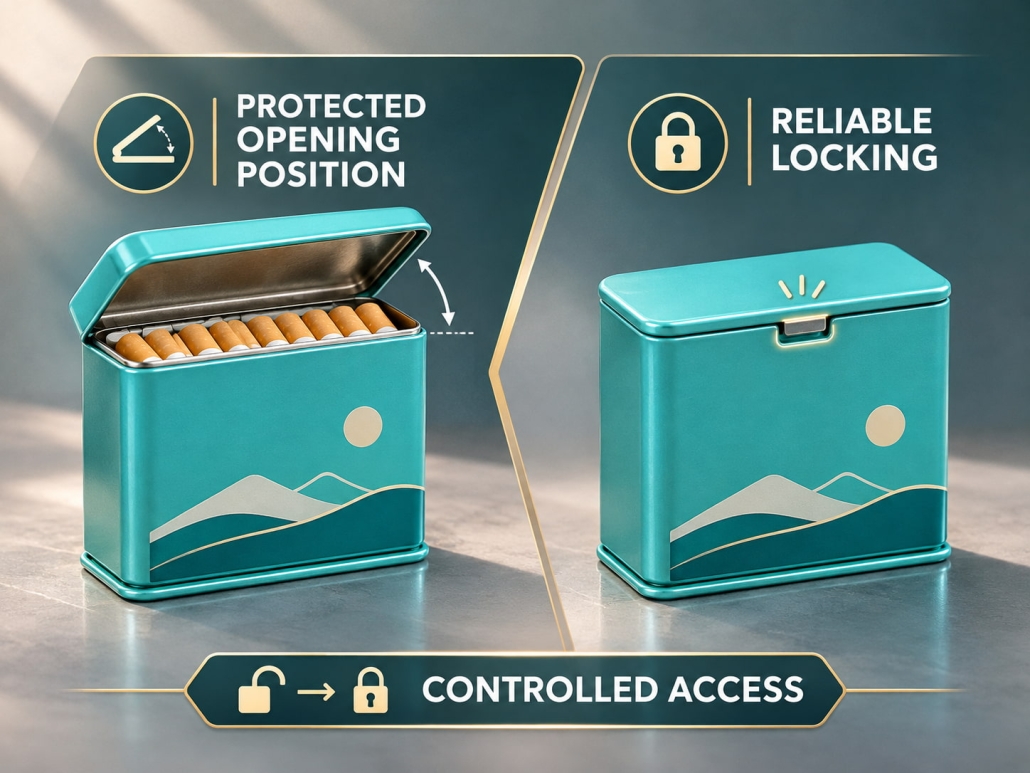
Validation Through Opening, Holding Force, and Durability Tests
Mechanical structures that work well in 3D CAD software drawings may behave differently in practice once manufacturers form and assemble the metal components. Therefore, TSING considers physical prototype testing an indispensable part of the custom development process.
The validation process primarily covers the following four aspects:
- One-handed operation: Confirming that users can grip the cigarette tin, release the latch, and open the lid without using their other hand.
- Opening force and holding force: Measuring the force required to operate the latch and the resistance needed to keep the lid securely closed.
- Accidental opening prevention: Apply simulated pressure to the cigarette tin’s exposed surfaces and control components to check whether normal handling or use accidentally triggers the opening mechanism.
- Hinge Durability: Through repeated opening and closing cycles, observe any loosening, misalignment, or change in operating resistance.
TSING also evaluates finished cigarette tins under simulated real-world usage scenarios (such as pressure from being placed in a pocket or bag, as well as required drop and vibration tests).

Precision Fit Achieves This Integration
For TSING, a successful metal cigarette case should open naturally with one hand while remaining securely closed during daily carrying and use. Achieving this goal requires precise coordination between the hinge, opening mechanism, and locking structure, supplemented by repeated physical validation.
The final design must fulfill three functions simultaneously: comfortable one-handed operation, controlled lid opening and closing, and reliable protection against accidental opening.
 Facebook
 Twitter
 Linkedin

