
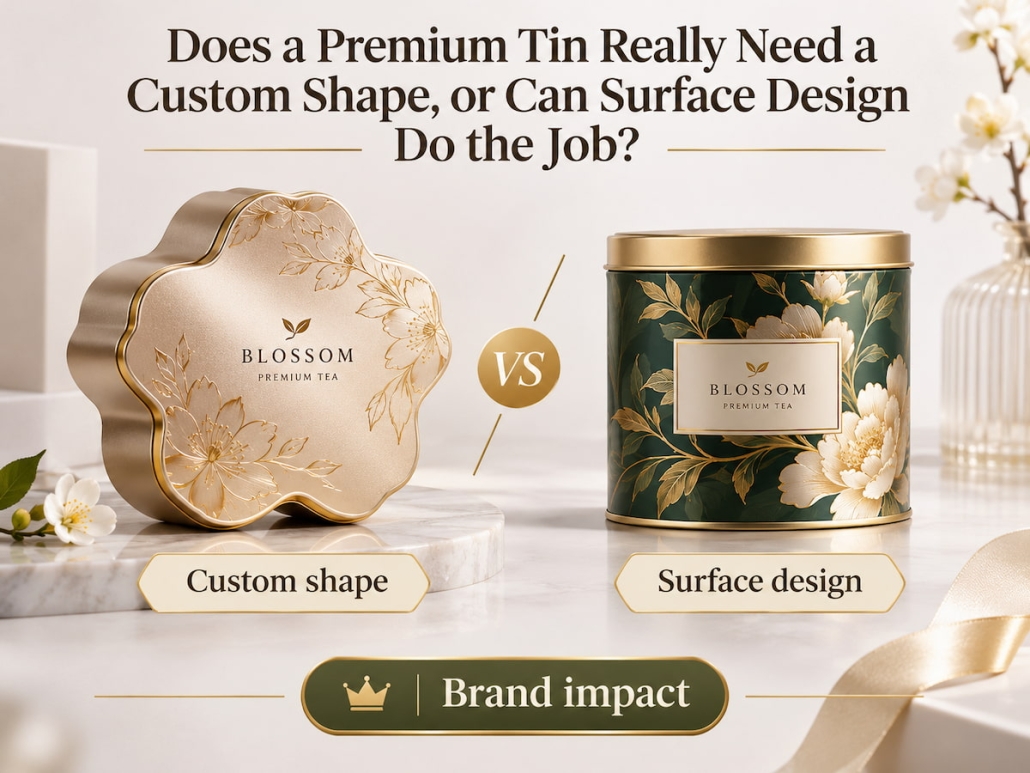
Does a Premium Tin Really Need a Custom Shape, or Can Surface Design Do the Job?
We have found that even when companies or brands add many unique design elements to their tin cans, their shelf appeal doesn’t necessarily surpass that of a well-designed standard tin can—provided the latter excels in printing, embossing, and surface finishing. So, when designing premium tin, the question is: Should this differentiation come from the structure or the visible surface?
As a tin box manufacturer, we believe both approaches can create high-end value, but they address different parts of the equation. Surface design is typically faster, carries lower risk, and is easier to replicate in large-scale orders. In contrast, custom shapes add value when their geometry enhances product compatibility, optimizes the opening experience, or boosts brand recognition. The final choice depends on the message the packaging needs to convey, as well as the functions the structure itself is intended to fulfill.
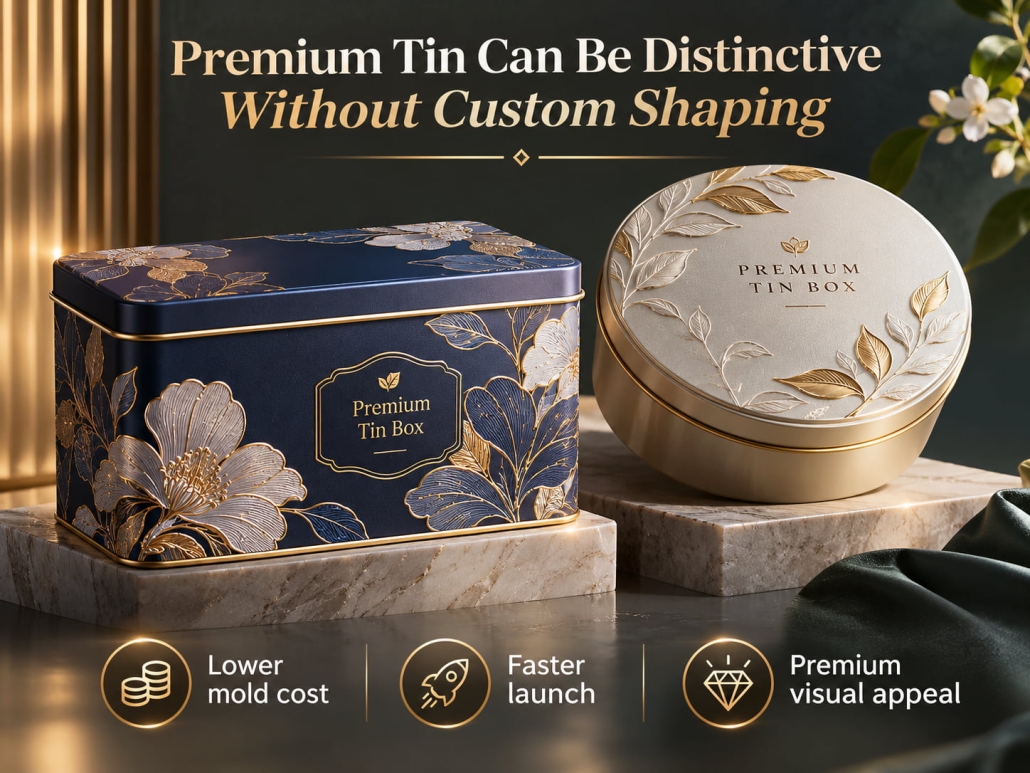
Premium Tin Can Be Distinctive Without Custom Shaping
You can achieve a premium feel without altering the basic geometric structure of a metal can. Metal Packaging Europe notes that specialty metal packaging can integrate printing, embossing, gravure printing, custom shaping, and a range of surface finishes—from high-gloss to matte and metallic textures—giving brands multiple ways to differentiate their packaging, both visually and tactilely.
For many standard projects, this means even common circular, square, or rectangular shapes can become highly recognizable, premium custom tin cans through sophisticated surface design alone.
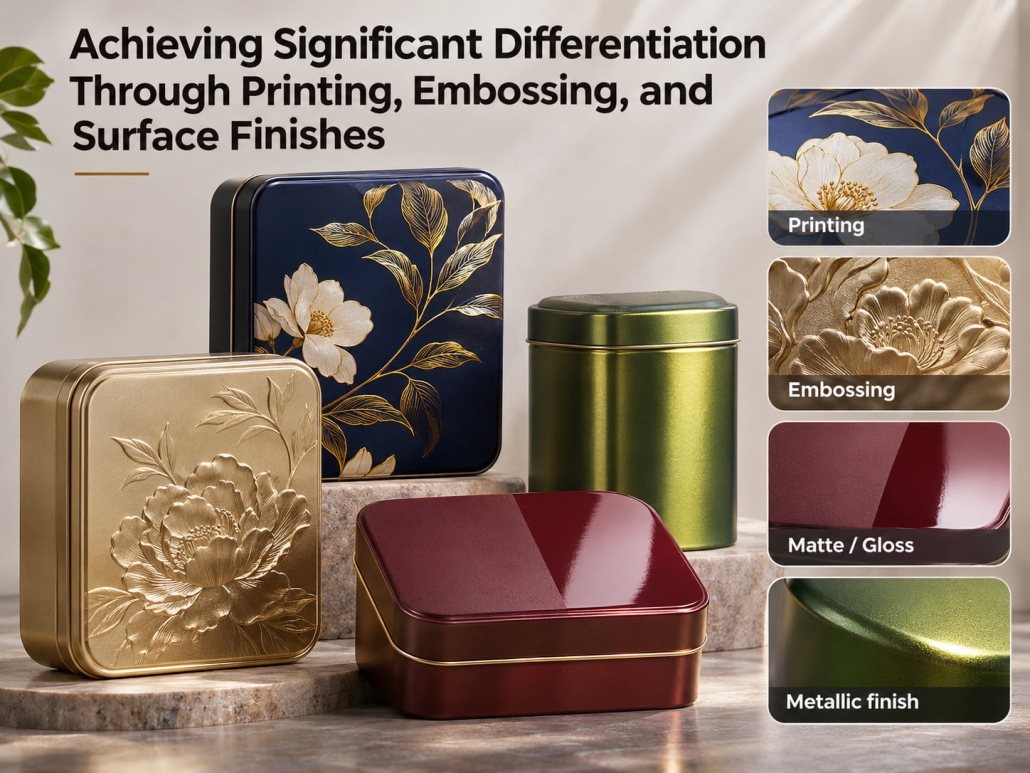
Achieving Significant Differentiation Through Printing, Embossing, and Surface Finishes
Tinplate supports a wide range of color effects and precise registration, and its metallic substrate can also serve as a decorative element. This opens up multiple avenues for designing premium custom tin cans:
- Printing: Can display colors, patterns, illustrations, and brand logos.
- Embossing or Debossing: Adds tactile texture to brand logos, borders, or specific graphics.
- Surface Finishes (matte, glossy, satin, or metallic): Change how light interacts with the packaging.
- Spot decoration: Creates visual contrast without overcomplicating the design.
For example, consider a standard rectangular metal can. If one brand uses a matte black finish paired with a raised metallic logo, while another uses bare tinplate with transparent color printing and spot varnish, the two will look completely different.
Although the structure is identical, consumers perceive the products very differently.
This approach is particularly suitable when clients have specific visual color requirements. It allows flexible updates to seasonal patterns and limited-edition visual designs without redesigning the metal can’s overall structure.
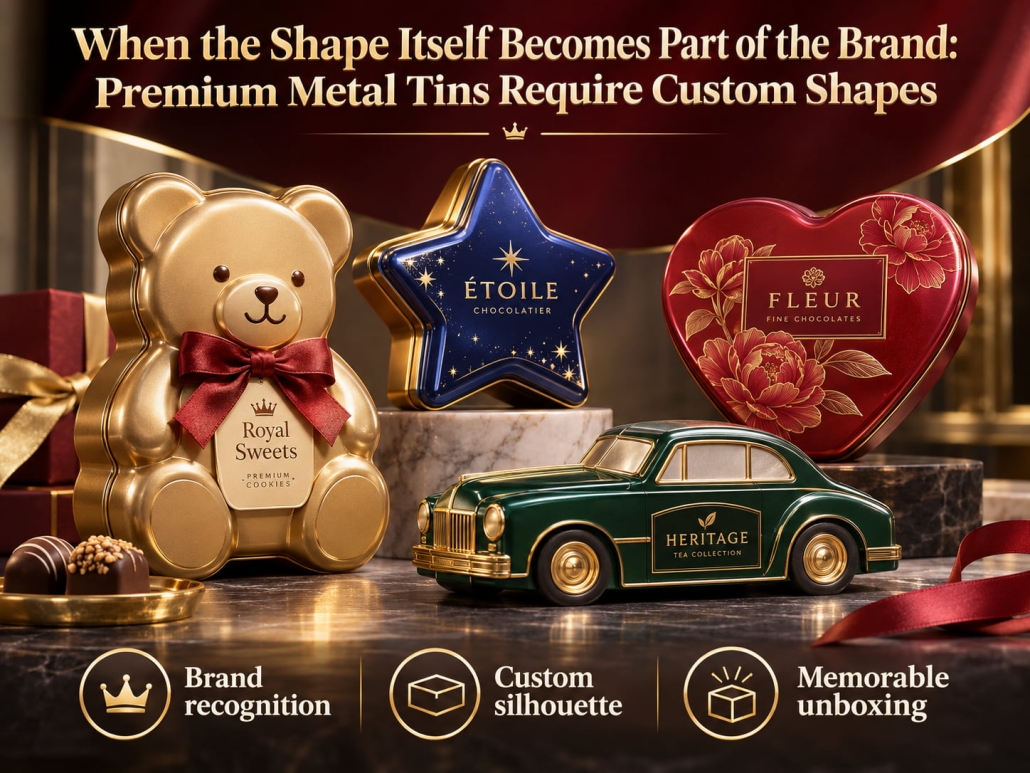
When the Shape Itself Becomes Part of the Brand: Premium Metal Tins Require Custom Shapes
Surface design has its limitations. If a brand wants consumers to recognize the packaging solely by its silhouette, structural differentiation becomes particularly important.
Custom shapes can alter the following aspects:
- Overall proportions
- Geometric structure of edges and corners
- Lid contour
- Opening experience
- Internal product arrangement
- How the metal cans are placed or stacked on the shelf
Take a certain candy brand as an example: its products feature a unique hexagonal arrangement. If standard rectangular metal cans were used, they would often require extra internal space and a larger inner liner. However, adopting a specially designed hexagonal structure, or one with unique proportions, not only lets the product fit more snugly within the packaging but also boosts brand recognition.
The same applies when the metal can itself has collectible value or is designed to be reusable. In such cases, the design is no longer merely a container but becomes an integral part of the product experience.
Custom designs are most valuable only when at least one of the following conditions is met:
1. Existing structures do not fit the product well.
2. The packaging’s silhouette itself helps enhance brand recognition.
3. The opening or display experience requires a specific geometric structure.
4. The packaging will be reused across multiple product lines or marketing campaigns.
Development Risks Are Generally Lower When Using Custom Surface Finishing Techniques
From a manufacturing perspective, the development risks associated with these two approaches differ for a tin box manufacturer.
Custom surface finishing is typically based on a proven physical structure. The primary variables involve pattern design, coating, embossing location, and print registration accuracy. Although these aspects still require technical evaluation, the can body and lid geometry are already determined.
If a completely new custom shape is involved, additional engineering steps are required:
Structural Concept → 3D Development → Mold Making → Trial Molding → Dimension Adjustment → Closure Testing → Surface Finishing → Final Validation
A simple comparison reveals the difference between the two approaches:
| Decision Factor | Surface-Designed Premium Tin | Custom-Shaped Premium Tin |
|---|---|---|
| New structural tooling | Usually limited or unnecessary | Often required |
| Development time | Lower | Higher |
| Forming risk | Lower with proven structure | Requires validation |
| Visual flexibility | High | High |
| Structural differentiation | Limited | Strong |
| Best for repeat branding changes | Very suitable | Less flexible |
| Best for iconic package silhouette | Limited | Strong |
Premium Tin Should Adopt the Most Streamlined Customization Approach to Create True Value
So, do high-end tin cans really need custom shapes?
Not necessarily.
If a brand’s differentiation comes primarily from color, pattern design, logo presentation, metallic texture, tactile details, or seasonal marketing campaigns, then a proven can structure combined with outstanding surface design is often enough to achieve strong differentiation. This approach typically involves lower tooling costs, shorter development cycles, and more convenient repeat production.
Custom shapes are appropriate only when the geometry itself enhances brand recognition, better accommodates the product, optimizes the opening experience, or builds a long-term brand identity.
 Facebook
 Twitter
 Linkedin
