
Gasket-sealed tins: Ideal packaging for storing fresh coffee beans and tea leaves
When fresh coffee beans are sealed in the wrong container, carbon dioxide escapes, carrying volatile aromatic compounds with it. Oxygen from the air rushes in and begins to oxidize lipids, while humidity accelerates structural degradation. By the time the product reaches the consumer, it has long since lost its optimal quality. The same is true for tea. Whether they are high-end coffee brands, tea brands, or large retailers, they all need gasket-sealed tins. We will explain why gasket-sealed tins are suitable for packaging coffee and tea by examining the materials, can performance, and real-world applications from the global packaging market.
Why Do Gasket-sealed tins Solve the Problem of Poor Sealing at the Source?
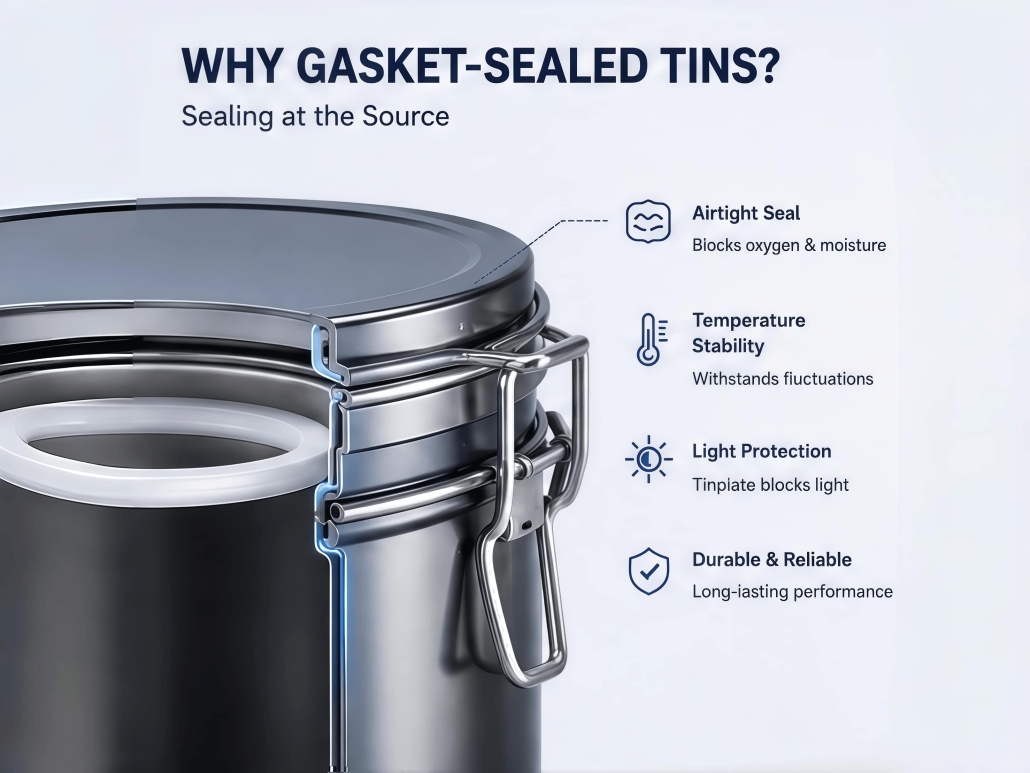
Gasket-sealed tins address issues related to light, oxygen, moisture, and temperature fluctuations through their sealing design rather than chemical methods. The tin cans are made of tinplate, which is inherently opaque. The metal substrate is impermeable to both oxygen and water vapor, unlike multilayer flexible films, which allow trace amounts of gas to permeate through their polymer matrix even after prolonged use.
Sealing gaskets are typically made of food-grade LDPE, EPDM, or silicone. They form a continuous, compressible barrier between the can lid and the can flange, eliminating the microscopic gaps that allow atmospheric exchange.
Temperature resistance is another structural advantage of metal can with sealing gasket. Tin cans have a high thermal conductivity, meaning the container quickly reaches thermal equilibrium with the ambient temperature without creating hot spots inside, thereby preventing localized degradation. A well-sealed gasket-sealed tin does not develop an air lock during temperature cycling.
Sealing Gaskets in Coffee and Tea Tins
Not all Metal tins with sealing gasket deliver the same level of performance. A carefully engineered gasket-sealed tin offers significant advantages over a standard can that simply uses a compressed foam liner.
The gasket material determines the sealing performance, chemical compatibility with the product, and the actual service life of the sealing system. At TSING, we select gasket materials based on three primary criteria:
- Resistance to compression set
- Odorlessness
- Compliance with applicable food contact regulations.
Material Selection Varies by Product Category and Price Tier
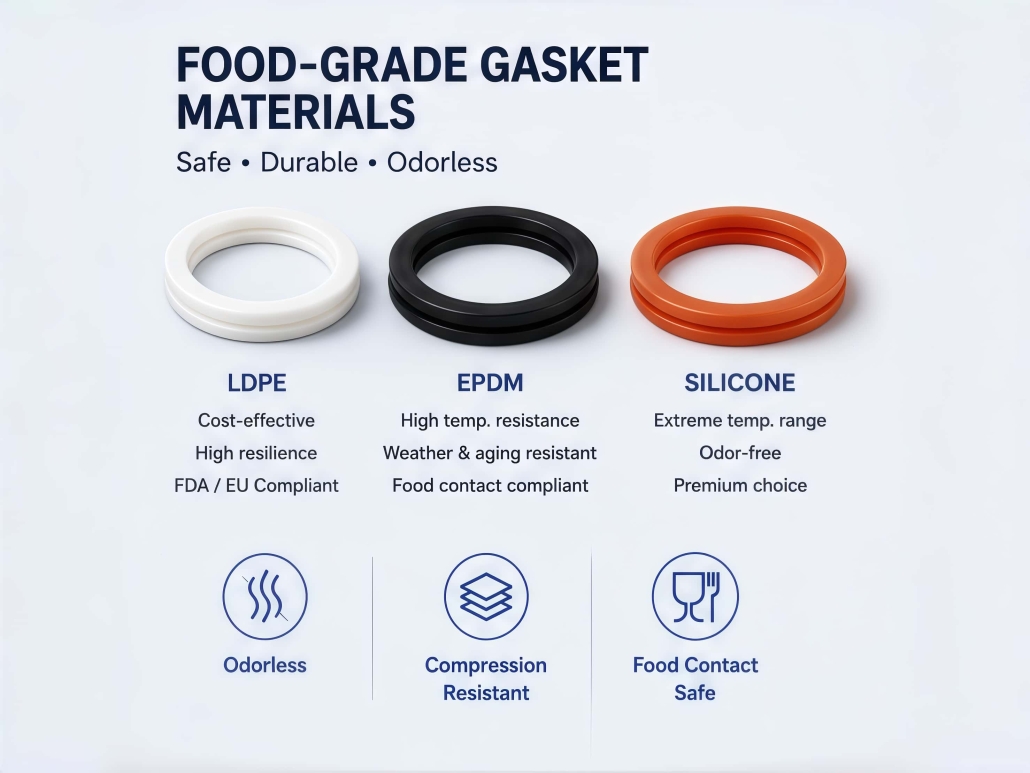
LDPE is the primary material used for sealing gaskets. It is cost-effective, complies with U.S. FDA 21 CFR and EU Regulation 10/2011, is odorless when properly formulated, and exhibits excellent resistance to compression set over thousands of opening and closing cycles. It is ideal for most standard coffee and tea tins across retail and e-commerce channels.
Silicone gaskets are more expensive but offer significantly better performance across a wide range of temperatures and chemical environments. Silicone remains flexible over a temperature range of -55°C to 200°C, ensuring seal integrity in both cold-chain logistics and warm environments. For customers targeting the high-end or organic-certified markets, silicone gaskets completely eliminate the risk of odor migration.
EPDM combines the advantages of both: it offers superior temperature resistance compared to low-density LDPE, is less expensive than silicone, and complies with a wide range of food contact standards. EPDM is the preferred sealing material for coffee tins sold in high-humidity tropical markets and for export tea tins that must traverse different climate zones.
Compatibility of the Gasket with the Shape of the Lid and Can Body
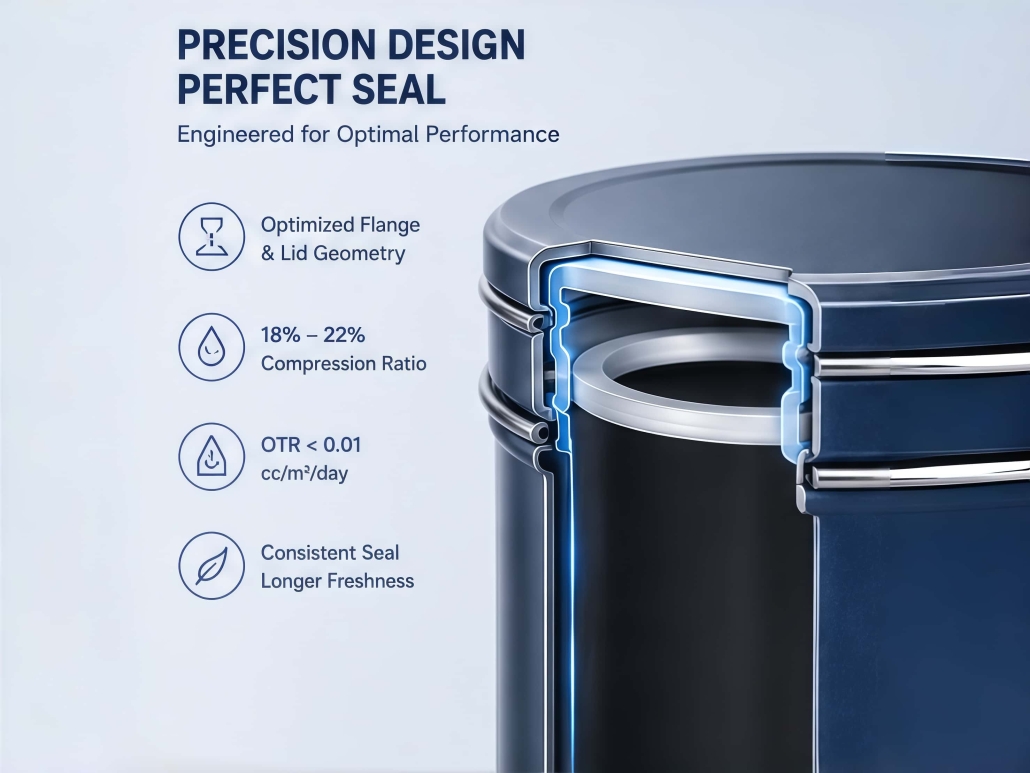
The gasket does not function in isolation; it works in conjunction with the lid’s geometry and the can body’s edges. At TSING, our mold engineers carefully design the roll-ups and flanges of each tin component to achieve the right gasket compression while keeping the material within its elastic recovery limit.
For round coffee and tea tins with diameters ranging from 73 to 99 millimeters, we specify a compression ratio for the gasket of 18%–22% of the uncompressed gasket height. Our internal quality control procedures have validated this range for various materials and lid geometries, ensuring that the gasket’s OTR remains below 0.01 cc/m²/day throughout the product’s lifecycle.
Internal Coatings for Sealed Coffee and Tea Tins
The inner surface of sealed food tins is not bare tinplate. We apply a protective paint layer—typically a bisphenol A-free epoxy-phenolic or polyester coating—to prevent the metal substrate from coming into direct contact with the product. In the case of coffee tins, because coffee oils are weakly acidic, prolonged contact with an uncoated can surface can cause a reaction. For tea tins, the main issue is tannic acid, which can discolor the uncoated can surface and, in extreme cases, impart an off-flavor to the tea. TSING uses a two-layer epoxy-phenolic system as the standard inner coating for sealed coffee tins. During the curing process, this system fully cross-links the polymer network before the coating contacts the product. For sealed tea tins, TSING uses a polyester-based coating instead.
Performance Comparison of Gasket-sealed tins with Other Packaging Formats
When selecting packaging for coffee and tea, procurement professionals face a wide array of options. The table below compares various packaging formats across multiple aspects, including actual freshness retention, logistics suitability, and brand promotion.
As shown in the table above, only airtight Tins achieve the highest levels of performance across all barrier properties, while also projecting a premium brand image and ensuring durability during logistics and transportation.
Gasket-sealed tins That Provide Oxygen Barrier, Moisture Barrier, and Light Protection
Gasket-sealed tins are the only packaging format capable of simultaneously meeting all freshness requirements—including oxygen barrier, moisture barrier, light protection, reliable sealing, and durability during logistics. They are also the only packaging format that can enhance the brand experience while scientifically and effectively protecting product quality. For brands that take coffee and tea seriously, gasket-sealed tins are the ideal packaging choice.
 Facebook
 Twitter
 Linkedin
