
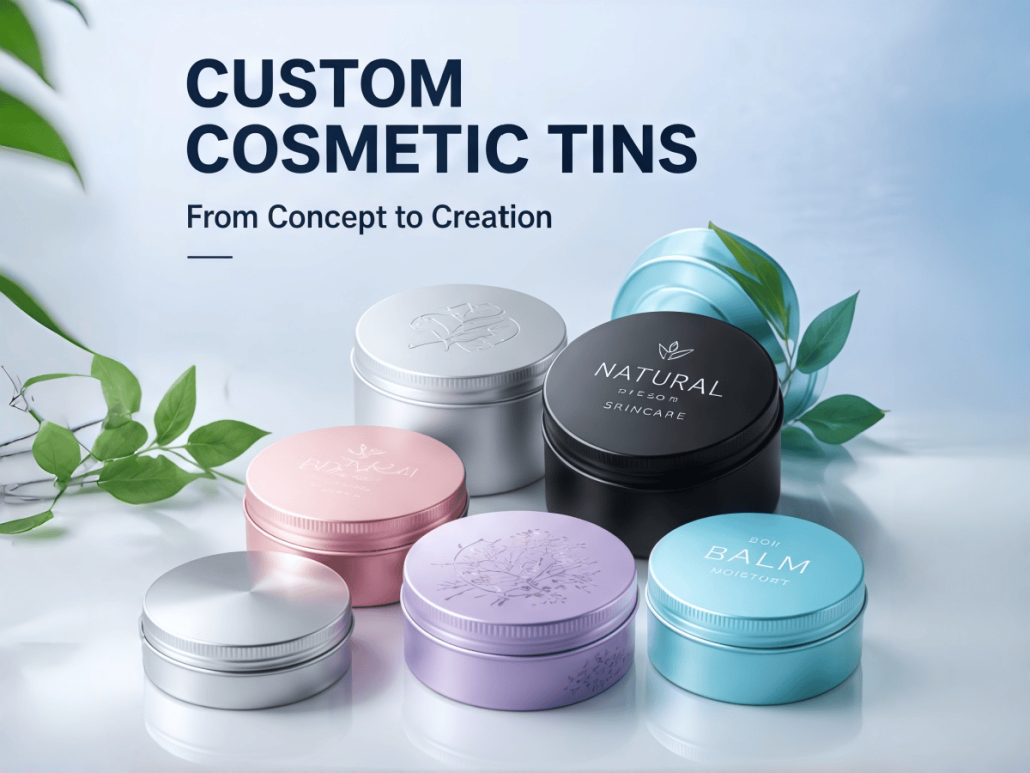
How do you customize the right cosmetic tins for your skincare and beauty products?
In some high-end beauty retail stores, you’ll notice that the product packaging itself tells the brand’s story. Behind these exquisite, sleek, and luxurious-feeling cosmetic tins lies the custom packaging decision made by each skincare and beauty brand. So, “How do we customize the right metal cosmetic tins for our skincare or beauty products?” is the question most frequently asked by skincare and beauty clients when they partner with us. In this article, we’ll walk you through every step of our process and use a case study to show you how we bring custom cosmetic tins to life.
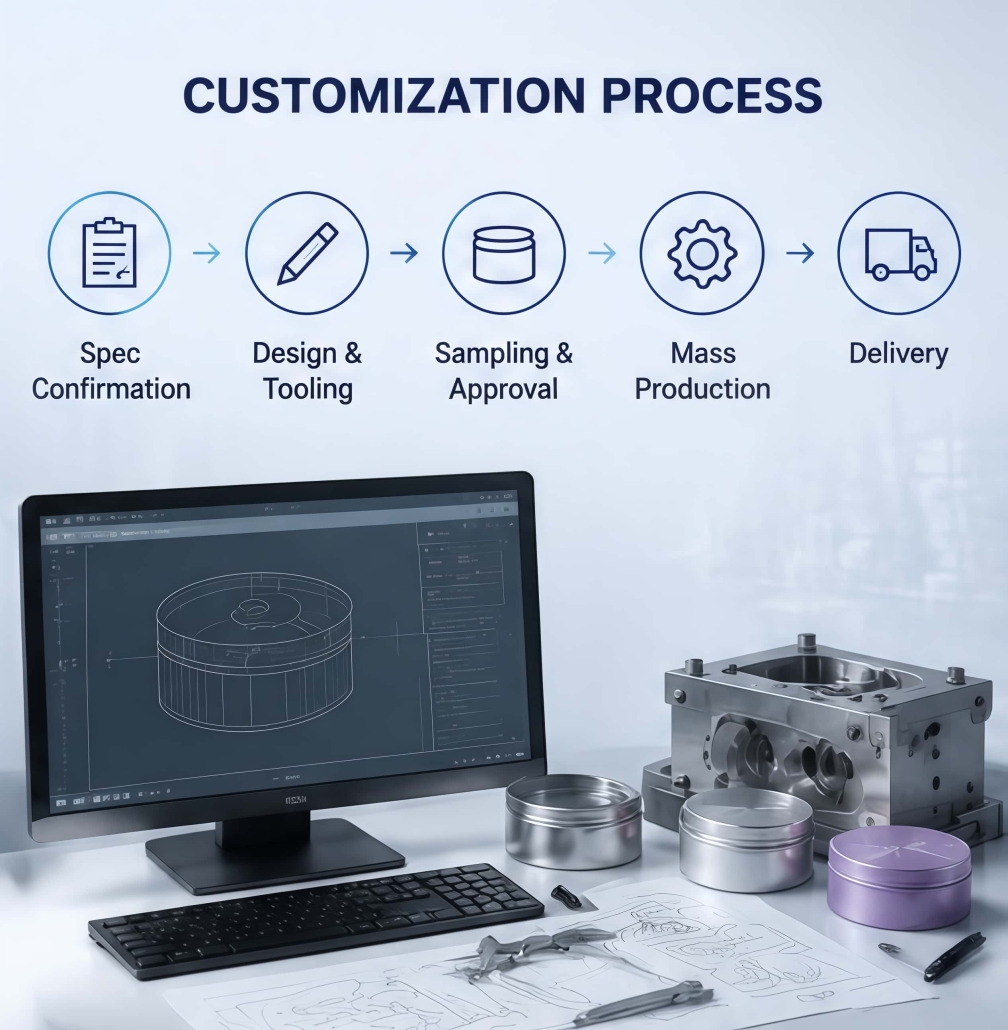
The Complete Customization Process for Cosmetic Tins
For brand owners and procurement managers, the most critical question is how to efficiently and accurately customize cosmetic tins. As a professional tin container manufacturer, we have a comprehensive customization process that minimizes lead times and ensures the cosmetic tin you receive match your vision exactly.
Essential Specifications for Every Batch of Custom Cosmetic Tins
For any custom cosmetic tin, we need clear, complete product specifications. This is often the step most clients overlook, and it is also the stage that results in the highest costs for subsequent revisions.
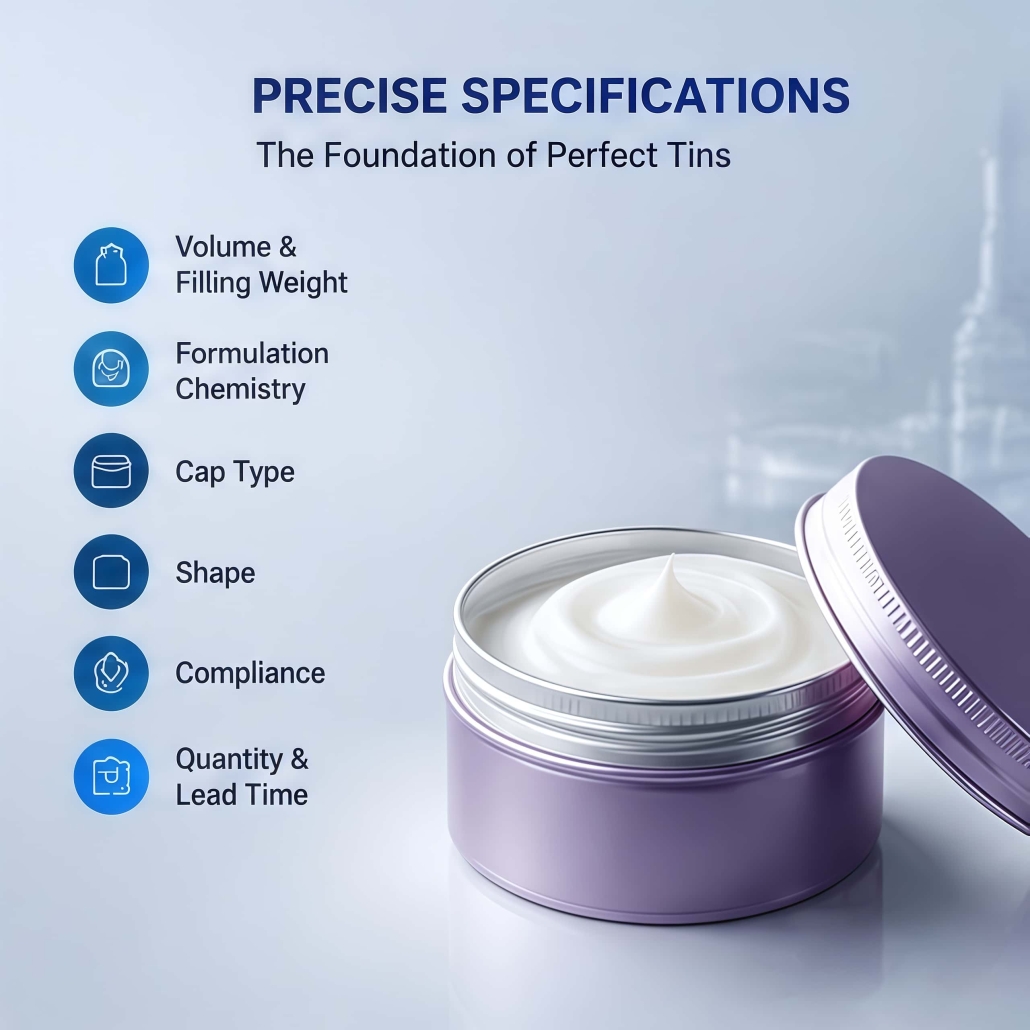
The complete specifications for custom cosmetic tins cover six core dimensions.
Product Volume and Filling Weight:
The tin’s internal volume must accommodate the labeled net weight of the product while leaving sufficient headspace. For thicker lip balms and creams, wider-diameter, shallower containers typically outperform narrower, taller ones in terms of both application ease and filling line efficiency.
Formulation Chemistry:
You should provide your tin box manufacturer with a complete list of ingredients and the pH range during the specification phase, not after sampling. This single piece of information determines the type of internal coating, which in turn affects mold selection and unit cost.
Cap Types:
Slide-on, snap-on, and screw-on caps each have their own appropriate applications. You need to inform your cosmetic tin manufacturer of the cap type you require.
Cosmetic Tin Shapes:
Mold costs and brand associations vary for round, rectangular, square, and oval cosmetic tins.
Regulatory Compliance Requirements:
If you are selling products to the EU, the U.S., or Southeast Asian markets, your packaging must comply with applicable regulations for food-contact or cosmetic-contact materials. Therefore, you need to communicate this clearly with your tin can manufacturer.
Quantity and Lead Time:
The minimum order quantity for custom cosmetic tins varies depending on the shape’s complexity. Please clearly communicate your demand forecast so that the tin can manufacturer can recommend the most cost-effective production solution.
Material Selection for Cosmetic Tins: Balancing Performance and Aesthetics
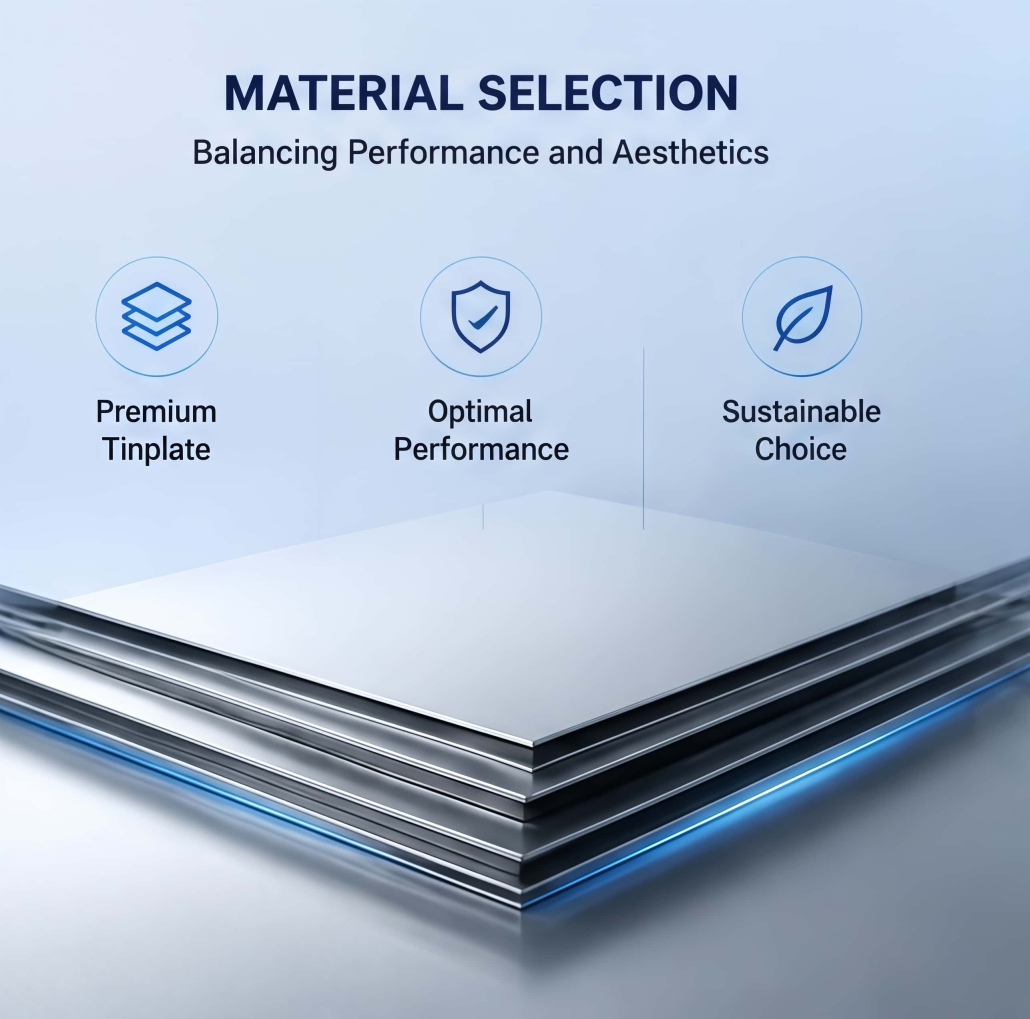
Once the specifications are finalized, material selection becomes the primary focus of discussion. At TSING, we primarily use tin-plated steel sheets with thicknesses ranging from 0.23 millimeters to 0.30 millimeters. The specific choice depends on the container size, the required stacking strength, and the decoration method.
Thinner sheet metal (0.17-0.20 mm) is suitable for small cosmetic tins with capacities under 30g, where a lightweight design is a priority. These materials allow for offset printing with extremely great detail fidelity and support fine decorative embossing without panel distortion. Thicker metal sheets (starting at 0.23 mm) are suitable for larger-capacity containers (100g and above), stackable travel sets, and any products that need to withstand the compressive forces of retail shipping packaging.
We select the material based on the tinplate’s hardness grade. This grade determines the tinplate’s hardness and formability, directly affecting the clarity of embossed details, the consistency of flanging during lid assembly, and the container’s long-term resistance to denting.
Structural Design and Tooling for Custom Cosmetic Tins
Structural design involves translating specifications into a form that is manufacturable. For custom cosmetic tins, this stage covers the can body geometry, wall chamfers, lid engagement depth, and any decorative features, such as embossed logos or stepped lid profiles.
At TSING, our in-house tooling team is responsible for the independent research and development of all molds and forming tools. This vertical integration allows us to directly control tolerances, with critical dimensions typically maintained within ±0.2 mm.
During the structural design phase, we pay particular attention to the details of embossing and debossing. Many brands choose to emboss their logos on tin lids to create a distinctive tactile brand identifier. To achieve the best results, engineers carefully calibrate the embossing depth according to the material thickness and the type of internal coating. Before cutting the steel, our engineers model each embossing depth based on material properties to ensure the final product is both visually distinct and structurally sound.
Decoration and Surface Finishing
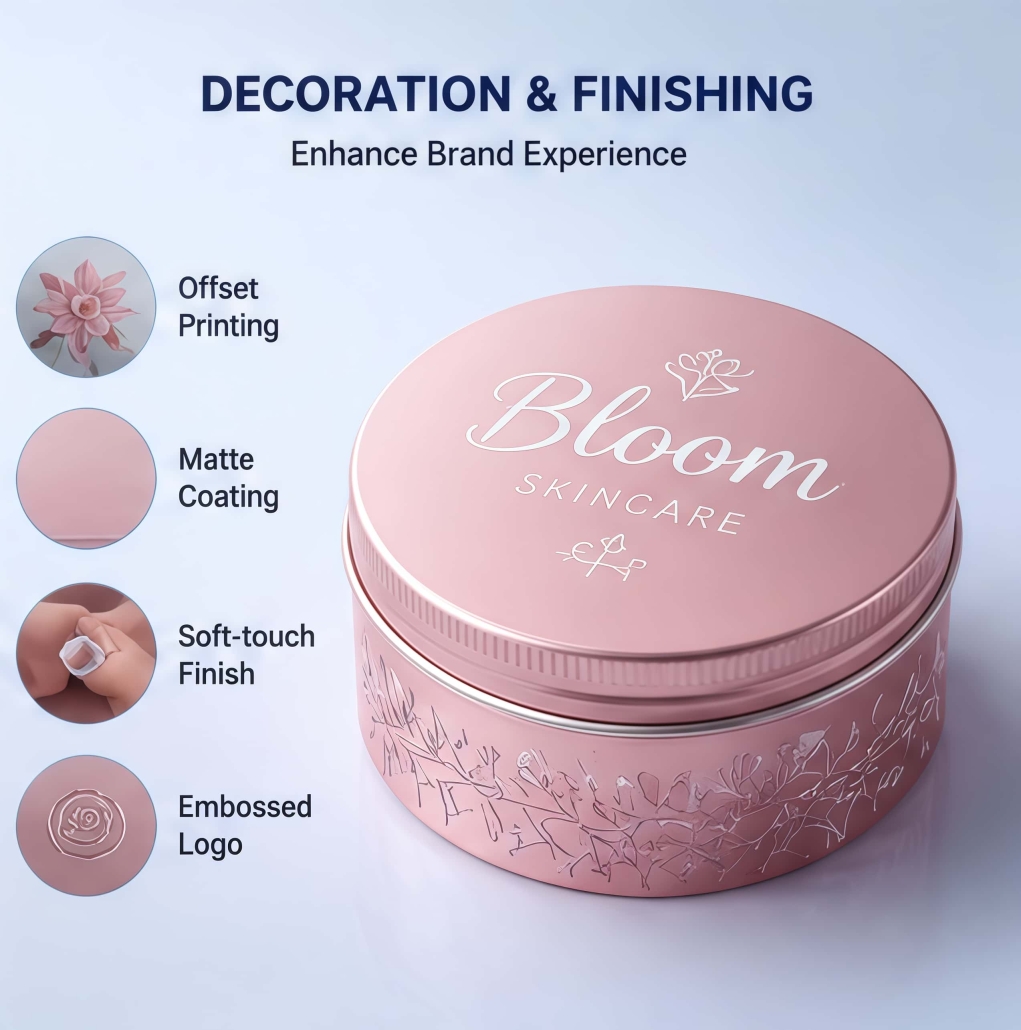
Decoration is key to transforming cosmetic tins from functional tin packaging into a brand experience.
Offset printing remains the gold standard for high-fidelity decoration on cosmetic tins. We print on a flat tinplate before forming, achieving color accuracy and image resolution that post-forming decoration methods cannot match. We calibrate our printing presses to keep color deviation (Delta E) at 2.0 or below, ensuring that we can reproduce consistent colors even across production runs separated by several months.
Matte and glossy varnish coatings play a crucial role in controlling the tactile and visual texture of printed surfaces. For example, a full-gloss varnish maximizes color vibrancy and creates a luxurious, lacquer-like finish, making it an ideal choice for high-end skincare products. In contrast, a matte coating creates a subtle and elegant appearance that many natural and organic beauty brands prefer. In addition, we can use spot-glazing techniques to emphasize specific design elements, creating a stronger sense of depth and dimension. So, brands can select the most appropriate coating process based on their needs to enhance the visual appeal of the packaging and the overall user experience.
Special coatings and textured finishes are premium design options.
Soft-touch coating: A thin layer of polymer is applied to the printed surface, transforming the tin’s feel from smooth and cool to warm and silky. A frosted finish has a satin-like texture that softens light and creates a gentle ambiance, making it particularly suitable for moisturizers and body creams.
A sandblasted coating adds a textured feel, giving the impression of handcrafted quality—a great choice for independent brands competing against mass-market giants.
Sampling, Testing, and Approval
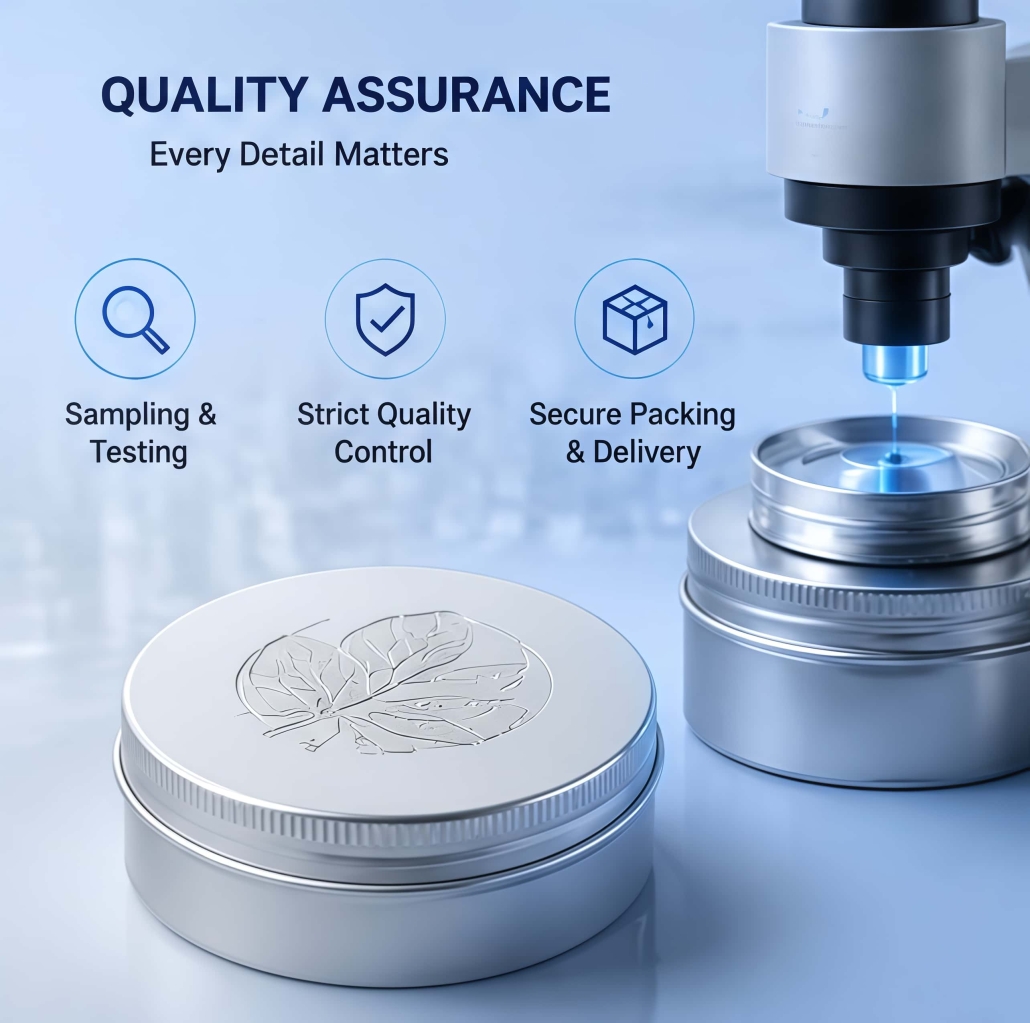
At TSING, all custom cosmetic tin boxes must undergo a formal sampling and testing process before entering mass production. This stage protects the interests of both parties by confirming that the samples we produce meet the approved specifications.
Our standard sampling process involves preparing three types of samples in sequence.
- Engineering samples are used to verify that structural dimensions, lid locking force, and embossing depth meet specifications.
- Pre-production printing samples are used to verify color accuracy and pattern registration under production conditions.
- Compatibility samples are filled with the actual product formulation and tested under accelerated stability conditions to verify that no interaction occurs between the formulation and the interior coating.
The third type of sample is most often overlooked by brands working with suppliers that have less stringent requirements.
Production, Quality Control, and Delivery
Once customers approve the samples and authorize production, TSING follows a written production control plan for each SKU. Our team inspects all incoming materials, checks and fine-tunes the molds to meet specifications, and measures the first unit from every production batch. The quality control department must approve that first unit before we move forward with full-scale production.
In-line inspection detects dimensional deviations, printing registration errors, and surface defects during production. For export shipments, we prepare a complete documentation package, including certificates of conformity, material safety data sheets for the interior coating, and any regulatory certificates required by the destination market. The lead time for TSING’s custom cosmetic tins varies depending on specific requirements; we proactively communicate at every stage of production to ensure a smooth delivery process.
A Few Case Studies of Custom Cosmetic Tins
A European natural skincare brand approached us, hoping to replace its plastic jar packaging with cosmetic tin boxes that prioritize recyclability and ingredient purity. We customized a matte white round tin box for them, with a botanical pattern embossed on the lid and an epoxy-free interior coating compatible with the brand’s high-AHA exfoliating products. Following the packaging change, retail sales increased by 22% in the first quarter.
A North American men’s grooming brand needed a sturdy, durable 75-gram hair wax tin that could withstand repeated drops and extreme temperatures in barbershops. We designed a 0.25-millimeter-thick tin body, a high-precision friction cap with a 15-Newton locking force, and a matte black sand-textured exterior coating. After the new tin was launched, the return rate was significantly reduced.
Manufacturing Custom Cosmetic Tins Tailored to Your Needs
We coordinate every aspect of the process—from material selection, formulation chemistry, structural design, and surface finishing to quality assurance and regulatory compliance. Clients choose us not only for our deep understanding of cosmetics, but also for our careful listening to their needs, our ability to provide the right solutions, our identification of potential risks, and our delivery of cosmetic tins on time, to specification, and in line with their brand identity.
 Facebook
 Twitter
 Linkedin
