
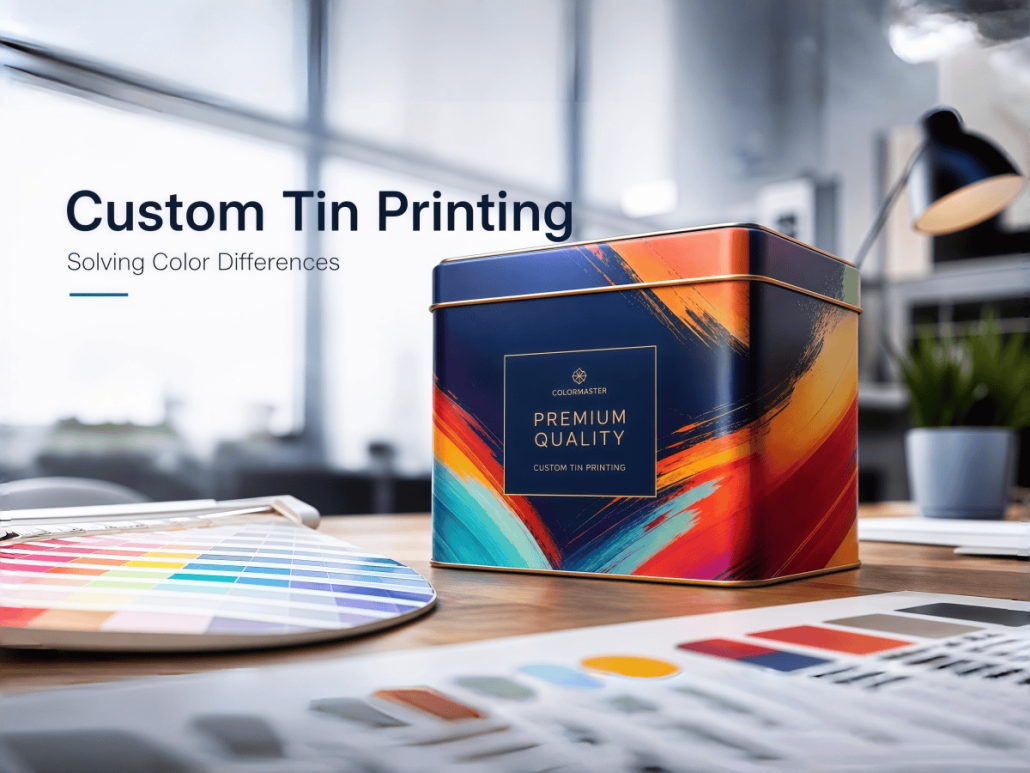
What Causes Color Differences in Custom Tin Printing and How to Avoid Them?
Packaging is often the first point of contact between a product and the consumer; therefore, color inconsistencies in custom tin boxes can, to some extent, affect the consumer’s first impression. In this article, we will explain—from a manufacturer’s perspective—the causes of color discrepancies in custom tin printing and how to avoid them. Drawing on our extensive production experience and real-world case studies, we will illustrate how materials, processes, and technologies interact to influence color rendering on metal surfaces.
The Complexity of Color Rendering in Custom Tin Manufacturing
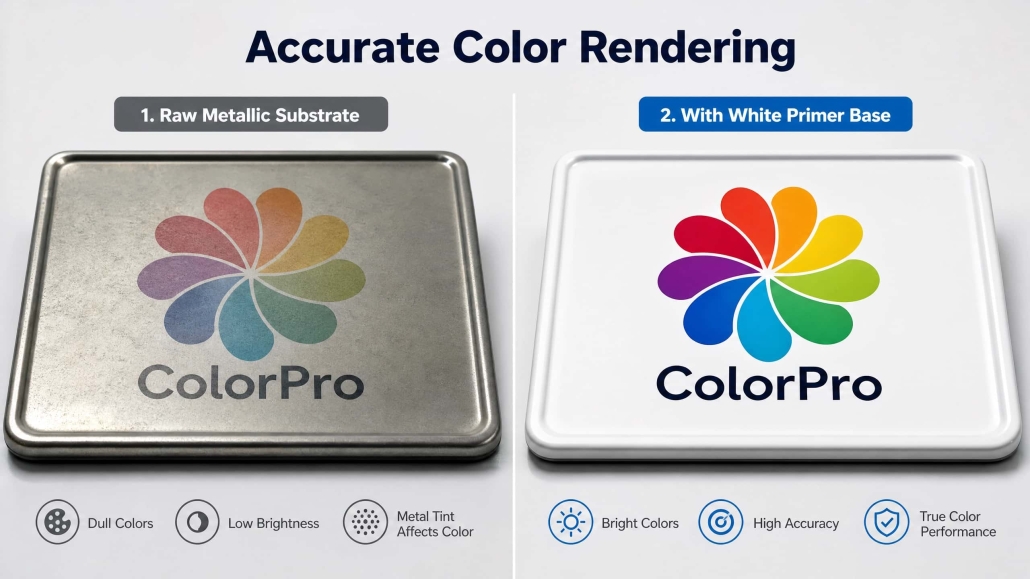
As the base material for custom tin cans, tinplate differs from traditional substrates such as paper or plastic in that it possesses a natural metallic luster and a non-absorbent surface. While this metallic luster lends custom tin box packaging a premium feel, it also means that the substrate itself is not a neutral white. Its reflective properties significantly affect people’s visual perception of printed colors. If printers apply ink directly to bare tinplate, the underlying metallic surface can alter the intended colors, making them look duller, more muted, or tinted with an unwanted metallic sheen. This inherent difference requires us to employ specialized techniques and meticulous planning during the printing process to ensure accurate color reproduction.
Therefore, during printing, we apply a layer of off-white primer or use white ink. This base layer acts like a canvas, effectively covering the metallic substrate and providing a neutral, bright background for printing other colors.
Three Printing Color Systems for Custom Tin: CMYK, Pantone, and Delta E
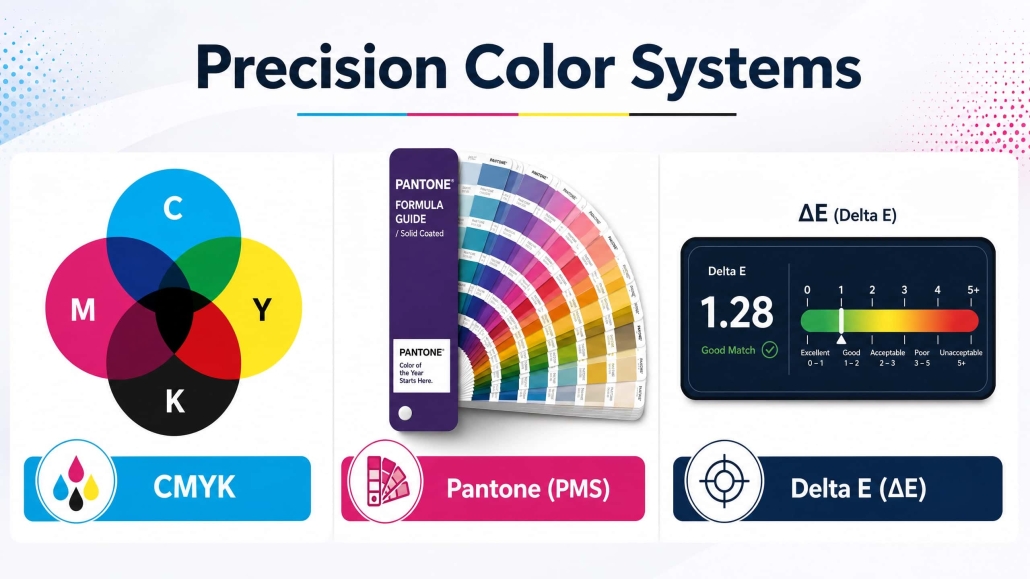
Achieving precise color in custom tin box packaging requires distinguishing between CMYK and Pantone, and using Delta E (ΔE) to quantitatively measure color differences.
CMYK is a subtractive color model used by printers for four-color printing. By layering four semi-transparent inks in different halftone patterns, they can produce an exceptionally wide range of colors. Although CMYK printing offers great flexibility in handling complex images and gradient effects, printing on tinplate requires precise calibration due to the substrate’s unique properties and interactions with the white undercoat.
For brand-specific colors, Pantone Matching System (PMS) spot colors are indispensable. Pantone colors use pre-formulated inks that ensure precise, consistent hues—often not accurately replicable with CMYK combinations. When a brand specifies a particular Pantone color for a custom tin, the printer can reproduce that exact shade consistently as long as the team follows the specified ink formulation regardless of when or where the printing takes place.
To objectively quantify color differences, our industry uses the Delta E (ΔE) metric, which represents the distance between two colors in a color space. Generally, a ΔE value of 1.0 is considered the minimum color difference detectable by the human eye. In the metal packaging industry, strict ΔE tolerance ranges must be maintained. As a professional manufacturer of custom tins, we strive for lower ΔE values to ensure exceptional color reproduction.
Key Factors in Minimizing Color Deviation in Printing
To achieve perfect color results on custom tin packaging, we begin the process even before the ink comes into contact with the metal. Any oversight at this stage can lead to significant color deviation, which in turn affects the final appearance of the tinplate box.
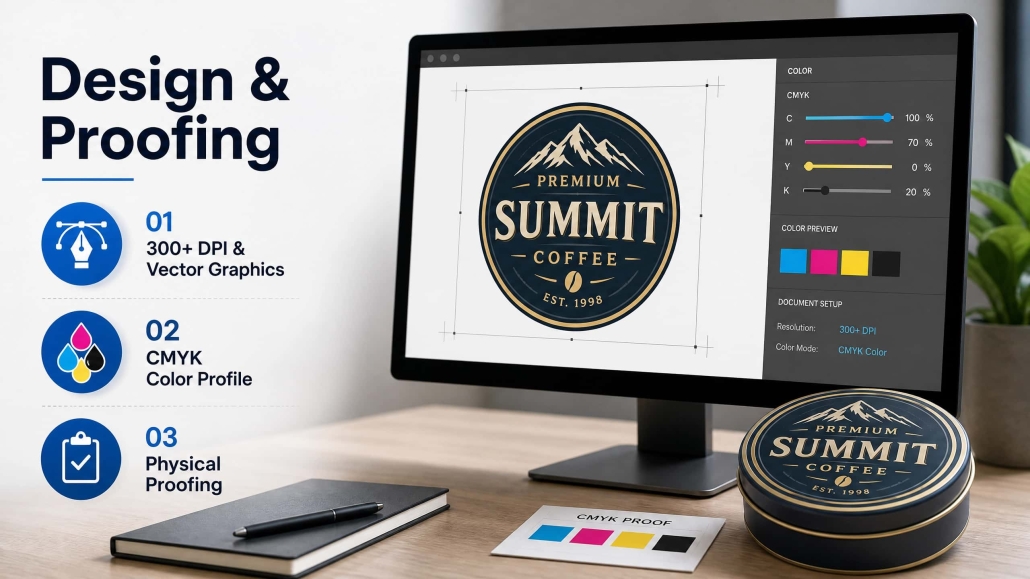
First, high-resolution graphic design is essential; logos and text should use vector graphics to ensure crisp lines that can be scaled freely without pixelation;
Second, raster images must be at least 300 DPI to prevent blurring or jagged edges during printing.
Most importantly, the correct color profile must be used. Designers typically use RGB for digital display design, while most printing processes use CMYK. Since the printable color gamut of CMYK is smaller than that of RGB, improper conversion from RGB to CMYK can result in noticeable color deviations. Therefore, designers should prepare and submit all artwork for custom tins in CMYK mode. For critical brand colors, if Pantone is specified, both Pantone and CMYK color values must be provided to the printer simultaneously. This ensures precise color matching while also providing an alternative for printing processes that cannot use spot colors.
Another important factor is the proofing process. The only reliable way to confirm colors is to produce a physical prototype or print a proof on an actual tinplate substrate. These proofs demonstrate the interaction between the ink, white undercoat, and the metal, thereby accurately representing the final color effect.
Inks, Equipment, and Environmental Factors
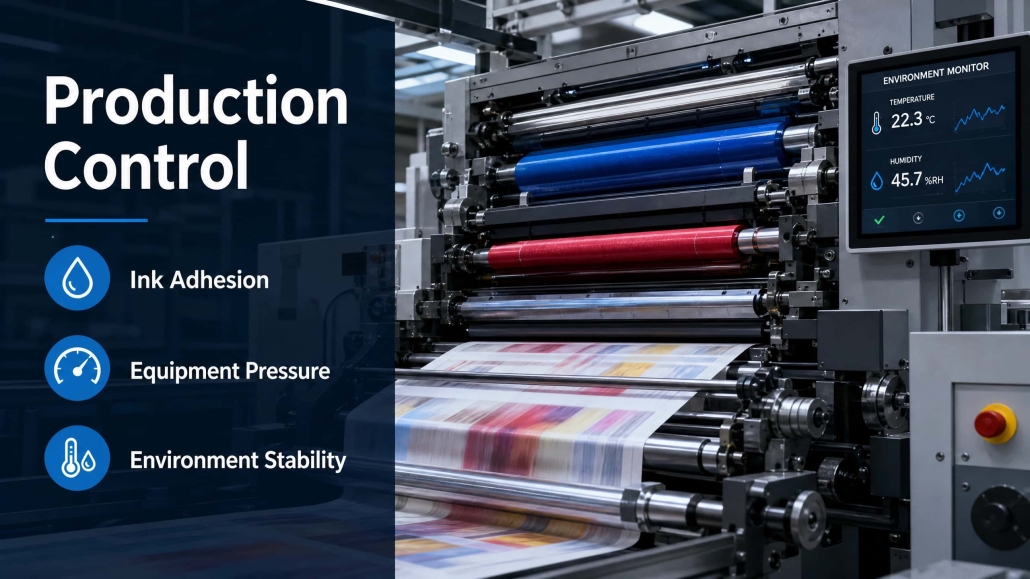
The actual printing process for custom tin cans involves a complex interplay of multiple factors; if not strictly controlled, any step can lead to color discrepancies. We specially formulate tinplate printing inks to adhere to non-absorbent metal surfaces. As a result, these inks must provide excellent adhesion, remain flexible enough to withstand forming processes, and resist the high temperatures used during curing.
Printing equipment is also a key factor influencing the outcome. Industry observations indicate that large-scale high-pressure printing presses, designed for mass production, typically produce more vivid, brighter colors than small proofing presses. This difference stems from the varying pressure applied during the transfer of CMYK inks onto the tinplate. Although proofing presses are convenient to use, they may not accurately reproduce the color intensity and depth achievable by mass-production presses.
People often underestimate how environmental conditions in the printing shop affect production, yet these factors play a crucial role in maintaining consistent color. Temperature fluctuations affect ink viscosity and drying speed, while humidity impacts the dimensional stability of the tinplate and the curing process. These environmental changes can lead to uneven ink distribution and poor drying, ultimately resulting in color shifts or inconsistencies across an entire print run.
How to Ensure Color Accuracy in Custom Tin?
In the complex process of tinplate printing, visual inspection alone cannot meet customers’ high-precision requirements. Therefore, we have integrated state-of-the-art spectrophotometers into our production workflow. These precision instruments objectively measure color and provide quantifiable data, thereby eliminating deviations caused by subjective judgment. By continuously monitoring and adjusting colors throughout the printing process, we ensure that every custom tinplate matches the established standards.
Additionally, the color management software we use enables us to create and manage precise color profiles, ensuring consistent color reproduction across different devices, shifts, and even production sites. This digital precision control enables accurate color separation and proofing, ultimately ensuring that mass-produced printed materials consistently meet strict specifications.
Achieving Reliable Color Accuracy
Color variations in custom tins during printing result from the interplay of ink, equipment, and environmental factors. By integrating spectrophotometric color measurement technology, digital color management, and rigorous process standards, we not only meet color specifications but also ensure that every batch of custom tin cans delivers stable and reproducible color results.

 Facebook
 Twitter
 Linkedin
