
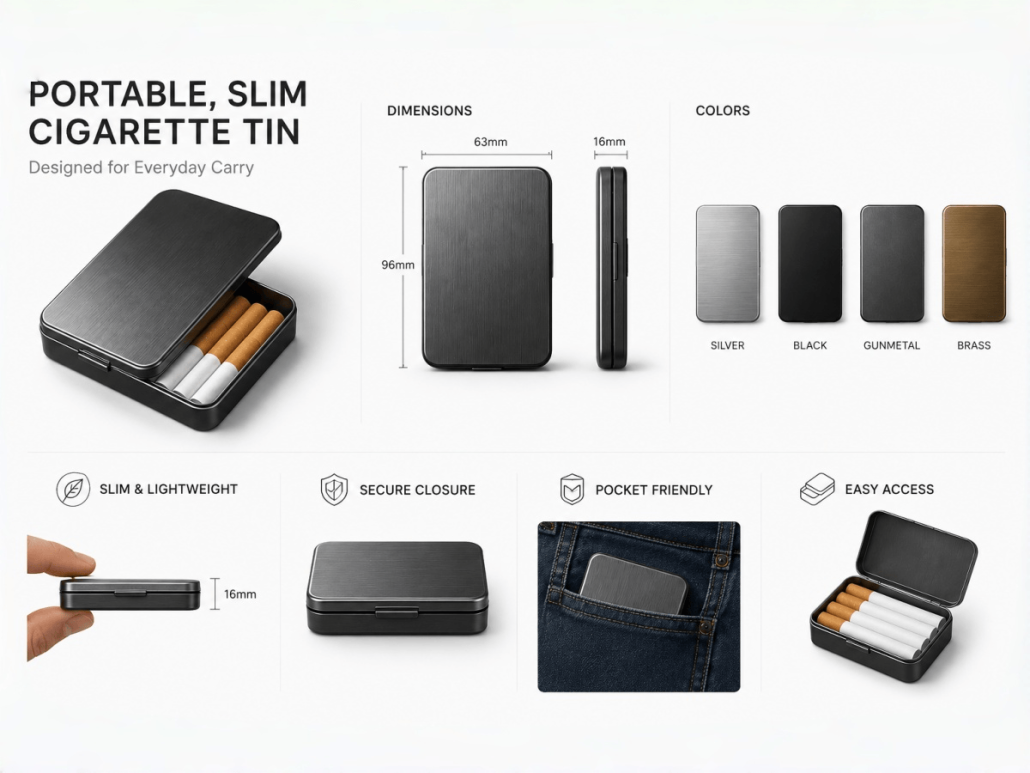
How do you design a portable, slim cigarette tin suitable for everyday carry?
Cigarette packaging designed for everyday carry must address a very specific set of challenges: it must be slim enough to fit easily into a pocket; sturdy enough to withstand daily use; and easy enough to open and close without hindering the user’s movements. Therefore, when designing cigarette tins, we focus on these practical user experiences. In this guide, we’ll also walk you through the specifics of designing a slim, portable cigarette tin for everyday use.
Key Design Considerations for Slim, Portable Cigarette Tin for Daily Carry
When designing this type of cigarette tin, our primary consideration is size. A case that is too thick will feel uncomfortable in a pocket, while one that is too narrow may be difficult to open or unable to hold cigarettes comfortably. We typically select from a standard range:
| Design Item | Recommended Range |
|---|---|
| Length | 85–100 mm |
| Width | 55–65 mm |
| Height | 12–18 mm |
| Tinplate thickness | 0.23–0.30 mm |
| Corner radius | R2–R5 mm |
| Lid overlap | 4–6 mm |
For standard-sized long cigarettes, the cigarette tin typically measures approximately 95 × 60 × 16 mm. This size is compact enough to fit in shirt and jacket pockets, handbags, and car glove compartments, while still providing ample interior space to securely hold cigarettes and ensuring the lid opens and closes smoothly.
For ultra-slim travel packs, dimensions such as 88 × 55 × 13 mm enhance portability without sacrificing too much structural integrity. In this context, the key to our design is not simply making the cigarette tin small, but ensuring it is sufficiently slim for everyday carry while remaining comfortable, durable, and easy to use.
Enhancing Durability and Consistency in Slim, Portable Cigarette Tins for Everyday Use
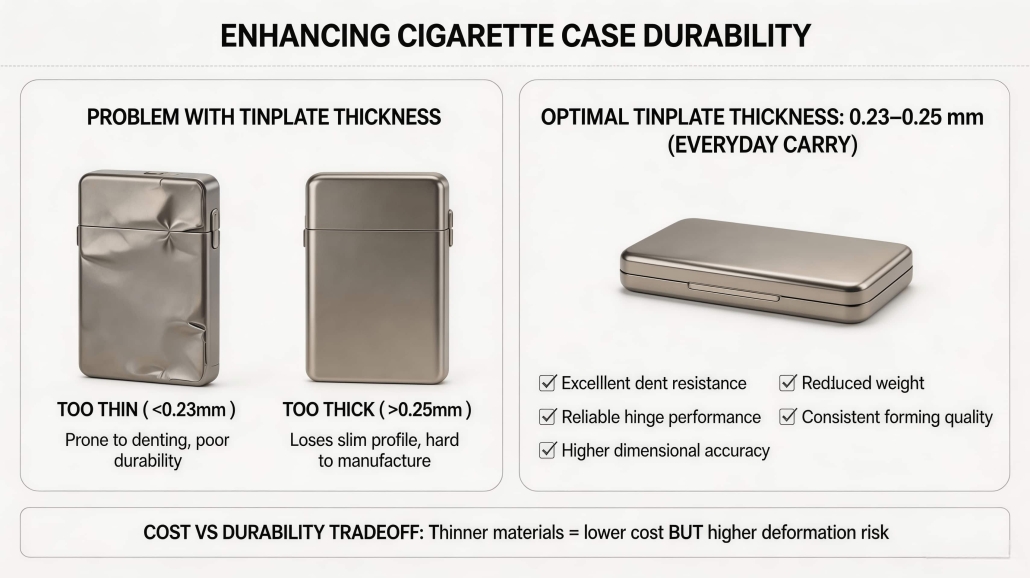
Once the dimensions are finalized, we determine the material thickness. If the tinplate is too thin, the can body is prone to denting during daily carry; if it is too thick, the can may lose its slim profile or become difficult to form. The thickness of the tinplate directly affects the finished cigarette can’s strength, weight, and durability.
Based on our extensive manufacturing experience, the following are the tinplate thicknesses we commonly use:
For products intended for daily carry, we typically consider:
| Tinplate Thickness | Application |
|---|---|
| 0.20 mm | Ultra-light promotional tins |
| 0.23 mm | Slim portable cigarette tins |
| 0.25 mm | Standard premium cigarette tins |
| 0.28 mm | Luxury cigarette tin cases |
| 0.30 mm | Heavy-duty collectible tins |
0.23–0.25 mm tinplate
This thickness offers:
Excellent dent resistance
Reduced weight
Reliable hinge performance
Consistent forming quality
Higher dimensional accuracy
While using excessively thin material can lower costs, it typically increases the risk of deformation.
Precise Stamping and Forming
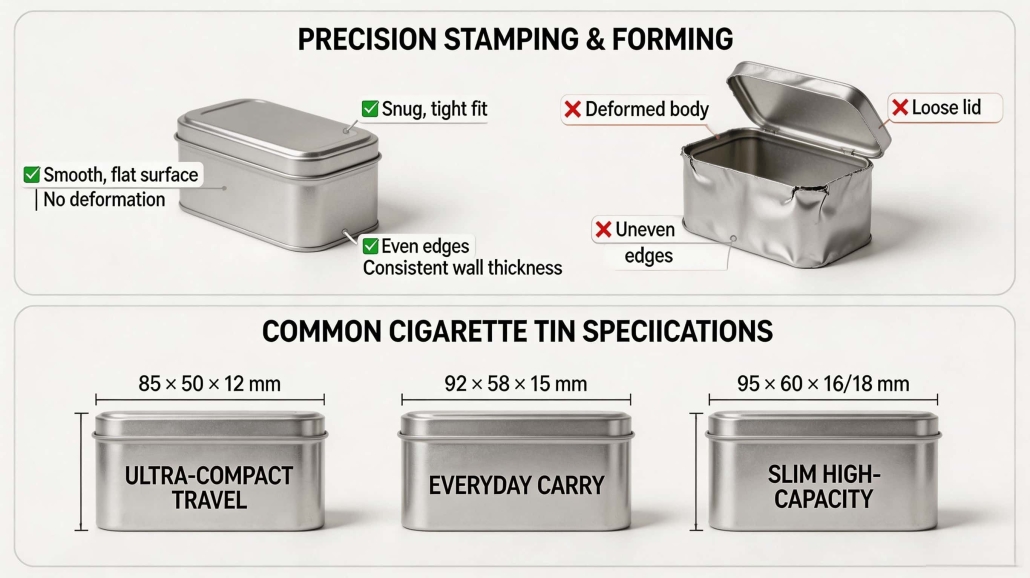
Once the material is selected, the forming process determines whether the cigarette tin cases will have consistent dimensions and shapes. We strictly control the entire stamping and forming process to ensure the tins are smooth and flat, free from defects such as deformation, uneven edges, or inconsistent wall thickness. A well-formed cigarette tin should feel smooth and uniform across the entire batch. The lid should fit perfectly, the body should maintain its geometric shape, and the packaging should remain stable even after repeated handling.
Common Cigarette Tin Capacities
Slim, portable cigarette tins should align with consumers’ daily smoking habits, not just the number of cigarettes. Based on our production experience, here are some common reference specifications:
| Capacity | Recommended Internal Size |
|---|---|
| 10 cigarettes | 85 × 50 × 12 mm |
| 12 cigarettes | 90 × 55 × 13 mm |
| 16 cigarettes | 92 × 58 × 15 mm |
| 20 cigarettes | 95 × 60 × 16–18 mm |
An 85 × 50 × 12 mm cigarette tin is suitable for ultra-compact travel products. A 92 × 58 × 15 mm cigarette tin is the ideal choice for daily carry for many users. A 95 × 60 × 16/18 mm cigarette case is suitable for users who need slightly more capacity while still maintaining a slim profile.
Customization Options That Enhance Brand Value and User Experience
In addition to size, cigarette packs can be customized in a variety of ways to significantly enhance brand image and the everyday user experience. As a cigarette pack manufacturer, we incorporate these details into our designs to enhance the packaging’s tactile feel, appearance, and practical functionality.
Surface Finishes and Visual Styles for Cigarette Tins
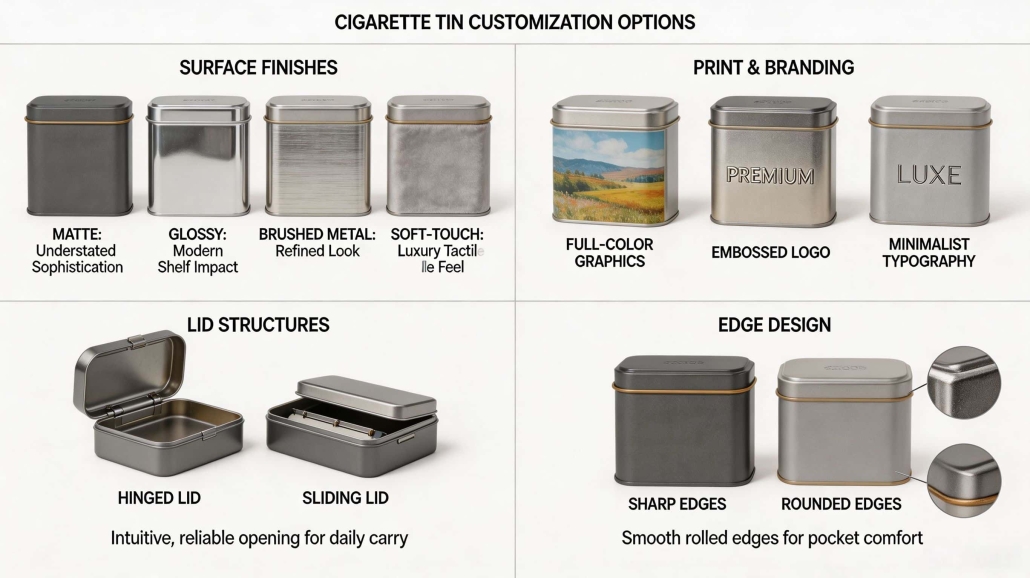
Surface finishes are one of the most effective ways to elevate the sophistication of a cigarette tin. A matte finish creates a calm, premium, and understated atmosphere. A glossy finish, on the other hand, delivers stronger shelf impact and a more modern feel. A brushed metal effect makes the packaging look more refined, while a soft-touch coating enhances the tactile experience, adding a touch of luxury. When designing slim, portable cigarette packs, we recommend that the surface finish align with the brand’s positioning. In our experience, premium brands may prefer understated matte or brushed finishes, while younger or more promotional brands might opt for brighter, more reflective surfaces.
Printing and Logo Placement
Printing is another key customization option. Slim, portable cigarette tins can be decorated with full-color graphics, monochromatic brand logos, embossed logos, or a combination of printing and texture. In our designs, we prioritize simplicity and clarity of purpose. For premium packaging, we typically recommend a minimalist brand design featuring clear typography, balanced spacing, and a distinct visual hierarchy. This approach makes the cigarette tin appear more refined and helps it stand out in the memory.
Lid Structure and Opening Experience
The lid structure is one of the most critical customization options affecting the user experience. Cigarette tins can be designed with hinged, sliding, or other closure systems, depending on how the product will be used. For everyday carry, the opening mechanism should feel familiar, simple, and reliable. If consumers are accustomed to standard paper cigarette packs, the tin’s opening mechanism should be equally intuitive. A hinged structure is typically our top recommendation because it securely holds the lid in place and facilitates repeated use.
Optimizing Edge Treatment and Enhancing Pocket Comfort
Edge design directly impacts comfort. A slim cigarette tin should not feel sharp or bulky when placed in a pocket. Rounded corners, smooth edge curves, and refined transitions all enhance the carrying experience. These small details may seem inconspicuous at first glance, but they significantly impact the comfort of the cigarette case during daily use. For tins carried in shirt pockets, jacket pockets, or handbags, smooth edges reduce friction with clothing and lend the packaging a more refined appearance.
Creating a Slim Cigarette Tin Suitable for Everyday Carry
A slim cigarette tin suitable for daily carry is not determined solely by size. It depends on the harmony of its structure, materials, surface finish, opening mechanism, and customization options in daily use. In our design process, we consider precise dimensions, controlled forming techniques, reliable lid fit, and meticulous surface customization—ensuring the cigarette case is both slim and ideal for daily carry.
 Facebook
 Twitter
 Linkedin
