
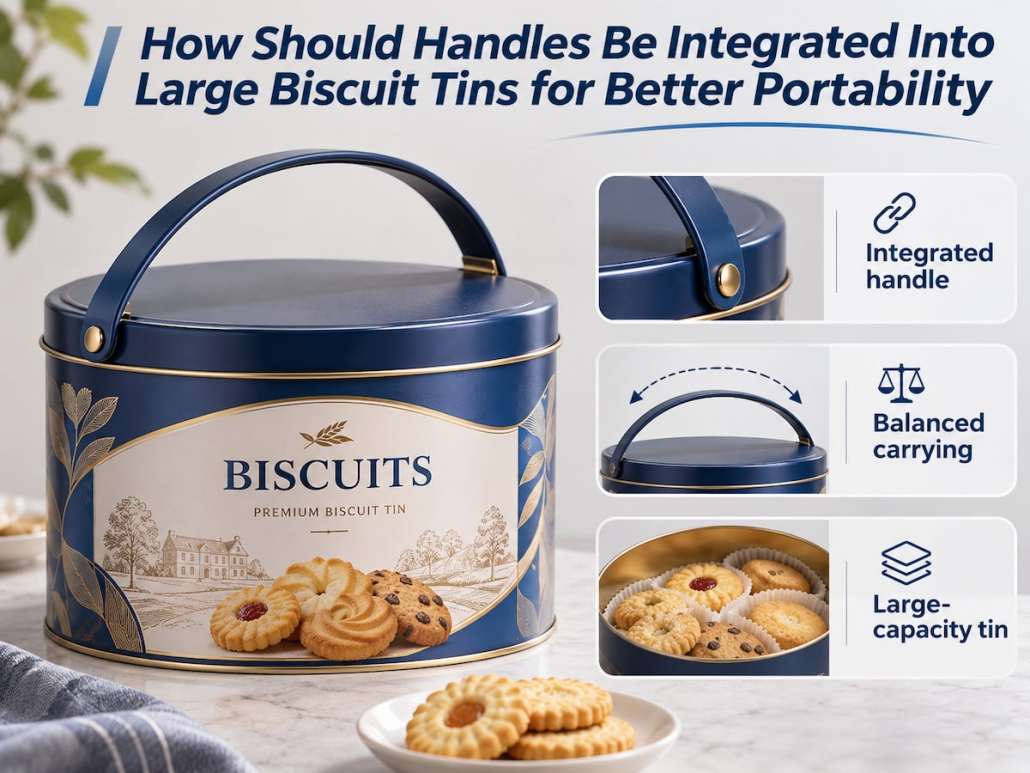
How Should Handles Be Integrated Into Large Biscuit Tins for Better Portability?
Handles do more than change how large biscuit tins are carried; they also affect force distribution on the tin, the gap between the lid and body, stacking height, and the dimensions of the outer shipping carton. For baking companies ordering large biscuit tins, the key challenge is ensuring that tins filled with cookies are easy to lift without compromising the strength of the metal tin or the integrity of the packaging structure. Depending on the size and specific application of the cookie tin, fixed handles, folding handles, or reinforced side-mounted handles can all serve as viable solutions. During the design process, TSING comprehensively considers these requirements and factors in actual load weights and handling conditions to plan the handle’s position, attachment points, and support structure—rather than simply adding a handle to an existing tin.
Determining Handle Structures Based on the Dimensions and Handling Requirements of Large Biscuit Tins
First, it is essential to clarify how the biscuit tins will be handled. For baking companies selling large cookie gift boxes, handling frequency may be a key consideration, whereas for seasonal gift tins, handles may only be used during occasional shipments. These different usage scenarios determine whether a fixed or folding handle design should be adopted, as well as where the handle should be mounted.
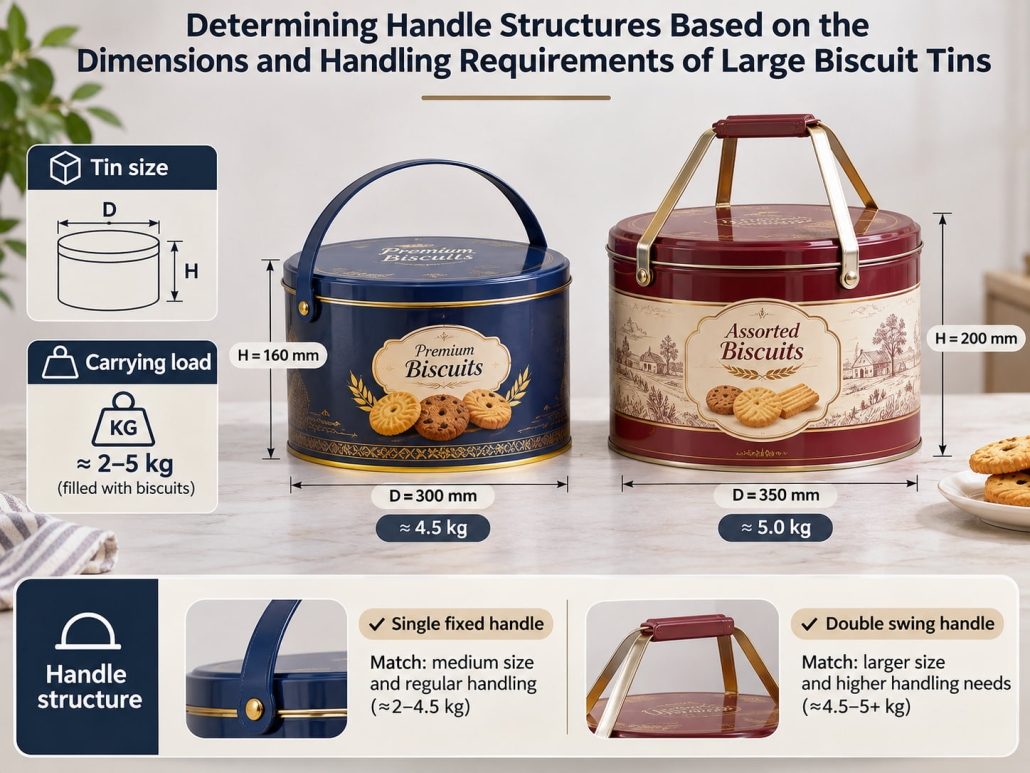
Depending on the Application, Large biscuit Tins Can Use Fixed or Folding Handles
Fixed and folding handles each have their own advantages.
Fixed handles remain upright at all times and are always ready for lifting. They suit large biscuit tins that require frequent handling, or when the handle is an integral part of the gift box’s overall design. However, their fixed height increases the packaging’s external dimensions, which may reduce stacking or packing efficiency.
Folding handles feature a hinge that allows them to lie flat against the lid or body of the tin when not in use. This not only saves storage space but also makes transportation more convenient; however, the hinged structure requires additional clearance and effective control of the moving parts.
| Design Factor | Fixed Handle | Folding Handle |
|---|---|---|
| Carrying readiness | Always accessible | Must be raised before use |
| Storage space | Requires additional height | Can fold closer to the tin |
| Structural complexity | Relatively simple | Requires pivot connections |
| Stacking | May obstruct stacking | Generally easier when folded |
| Best application | Frequent carrying | Gift packaging and space-efficient storage |
When customizing biscuit tins, TSING selects the appropriate structure based on actual handling frequency, load weight, and packaging requirements.
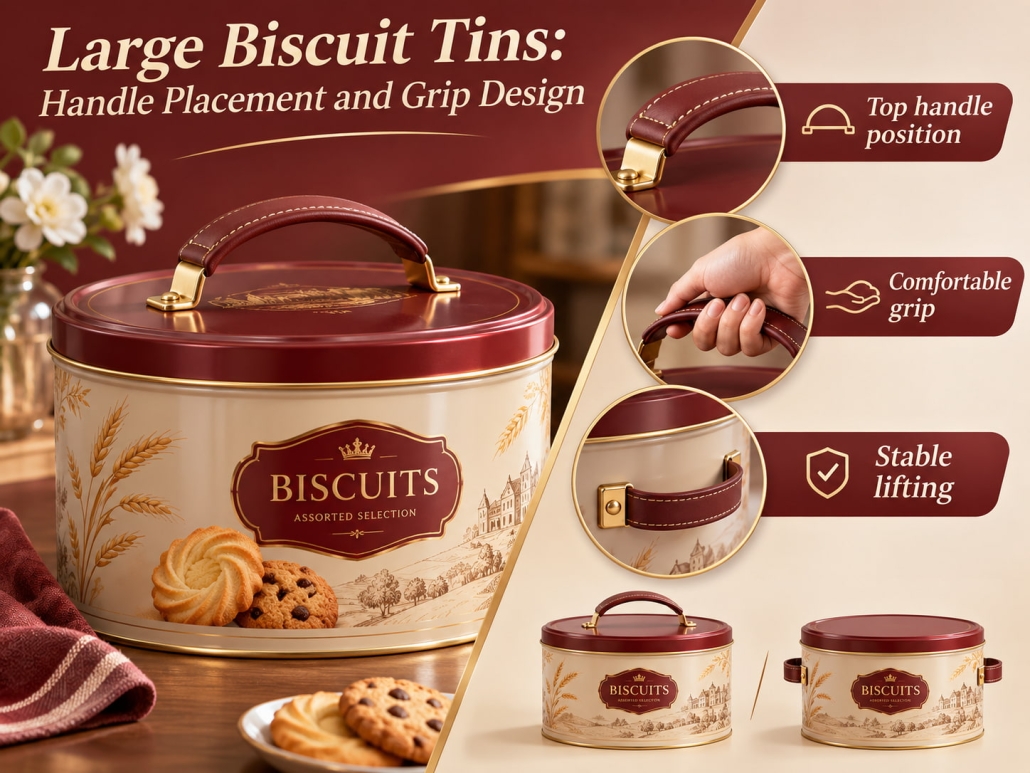
Large Biscuit Tins: Handle Placement and Grip Design
Considerations Based on the Center of Gravity After Loading
The handle position directly affects how the tin behaves when lifted after filling. For larger rectangular containers, mounting the handle symmetrically on opposite side walls is typically a practical solution. When users lift the container by its handles, the handles distribute the load across two connection points, helping maintain the container’s balance. This arrangement ensures that the center of gravity of the loaded container is roughly directly below the effective lifting line of the handles.
If manufacturers mount the handles directly on a removable lid, the entire load may pass through the joint between the lid and the tin body, potentially lifting or detaching the lid. Unless manufacturers specifically reinforce the lid and its closure mechanism, they should generally mount the handle on the container body when users need to handle heavier loads.
When determining the handle dimensions, we ensure the grip area provides sufficient room for finger movement; at the same time, the handle’s height must allow comfortable lifting without making the entire package appear too tall.
Therefore, during the design process, TSING considers the overall width and height of the tin, the expected load weight, the grip space, and the space required to open the lid. This ensures that the handle not only feels comfortable to grip but also does not hinder the user from opening the lid.
Reinforcement of Connection Structures and Structural Validation
Once designers determine the handle type and position, their primary challenge is to transfer lifting forces to the metal box without causing local deformation. The connection structure must be sufficiently sturdy while also ensuring the tin’s seal, aesthetic integrity, and durability during transportation.
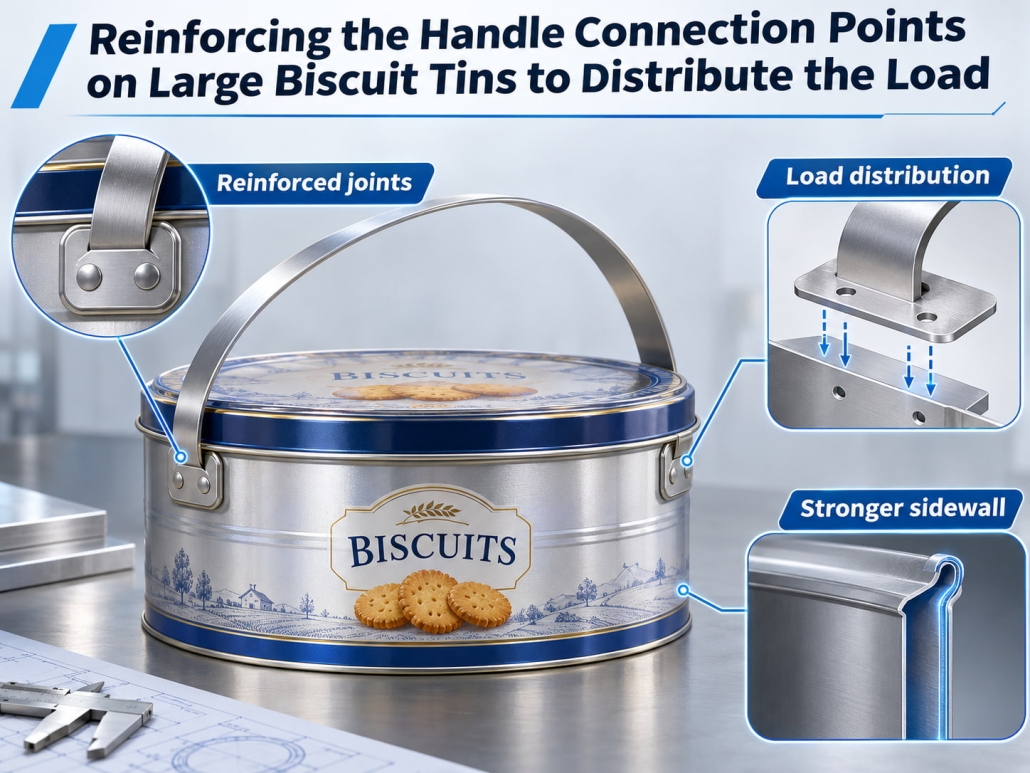
Reinforcing the Handle Connection Points on Large Biscuit Tins to Distribute the Load
The handle transfers the weight of the filled tin through the grip, pivot point, fasteners, and supporting metal plates.
If stress concentrates in a small area of thin tinplate, repeated lifting may stretch the mounting holes or bend the surrounding tin walls. Therefore, during the design process, we evaluate whether we need additional reinforcement around the connection points.
Our design solutions include:
- Reinforcement plates: Distribute the load over a wider area of the tin’s walls.
- Riveted mounting brackets: Provide a mechanical connection for movable or fixed handles.
- Formed metal lugs: Integrate the mounting structure directly into the tin body, thereby reducing the number of separate components.
- Mechanical fasteners: Facilitate the assembly or replacement of specific handle components; however, designers must account for internal protrusions and ensure that the components resist loosening.
The selection of a specific design solution depends on the handle’s design requirements and the anticipated load-bearing demands. The core objective is to distribute the load during lifting, preventing the handle from exerting force on only a small, unsupported area of the tinplate.
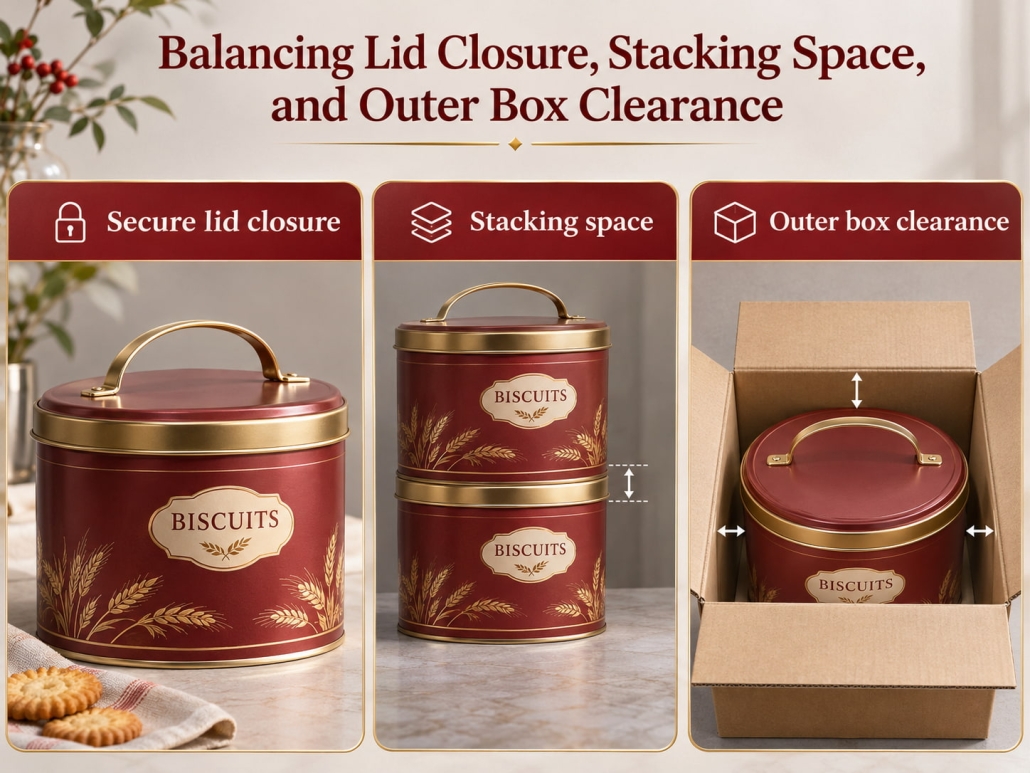
Balancing Lid Closure, Stacking Space, and Outer Box Clearance
The handle design should not compromise the tin’s other functions.
For example, while foldable handles appear compact, their connecting brackets must not obstruct lid opening or press against it when folded. Similarly, fixed handles must allow sufficient clearance within the outer carton and should not act as stress points during stacking, which could cause accidental crushing.
For large gift tins, TSING evaluates the clearance relationships in the following three areas:
- Clearance between the handle and the lid: The handle and its mounting components must not interfere with the latching, removal, or closing of the lid.
- Clearance between the handle and the stacking space: When folded, the handle should fit within the preset storage area; if the handle remains upright, the stacking plan must account for its height.
- Clearance between the handle and the outer shipping carton: The outer shipping carton must accommodate the handle, ensuring that external pressure does not cause the handle to bend or transmit excessive force to the tin lid.
The cookie tin should be easy to carry once filled with product, while also allowing for efficient stacking and packing before delivery to the customer. A suitable packaging solution would use a foldable handle with protective padding inside the carton to keep the handle in its intended position throughout transit.
Testing Handles and Connections Before Mass Production
A handle that appears sturdy might perform quite differently once workers fill the tin with cookies.
Therefore, we validate the structural integrity using containers filled with the actual product. The test load accounts for the product weight, internal packaging materials, and the conditions under which users expect to carry the tin.
Our evaluation focuses on three key areas:
- Connection strength;
- Durability under repeated lifting;
- Overall packaging performance.
The design process follows this sequence:
Load weight and dimensions → Handle selection → Mounting position → Reinforcement design → Tooling and assembly → Prototype load testing → Carton compatibility → Approval for mass production
Balancing Portability, Structural Strength, and Packaging Efficiency
When designing large biscuit tins with handles, TSING carefully considers factors such as weight when filled, center of gravity, handle mounting position, structural reinforcements, lid clearance, and outer shipping carton dimensions.
We ensure that our large biscuit tins are comfortable for consumers to carry, feature secure handle attachments and tightly fitting lids, and are designed for efficient stacking and transport. By holistically addressing load-bearing capacity, ease of opening, and packaging efficiency, we create large biscuit tins that are both highly practical and portable.
 Facebook
 Twitter
 Linkedin

