
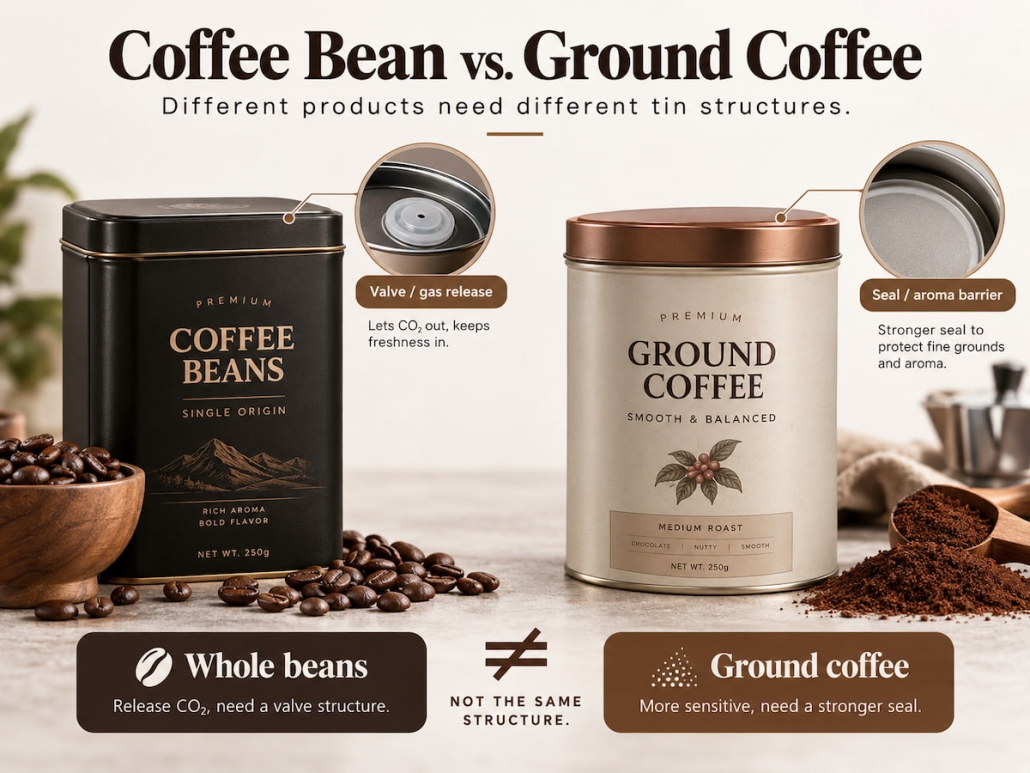
Coffee Bean vs. Ground Coffee: Should They Use the Same Coffee Tin Packaging Structure?
We believe whole coffee beans and ground coffee should not be packaged in the same coffee tin format. Although both need protection from oxygen, moisture, light, and external odors, they behave very differently after roasting and packaging. Whole coffee beans typically release carbon dioxide more slowly and take up more volume, whereas ground coffee has a much larger surface area; once oxygen enters the package, its aroma dissipates much faster.
Therefore, when designing coffee tins, TSING comprehensively considers product form, roast profile, fill weight, venting methods, sealing performance, and internal barrier requirements. We believe the optimal packaging structure is a tin can that effectively controls gas, limits oxygen exposure, accommodates the product’s volume, and meets the expected shelf-life requirements.
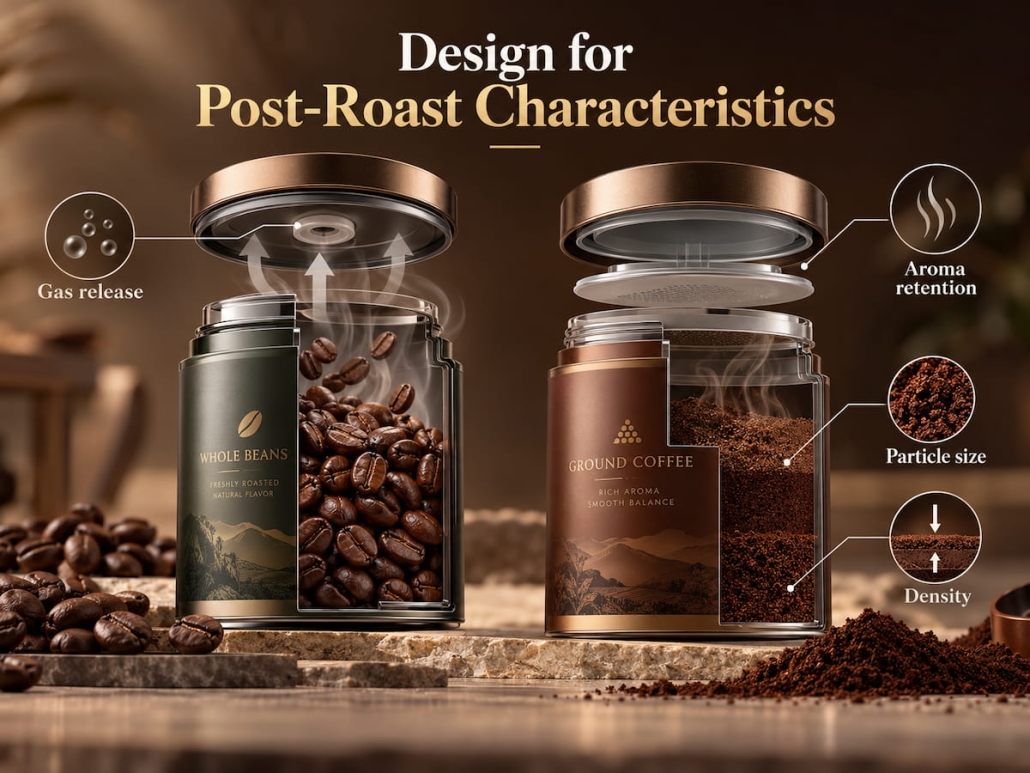
The coffee tin packaging structure should fully account for the post-roast characteristics of both forms
After roasting, coffee continues to release carbon dioxide. Still, the rate of release and its impact on the packaging depend largely on whether the coffee exists as whole beans or has been ground into powder.
Coffee beans retain most of the gas within their cellular structure and release it slowly over time. Ground coffee has a much larger exposed surface area, so gas escapes more quickly; however, this increased surface area also makes the product more susceptible to aroma loss and oxidation.
This means the packaging design requirements for the two differ.
| Packaging Factor | Coffee Bean Tin Packaging | Ground Coffee Tin Packaging |
|---|---|---|
| Degassing behavior | More gradual | Faster after grinding |
| Product volume | Higher for the same weight | More compact |
| Oxygen sensitivity | High | Higher after grinding |
| Aroma-loss risk after opening | Moderate to high | Very high |
| Headspace control | Important | Especially important |
| Inner barrier requirement | Often important | Usually more demanding |
(The content in this table is compiled based on our experience and is provided for reference only.)
For TSING, this contrast serves as the starting point for designing coffee tin packaging structures. If coffee tins are designed based solely on net weight, the product’s actual behavior during storage is often overlooked.
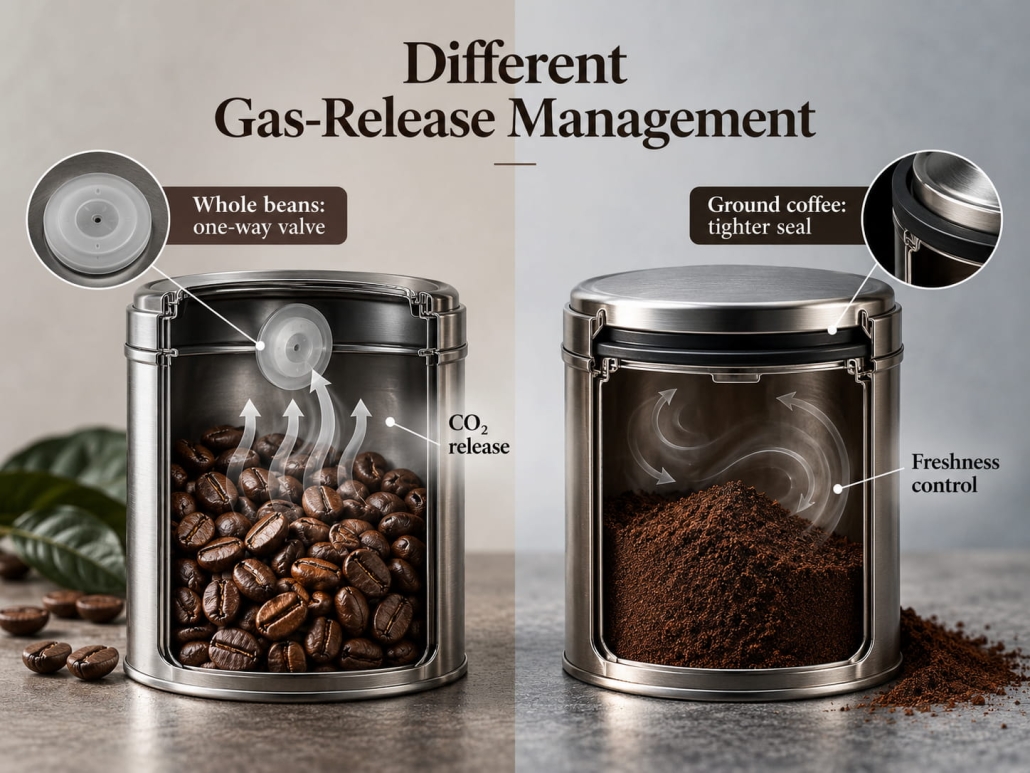
Coffee Beans and Ground Coffee Require Different Gas-Release Management Approaches
“Gas release” is a primary reason coffee beans and ground coffee should not share the same packaging design.
Freshly roasted coffee beans continue to release carbon dioxide for an extended period. If you put them into a completely sealed package too early, without a gas-management mechanism, internal pressure will rise.
However, this does not mean all coffee tin packaging projects require installing a vent valve directly on the metal tin. In many applications, coffee tins work alongside an inner coffee pouch. The pouch blocks gases and oxygen, while the tin protects the coffee from physical damage and light, showcases the brand, and allows consumers to store the coffee conveniently between uses.
Therefore, the packaging process might be:
Roasted coffee beans → Inner pouch with venting function → Coffee tin → Capping
For ground coffee, the situation is somewhat different. The grinding process accelerates gas release, so pressure issues are resolved more quickly, but the problem of aroma loss becomes more urgent.
Therefore, during the manufacturing phase, the key decision point is:
“At which stage should the degassing issue be addressed—on the metal can itself, inside the barrier packaging bag, or before final packaging?”
TSING determines the coffee tin’s specific structure only after finalizing the entire packaging solution.
The Coffee Tin Packaging Structure Must Fully Account for Different Capacities and Headspace Requirements
Whole coffee beans and ground coffee may have the same net weight, but they require different internal volumes.
Whole coffee beans leave more gaps between them, while ground coffee packs more tightly, and its volume can vary significantly depending on grind size, roast level, and filling method. Therefore, a can designed to hold 250 g of whole coffee beans should not have the exact same internal dimensions as one designed to hold 250 g of ground coffee.
When evaluating capacity, TSING does not rely solely on weight but considers the product’s actual state after filling.
The calculation formula can be expressed as follows:
Product bulk volume + Filling allowance + Required headspace + Inner bag or liner = Usable can volume.
For coffee bean packaging tins, a deeper can may be required to accommodate the larger bulk volume of the beans; in contrast, for coffee ground packaging tins with the same nominal weight, a more compact design can be adopted. We also consider ease of access, filling equipment requirements, inner bag dimensions, and actual consumer usage habits.

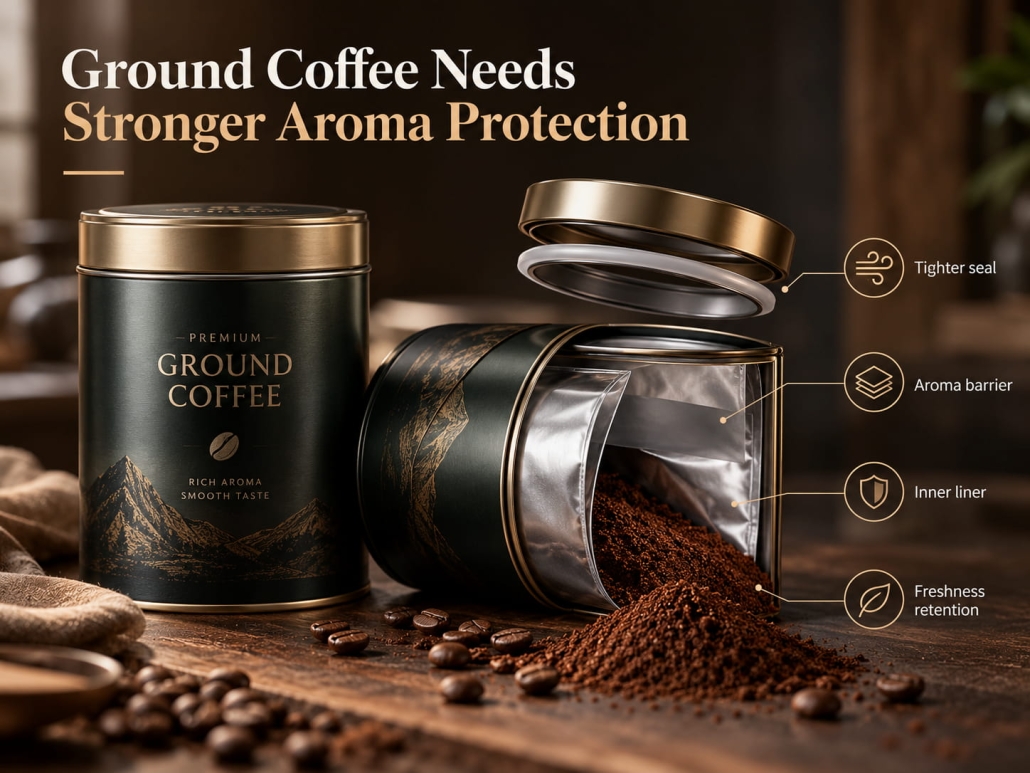
Packaging Structures for Ground Coffee Typically Require Stronger Aroma Protection
Both whole coffee beans and ground coffee are highly sensitive to oxygen, moisture, and foreign odors; the grinding process, in particular, significantly increases the coffee’s exposed surface area. This means that once ground coffee comes into contact with air, its volatile aromatic compounds typically dissipate more rapidly. Therefore, when designing packaging for ground coffee, pay special attention to the sealing solution. Although decorative snap-on lids can keep dust out and facilitate resealing, they should not be regarded as the sole long-term oxygen barrier.
Depending on the customer’s shelf-life requirements, TSING may recommend using coffee tins in combination with the following components:
- Sealed inner pouches
- Barrier bags
- Liners or secondary sealing layers
- Individual portion pouches
Building on this foundation, coffee tins can also block light, provide mechanical protection, convey brand identity, enhance shelf display appeal, and enable reuse after opening. Whole coffee beans also require effective oxygen-barrier protection; however, because their aroma dissipates more slowly, the packaging system typically allows greater flexibility after opening.
The practical difference between the two is as follows:
Whole coffee beans require controlled venting (degassing) and aroma protection.
Ground coffee, on the other hand, requires stricter control over oxygen exposure and aroma loss.
Determining the Structure of Coffee Tin Packaging Based on Product, Filling Method, and Shelf Life
So, should whole beans and ground coffee use the same tin packaging structure?
In some cases, they can share the same outer tin, provided the internal packaging system, capacity, and sealing solution are adjusted for the specific product.
For whole beans, TSING typically focuses on the following factors:
Bulk volume → Degassing strategy → Headspace → Compatibility between the lid and inner pouch
For ground coffee, the focus typically shifts to:
Compact fill volume → Smaller headspace → Excellent aroma barrier properties → Resealability after opening
The Final Design Process
Coffee Form → Roasting and Degassing Conditions → Net Weight → Actual Filling Volume → Internal Barrier Layer → Can Dimensions → Lid Structure → Shelf Life Validation
Practically, tin packaging for whole beans typically needs more internal space and a more defined degassing strategy, while tin packaging for ground coffee often requires stricter control of oxygen exposure to retain aroma.
 Facebook
 Twitter
 Linkedin

