
How Can Printing and Embossing Be Combined Without Compromising Custom Metal Tin Forming?
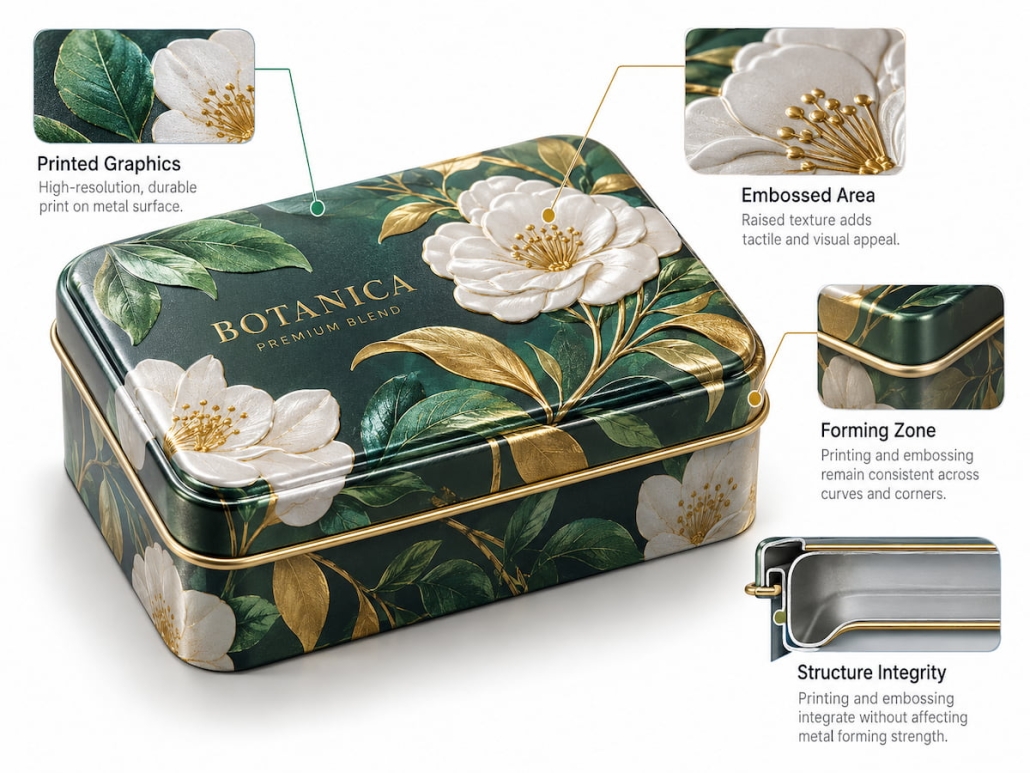
On a flat tinplate surface, printed designs can be positioned with extreme precision; however, after embossing, the designs may become misaligned. Deformation may also occur during forming. The issue is that printing, embossing, and metal forming each affect the same metal surface differently. Therefore, to seamlessly integrate printing and embossing in custom metal tin forming, we must consider several factors: design layout alignment with the embossing die, coating flexibility, the sheet metal’s geometric structure, and subsequent bending or seaming processes.
Before finalizing the production dies, TSING comprehensively evaluates all the above factors; after prototype samples are completed, we further verify pattern registration and surface integrity. Our goal is to ensure that tinplate products maintain an ideal aesthetic appearance while also meeting requirements for structural shape, sealing performance, and production consistency.
Planning Printing and Embossing Strategies Before Custom Metal Tin Forming
Printing and embossing serve distinct functions: printing presents colors, patterns, and brand logos, while embossing creates raised or recessed details by altering the tinplate’s physical form. If the design requires both, the team must coordinate their positions and production requirements before finalizing the dies.
In many decorative metal tin projects, tinplate sheets must be printed and coated before cutting and forming. Therefore, when designing artwork, fully consider the finished product’s geometric structure, rather than focusing solely on the visual effect on a flat sheet.

The Sequence of Printing and Embossing Must Be Coordinated
A rational production process depends on the embossing design, printing process, coating performance, and the required alignment precision between the printed pattern and the embossed areas.
For example, a brand may wish to print its logo in gold and create a slightly raised effect on the can lid’s surface. In this scenario, the printing process and the embossing die must share a common reference point to ensure the raised logo aligns precisely with the printed pattern. The coating must also be durable enough to withstand deformation during embossing without cracking or losing adhesion.
The following two production scenarios illustrate the trade-offs involved:
| Production Approach | When It May Be Suitable | Main Consideration |
|---|---|---|
| Print and coat, then emboss | Registered embossing that must align closely with printed graphics | The printed coating must withstand embossing deformation |
| Emboss, then print and coat | Designs and production routes that support printing over the formed relief | Ink coverage and registration across raised or recessed areas must be verified |
Neither sequence should be selected automatically. TSING evaluates design and manufacturing options before finalizing the specific process sequence. This approach allows TSING to identify potential issues before mass production.
When Custom Metal Tins Forming, Avoid Placing Embossing Near Sensitive Structural Areas
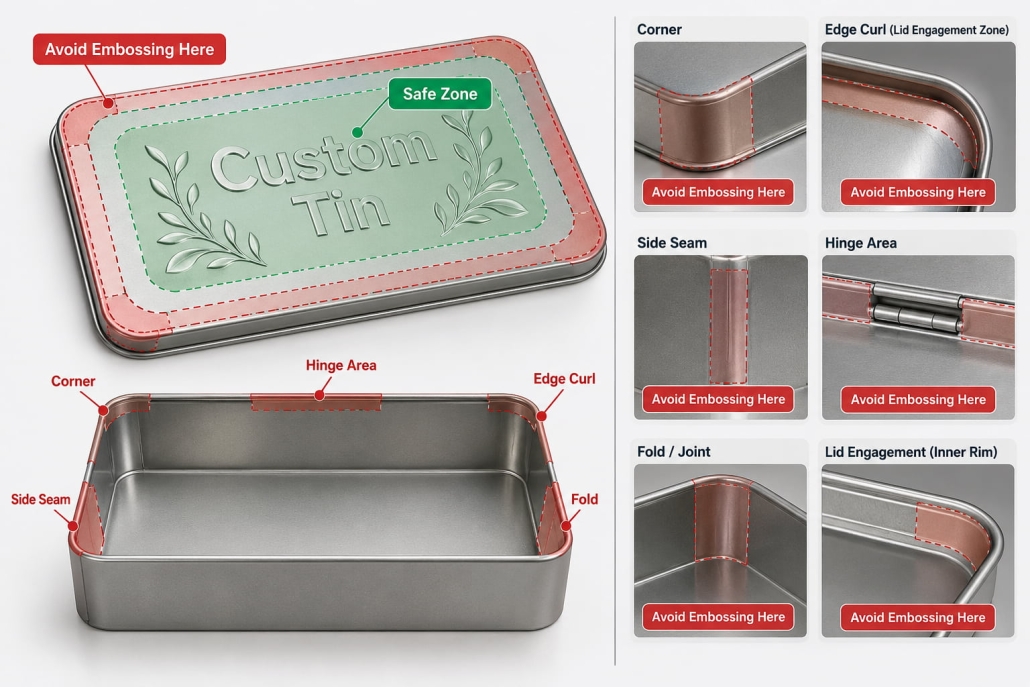
Not every area of the can suits embossing. Wide, relatively flat lid panels typically offer greater design flexibility than corners, flanges, deep-drawn walls, or narrow structural sections. Embossing causes localized metal deformation. If this deformation overlaps with other forming processes, the material may experience concentrated stress, increasing the risk of deformation or coating damage. Raised features may also affect can lid assembly or the appearance of adjacent panels.
Therefore, design reviews should pay special attention to the following locations.
Embossing locations must be coordinated with the can’s structural features. Areas prone to additional deformation or those serving a functional purpose require particular attention.
- Flanges and seams
- Corners and sharp bends
- Hinges and closure interfaces
- Narrow borders and fine patterns
- Deep-drawn transitions
These areas are not entirely unsuitable for embossing. The final decision depends on the material, embossing depth, die design, and surrounding structure. For custom-embossed tin cans, TSING prioritizes maximizing embossing without compromising structural integrity, while maintaining the desired visual effect.
Considerations Regarding Embossing Depth and Coating Compatibility
Embossing depth affects both appearance and manufacturability. Deeper embossing provides a more pronounced tactile sensation but also requires greater localized deformation of the tinplate. The achievable embossing depth depends on material thickness, feature dimensions, transition radius, panel size, and forming conditions. For fine text with sharp corners, maintaining consistent forming results is more challenging.
Printing coatings face similar challenges. A coating may look intact on a flat metal sheet but crack or lose adhesion during embossing or later forming processes when the metal substrate stretches.
Therefore, the design must strike a balance among the following three requirements:
- Embossing clarity
- Material formability
- Coating integrity
Compared with embossed designs with excessive depth and complex edges, logos with smooth transitions and moderate embossing often form more reliably.
Custom Metal Tin Forming Requires Register Control and Final Product Verification
Even when printing and embossing deliver excellent results individually, the finished product may still fall short of quality standards if the embossed areas do not align precisely with the printed patterns or if later forming processes change the final appearance. Therefore, TSING conducts component-level register checks and verifies the complete, finished custom metal tins before beginning mass production.
Custom Metal Tin Forming Requires Precise “Printing and Embossing” Alignment
Printing and embossing stay aligned when designers use a consistent reference across the printed artwork, embossing die, and final product layout. If they overlook the blank’s orientation, cutting positions, or forming layout, a logo that looks centered on the flat printed sheet may shift out of position on the finished can lid. This deviation is especially noticeable when fine-line contours must closely follow the edges of the embossed logo.
TSING manages this risk by clearly defining registration requirements before production. We control registration between printing and embossing through coordinated inspection steps.
Step 1 — Artwork and Die-Cut Line Verification
Step 2 — Print Registration Check
Step 3 — Embossing Die Calibration
Step 4 — Cutting and Forming Verification
Step 5 — Finished Can Inspection
Acceptable alignment tolerances should be determined through consultation based on the artwork and product structure. Compared with fine borders that must precisely match raised contours, large center logos typically allow greater tolerance for minor deviations. For custom-printed metal tins, it is critical to evaluate the alignment on the final formed part rather than focusing solely on the appearance on flat printed sheets.

Validation Through Physical Samples
Digital renderings cannot fully capture how printing, embossing, coating, and forming interact in actual production. Therefore, when these processes require close coordination, creating physical samples is crucial.
TSING conducts a comprehensive evaluation of representative samples, covering every stage of manufacturing—from tinplate printing to embossing and forming components. The final review checks whether the raised patterns match the design artwork, the embossing effect is consistent, and the surrounding sheet metal maintains the expected geometric shape. The team also inspects samples for coating cracks, peeling, scratches, and localized deformation, as well as issues that could affect lid closure or subsequent assembly. Before final design approval, identify and implement appropriate corrective measures.
The Perfect Integration of Printing and Embossing
For TSING, achieving perfect integration of printing and embossing requires a holistic approach from the project’s early stages, considering the design artwork, embossing depth, pattern placement, coating flexibility, and the die-processing sequence. By positioning embossing away from structurally sensitive areas, using a unified reference point to control registration accuracy between printing and embossing, and rigorously verifying finished samples after forming, we ensure reliable custom metal tin can production.
 Facebook
 Twitter
 Linkedin

