
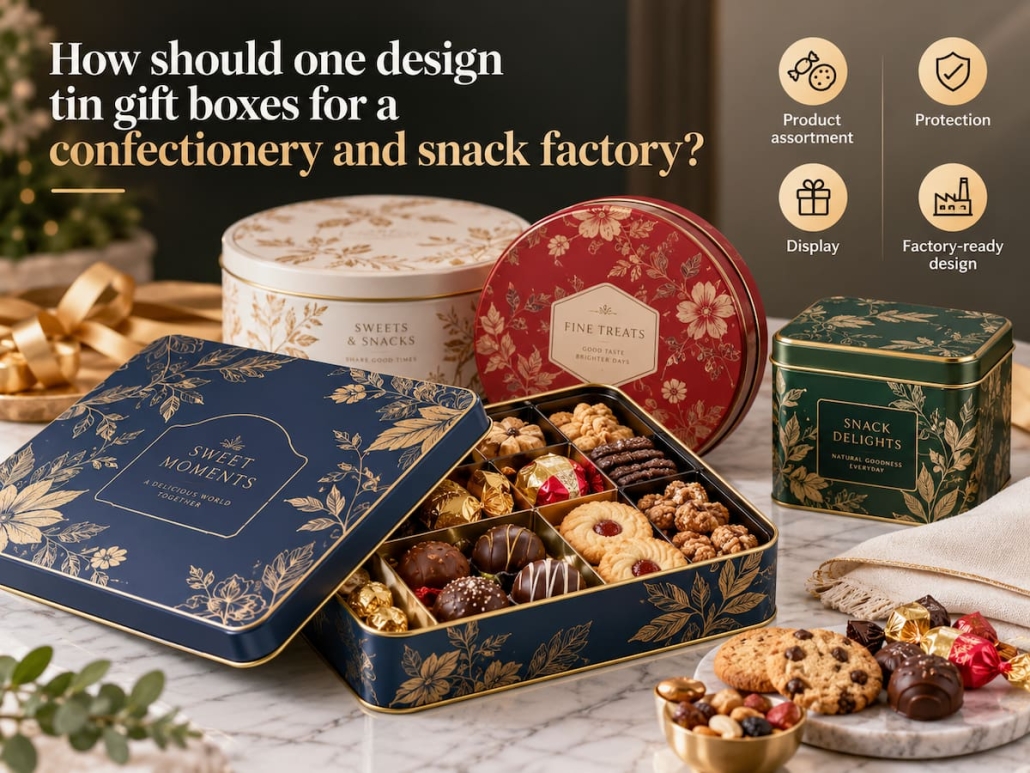
How should one design tin gift boxes for a confectionery and snack factory?
Tin gift boxes often catch the eye on store shelves, but their production can pose many challenges. For example, internal compartments may be difficult to fill, the interior space may be too large, or the lid may crush the snacks inside—all of which can turn what should be exquisite packaging into a flawed product. For candy and snack manufacturers, a gift tin box must balance three key aspects: product protection, an elegant gift appearance, and efficient, convenient packaging. As a tin can manufacturer with years of experience, we design each candy gift tin to fit our clients’ product portfolios.
We evaluate product dimensions, fragility, packaging methods, and fill quantities to determine the internal layout, tin structure, exterior decoration, and mold requirements, then prototype and proceed with mass production based on these factors.
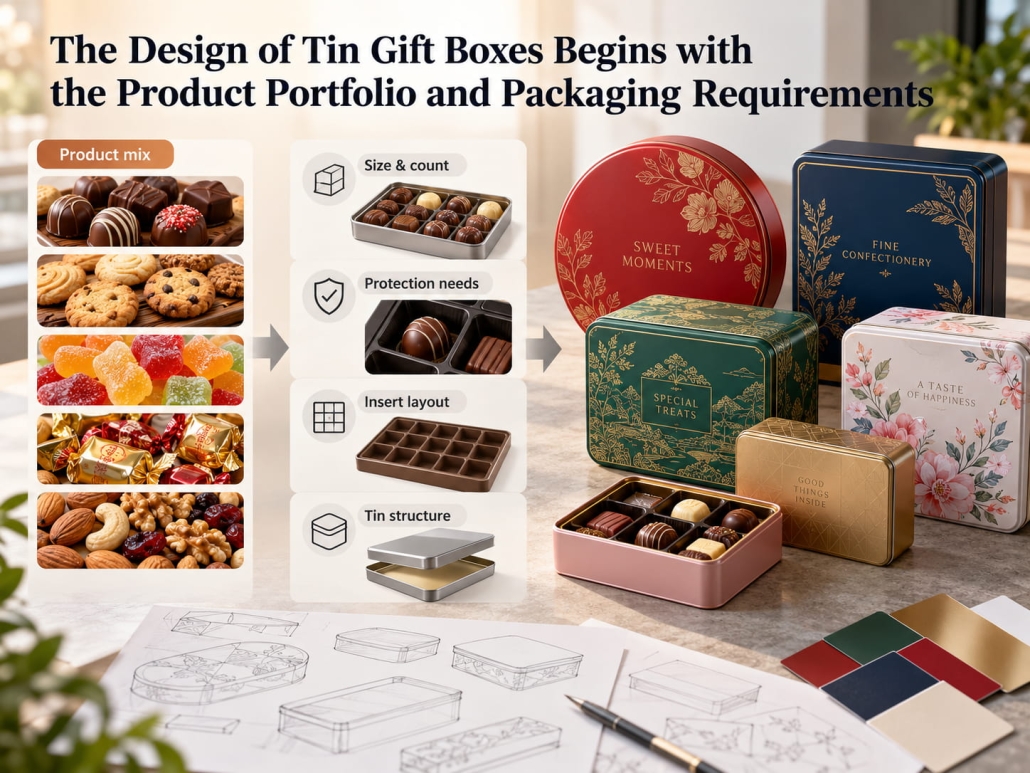
The Design of Tin Gift Boxes Begins with the Product Portfolio and Packaging Requirements
Candy and snack manufacturers may produce a variety of products under the same brand, such as hard candies, chocolates, cookies, gummy candies, nuts, or individually wrapped snacks. These products have varying packaging requirements. Before finalizing the tin box structure, the design must fully account for differences in product dimensions, fragility, surface characteristics, filling methods, and retail positioning.
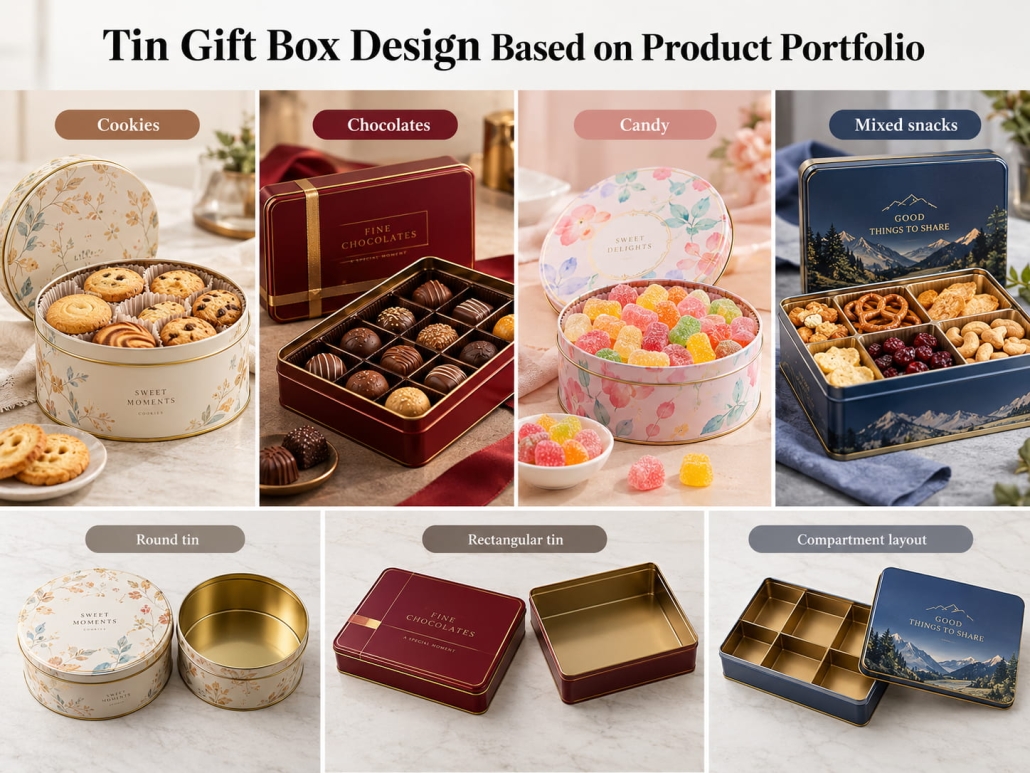
Tin Gift Box Design Based on Product Portfolio
First, decide whether the tin box will contain a single product or multiple products.
For single-product packaging, you can optimize internal space based on uniform product dimensions and fill quantities. For mixed-assortment candy gift boxes, however, you may need separate compartments to prevent products from colliding, mixing, or damaging one another.
Take a real-world example: A snack manufacturer wanted to pack chocolate bars, hard candies, and small cookies into the same gift box. If we put them in a large, empty box, they would shift around during transport and look messy when someone opened the lid.
A more reasonable approach is to plan the product layout. Therefore, before finalizing the internal structure, TSING first evaluates the product dimensions, quantities of each type, packaging methods, and the intended arrangement.
The design philosophy is straightforward: plan the product arrangement first, then determine the tin box dimensions based on that layout.
Determining the Capacity, Dimensions, and Internal Structure of Tin Gift Boxes
Once the product combination is confirmed, the next step is to calculate the available internal space.
You can’t determine how many products a tin gift box can hold based solely on its external dimensions. The thickness of dividers, the wall thickness of the inner tray, the depth to which the lid is recessed, and necessary clearance gaps all occupy and reduce the actual usable space. When designing the structure, the following three interrelated factors should be comprehensively considered:
Capacity: How many products must the tin box hold?
Protection: How tolerant are the products to movement?
Ease of Access: Will consumers damage other products remaining in the box when removing items?
Internal structural components should meet these objectives while keeping the filling process simple.
Depending on specific application requirements, TSING may consider using cardboard dividers, molded trays, paper cups, or removable interlayer partitions. We choose the final solution based on the product, the desired display effect, and the production process, rather than simply favoring one type of inner lining material.
Designing the Structure of Candy Gift Tin Box to Match Product and Brand Characteristics
A candy gift tin‘s shape must fulfill its packaging function while aligning with the brand’s positioning.
Round tins suit candies and small desserts, offering a compact, elegant look; rectangular tins work better for arranging cookies and assorted chocolates, or for fitting multiple products with internal dividers. While custom designs can give gift boxes a unique look, they often require more complex molds and may complicate internal-space planning.
If a project involves custom lids, special edge treatments, embossing techniques, or non-standard box structures, we will assess its feasibility during the structural design phase.If a project involves custom lids, special edge treatments, embossing techniques, or non-standard box structures, we will assess its feasibility during the structural design phase. Our goal isn’t to create overly complex shapes just for the sake of it. Instead, we focus on achieving the desired appearance while ensuring the gift box offers enough usable capacity, makes filling easy, seals reliably, and supports consistent, repeatable production batches.
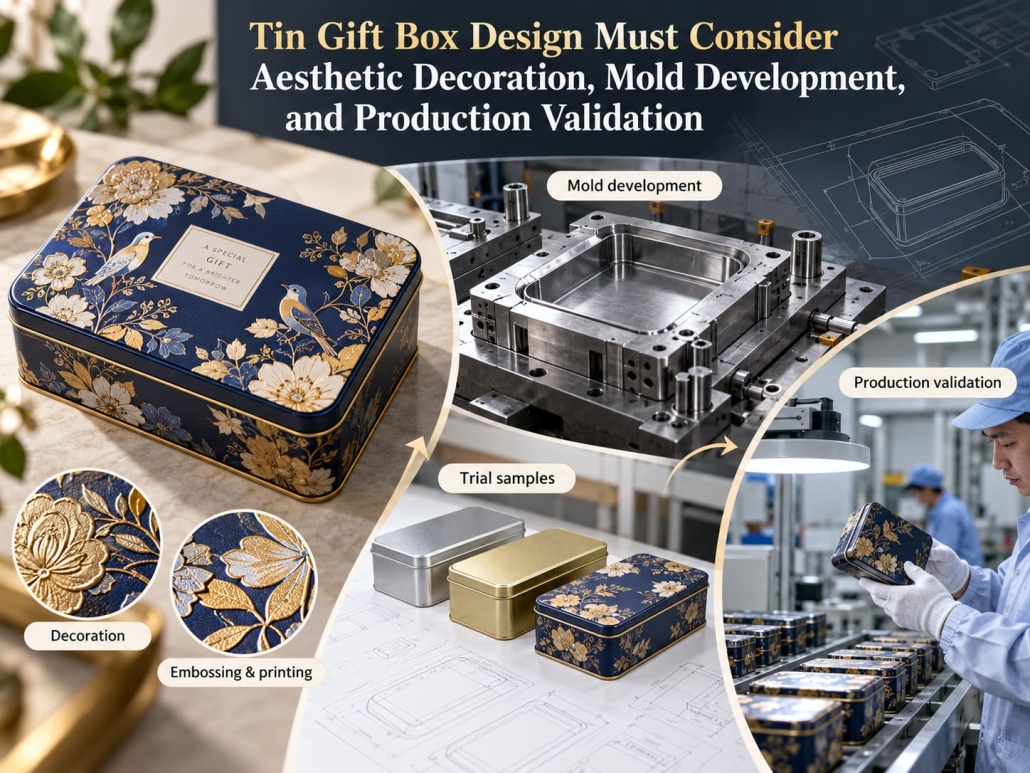
Tin Gift Box Design Must Consider Aesthetic Decoration, Mold Development, and Production Validation
Once we finalize the packaging structure, we move from concept development to manufacturing preparation. We coordinate printing, surface treatments, embossing (raised and recessed patterns), mold feasibility, and prototyping to ensure the final candy tin matches the intended design while maintaining its structural integrity and functionality.
Synergy Between Printing Processes and Die Development
The exterior decoration design should be based on the established tin structure, not conceived independently.
Candy brands may request full-color printing, metallic accents, embossed logos, or unique lid patterns. TSING comprehensively evaluates these requests while considering printable areas, panel geometry, forming processes, and die requirements.
For example, if a brand wants to place an embossed logo in the center of the tin lid, the embossing depth and position must align with the panel structure. If the embossed pattern is too close to the forming edge or functional closure areas, it may increase the risk of deformation or interfere with lid assembly.
When designing patterns, we also fully consider the final geometric shape after forming.
The entire manufacturing process can be summarized as follows:
Product Requirements → Structural Design → Pattern and Surface Finish Selection → Mold Evaluation → Prototype Development → Sample Approval → Mass Production
This process helps us identify and resolve potential conflicts promptly before the project enters full-scale mass production.
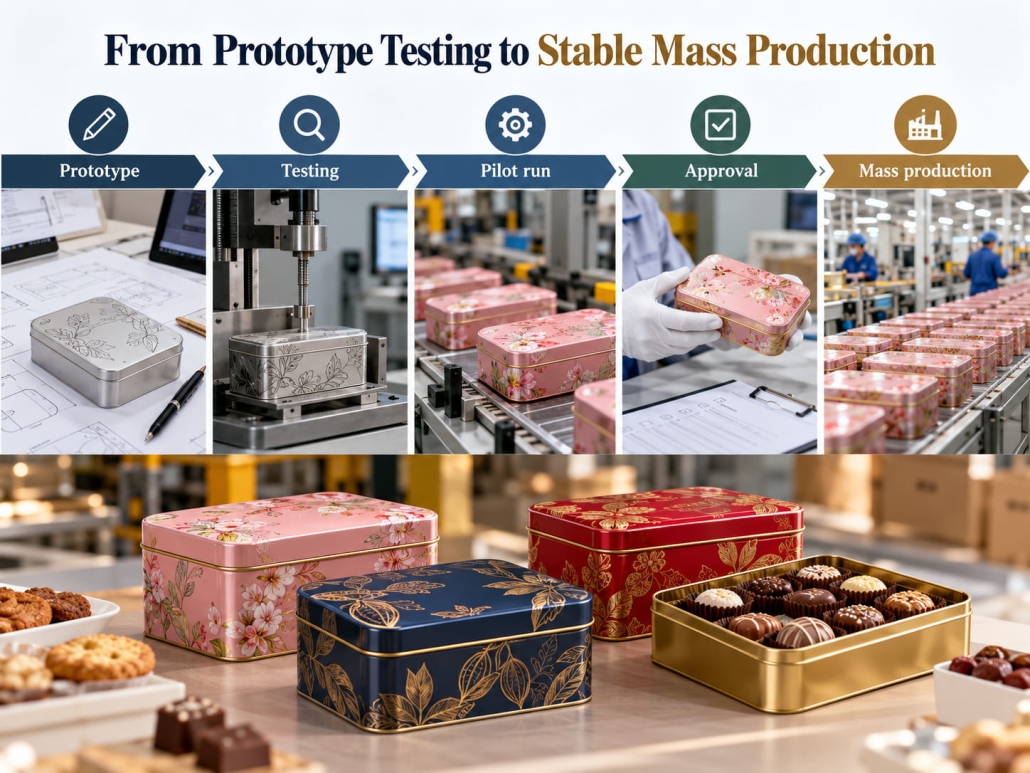
From Prototype Testing to Stable Mass Production
Passing the design review alone does not mean the product is ready for mass production. The physical tin box must properly accommodate the product, ensure precise assembly, and perfectly showcase the intended visual appearance.
Through prototype evaluation, TSING closely integrates design concepts with actual manufacturing performance. Depending on the specific project, the evaluation may cover:
- Dimensional accuracy
- Lid fit
- Inner tray positioning
- Print registration accuracy
- Embossing quality
- Surface finish
For example, in a candy factory project, we test samples containing chocolate, hard candies, and cookies by placing the pre-designed inserts inside the boxes. The evaluation focuses on whether the dividers can securely hold the products in place; whether the lid, when closed, squeezes or interferes with the contents; and whether the products remain neatly arranged and presentable after handling.
In addition, practical filling requirements must be considered. If an inner divider protects the products but complicates filling, it will significantly reduce production efficiency. Only after both structural and aesthetic requirements have been rigorously evaluated can the project proceed to mass production. For any tin can manufacturer, the goal is to turn an approved design into a consistently reproducible finished product—not just an aesthetically pleasing sample.
Here is a summary of the complete design process for candy gift tin boxes:
Product Portfolio → Internal Layout → Tin Dimensions → Structure and Lid Design → Printing and Decoration → Mold Making → Prototype Testing → Final Approval → Mass Production Control
Designing Candy Gift Tins for Candy and Snack Factories
First, based on the products and their arrangement, determine the dimensions and internal structure needed to protect them; next, select the right tin shape and closure method; and simultaneously, coordinate printing and decoration with the manufacturing workflow. Finally, the finished packaging must be validated before officially commencing mass production. At TSING, this integrated design approach ensures our custom candy tins look exquisite and gift-worthy while balancing ease of filling, product protection, and production consistency.
 Facebook
 Twitter
 Linkedin

