
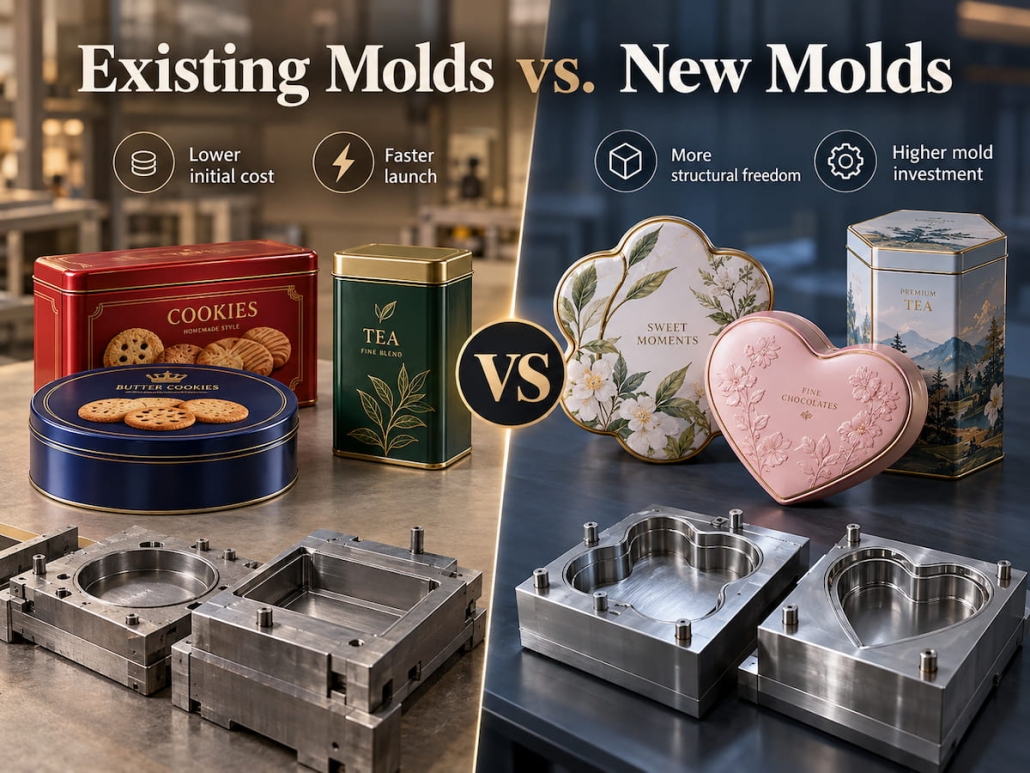
Existing Molds vs. New Molds: Which Is Better for Custom Food Tin Packaging?
It is important to clarify that “customization” is not the same as “developing new molds.” For many of the custom food tin packaging products we manufacture, most customization requests do not require the development of new molds. Instead, they can be achieved based on the existing tin structure through printing processes, surface treatments, inner liner configurations, embossing, or lid decoration. New molds are required only when the desired dimensions, shape, sealing method, forming profile, or internal structure cannot be accommodated by existing molds.
At TSING, we first distinguish between “visual customization” and “structural customization,” and then comprehensively consider the project’s order volume, budget, time-to-market schedule, and long-term packaging needs. Using existing molds typically reduces mold costs and shortens lead times, while developing new molds offers greater design flexibility and significantly enhances product differentiation. Which approach is more suitable depends on exactly how many aspects of the packaging truly require modification.
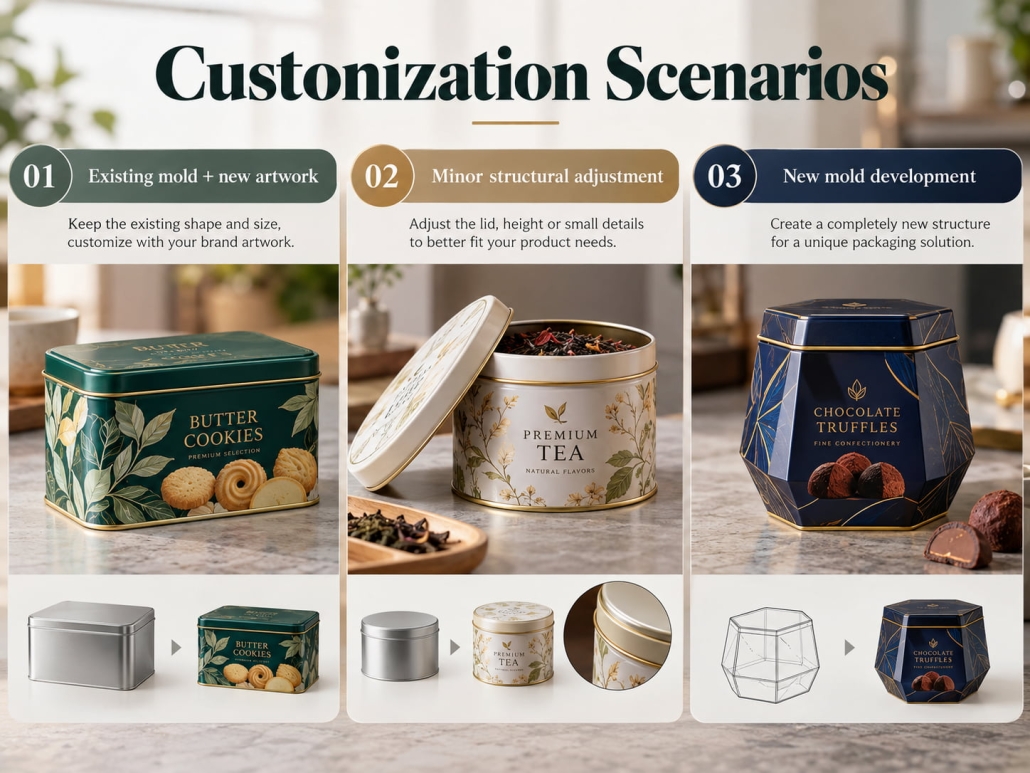
Distinguishing Between Customization Scenarios When Custom Food Tin Packaging
A common misconception when discussing custom tin packaging is the belief that every new brand design requires an entirely new tin structure. In reality, many food tin packaging projects do not require structural changes; visual adjustments alone can create a completely different appearance in the marketplace.
Clients can choose from existing round, square, rectangular, or irregularly shaped tins and customize them as follows:
- Printed designs
- Surface finishes (matte, glossy, etc.)
- Embossed or debossed logos
- Color combinations
- Designs tailored for specific events
None of these adjustments require the development of entirely new production dies.
“Structural customization,” however, is different. When clients need to alter the geometric shape of the packaging—such as length, width, height, corner radius, lid contour, base structure, opening mechanism, or deep-drawing features—it often necessitates the development of new dies.
The distinction lies in how it directly impacts the project’s cost structure. Therefore, the core question is not “Do you need to customize the tin can?” but rather “Which parts of the food tin require customization?”
Custom Food Tin Packaging Using Existing Molds Is More Cost-Effective
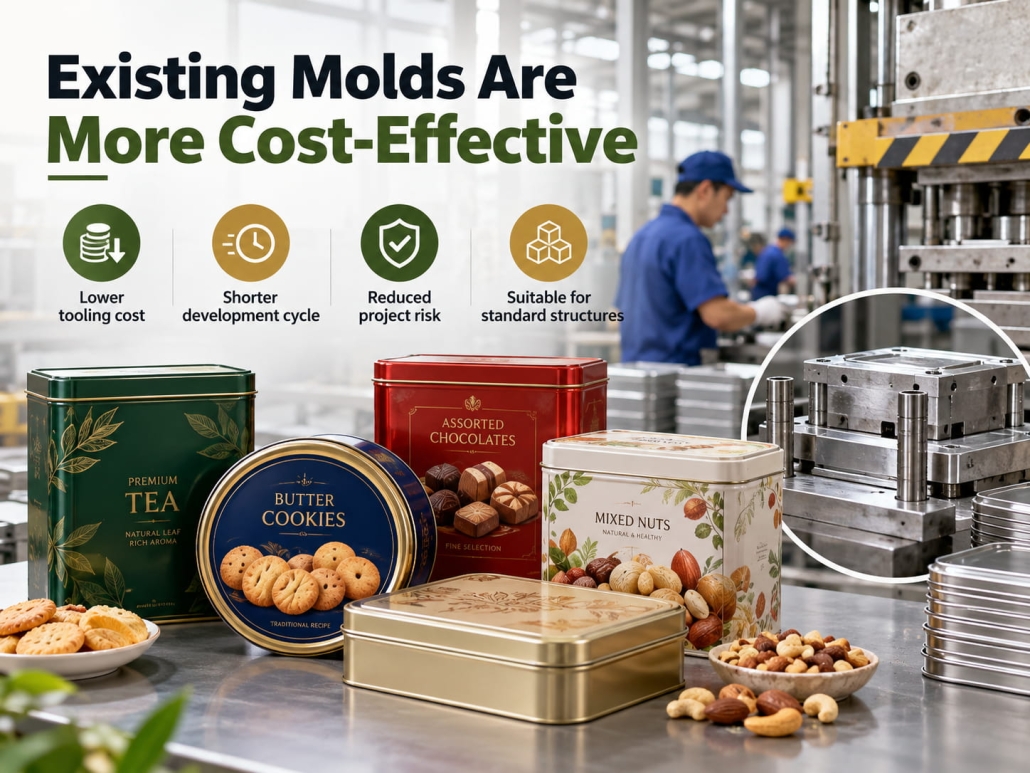
When the required packaging dimensions and structure are similar to existing designs, using existing molds is usually the more economical choice.
The main advantage is that customers can avoid or reduce the costs associated with developing new molds.
Projects using existing molds typically follow a faster process:
Design draft → Prepress → Prototyping → Approval → Mass production
In contrast, projects involving the development of new molds require more steps:
Structural design → Mold engineering → Mold manufacturing → Trial molding → Adjustments → Prototyping → Approval → Mass production
This additional development work increases costs and extends the delivery cycle.
Therefore, using existing molds is particularly suitable in the following situations:
- The product fits existing standard tin can dimensions
- Customization requirements are primarily focused on visual appearance
- There is a tight time frame for product launch
- The initial order quantity is limited
However, products should not be forced to fit an unsuitable packaging structure solely to reduce mold costs. If the selected existing tin can structure results in excessive internal space, poor product display, or an unreasonable inner tray layout, it may lead to a decline in the overall quality of the packaging solution—even though mold costs are saved.
Custom Food Tin Using New Molds Offers Greater Design Freedom
When packaging needs to stand out not only in appearance but also in functionality, developing new molds becomes extremely valuable. In such cases, custom food tin packaging goes beyond mere decoration to enable structural differentiation.
With dedicated molds, customers can customize packaging specifications based on the product’s actual dimensions, rather than having to “make do” with the closest available size from existing options. This not only improves the utilization of internal space but also enhances the fit between the product and the packaging, optimizes shelf display, and elevates the consumer’s unboxing experience.
With new molds, manufacturers can achieve:
| Structural Requirement | What a New Mold Can Change |
|---|---|
| Product-specific dimensions | Length, width, diameter, height |
| Distinctive package shape | Curves, corner radii, stepped forms |
| Custom lid interaction | Lid depth, plug-in structure, special profile |
| Internal fit | Better compatibility with trays or product layouts |
| Brand-specific geometry | Unique surface or formed features |
This flexibility delivers particularly significant value in high-end product packaging or long-term packaging projects. With custom molds, designs can be tailored entirely to the actual footprint of the cookies.
This helps enhance:
Product fit → Shelf display → Material efficiency → Brand differentiation
For high-end food products, these advantages fully offset the additional investment required to develop custom molds.
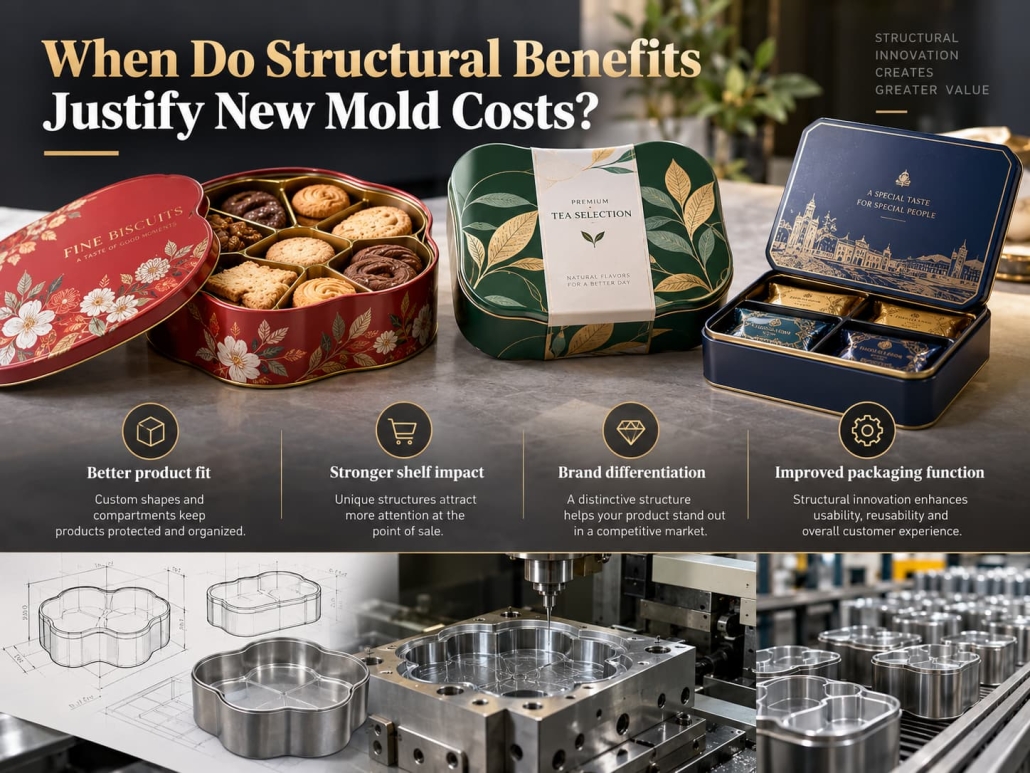
When Do Structural Benefits Justify New Mold Costs?
If the long-term value derived from structural improvements is sufficient to offset the additional development costs and time investment, then creating a new custom food packaging mold is worthwhile.
This decision should not be based solely on aesthetic considerations.
As a manufacturer, we typically recommend mold development to clients when one or more of the following conditions are met:
1. The product cannot be properly accommodated in existing food tin packaging. Examples include fragile cookies, assorted chocolates, candy trays, or products requiring precise internal positioning.
2. The client may require a unique packaging design as part of their brand identity. If the tin is to be reused across multiple marketing campaigns or product lines, a custom mold can create a long-term, recognizable packaging asset.
3. Another consideration is operational efficiency. A customized structural design can optimize the filling process, reduce unnecessary lining materials, improve case-packing efficiency, or make the packaging dimensions better suited to retail shelf requirements.
Therefore, the decision-making logic can be simplified as follows:
Existing suitable dimensions + only cosmetic customization required → Typically, existing molds are the preferred choice.
Unique dimensional specifications + structural differentiation → Tooling is more valuable.
The key lies in whether a new mold or an existing mold can solve your packaging challenges.
If mold development is solely for a minor aesthetic adjustment of a few millimeters, its value is often limited; however, if it is intended to improve product fit, increase capacity, optimize display effectiveness, or strengthen brand differentiation, then mold development is a highly worthwhile investment.
Consider the Overall Value of the Project, Not Just the Mold Cost
When making the final decision, both options should be compared as complete packaging solutions.
The advantages of using existing molds are obvious: lower upfront costs, shorter development cycles, and lower project risks. If the product itself fits within an existing, proven tin structure, using an existing mold is often the most practical choice. On the other hand, developing a new mold offers greater flexibility and provides more control over dimensions, shape, internal layout, closure design, and long-term brand differentiation.
So, for custom food tin packaging, is it better to choose an existing mold or to develop a new one?
1. If existing molds already meet the functional requirements, and the customization involves only graphic design, surface finishes, inner liners, or branding, then existing molds are sufficient.
2. If the product has specific requirements regarding dimensions, shape, sealing method, internal fit, or structural features that existing molds cannot effectively meet, then developing new molds is the better option.
 Facebook
 Twitter
 Linkedin

