
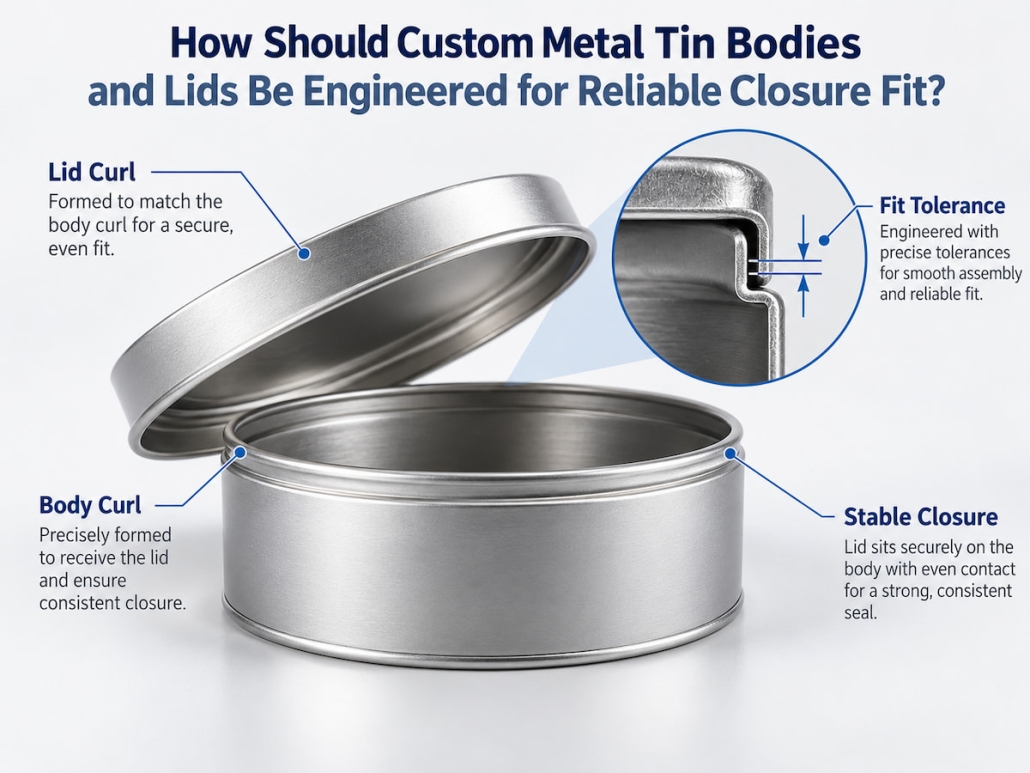
How Should Custom Metal Tins Bodies and Lids Be Engineered for Reliable Closure Fit?
If a metal tin lid is fastened too tightly, it may dent the can body when opened; if it is fastened too loosely, the lid may come off easily during use, giving the impression of poor packaging quality. For custom metal tins, a reliable seal depends on how well the can’s external dimensions match the lid’s internal dimensions. TSING controls this fit by defining the closure type, setting tolerances for the mating surfaces, fully considering tinplate thickness and its forming characteristics, and validating assembly samples before mass production.
Factors such as the can body’s roundness, edge geometry, flanging process, coating, and die wear all affect the final closure performance; therefore, we integrate the design and testing of the entire custom metal can’s closure performance into the overall manufacturing process.
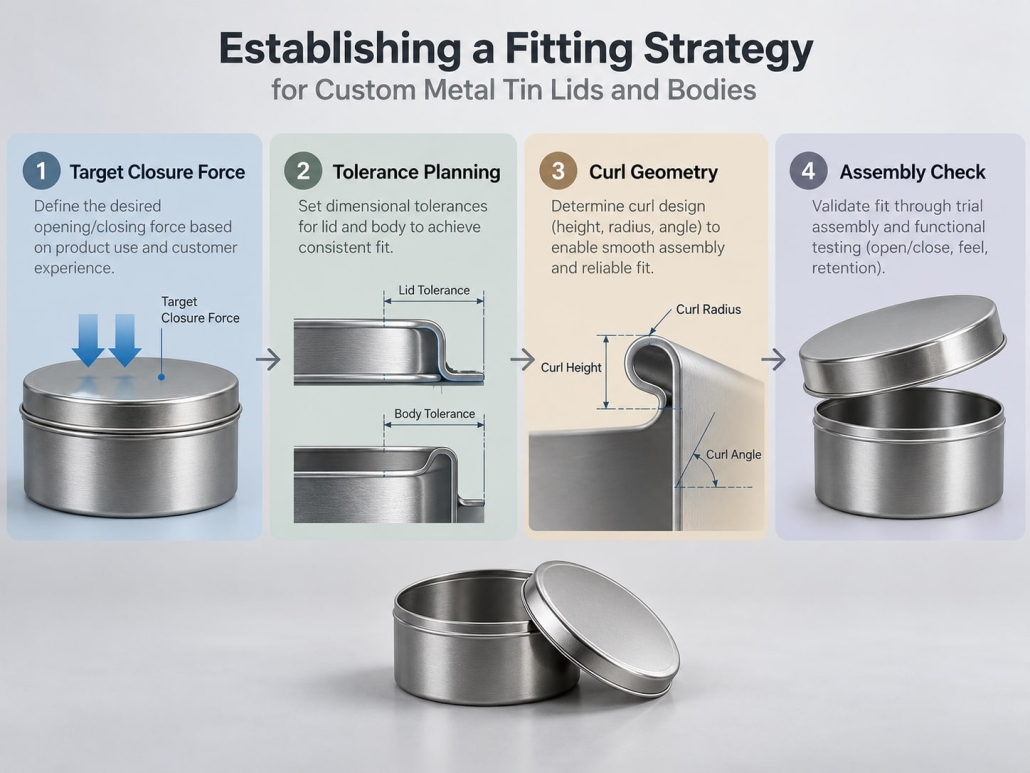
Establishing a Fitting Strategy for Custom Metal Tin Lids and Bodies
To achieve reliable closure, the engagement method between the lid and the can body must first be clearly defined. For example, a removable slip lid relies on the dimensions and contours of the two components to achieve a controlled fit. Even if two metal tins have similar overall dimensions, their fit performance will differ if the lid’s engagement depth varies.
During the design phase of custom metal tins, TSING first determines the closure mechanism and clearly identifies the key contact surfaces that determine the fit. This decision directly impacts the can body dimensions, lid geometry, forming allowances, and mold specifications.
User experience is also a key consideration. For food tins consumers open repeatedly, designers must balance ease of opening and lid stability differently than for packaging intended only for one-time display.
Our goal is to finalize the right fit solution before mold fabrication begins. This helps us avoid repeated adjustments to fix closure issues after we’ve manufactured the can body and lid.
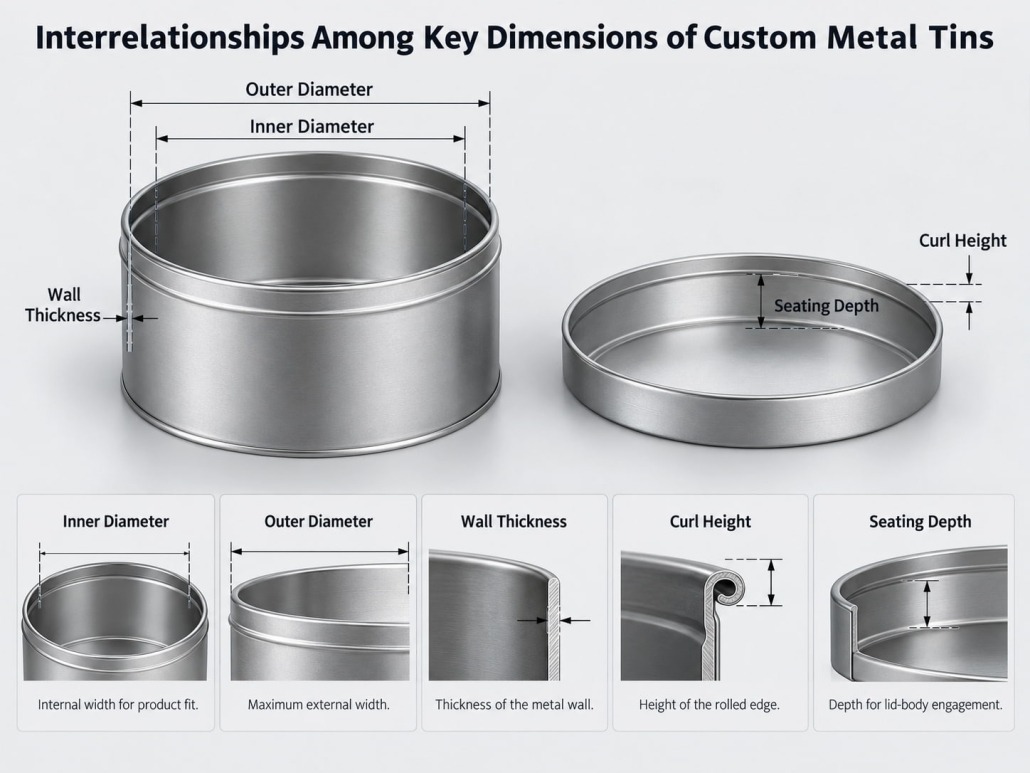
Interrelationships Among Key Dimensions of Custom Metal Tins
To design a reliable closure structure, TSING determines the precise dimensions of the contact areas between the lid and the can body. The most critical measurements are not the can’s overall length, width, or height, but the can body’s outer dimensions and the lid’s inner dimensions in the mating area. For traditional slip-on lids, these dimensions determine the size of the gap left when the lid is slipped onto the can body.
| Critical Dimension | What It Determines |
|---|---|
| Body outside diameter or width | Size of the body entering the lid |
| Lid inside diameter or width | Available clearance around the body |
| Engagement depth | Alignment and retention |
| Body and lid roundness | Consistency of fit around the perimeter |
| Corner radius | Fit at the corners of rectangular tins |
| Rolled-edge profile | Contact and resistance during closure |
The basic relationship is:
Nominal Diameter Gap = Lid Inner Diameter − Can Body Outer Diameter
For rectangular metal tins, the same principle applies to their corresponding inner and outer widths and lengths; the corner radii and edge-forming profiles must also match. If the clearance is too small, you may need to apply excessive force to slide the lid onto the can. If it’s too large, the lid may not fit securely. The right clearance depends on the closure design, so determine it through engineering calculations and sample testing.
How do manufacturing tolerances affect the actual fit?
Nominal dimensions are design targets, but in production, part dimensions vary within specified tolerances. The can body’s final dimensions may be slightly larger or smaller than the target values, while the lid’s inner dimensions may also vary independently. This means that all possible combinations of the two components must be comprehensively considered to evaluate their fit.
For simple slip-fit assemblies:
Minimum clearance = Minimum inner dimension of the lid − Maximum outer dimension of the can body
Maximum clearance = Maximum inner dimension of the lid − Minimum outer dimension of the can body
Minimum clearance corresponds to the situation most likely to result in an overly tight fit. In contrast, maximum clearance corresponds to the situation most likely to result in an overly loose fit. For this reason, when setting tolerances, TSING considers these two components as a single unit.
Cumulative Manufacturing Deviations Cause Custom Metal Tin Lids to Fit Too Tightly or Too Loosely
A poor lid fit does not necessarily indicate a flaw in the original design. The cause may result from interactions among material thickness, mold dimensions, forming deviations, and the finished assembly’s shape.
Take can lids as an example: if they fit well during initial prototyping but inconsistencies arise during mass production, the cause may be that when the can body size increases. At the same time, the lid’s inner diameter remains unchanged, the gap between the two decreases. Although dimensional changes in individual components may seem minor, they can make sealing the lid difficult.
Conversely, if the can body is too small or the lid’s inner diameter is too large, fitting issues will also occur.
Common Sealing Issues and Their Possible Causes
Can lid too tight:
This may be caused by an oversized can body, an undersized can lid, or insufficient clearance allowed for the mating edges during forming. Additionally, coating buildup and localized deformation may also affect the fit.
Lid Too Loose:
Excessive clearance, a can body that is too small, a lid that is too large, or inconsistent edge profiles can reduce clamping force, making the lid appear loose and unstable.
Different corrective measures are required for these issues. If the can body is too large, the mold may need to be adjusted; if roundness is inconsistent, control over the forming process must be strengthened. Therefore, before deciding how to correct closure issues, we conduct an in-depth analysis of the interrelationships between the design, the dies, the materials, and the final formed components.
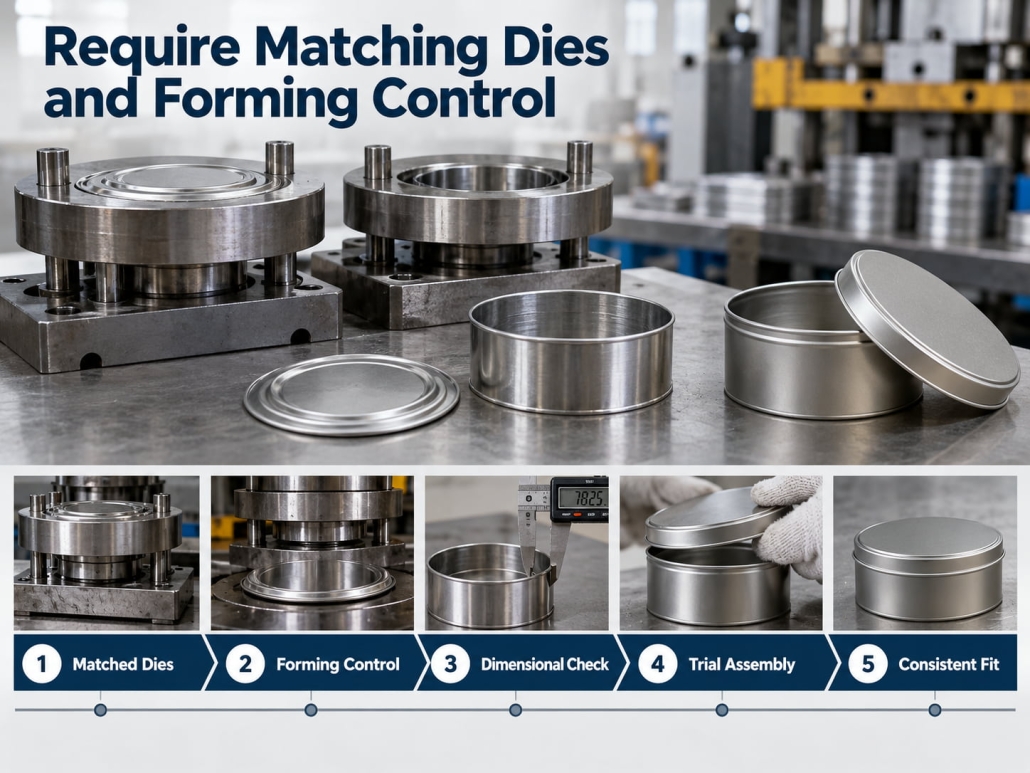
Require Matching Dies and Forming Control
Although the can lid and body may require different die processes, their final dimensions must match. TSING translates the approved closure specifications into the appropriate die dimensions and forming requirements, then applies them to both the lid and body components.
Before finalizing the die, the thickness of the tinplate is confirmed, as it affects the material’s behavior during the forming process, as well as the dimensions at the rolled or folded edges. The forming process must also ensure consistent can walls, corners, and mating surfaces while preventing excessive deformation. Crucially, die design must prioritize final assembly fit rather than being developed solely from the individual dimensions specified in each component’s drawings.
Assembly Fit Verification Required Before Mass Production
Although the drawings specify target dimensions, only physical prototypes can accurately demonstrate how the components will actually perform when assembled. Therefore, TSING verifies the assembled lid structure before approving the design for mass production.
The first step is dimensional verification: measuring the can body and lid mating surfaces, including relevant widths or diameters, edge profiles, and roundness.
Next comes functional testing: the lid must snap into place evenly, remain aligned, and open without excessive resistance. For removable lids, the fit must ensure sufficient holding force while requiring minimal effort to open.
TSING will test multiple samples during validation: a passing first-article sample demonstrates the design’s feasibility, while consistent performance across multiple samples further confirms the stability and repeatability of the production process.
If inconsistent fit is detected, TSING will conduct an in-depth analysis of the relationships between all relevant dimensions before adjusting the mold. This approach helps avoid “solving one problem creates another.”
Ensuring a Reliable Fit Between Custom Metal Tins and Their Lids
Whether custom tin cans can achieve a reliable seal depends on four key control points:
1. Defining the correct fit dimensions
2. Setting reasonable tolerances for the lid and can body
3. Ensuring dimensional consistency during the forming process
4. Verifying the fit after assembly before mass production.
TSING integrates these control measures throughout the design process for custom metal tins—from initial structural planning through mold debugging to final inspection. When body dimensions, lid clearance, edge contours, and forming accuracy are tightly coordinated, the resulting metal tins seal securely and open smoothly.
 Facebook
 Twitter
 Linkedin

