

How Are Cigarette Tin Case Size Dimensions Controlled During Stamping and Forming?
In the stamping process, control of cigarette tin case size dimensions begins before the first tin blank enters the stamping press. We first determine the finished product’s external dimensions, usable internal space, corner radius, body height, lid depth, and the lid-to-body fit based on the cigarette specifications and box structure. We then convert these target dimensions into blank dimensions, die geometry parameters, and forming allowances, fully accounting for material flow characteristics during stamping. After forming, we measure the prototype samples and conduct a combined inspection of the fit and alignment accuracy between the assembled lid and body. This approach helps us control the nominal dimensions of the cigarette tin case and ensure high consistency and repeatability during mass production.
Cigarette Tin Case Size Control Begins With Functional Dimensions
Simply inspecting the overall length, width, and height of a cigarette tin is insufficient for effective dimension control. Some dimensions affect the product’s assembly fit, closure performance, and appearance far more than others.
Therefore, TSING classifies drawing dimensions into critical functional dimensions and general appearance dimensions.
| Critical Dimension | Why It Matters |
|---|---|
| Outside length and width | Determines overall case size and lid alignment |
| Internal usable dimensions | Controls cigarette or insert fit |
| Body height | Affects capacity and lid clearance |
| Lid depth | Determines engagement with the body |
| Lid-to-body clearance | Controls whether the case feels loose or tight |
| Corner radius | Influences internal space and forming stability |
| Edge or curl dimensions | Affect assembly and finished feel |
The key point is that these dimensions are interrelated.
For example, increasing the external width does not necessarily mean that the usable internal width will increase accordingly. Rounded corners, formed side walls, rolled edges, and the lid structure all take up space.
The dimensional relationship between the lid and the body is particularly sensitive. If the body is formed slightly wider and the lid is produced slightly narrower, even if both components are close to the target values, the final assembled unit may close too tightly. Therefore, we manage cigarette tin dimensions using an “assembly dimension system” rather than a series of unrelated dimensional data points. This is especially important for custom tins designed for specific cigarette counts, filter lengths, liners, or internal layouts.
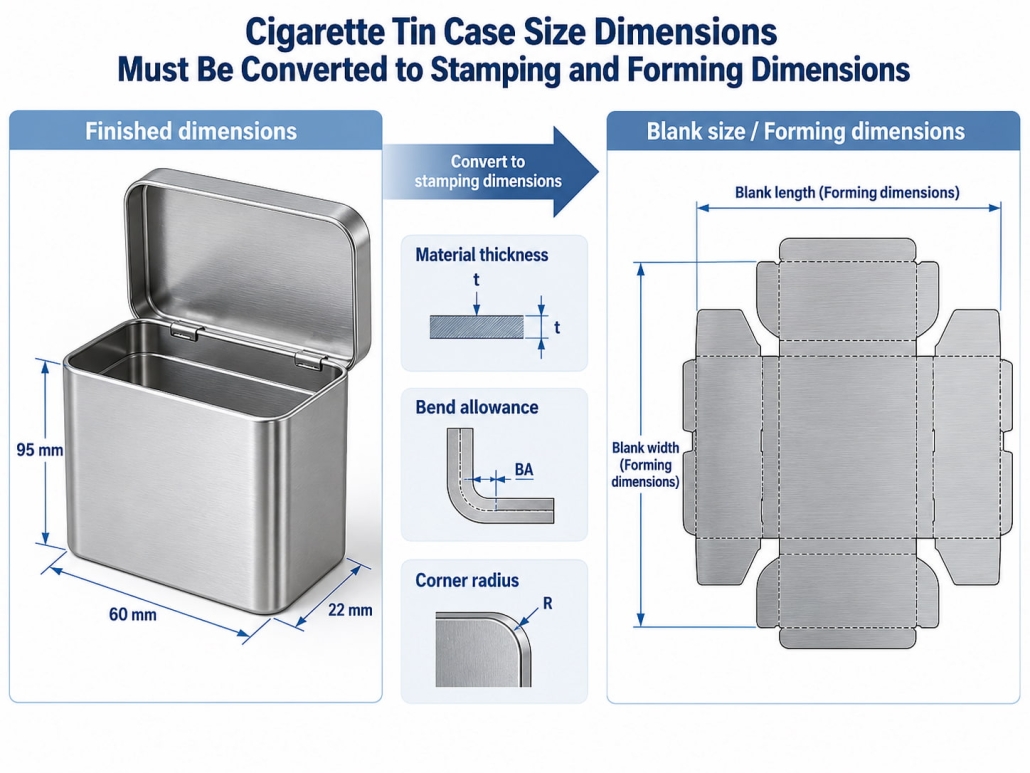
Cigarette Tin Case Size Dimensions Must Be Converted to Stamping and Forming Dimensions
You cannot apply the finished dimensions shown on product drawings directly to flat tinplate sheets.
A cigarette tin initially starts as a flat blank. During production, the blank undergoes stamping, deep drawing, bending, flanging, or other forming processes to become a three-dimensional tin body and lid. In this process, the material transitions from a flat state and distributes across the side walls, corners, edges, and other structural features.
The dimension conversion process can be understood as follows:
Finished cigarette tin dimensions
→ Blank dimensions
→ Die geometry
→ Forming allowance
→ Trial stamping
→ Finished product measurement
For rectangular cigarette tins, engineers must consider not only the final length and width but also ensure the blank has enough material to form the side walls and corners without excessive stretching or deformation. Of course, the forming depth also affects the calculations. Shallow cigarette tins require relatively little material displacement, whereas deeper tins place higher demands on corner and vertical side-wall forming.
A common production principle is:
Target dimensions refer to the dimensions after forming, not before stamping.
Clarifying this distinction enables stable control of cigarette tin dimensions.
The Corner Dimensions of Cigarette Tins Depend on Controlled Material Flow
For rectangular cigarette tins, the corners are among the most process-sensitive areas because the metal’s forming characteristics there differ greatly from those on straight tin walls. On straight sections, the bending or stretching of the material is relatively predictable; at corners, however, the tinplate must both change its flow direction and undergo simultaneous stretching or compression to form a three-dimensional shape. This means the corner geometry directly affects the finished product’s length, width, wall position, and lid fit.
A smaller fillet radius produces a sharper, more aesthetically pleasing visual effect, but it also concentrates forming stresses in a smaller area. If the fillet radius is designed too aggressively relative to the material thickness and forming depth, it may lead to the following issues:
Uneven fillet radius → Box wall deformation → Dimensional deviations → Poor lid alignment
Therefore, corner design is a critical component of the overall structural design.
The most important interrelated factors include:
Corner radius + Molding depth + Tinplate thickness + Mold geometry
These four factors must work in concert to design a corner structure that looks clean and sharp, meets the specified dimensions for cigarette tins, and maintains high consistency during mass production of thousands of units.

Controlling Dimensional Deviations in Cigarette Tins Throughout the Production Process
Dimensional deviations rarely stem from a single, isolated issue. In most cases, the final dimensional differences result from the cumulative effect of multiple minor production variables.
The table below shows how common sources of variation can affect the finished cigarette tin case size.
| Source of Variation | Possible Result |
|---|---|
| Incorrect blank dimensions | Changes final length, width, or wall height |
| Tinplate thickness variation | Alters forming behavior and mating fit |
| Tool wear | Gradually shifts component dimensions |
| Punch and die misalignment | Creates uneven walls or asymmetric corners |
| Material springback | Changes wall position after leaving the tool |
| Unstable forming pressure | Produces inconsistent depth or shape |
| Corner-forming variation | Affects overall footprint and alignment |
| Edge-forming variation | Changes lid or body engagement |
These factors rarely act independently.
For example:
Deviation in body dimensions + deviation in lid dimensions + deviation in edge forming = final closure fit
If the body is slightly oversized but the lid is at the appropriate end of its tolerance range, the overall fit may still be acceptable. Quality control during production must not stop at the first-piece trial stage. Even if the mold is adjusted to produce a perfect first piece, gradual dimensional changes may still occur during prolonged continuous production. Therefore, evaluate critical dimensions early in production and conduct regular inspections throughout the process.
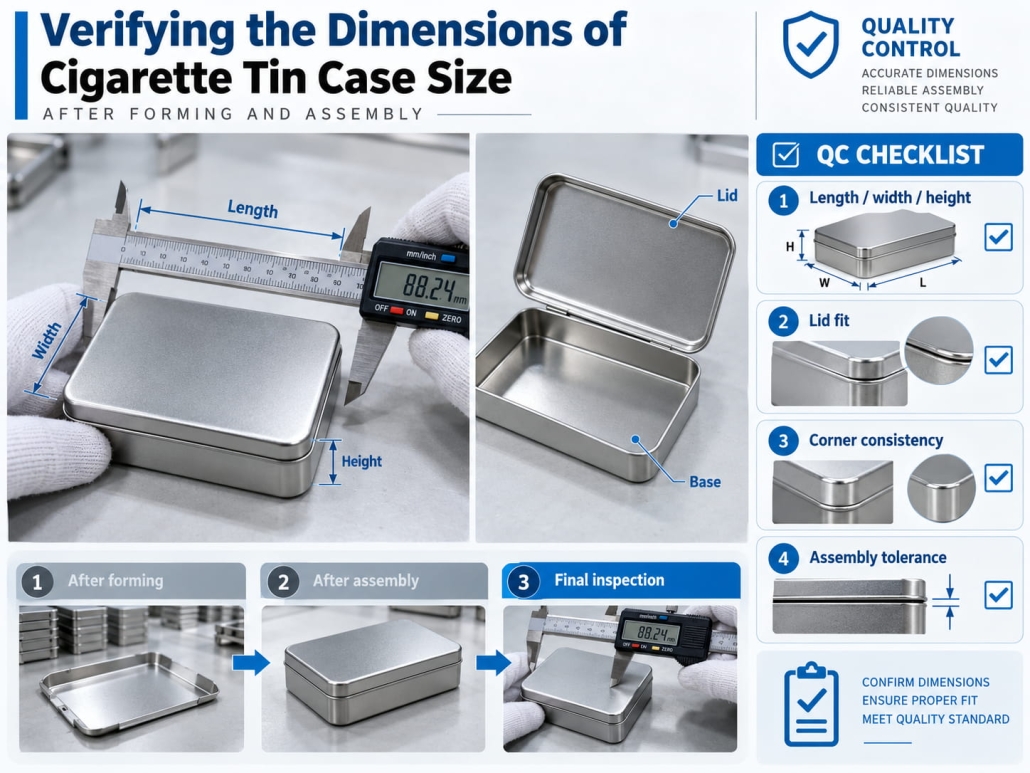
Verifying the Dimensions of Cigarette Tin Case Size After Forming and Assembly
Conduct final dimensional verification after the cigarette tins are fully formed and assembled, as only then does the actual fit between components become apparent. Dimensional verification typically combines actual measurements with functional assembly tests.
The inspection focuses on the following four aspects:
1. Overall Dimensions:
Compare the finished product’s length, width, and height with the approved specifications.
2. Internal Capacity:
Inspect the usable internal dimensions to confirm that the intended cigarettes, liners, or internal layout fit properly.
3. Forming Quality:
Inspect the corners, side walls, base, and edge structures to confirm the absence of any deformation that could affect dimensional accuracy.
4. Fit Between Lid and Body:
The lid must align precisely, snap securely into place, and open without requiring excessive force.
This final point is particularly important because caliper readings alone cannot fully assess the effectiveness of dimensional control. Even if the dimensions of both the body and the lid are within tolerance, the fit between the two when assembled may still be unsatisfactory. Therefore, TSING must measure and test finished cigarette tins.
Controlling Dimensional Accuracy During Stamping and Forming
To effectively control the dimensions of cigarette tins during stamping and forming, TSING focuses on four core areas: defining the critical dimensions of the finished product, translating these dimensions into precise die and blank specifications, controlling material flow during the forming process, and verifying the fit between the lid and the body throughout the entire production process.
Key dimensions include the finished product’s length, width, height, effective internal volume, corner radius, lid depth, and the fit clearance between the lid and body. Integrate dimensional requirements into the stamping and forming processes from the start, and verify them repeatedly after forming and assembly. Only when the internal volume, external dimensions, corner geometry, and lid-to-body fit remain consistent across all production batches can we say the cigarette tin’s dimensional specifications have been properly controlled.
 Facebook
 Twitter
 Linkedin
