
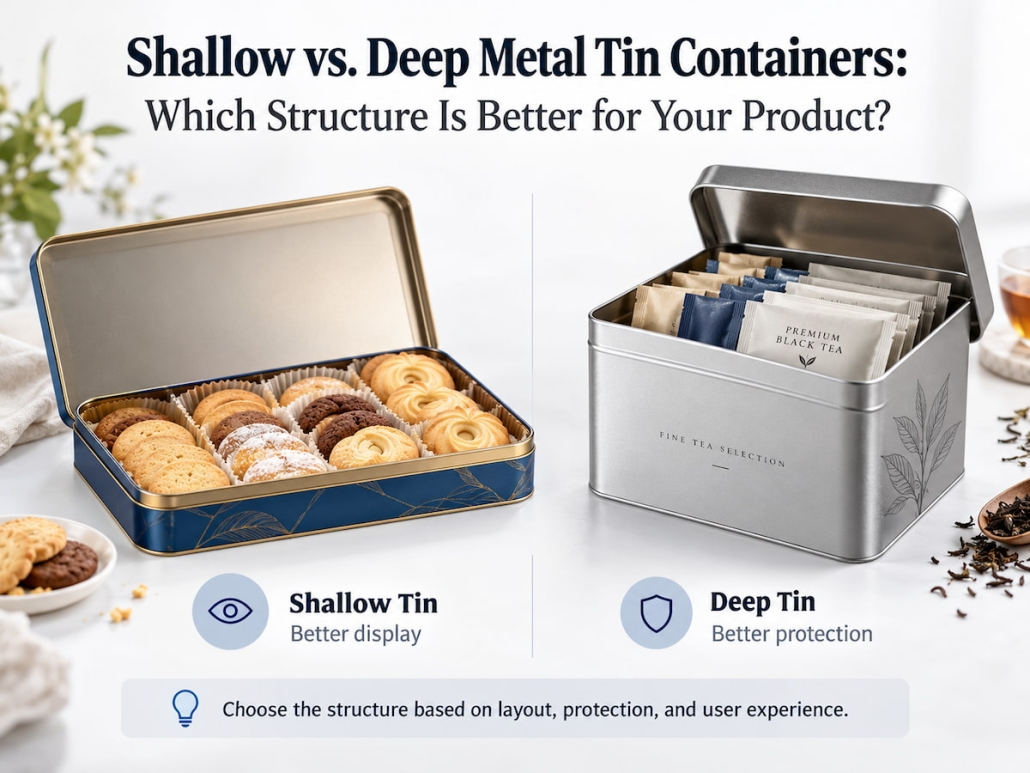
Shallow vs. Deep Metal Tin Containers: Which Structure Is Better for Your Product?
When choosing between shallow and deep metal tin containers, the product itself should be the primary consideration. Before determining can depth, we evaluate required capacity, product dimensions, internal layout, potential movement during transport, display methods, and structural requirements.
Shallow metal tin containers typically make the product easier to access, offer better visual presentation, and suit single-layer arrangements of multi-pack products. Deep metal tin containers, on the other hand, offer greater volume while taking up less floor space, making them better suited to products that are stacked, sold in bulk, or arranged vertically. The choice between these two designs depends on how the product fills the internal space and the container’s functional requirements during filling, transportation, retail display, and consumer use.
Considering Metal Tin Containers Capacity and Internal Space Utilization
Depth directly affects capacity, but greater depth does not necessarily mean higher packaging efficiency.
Given the same length and width, a deeper metal tin container naturally provides greater internal volume. Deep metal cans offer clear advantages when manufacturers need to stack products in layers or fit more products into limited shelf space. For example, bulk tea, candy, coffee, powdered foods, or individually packaged desserts can often use vertical space effectively. By using deeper metal tin containers, brands can increase load capacity without widening the packaging too much.
If products need to be neatly arranged in a single layer and clearly visible, shallower metal tins are generally more suitable.
Take premium assorted cookies as an example: if you plan to place 12 cookies in separate compartments, increasing the can’s depth may leave unused space above the products. Unless additional layers are added, this excess volume does not increase the actual loading capacity.
The relationship is as follows:
Required product volume + Arrangement method + Reserved headspace = Appropriate can depth
A simple capacity comparison illustrates this clearly:
| Packaging Requirement | Shallow Metal Tin Containers | Deep Metal Tin Containers |
|---|---|---|
| Single-layer products | Very suitable | Often unnecessary |
| Multi-layer packing | Limited | More suitable |
| Loose-filled products | Moderate capacity | Higher capacity |
| Large visual presentation area | Strong | Depends on footprint |
| Compact shelf footprint | Less efficient at high capacity | More efficient |
| Easy access to all contents | Better | May require reaching deeper |
Therefore, for custom tin packaging, TSING calculates available internal volume rather than determining depth solely from external dimensions.
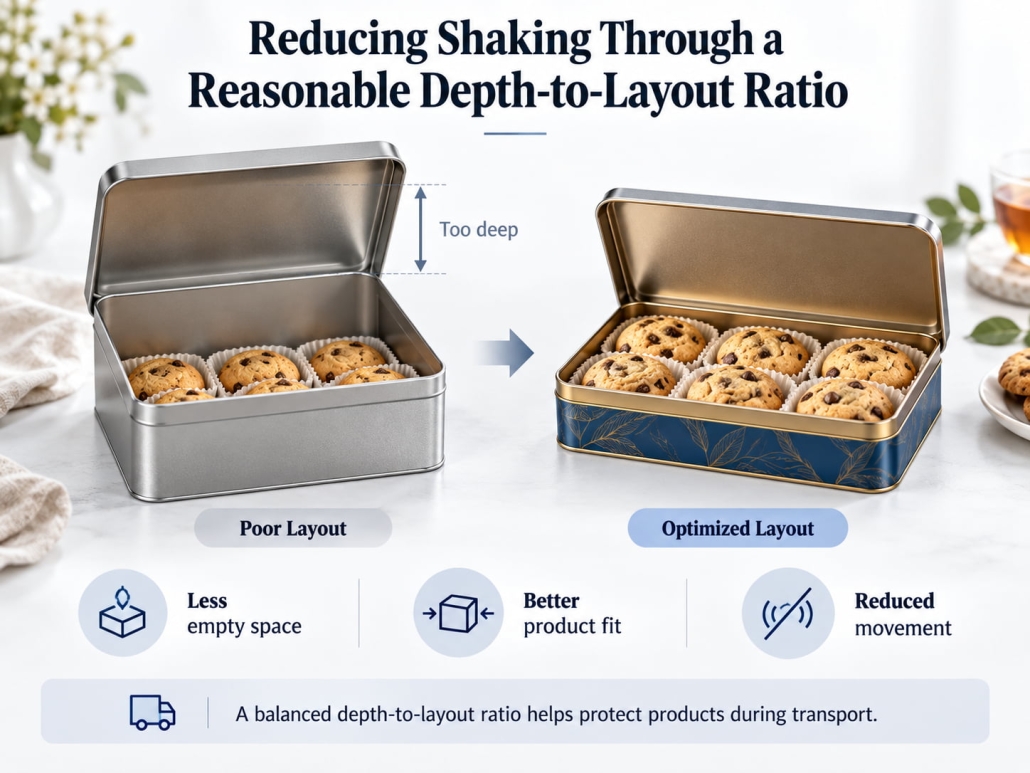
Reducing Shaking Through a Reasonable “Depth-to-Layout” Ratio
Simply choosing a shallow tin can does not effectively control product shaking.
If the can’s base is much larger than the product’s footprint, the product may still shift even in a shallow can. However, a deep metal tin container can hold the product securely when its internal space includes proper dividers or suitable filling materials.
For metal tins containing cookies, chocolate, or candy, the packaging design should prevent excessive horizontal or vertical displacement of the products. Products arranged in a single layer are typically well-suited for shallow metal cans, as they can be placed in trays, paper cups, or dividers, leaving limited headspace.
If manufacturers pack the same products in deep cans without effective internal supports, the products may shift vertically or become disarranged during transport.
Therefore, deep can structures typically require additional internal design elements, such as:
Interlayer dividers → Second layer of products → Top padding or headspace control
However, the situation is different for loose tea or individually wrapped candies. Because the contents can fill most of the available space, a deeper structure may not cause the same rattling issues.
From TSING’s perspective, the real question is not:
“Do shallow or deep containers better prevent shifting?” but rather, “After filling with the actual product and internal securing structures, which depth leaves the least amount of uncontrolled space?”
Only then can you choose the right packaging structure.
The Shape of Metal Tin Containers Influences Product Display, Accessibility, and Unboxing Experience
The container’s depth also shapes how consumers view and interact with the product.
Shallow metal tin containers typically offer a more intuitive display, as most—if not all—of the product is visible at a glance once the lid is opened. This design suits premium cookies, chocolates, assorted candies, gift sets, and products arranged by color, shape, or flavor. The shallow structure also makes it easier to retrieve individual items. For this reason, wide, shallow tin packaging often works better for products where the unboxing experience is part of the brand experience.
Deep-profile tins, by contrast, offer a completely different experience. They convey an impression of “substantial quantity” and take up less shelf space; however, products at the bottom are relatively difficult to access.
Furthermore, retail display requirements cannot be overlooked. Shallow, rectangular tins may require more shelf space, while taller tins can use vertical space more efficiently.
Therefore, decisions regarding display methods involve two distinct questions:
“How should the packaging appear on the shelf?” and “What should consumers see when they open the can?”
These two requirements don’t always point to the same packaging structure, so customers must judge and choose.

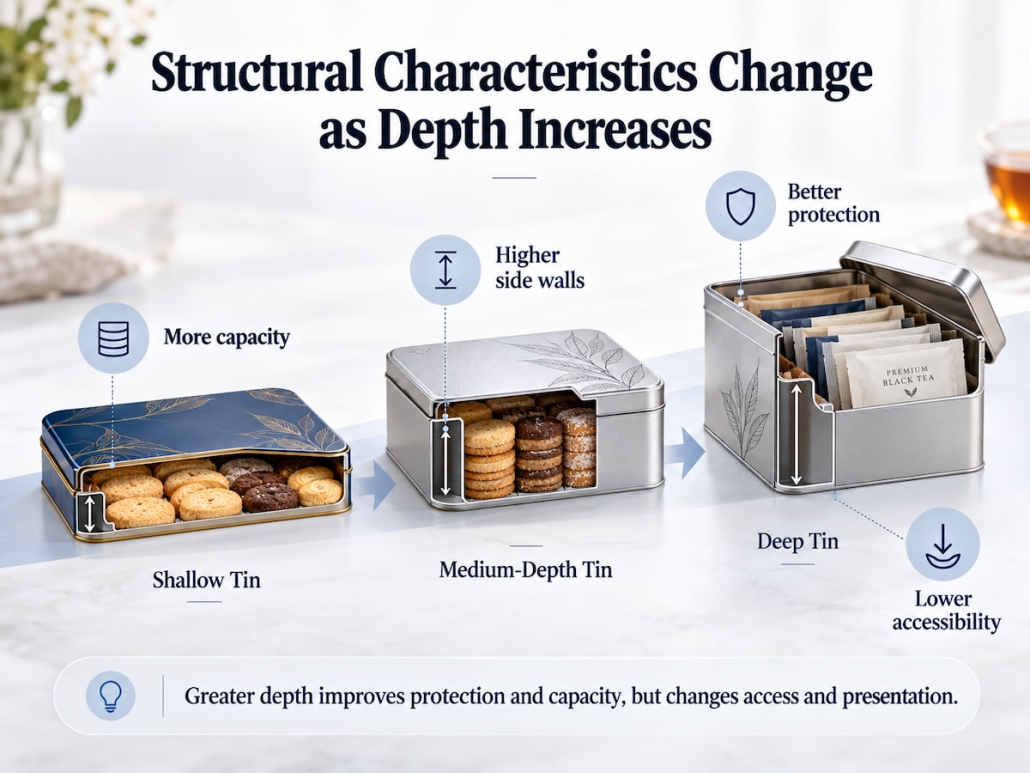
Structural Characteristics Change as Depth Increases
Depth affects not only capacity but also the can’s forming characteristics and rigidity.
Shallow cans typically have shorter side walls, which makes the can body less prone to sidewall deformation. However, for large, shallow cans, if the lid or bottom panel area is too large relative to the selected tinplate thickness and structure, the panel may experience bending deformation. Longer side walls mean a larger vertical surface area, so pay closer attention to side wall stability, corner geometry, forming depth, and stacking loads.
This means that structural rigidity cannot be determined by depth alone; rather, it must be assessed by combining the following factors:
Can dimensions + sheet area + forming depth + tinplate thickness + structural reinforcement design = overall rigidity
For example, deep rectangular tins can enhance sidewall stability through appropriate corner design or structural ribs, whereas wide, shallow cans may require sufficient lid depth or sheet reinforcement to minimize bending deformation.
Well-designed metal cans achieve the required rigidity through a combination of material thickness and structural geometry.
Choosing Tin Boxes Based on Product, Packaging Method, and User Experience
No single depth works for every food or gift.
The most effective approach is to link the product’s characteristics directly to the tin box’s structure.
Shallow tin boxes are generally better suited for:
single-layer cookies, premium chocolates, assorted candy gift boxes, stationery sets, flat promotional items, and other products where visual presentation and ease of access are prioritized.
Deep tin boxes are generally better suited for:
loose-leaf tea, coffee, candy, stacked cookies, individually wrapped foods, powdered products, and situations that need larger capacity in a smaller footprint.
Some products fall between these two categories. In such cases, we typically evaluate the actual packaging layout before determining the final depth.
Which Is Better—Shallow or Deep Metal Tin Containers?
When visual appeal, easy access, a single-layer arrangement, and a premium look matter more than maximum capacity, choose shallow metal tin containers. When products require greater capacity, multi-tier stacking, bulk filling, or minimal shelf space, choose deep metal tin containers.
From a tin can manufacturer’s perspective, the optimal structure should use internal space efficiently while preventing unnecessary product movement, without compromising display appeal or structural strength.
 Facebook
 Twitter
 Linkedin
