
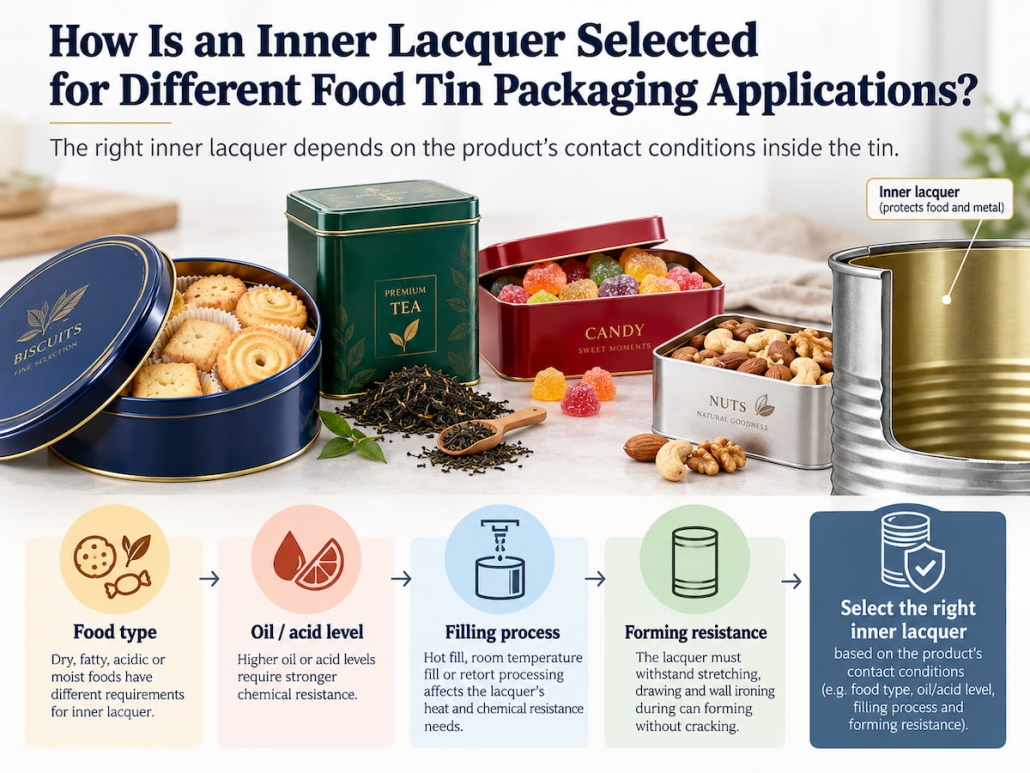
How Is an Inner Lacquer Selected for Different Food Tin Packaging Applications?
When selecting an interior coating for food tin packaging, it is essential first to understand how the food being packaged will affect the metal surface. At TSING, we never select a coating simply because it is labeled “food-grade.” We first confirm whether the food will contact the tinplate directly and consider its acidity, fat content, moisture content, filling temperature, expected shelf life, and whether an inner bag or tray provides additional barrier protection. These conditions determine the coating’s required chemical resistance, adhesion, flexibility, and suitability for food contact. We then evaluate the final coating specifications based on the intended application and validate them with coated tinplate samples before mass production, ensuring the structure and inner surface of the food tin work together reliably.
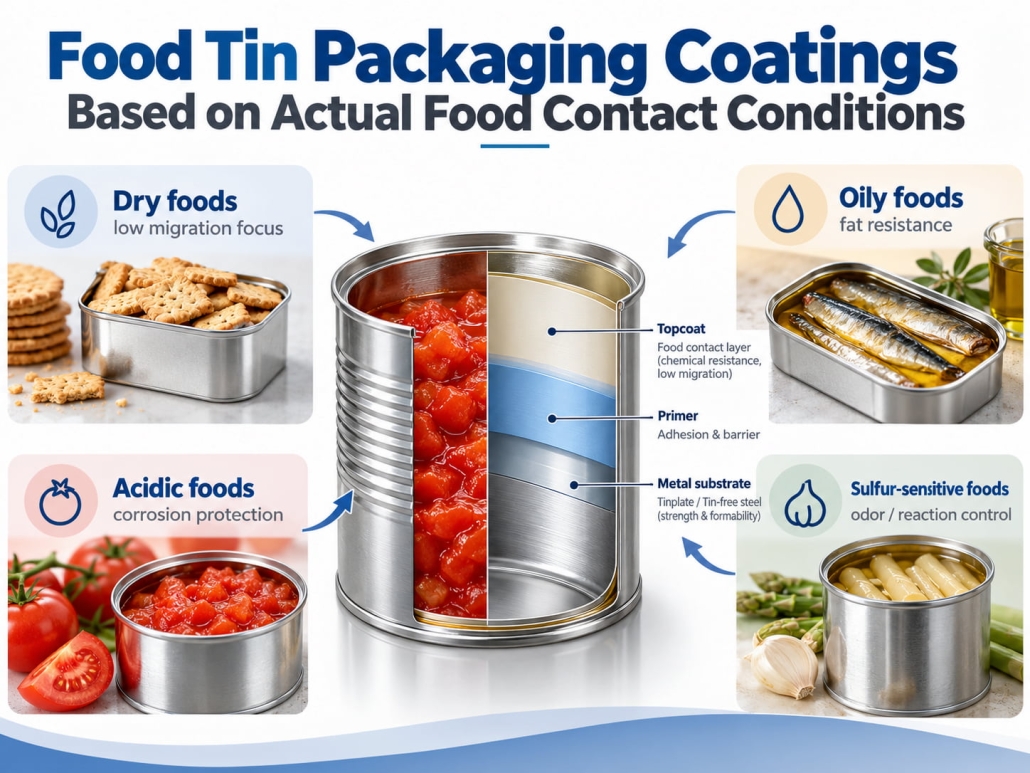
Food Tin Packaging Coatings Based on Actual Food Contact Conditions
The primary consideration is not the coating’s color or whether the inner surface appears transparent, golden, or features other decorative finishes; the key is that the coating must withstand the environmental factors it may encounter throughout the packaging’s lifecycle.
Food contact requirements vary significantly among tea tins, butter cookie tins, candy packaging, and containers for acidic or oily foods. The FDA’s guidance on food contact materials also categorizes food types based on factors such as acidity, moisture content, free fat or oil content, and packaging usage conditions.
Therefore, before determining the interior coating, TSING typically establishes an application profile:
Food ingredients → Direct or indirect contact → Filling conditions → Storage conditions → Expected shelf life → Coating performance requirements
This helps avoid a common procurement pitfall: simply requesting “food-grade coatings” in general terms without specifying the exact application scenario.
Even if two coatings both comply with food contact regulations, they may not be equally suitable for the same food product, temperature, or storage conditions. Therefore, professional tinplate can manufacturers should base coating selection on the intended food product and usage conditions, not solely on appearance.
Food Tin Packaging for Acidic Foods Requires Particular Attention to Chemical Resistance
Food acidity is critical, as acidic products create a vastly different contact environment than dry, low-reactivity foods.
A key design consideration is the integrity of the barrier layer between the food and the metal.
If the coating isn’t suitable for the product, prolonged contact may increase the risk of discoloration, loss of adhesion, surface degradation, or chemical reactions in damaged areas. Therefore, for acidic foods, select a coating that suits the food-contact environment, offers appropriate corrosion resistance, and remains intact after forming and processing.
We have created a simple comparison table for your reference, as shown below:
| Food Characteristic | Main Concern for Food Tin Packaging | Lacquer Selection Focus |
|---|---|---|
| Dry, low-moisture food | Basic food-contact barrier and surface integrity | Approved use, adhesion, forming resistance |
| Acidic food | More demanding chemical contact | Acid resistance and long-term coating stability |
| Moist food | Prolonged contact with water-containing product | Barrier integrity and corrosion resistance |
| Acidic + moist food | Combined exposure | Higher compatibility requirement and validation |
Therefore, when considering acidity, also consider factors such as moisture content, storage duration, and whether the food comes into direct contact with the tinplate. A low pH value does not directly determine the coating choice; coating requirements depend on overall food-contact conditions.
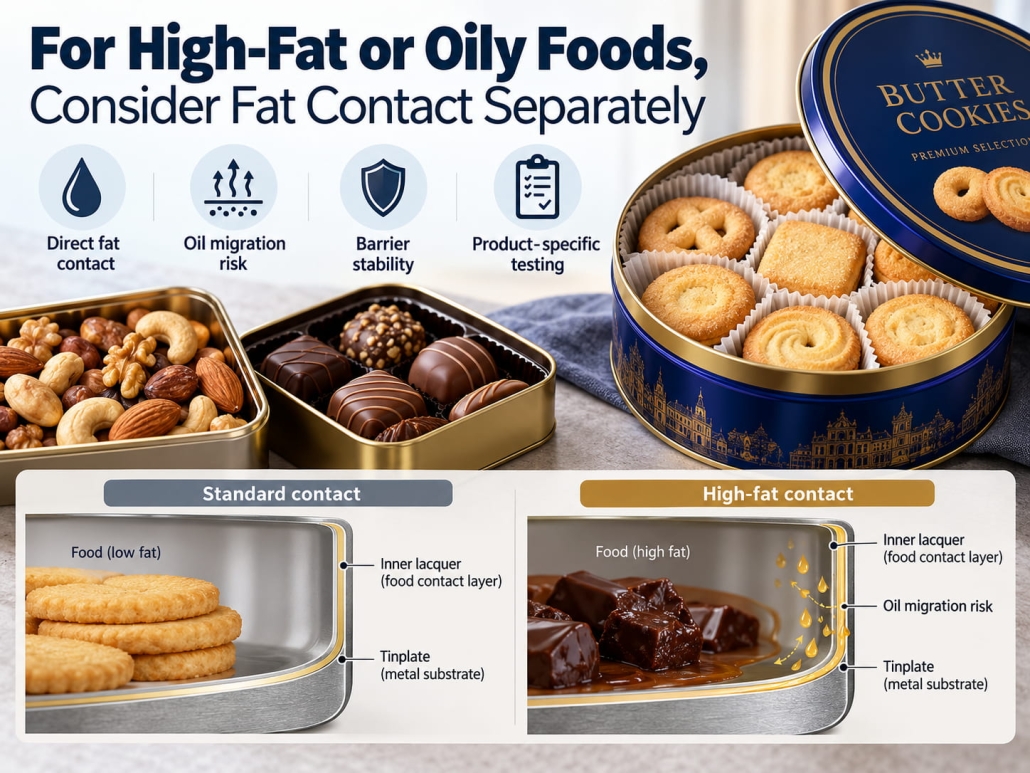
For high-fat or oily foods, consider the issue of fat contact separately
The FDA’s classification standards for food contact materials distinguish between foods containing free fats and those without free fats on their surfaces; for example, baked goods and dry solid foods are classified into different categories based on the presence or absence of free fats.
This distinction matters for foods such as butter cookies, chocolate products, candies, nuts, and others where fats may contact the inner surface of the packaging. Take butter cookies, for example: while they may appear to be a simple dry food, their surface may contain enough fat to create contact characteristics that differ entirely from those of completely dry, fat-free solid foods.
Therefore, when designing tin packaging for such foods, TSING focuses on the following three practical considerations:
Is there free fat present on the food’s surface?
Does the food come into direct contact with the coating?
How long does this contact last before consumption?
If the cookies are individually wrapped or placed in a sealed inner pouch, the tin serves primarily as secondary structural protection and decorative packaging; however, if the unwrapped product comes into direct contact with the coated metal, compatibility between the coating and the actual product becomes critical. This principle also applies to chocolate and candy products.
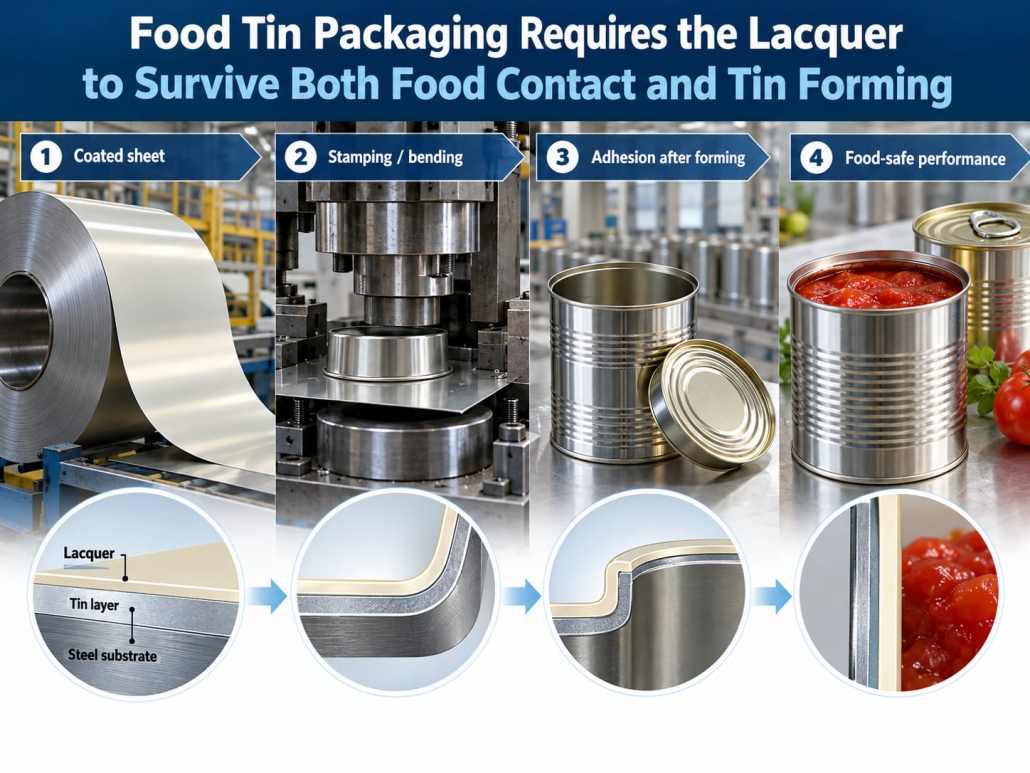
Food Tin Packaging Requires the Lacquer to Survive Both Food Contact and Tin Forming
Chemical compatibility is only one factor when selecting a coating. The coating must also withstand the manufacturing processes that transform coated tinplate into final packaging.
During stamping and forming, coated sheet metal may bend, stretch, flange, emboss, or edge-form. If a coating performs well on a flat test panel but develops cracks or loses adhesion after forming, it will fail to provide the expected protection for the final tin packaging.
Therefore, when evaluating coating performance, TSING conducts a comprehensive assessment that considers the tinplate’s physical structure to ensure the expected surface properties are consistently achieved during mass production.
Verifying coating compatibility
The final selection of a coating should be based on documented suitability for food contact and verification results specific to the application, rather than mere assumptions.
Our verification process follows this logic:
Identify the food type
→ Determine direct contact conditions
→ Evaluate acidity and exposure to fats and oils
→ Determine filling and storage conditions
→ Select appropriate coating specifications
→ Produce coated and formed samples
→ Inspect coating integrity
→ Conduct application-specific compatibility validation
→ Approve for production
Specific validation methods depend on the food’s characteristics and market requirements. Additional validation measures may include reviewing coating supplier data, verifying compliance with applicable food-contact regulations, inspecting formed components, evaluating adhesion, and conducting compatibility testing using representative foods or appropriate test conditions.
Selecting the Right Inner Coating for Food Tin Packaging
The correct selection should be based on five key factors: food acidity, fat content, moisture content and direct contact conditions, processing and storage conditions, and the coating’s ability to remain intact after tinplate forming. Dry, low-fat products have relatively moderate inner-coating requirements, whereas acidic, oily, high-moisture products, or those with prolonged contact times, typically require more rigorous compatibility assessments.
Therefore, from a tin can manufacturer’s perspective, the correct approach is:
Food Characteristics → Contact Conditions → Coating Performance Requirements → Forming Compatibility → Regulatory Compliance and Application Validation
Coatings for food tin packaging must be compatible with the packaged product for intended food-contact use, chemical resistance, forming performance, and verified conditions of use.
 Facebook
 Twitter
 Linkedin
