
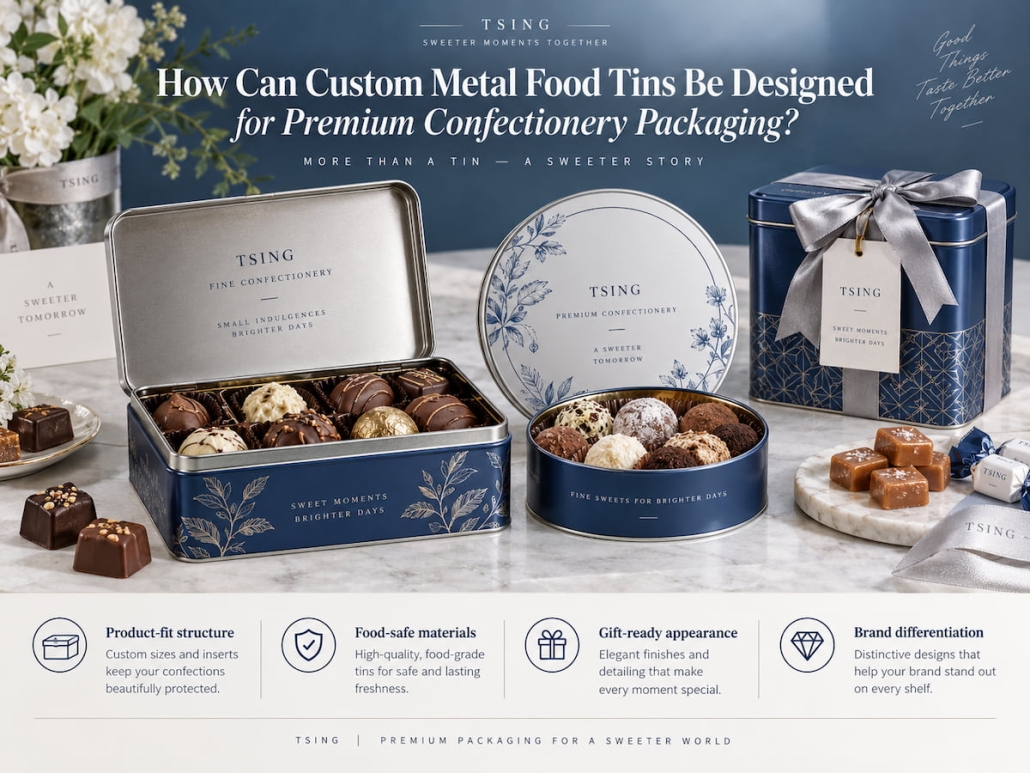
How Can Custom Metal Food Tins Be Designed for Premium Confectionery Packaging?
When designing custom metal food tins for premium confections, the first consideration must be the product’s characteristics: size, shape, fragility, arrangement, shelf-life requirements, and the desired retail display effect. At TSING, we begin by planning the layout of chocolates, candies, truffles, or other confectionery products within the tin, and then determine the required dimensions, lid structure, inner tray design, surface finishes, printing methods, and decorative details.
High-end packaging cannot be achieved simply by adding a metallic finish or embossed effect; the tin must protect the confections, ensure an orderly product display, and consistently deliver the brand’s intended visual identity during mass production. Therefore, TSING employs a standardized process to advance every project, covering every stage from product layout planning and structural design to visual presentation, prototype evaluation, and production validation.
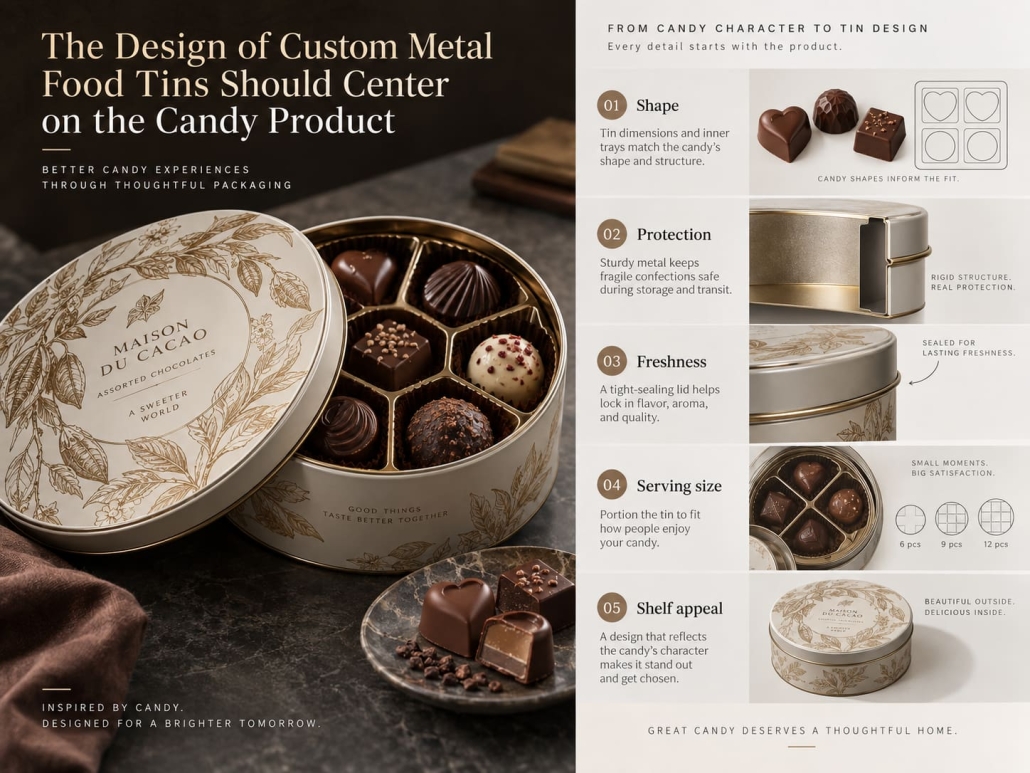
The Design of Custom Metal Food Tins Should Center on the Candy Product
High-quality candy packaging must balance aesthetics with product protection. Before choosing printing effects, embossing techniques, or decorative finishes, TSING first plans the candy’s arrangement, the required internal space, and the structural features needed to keep the product secure. These decisions determine the candy tin’s available dimensions and lay the foundation for the subsequent custom candy tin design.
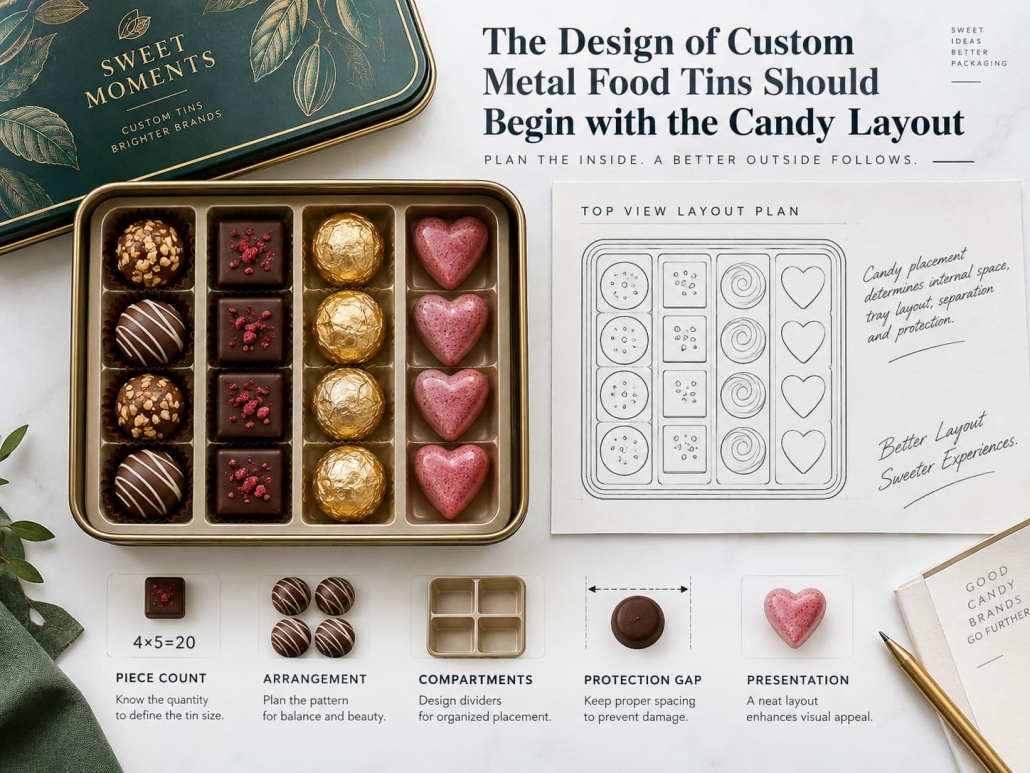
The Design of Custom Metal Food Tins Should Begin with the Candy Layout
The internal product layout is a primary consideration in the design process, as it directly determines the can’s dimensions, the inner tray design, the opening size, and the final display effect.
TSING typically asks clients to provide information such as the dimensions of individual candies, the number of pieces per can, and product shapes. Common internal solutions we offer include molded plastic trays, cardboard inserts, individual paper cups, tiered dividers, or custom grooves.
For high-end confections such as premium chocolates or truffles, the arrangement layout is critical. If the packaging is too loose, products may shift during transit, causing surface damage, peeling decorations, or a disorganized display. Our design objective is not merely to fill the available space, but to create appropriate spacing that ensures the candies are easy to access while preventing excessive shaking or shifting during transport.
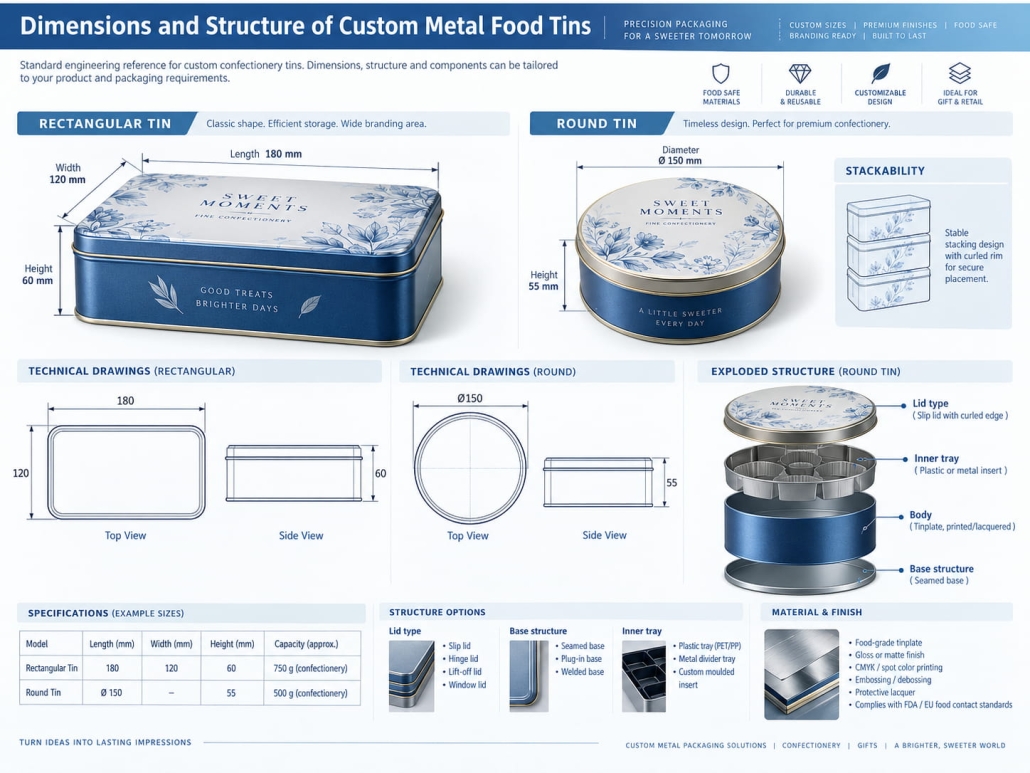
Dimensions and Structure of Custom Metal Food Tins
High-end confectionery packaging must reserve sufficient internal space for the product and inner tray while avoiding unnecessary gaps. Excessive gaps can cause the product to shift, while insufficient space may squeeze the chocolates, damage decorative ingredients, or prevent the lid from closing properly. After determining the arrangement of the confections, TSING will define the metal tin’s external dimensions and structural design.
Key structural factors include:
- The can’s length, width, height, or diameter
- Required internal headspace (top clearance)
- Inner tray thickness
- Lid depth
- Tinplate thickness
- Bottom rigidity
- Stacking stability
For custom candy tins used as gift packaging, TSING also considers their practical value after the candy has been consumed. A metal tin with a sturdy structure, a smooth-closing lid, and durable decorations adds value to the packaging that extends beyond the food itself.
Achieving a High-End Aesthetic Through Surface Design and Production Testing
Once the basic packaging structure is finalized, TSING moves on to designing and developing the exterior surface treatment. This phase encompasses printing, metallic finishes, matte or glossy finishes, embossing, and other decorative techniques. These elements must align with the brand’s design philosophy and the can’s shape, and TSING validates them through physical prototyping before mass production.
Custom Food Tins Feature Surface Finishes That Complement the Brand
No single finish automatically gives custom metal food tin a premium feel. The appropriate finish depends on the design motif, brand image, product category, and the desired retail display effect.
We offer the following common finish options:
- White Magnetic +4C
- White Ink +4c
- Pantone
- Gloss Silver
- Gloss Gold
- UV+Matte
- Explosion Ink
- Rubber Varnish
- PearlInk
Consider decorative effects alongside the printing process’s characteristics. Print quality for fine text, color gradients, metallic areas, and dark solid color blocks on tinplate often differs from that on cardboard. Therefore, before finalizing a custom candy tin design, TSING will evaluate the draft based on the actual metal substrate.
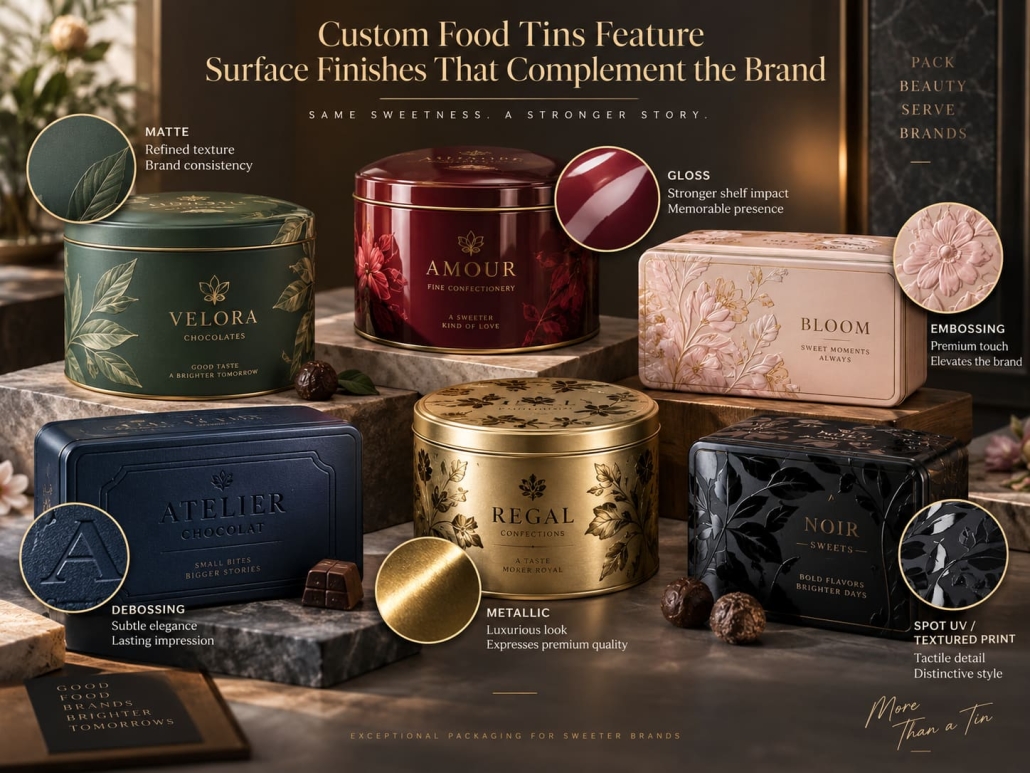
Embossing Enhances Design Impact
Embossing can enhance the premium feel of candy tin packaging, but it should be used selectively. Areas suitable for embossing include:
- Brand logos
- Product names
- Decorative borders
- Central design elements
- Localized three-dimensional patterns
However, not all design elements suit embossing. When developing custom metal food tins, we evaluate the relationship between the embossing process, design patterns, and the structural forming process. For many high-end custom candy tins, a minimalist embossed logo or central brand motif often yields better results than covering the entire lid with embossed details.
Prototyping and Validation Should Be Conducted Before Mass Production
Evaluate the final design as actual packaging, not just renderings. TSING uses prototyping to validate the combined effects of structural design, product layout, printing, surface treatment, and decorative details.
Standard inspection items include:
- Fit between the product and the inner tray
- Smoothness of lid opening and closing
- Internal headroom
- Alignment accuracy of printed and embossed patterns
- Consistency of surface finishes
During validation, we use actual candies or dimensionally accurate mock-ups whenever possible. This validation phase ensures that TSING can refine the design of custom candy tins before mass production begins.
Providing Comprehensive Custom Candy Packaging Design
When designing custom metal food tins for high-end candy packaging, we follow this design process:
Candy dimensions → Product layout → Tin dimensions → Internal support structure → Lid and overall structure → Graphic design → Surface treatment → Embossing (if required) → Prototyping → Product fit verification → Mass production
We follow this process because high-end candy packaging must balance visual appeal with physical functionality. We believe that the finest custom metal food tins are not merely decorative containers, but rather packaging designs meticulously crafted around the candy itself, its presentation, the brand image, and the requirements for repeatable production.
 Facebook
 Twitter
 Linkedin
