
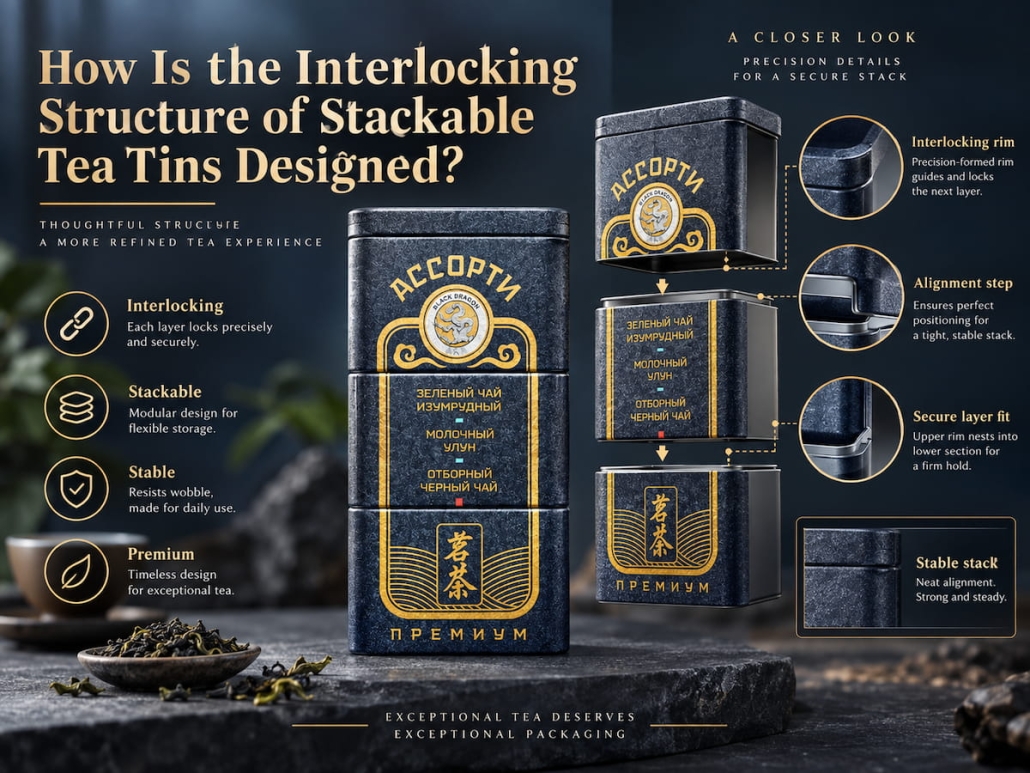
How Is the Interlocking Structure of Stackable Tea Tins Designed?
The interlocking structure of stackable tea tins treats each layer as part of a unified mechanical system rather than an independent container. We first determine the tea-tin diameter, number of layers, fill weight, opening mechanism, and required stacking height. Next, we design the geometric fit between the upper and lower cans, including shoulder positioning, bottom grooves, contact surfaces, and gaps between adjacent layers. During the design process, TSING evaluates connection stability, separation force, wobble, dimensional consistency, and molding tolerances before prototyping. Therefore, a successful stackable tea tins design must achieve three objectives simultaneously: precise alignment, stable stacking, and easy separation during daily use.
The Stackable Tea Tins Design Begins with the Geometry of the Interlocking Layers
The basic function of an interlocking tea tin structure is simple: the upper container must sit precisely on the lower container without sliding arbitrarily or becoming difficult to separate. To achieve this consistently, the mating surfaces of the upper and lower containers must be designed as a single unit. Therefore, TSING develops the connection-point geometry before finalizing decorative embossing, printing, or other non-functional details.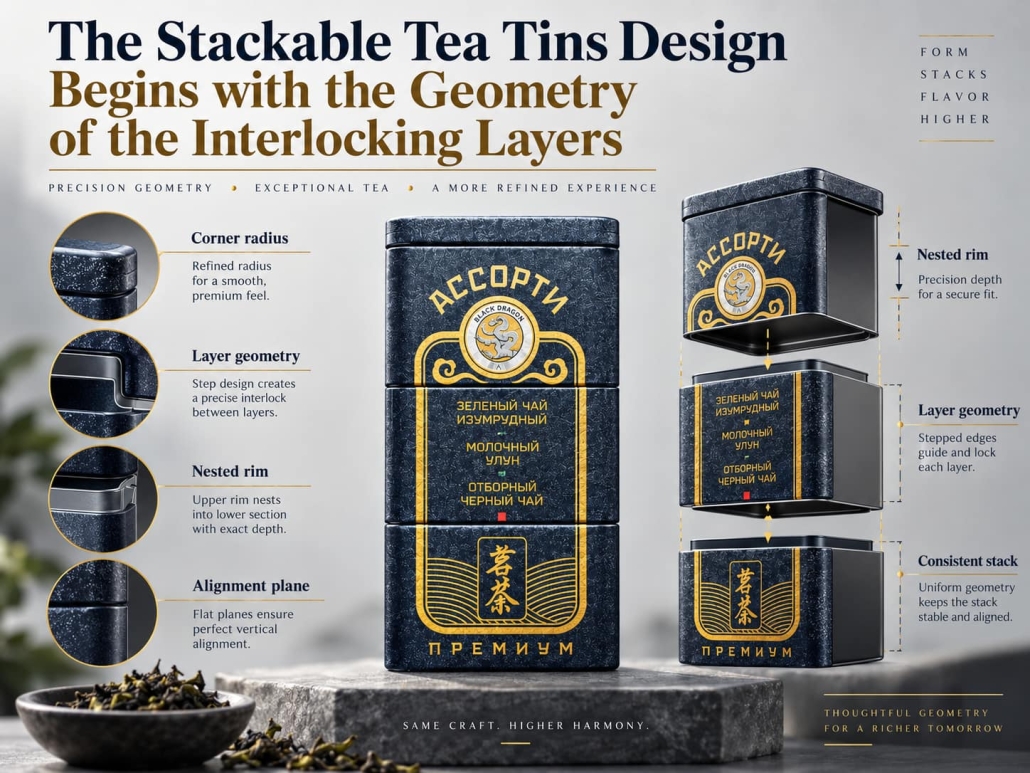
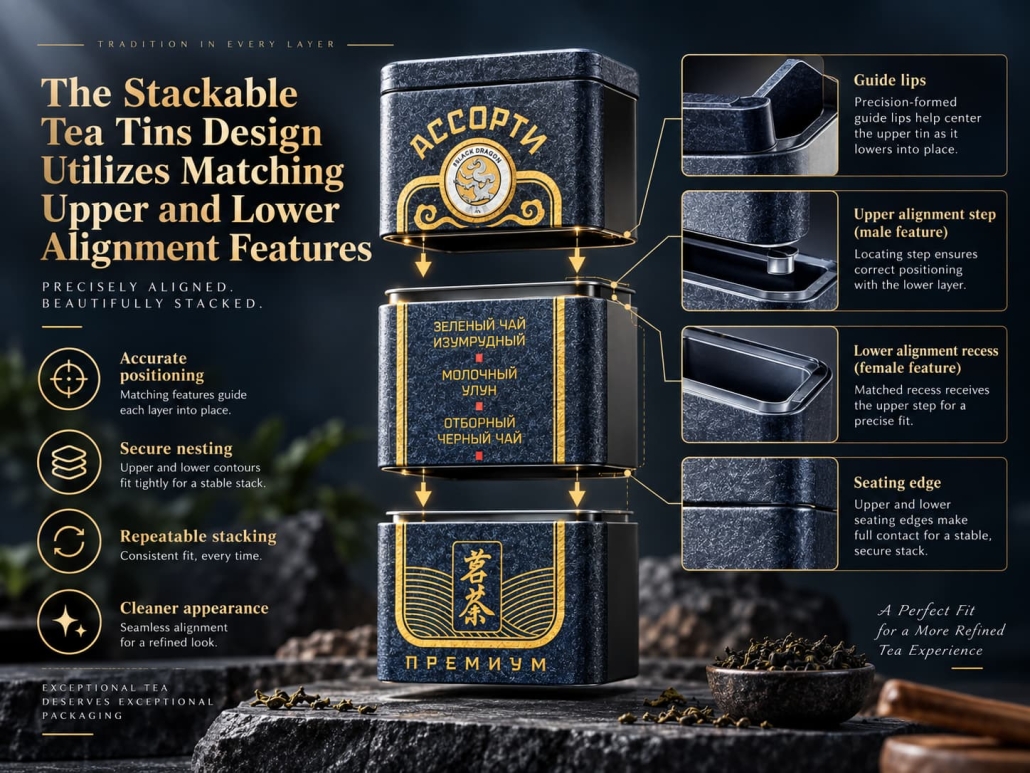
The Stackable Tea Tins Design Utilizes Matching Upper and Lower Alignment Features
The connection between layers of stackable tea tins typically relies on complementary structural features rather than flat contact surfaces alone.
Common structural design elements include:
- A raised alignment shoulder around the top of the lower tea can
- A matching recessed area on the bottom of the upper tea can
- Controlled peripheral contact surfaces
- A specific insertion depth that restricts lateral movement
When an upper tea tin is placed on a lower unit, the bottom groove engages the positioning features below. This design ensures consistent alignment and prevents the cans from sliding against one another. For round tea tins, the positioning features can take the form of a continuous circular contour. For square or rectangular stackable tea tins, corner rounding radii and straight-wall alignment are critical.
TSING also considers the disassembly method. Stackable structures do not necessarily need to operate like “snap-fit” closures. In many tea packaging applications, a better solution is a “controlled positioning fit”: one that ensures stable alignment during handling while allowing consumers to remove a layer effortlessly.
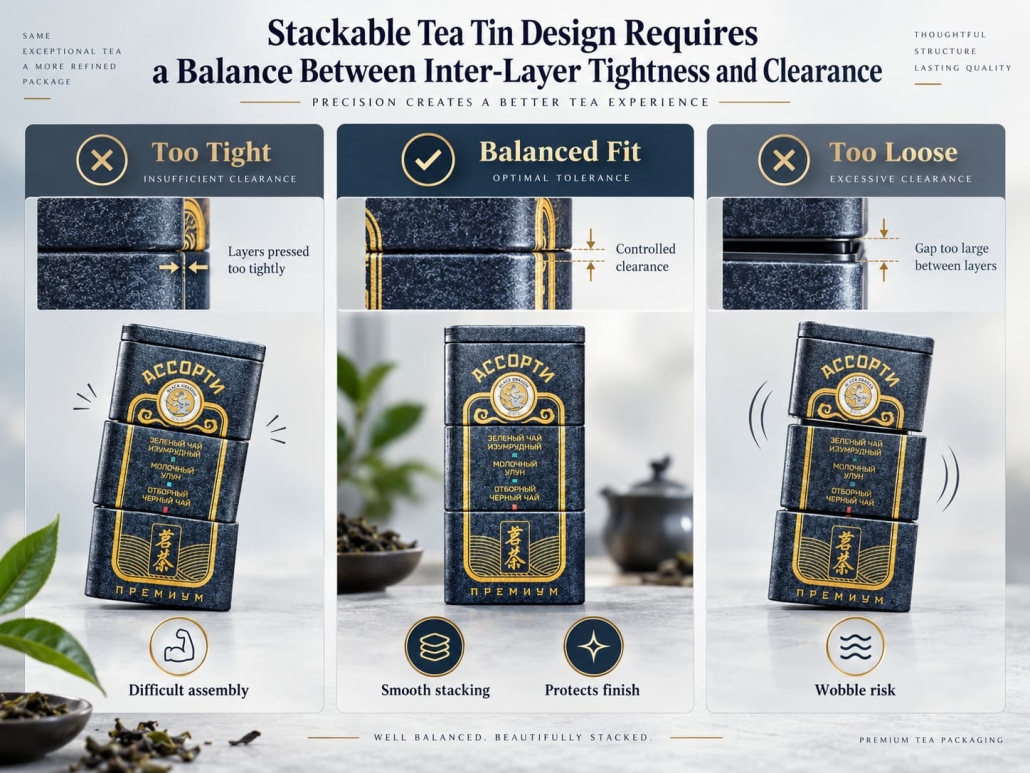
Stackable Tea Tin Design Requires a Balance Between Inter-Layer Tightness and Clearance
The fit between layers is one of the most critical aspects of the entire structure.
If the interlocking areas are too loose, the upper tea can may shift laterally, resulting in noise, misalignment, and unstable stacking. If they are too tight, users may need to pull or twist with force to separate the layers; furthermore, normal manufacturing tolerances may make the fit noticeably tighter on some products than others.
Therefore, TSING has designed controlled clearances between mating surfaces rather than using zero-clearance connections. The required fit depends on various factors, including tinplate thickness, diameter or overall footprint, the depth of the positioning structure, forming processes, surface coatings, and printing, among others. Contact-area design is also crucial. When designing stackable tea tins, TSING evaluates these variables comprehensively rather than adjusting a single dimension.
For multi-layer tea can packaging, our design goal is to achieve a structure that provides both reliable positioning and a smooth sliding fit—avoiding both uncontrolled loose stacking and unnecessary forceful mechanical locking.
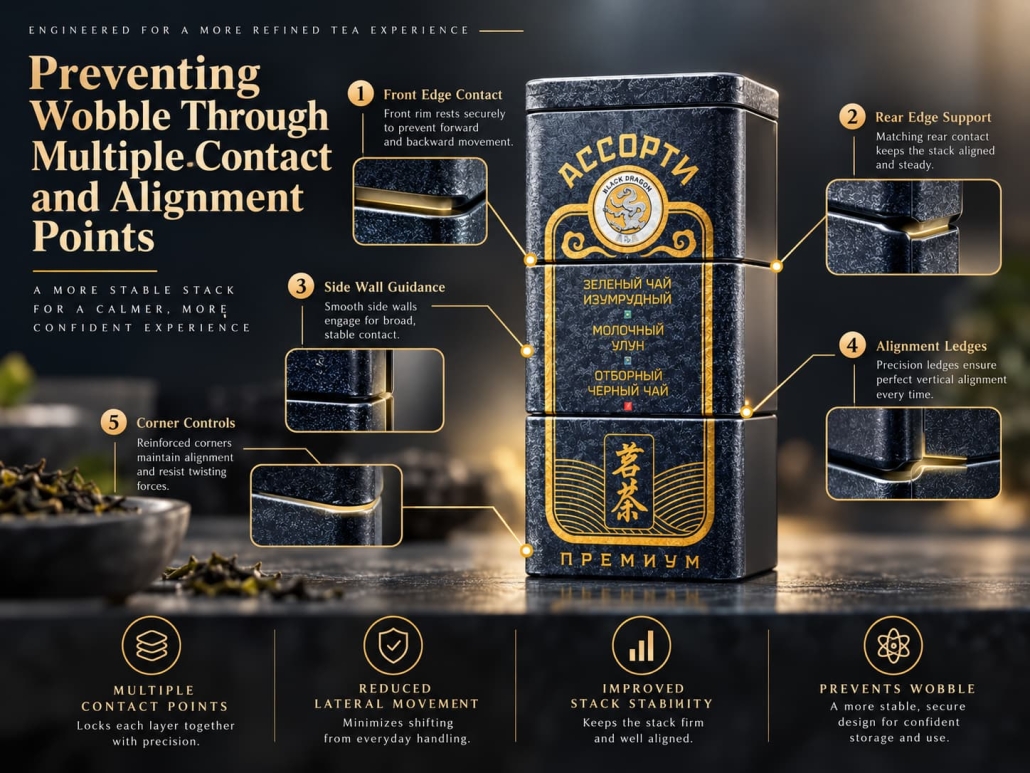
Preventing Wobble Through Multiple Contact and Alignment Points
Wobble typically stems from excessive radial clearance, insufficient insertion depth, uneven contact surfaces, or accumulated dimensional deviations. Therefore, simply increasing the fit tightness is insufficient to achieve stable stacking. TSING first verifies that the upper container is positioned on a clearly defined support surface. Loads should be transferred through predetermined structural areas, rather than through random contact points caused by deformation or uneven molding.
We pay attention to the following design details to enhance stability:
Adequate positioning depth between layers
Uniform support around the mating edges
Controlled radial clearance
A flat and rigid base plate
Symmetrical molding at the stacking interfaces
Appropriate corner radius for non-circular containers
Sufficient structural rigidity for the anticipated load weight
For stackable containers, reducing wobble requires a careful consideration of interlocking geometry, panel rigidity, dimensional consistency, and overall packaging proportions.
The Stackable Tea Tins Design Requires Strict Control of Manufacturing Tolerances and Validation
Even if the structure appears flawless on 3D drawings, actual performance may still be inconsistent if critical fit dimensions change during the forming process. Processes such as cutting, stamping, flanging, can body forming, seaming, coating, and tinplate assembly all introduce normal manufacturing deviations. Therefore, TSING clearly identifies the key dimensions that directly determine interlocking performance and controls them strictly.
The Quality of an Interlocking Structure Design Depends on the Control of Key Fitting Dimensions
Not all tea can dimensions require the same level of strict control. For interlocking structures, the most critical dimensions typically include the following:
- Outer diameter of the positioning shoulder
- Inner diameter of the mating groove
- Engagement depth
- The height of the support step
- The flatness of the can bottom
- The roundness of the lid or body of a cylindrical can
These dimensions determine whether products from different batches can maintain a stable fit between layers when stacked. TSING also considers the cumulative effect of tolerances. A minor deviation in a single component may fall within acceptable limits. Still, if multiple deviations accumulate in the same direction, the stack may become too loose or too tight. For example:
Forming deviation + coating thickness + can bottom deformation + positioning feature deviation = actual interlocking fit
For this reason, stackable tea tin design cannot rely solely on nominal CAD dimensions; it must also incorporate mold capabilities and the characteristics of tinplate after forming. Determine specific tolerance values based on can dimensions, geometry, material thickness, mold processes, and production equipment.
Comprehensive Design of Interlocking Structures for Stackable Tea Tins
Tea capacity and number of layers → Determination of container dimensions → Design of interlocking geometry → Setting of positioning depth and clearance → Structural support design → Mold design → Prototype molding → Multi-layer fit testing → Tolerance adjustment → Mass production validation
At TSING, this process ensures stackable tea tins are more than containers you can stack on top of one another. A well-designed stackable tea tin ensures precise alignment between layers, minimizes wobble, maintains an appropriate separation force, and consistently delivers the same stacking performance throughout mass production.
 Facebook
 Twitter
 Linkedin
