
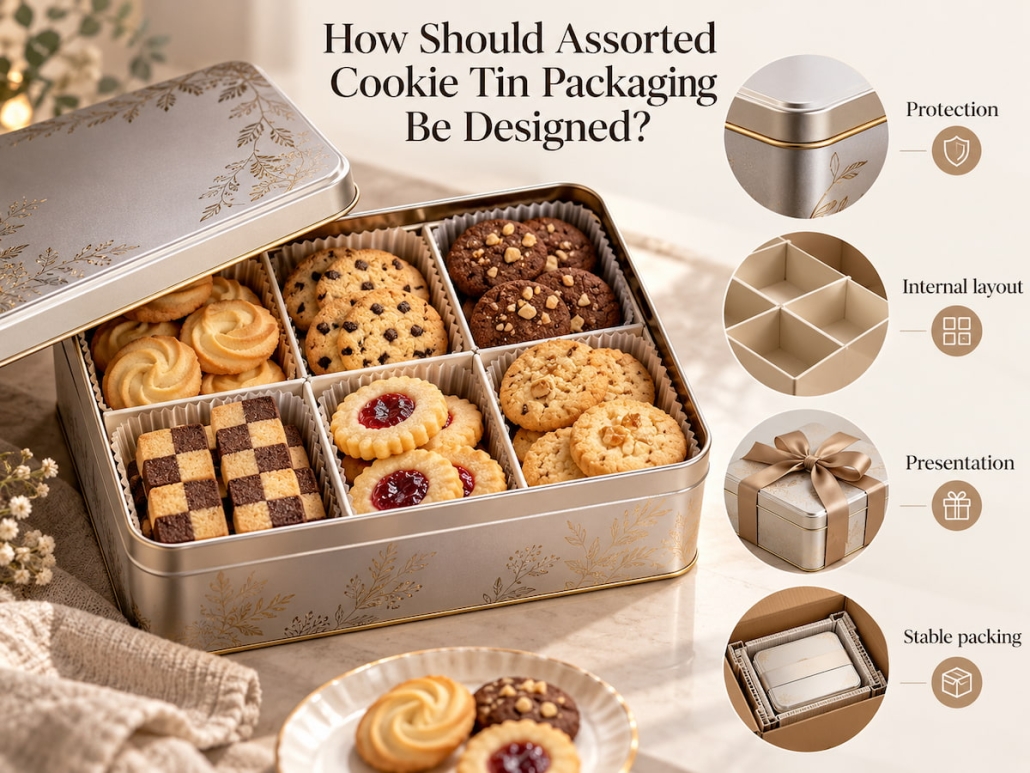
How Should Assorted Cookie Tin Packaging Be Designed?
At TSING, we design assorted cookie tin packaging using an “inside-out” approach—starting with the cookies themselves rather than the tin’s shape. We begin by confirming the number of cookie varieties, individual dimensions, fragility, surface coatings, packaging methods, and intended arrangement. Based on this, we determine the internal layout, divider or tray structure, number of layers, required headroom, tin dimensions, and lid configuration. Our goal is to prevent cookies of different sizes and textures from colliding, shifting, or damaging each other during transport, while ensuring the gift tin looks neat and orderly. Therefore, cookie tin design depends on a precise match between the internal structure and the actual cookie assortment—rather than selecting a standard tin first and then forcing the products to fit.
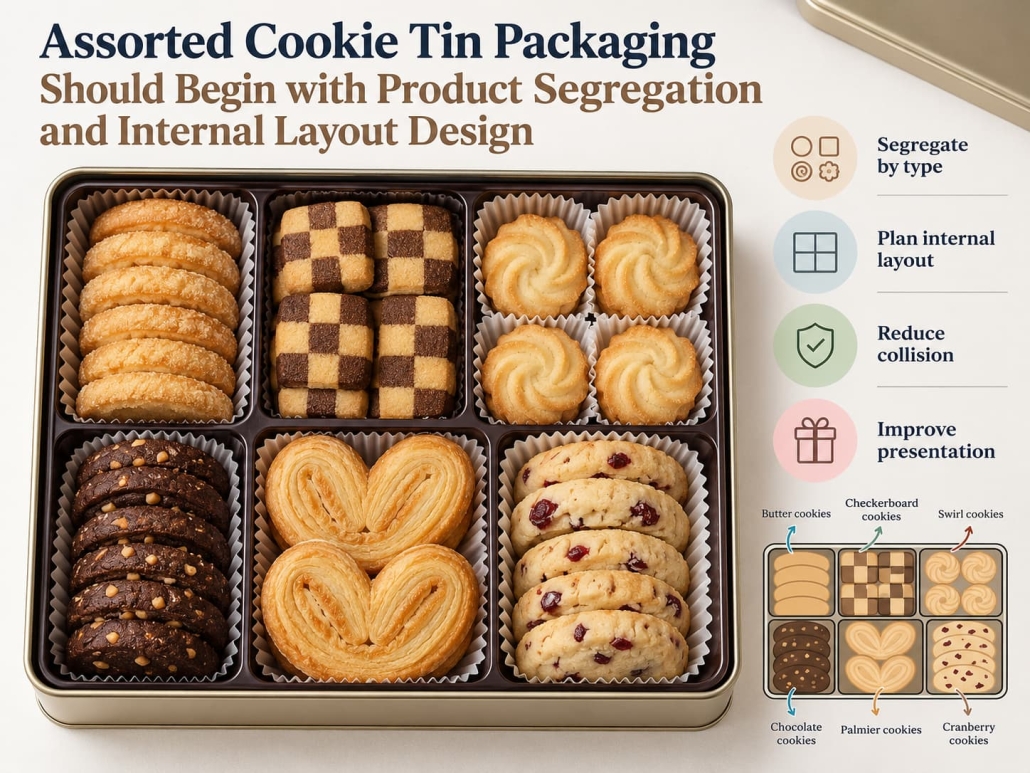
Assorted Cookie Tin Packaging Should Begin with Product Segregation and Internal Layout Design
The design challenges of assorted cookie tin packaging differ fundamentally from those of single-variety cookie packaging. Different products may vary in diameter, thickness, edge strength, surface decoration, and characteristics such as oil or moisture content. Therefore, TSING first reviews the assorted cookie mix to determine which cookies can safely share space and which ones need to stay separate. This internal layout forms the foundation for subsequent tin design, including divider types, compartment dimensions, layer heights, and the tin’s overall dimensions.
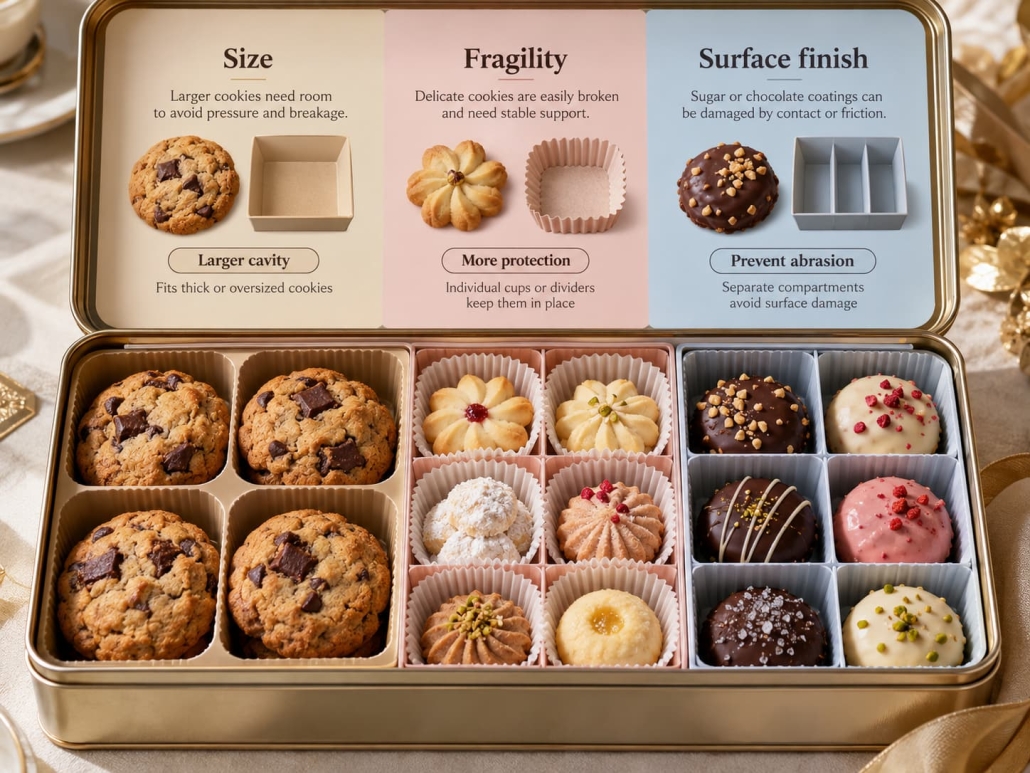
Compartmentalizing Assorted Cookie Tin Packaging Based on Size, Fragility, and Surface Characteristics
Butter cookies, chocolate-coated cookies, filled cookies, and thin wafer cookies react differently to vibration and impact. Harder cookies may damage more fragile ones; meanwhile, surfaces with chocolate coatings or icing decorations may develop scratches or wear marks if repeatedly rubbed against adjacent products. Before finalizing the internal structure, TSING typically confirms the following information:
- The diameter, length, and width of the cookies
- The thickness of the cookies
- The quantity of each variety
- Any surface coatings or decorations on the tin
- Whether the cookies are individually wrapped
- Expected shipping conditions
The primary objective is to establish a clear product placement plan. The best layout for assorted cookie tins is to divide the interior space into two zones or create separate compartments based on the dimensions of the different cookie varieties.
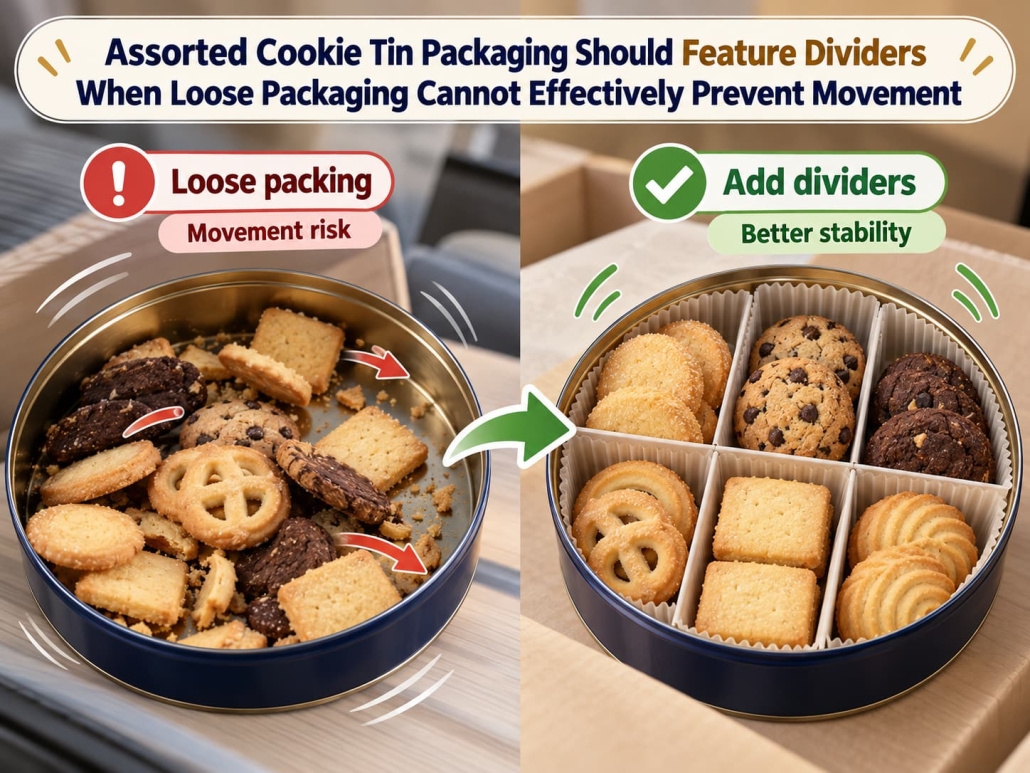
Assorted Cookie Tin Packaging Should Feature Dividers When Loose Packaging Cannot Effectively Prevent Movement
Dividers are particularly useful when assorted cookies include products with different shapes, fragile edges, decorated surfaces, or those that need to remain visually distinct. However, not all assorted cookie tin packaging projects require the same divider design.
TSING offers several common internal configurations:
- Cardboard dividers: Used to separate larger groups of products
- Molded plastic trays: Used for precise single-item positioning
- Paper cups: Suitable for cookies or candies that require individual display
- Spacers: Used to separate stacked rows
- Custom molded inserts: Suitable for irregularly shaped or premium assorted combinations
Cardboard dividers work well when the main goal is to keep different cookie groups from bumping into each other or getting mixed up. Molded trays provide tighter positioning control. These trays are typically better for fragile cookies, high-end products, or items that need to be displayed in a fixed arrangement. Individual paper cups separate products and create a traditional candy-style display effect, but they don’t provide as much structural stability as form-fit cavity trays.
When selecting dividers, also consider the tin’s dimensions. If the dividers leave too much space around the cookies, the products may still shift within the individual compartments.
Minimize the Number of Layers as Much as Possible While Meeting Protection and Display Requirements
No universal “optimal” number of layers exists for assorted cookie tin packaging. In most cases, the right number of layers depends on cookie thickness, total quantity, fragility, tin height, and how consumers are expected to open and consume the product.
A single-layer design offers the best visual presentation. It also minimizes the vertical pressure exerted on the cookies. However, for larger quantities, a single-layer design requires more floor space in the tin.
A two-layer design can improve space utilization, provided that the upper and lower layers are properly separated. TSING may use rigid divider panels, trays, or cardboard dividers to prevent the upper layer of cookies from pressing directly onto the products below.
While a three-layer or multi-layer structure can increase loading capacity, it also adds challenges, including increased packaging height, greater vertical load-bearing stress, and difficulty accessing cookies from the bottom layer.
For high-end assorted cookie tins, rather than simply maximizing the number of cookies in a deep tin, a well-designed one- or two-layer structure often better balances display appeal, load capacity, and product protection.
Packaging Design for Assorted Cookie Tins Must Balance Dimensions and Production Feasibility
Once TSING finalizes the cookie arrangement, divider structure, and number of layers, it can determine the tin box’s final dimensions and structural details more precisely. At this stage, TSING shifts from layout planning to ensuring the entire package can be produced reliably and perform as required during filling, transportation, and retail display.
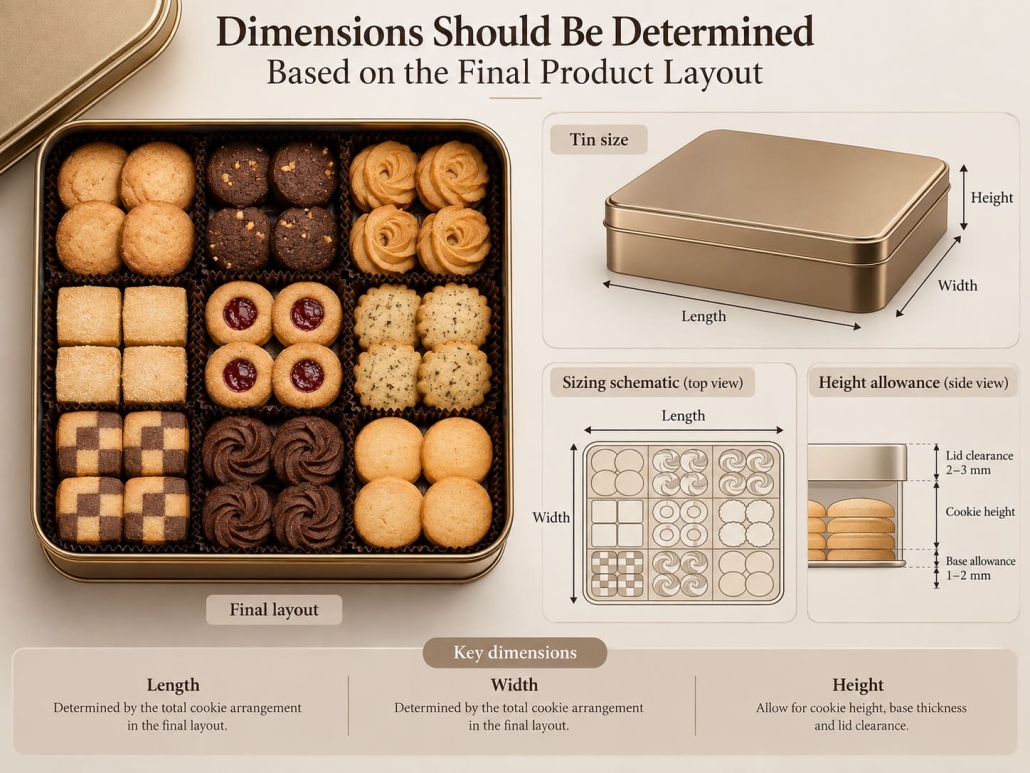
Dimensions Should Be Determined Based on the Final Product Layout
Calculate the tin’s external dimensions based on the final internal layout, rather than selecting them independently. Key design considerations include:
- Total floor area occupied by the cookies
- Divider thickness
- Tray dimensions
- Clearance around the liner
- Number of layers
- Thickness of divider spacers
- Headroom (clearance at the top)
- Lid insertion depth
If the tin is too large, it creates unnecessary gaps that allow the liner or cookies to shift. If it is too small, it can compress the cookies, deform the dividers, or cause the lid to press against the top layer. The design of cookie tins must also ensure structural rigidity. For large, shallow tin boxes, you may need to reduce surface deformation by adjusting tinplate thickness, optimizing edge and corner geometry, setting an appropriate lid depth, or adding reinforcing ribs.
Creating a Well-Designed Assorted Cookie Tin Packaging
High-quality packaging for assorted cookies should match the specific cookie mix instead of relying on standard tin box dimensions. TSING first classifies the cookies by size, fragility, surface texture, and packaging method, then determines whether the package needs dividers, trays, paper cups, or interlayer spacers. When setting the number of layers, we strive to keep the design as streamlined as possible while meeting capacity requirements; for high-end assorted cookie gift boxes, we typically use a stable, one- or two-layer layout that provides better protection while presenting a more refined visual appearance.
The final tin dimensions must account for cookie size, divider thickness, internal clearance, headroom, and lid insertion depth.
The design process is as follows:
Cookie type and size → Separation method → Selection of dividers or trays → Number of layers → Internal clearance → Tin dimensions → Lid structure → Testing of the finished packaging
A well-designed assorted cookie tin should keep each cookie securely in place, prevent fragile varieties from colliding and breaking, avoid excessive vertical pressure, and ensure a neat, orderly visual presentation when opened.
 Facebook
 Twitter
 Linkedin
