
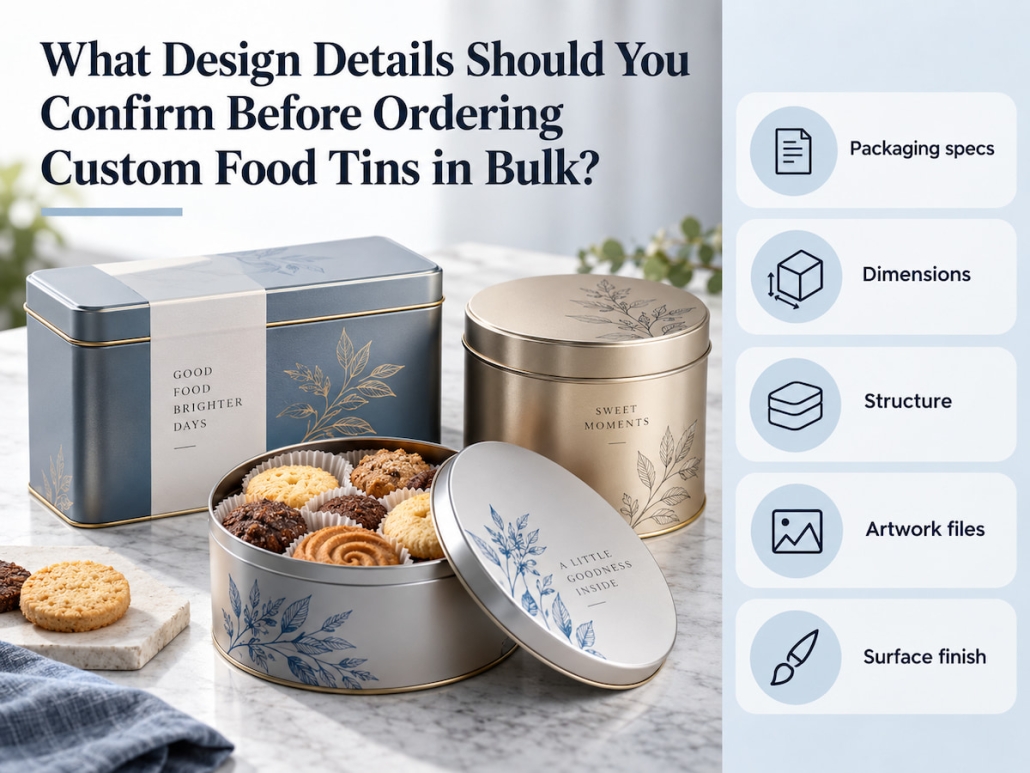
What Design Details Should You Confirm Before Ordering Custom Food Tins in Bulk?
Before placing a bulk ordering custom food tins, buyers should confirm details such as packaging dimensions, product layout, tin structure, lid type, printed designs, surface finishes, and internal trays or dividers. At TSING, before finalizing production specifications, we also need to understand the type of food, the quantity per box, reference dimensions, preferred opening method, design files, and the estimated order quantity. These details determine whether we can use existing molds, the tin forming process, the placement of printed designs, and how well the finished packaging fits the product. Confirming these requirements before mold fabrication, printing, and mass production helps minimize revisions, ensures a smoother transition from prototyping to production for bulk orders of food tins, and avoids unnecessary changes.
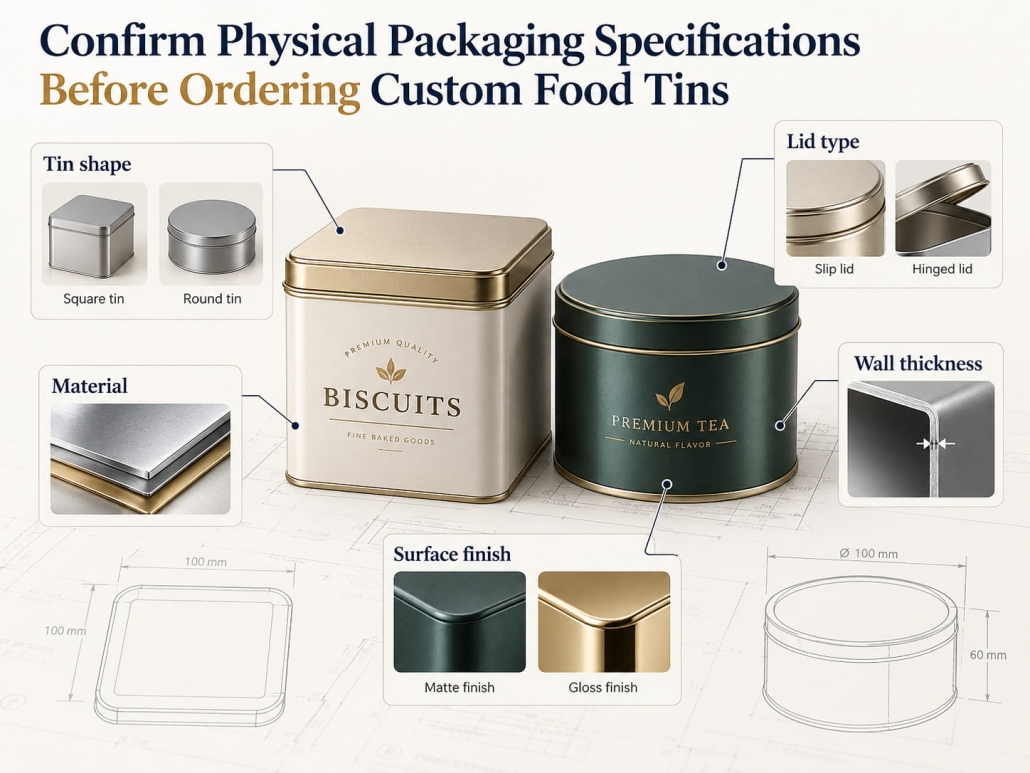
Confirm Physical Packaging Specifications Before Ordering Custom Food Tins
Before approving print files, determine the tin’s physical structure. The tin’s dimensions, internal space, product arrangement, lid shape, and forming details all influence the final artwork template and production process. Therefore, we recommend establishing the functional packaging specifications first, then defining the desired aesthetic design requirements based on the confirmed structure.
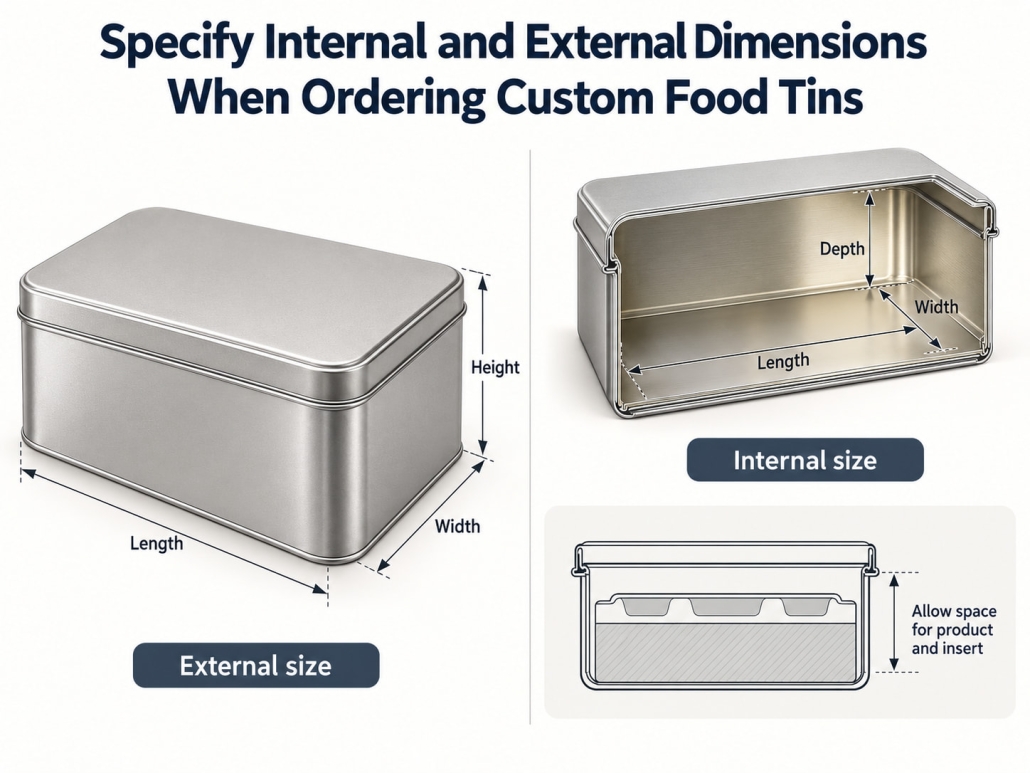
Specify Internal and External Dimensions When Ordering Custom Food Tins
Never determine dimensions based solely on the product name.
When customers request custom cookie tins, they must still specify the exact dimensions and arrangement of the cookies; even when holding the same number of cookies, different arrangements may require significantly different internal volumes. Before producing custom food tins, TSING typically confirms the following information:
Finished tin dimensions (LxWxH)
Finished diameter and height of round tins
Product dimensions
Number of products per tin
Tray or divider dimensions
Lid depth, or the length by which it extends into the body of the tin
For example, if twelve cookies are placed in a molded tray, the tin must accommodate the cookies and allow for the tray’s wall thickness, edge clearance, and vertical space beneath the lid. Selecting only the external dimensions without accounting for the internal structure may result in packaging that looks suitable but cannot hold the finished product.
Therefore, for bulk customization projects involving food tins, TSING recommends confirming the complete packaging layout before finalizing the dimensions.
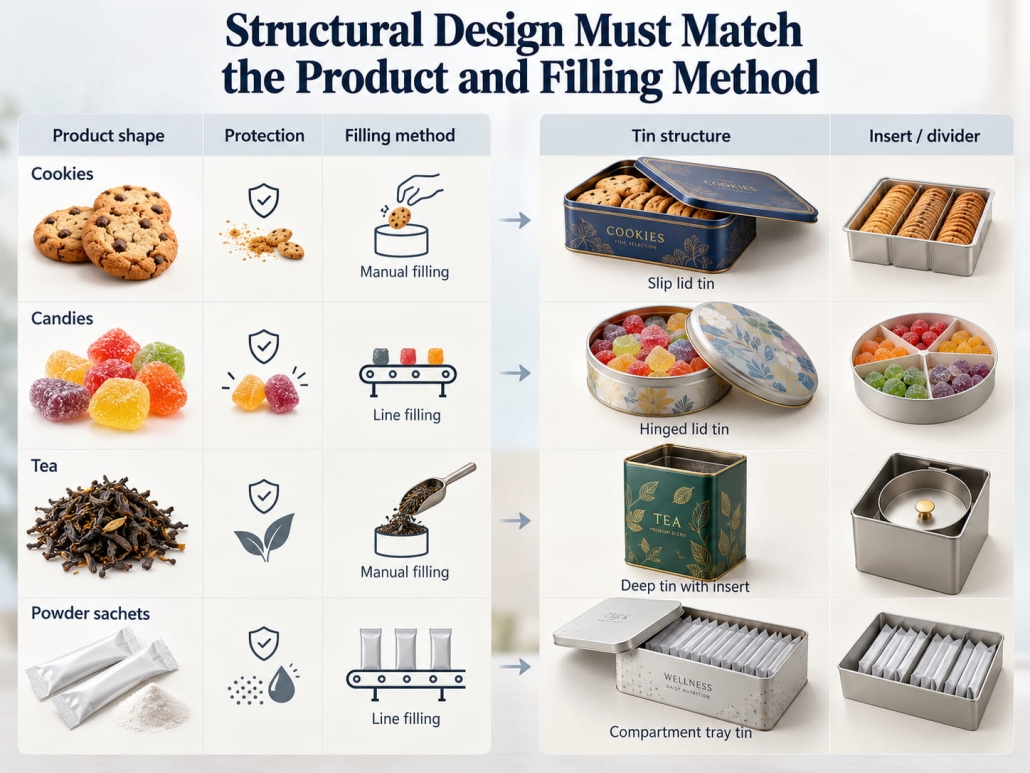
Structural Design Must Match the Product and Filling Method
After determining the dimensions, customers should specify the tin’s structural design requirements. Key structural design considerations include:
Body Shape: Round, square, rectangular, or irregular
Lid Type: Separate or integrated
Edge finishing: rolled edges or formed edges
Surface finish: embossed (raised) or debossed (recessed) effects
Internal components: inner trays or dividers
Stacking requirements
Opening mechanism: hinged (flip-top) or removable lid
Window design (if required)
Reinforcement design for large-surface boxes
For fragile items such as cookies, chocolates, or candies, we may design packaging solutions that include inner trays or partition structures. The filling process is also important. If the opening is too narrow or closing the lid requires too much force, a structural design intended for manual filling may not suit automated or semi-automated production lines.
Therefore, before ordering custom food tins, buyers should not only specify their desired appearance but also provide details regarding:
The product type, the filling method, and expected consumer opening and reuse patterns.
When Ordering Custom Food Tins, Specify the Lid Structure and Closure Method
The lid is one of the most critical elements of the structural design, as it directly affects the opening experience, internal space, visual appeal, and reusability. Common lid types for custom food tin boxes include:
Slip lids
Plug-in lids
Hinged lids
Deep lids
Shallow lids
Each structure offers distinct functional characteristics. Slip lids suit decorative cookie or candy tins because they open easily. Deep lids enhance the visual cohesion between the lid and the tin body. Hinged lids, on the other hand, provide greater convenience for products that require frequent opening. In addition, the required lid fit must be clearly defined.
Therefore, we evaluate the relationship between lid depth, can body dimensions, forming tolerances, coating thickness, and the expected opening force. If the product is a food item requiring a high level of moisture or oxygen protection, the buyer should also confirm whether the metal lid is the primary barrier or whether the product will use inner seal bags, flexible packaging, liners, or individual packaging.
Confirming Design Artwork and Production Details
Once the tin box structure is finalized, the project moves to design artwork preparation and production approval. Print files are created based on the confirmed die line, as factors such as forming edges, lid overlaps, seams, embossing, and curved surfaces affect the design layout. Final production can begin only after both the structural and visual requirements are approved.
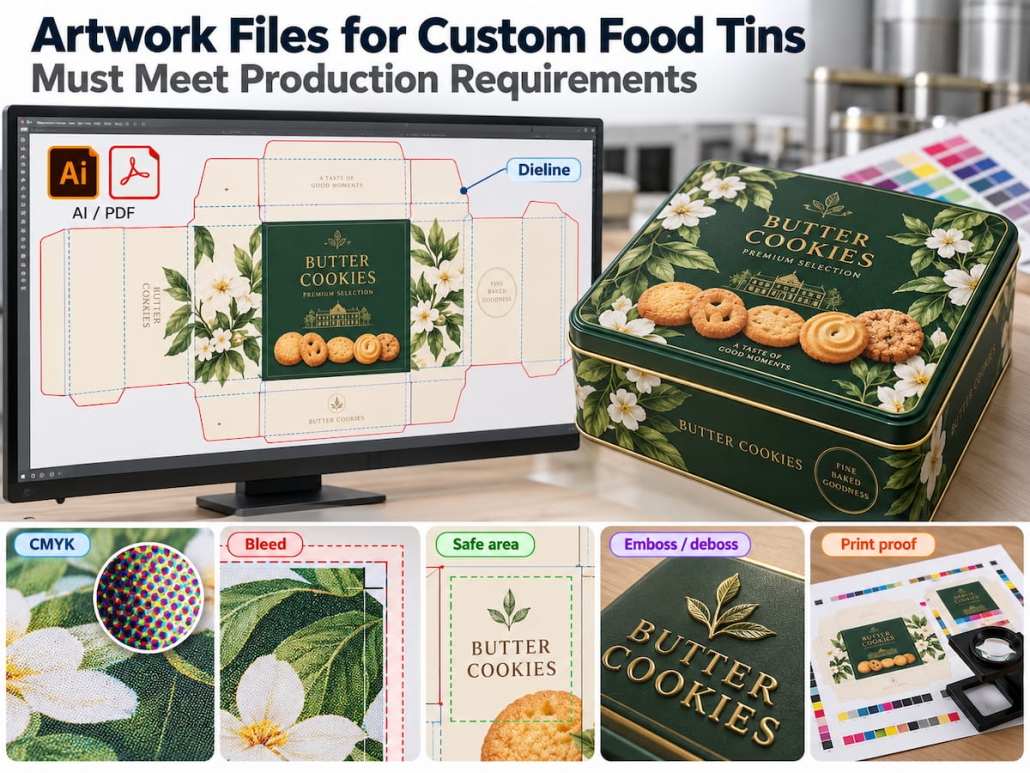
Artwork Files for Custom Food Tins Must Meet Production Requirements
For custom printing, we typically require editable vector artwork—not just low-resolution preview images—whenever possible. Preferred file formats generally include:
Adobe Illustrator files
Editable PDF files
Vector EPS files
High-resolution linked images, if necessary
The artwork should also clearly specify the following information:
- CMYK or specified spot colors
- Pantone color numbers when strict color matching is required
- Logo placement
- Text placement
- Embossed or debossed areas
- Matte or glossy areas
- Metallic finish effects
Create artwork using the actual production die-cut lines provided or approved by the manufacturer. This is because the graphic design’s visual appearance may not perfectly match the final formed tin box. If designs are placed too close to flanges, rounded corners, embossed areas, or lid overlaps, they may look misaligned after forming.
Comprehensive Pre-Production Approval Process
Before placing a bulk order, the client and manufacturer should confirm all specification requirements together, rather than approving details piecemeal.
At TSING, the final review typically covers the following 13 aspects:
Final dimensions of the tin box
Food capacity and product layout
Tinplate specifications
Body and lid structure
Internal trays or dividers
Lid fit
Design draft version
Print Colors
Surface Finish
Embossing or Debossing Effects
Packaging Method
Number of Units per Outer Carton
Approved Physical Sample or Production Sample
Therefore, when placing a bulk order for custom food tins, the most reliable process sequence is as follows:
Product Information → Internal Layout → Dimensions → Tin Structure → Lid Design → Inner Tray Requirements → Design Draft → Surface Finish → Final Approval → Mass Production
Confirming Design Details to Ensure Production Quality
Before placing a bulk order for custom food tins, buyers should confirm six key design details: finished dimensions, internal product layout, tin structure, lid type and fit, graphic design specifications, and surface treatment or decorative finishes. Finalize any requirements involving trays, dividers, embossing, special openings, or stacking features before mass production. For TSING, these details form the foundation for ensuring smooth progress on bulk food-tin orders. Only after confirming all of the above items can custom food tins proceed to mass production.
 Facebook
 Twitter
 Linkedin
