
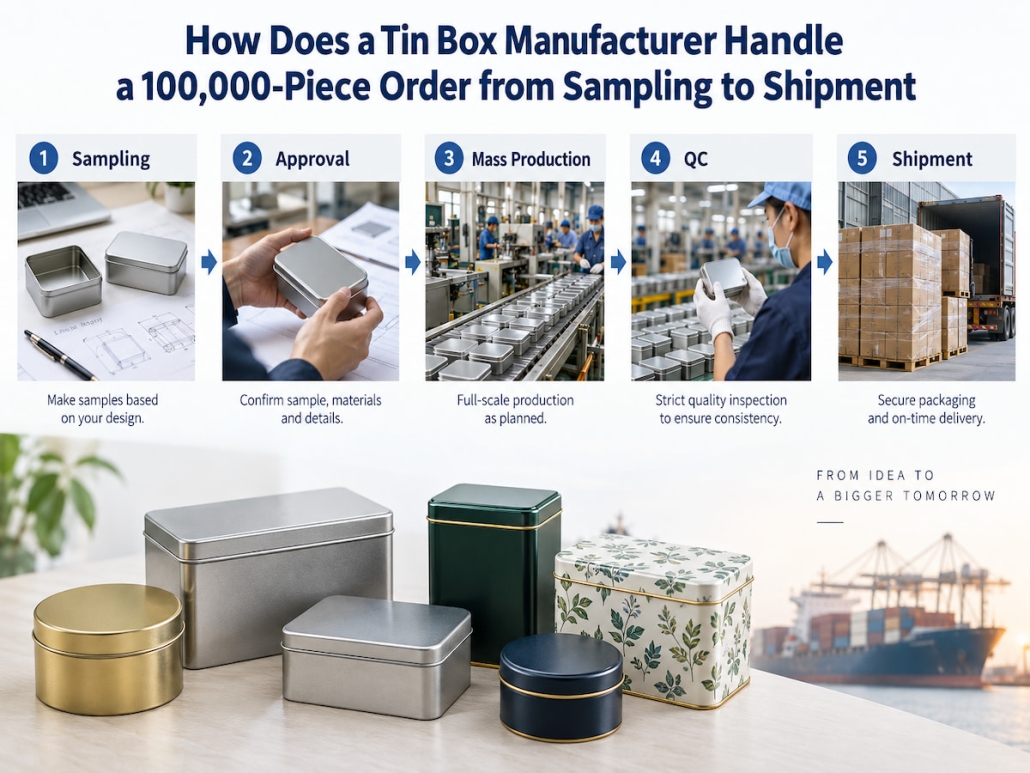
How Does a Tin Box Manufacturer Handle a 100,000-Piece Order from Sampling to Shipment?
With such a large production volume, even the slightest deviation in color, lid fit, embossing, or packaging can affect the quality of thousands of finished tin boxes. Therefore, professional tin box manufacturer prioritize establishing repeatable production standards before mass production begins and ensuring every batch strictly adheres to them.
Our production process for large-volume custom tin cans follows strict control steps:
Sample Approval → Specification Finalization → Material and Capacity Planning → Printing and Forming → Batch Inspection → Packaging → Shipping
TSING currently has over 2,500 molds and more than 8 production lines, with a monthly production capacity of approximately 8 million metal tin cans. This scale advantage lets us coordinate dedicated production resources for large-scale orders. The following outlines how we, as a professional tin can manufacturer, manage orders ranging from the first sample to the final delivery of 100,000 units.
Pre-production Controls by Tin Box Manufacturer Determine Quality Consistency
The first stage isn’t mass production; it’s sample confirmation. For high-volume custom tin cans, the confirmed sample establishes physical reference standards for the following aspects:
Overall dimensions
Fit between the lid and the body
Print colors
Logo placement
Matte or glossy finish
Embossing depth
Surface quality
Internal coating
Functional components
For custom projects involving new structures, TSING may first conduct 3D modeling and mold design before producing physical samples. Before mass production begins, TSING must produce samples for client approval. At this stage, approving design artwork alone is not sufficient. The physical samples must also undergo the following inspections:
Appearance + Dimensions + Closure Performance + Functionality + Product Compatibility
Once the sample is approved, we make no unnecessary design changes.
Finalizing Specifications and Securing Materials Before Production
Preparing for an order of 100,000 pieces involves far more than simply reserving production time.
As a tin box manufacturer, we must calculate and procure all materials required for the entire project, including:
Tinplate
Printed tinplate
Coatings and varnishes
Inner liners or accessories
Outer cartons
Dividers
We must also finalize production specifications to establish clear order standards.
Here is a typical specification sheet we use, which usually includes the following:
| Item | Production Standard |
| Tin dimensions | Approved sample dimensions |
| Tinplate | Confirmed grade and thickness |
| Printing | Approved CMYK/Pantone reference |
| Finish | Matte, gloss, metallic, etc. |
| Structure | Approved lid/body configuration |
| Packing | Pieces per carton + protection method |
For high-volume tin packaging orders, ensure material consistency, as changing material sources or specifications during production may create visually noticeable differences between consecutive batches.
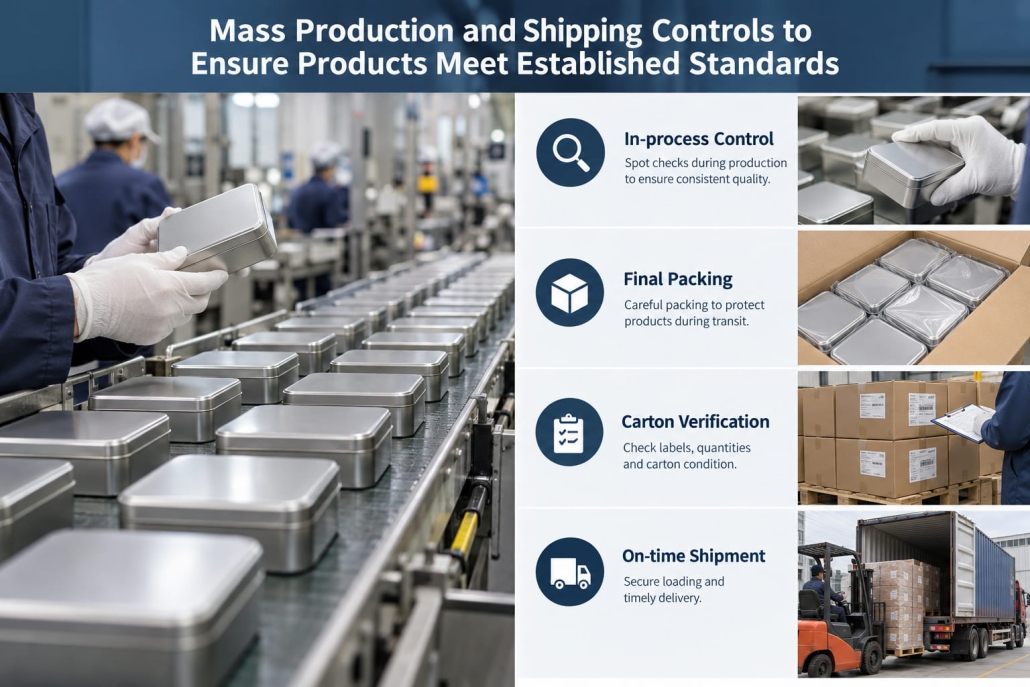
Mass Production and Shipping Controls to Ensure Products Meet Established Standards
Once specifications are finalized, the mass production phase begins. Our production process consists of the following steps: tinplate preparation, printing, metal sheet cutting, forming, inspection, packaging, and shipping. For an order of 100,000 tin boxes, there are corresponding control points at each stage of production. For example:
1. During the printing stage, the team inspects:
Color consistency;
Registration accuracy;
Surface defects;
Appearance quality of the varnish or coating.
After printing, the metal sheets are cut according to the required part layout.
2. During the forming stage, dies are used to produce:
The can body;
The can lid;
The can bottom;
Hinges or other structural features.
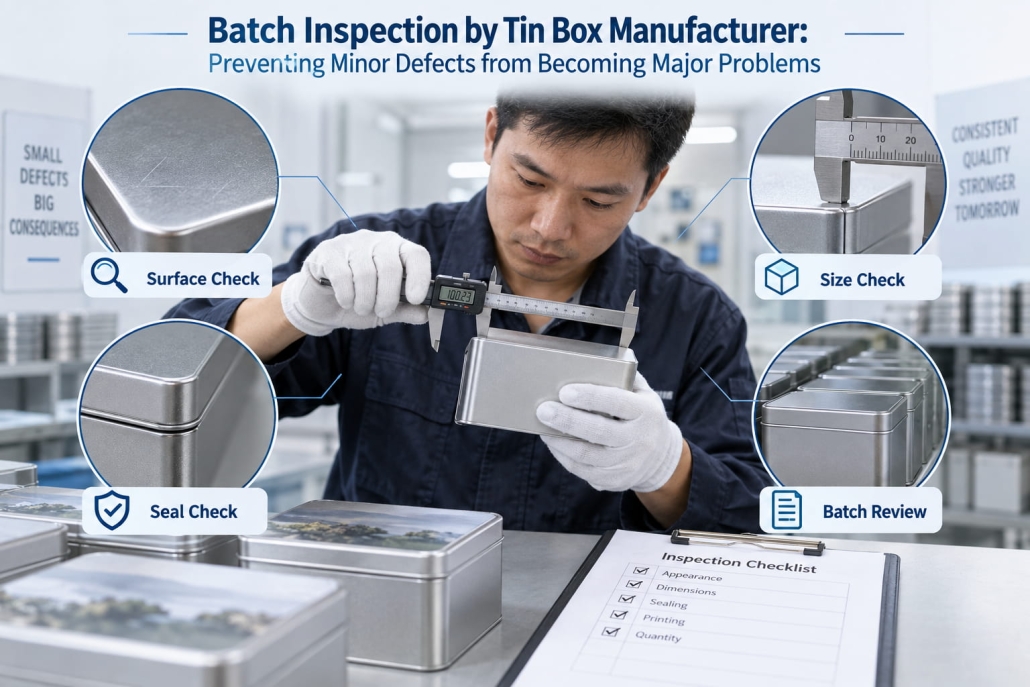
Batch Inspection by Tin Box Manufacturer: Preventing Minor Defects from Becoming Major Problems
As order volumes increase, quality control becomes even more important. If defect rates go undetected early, even a minor recurring issue could affect thousands of tin cans.
Before final packaging, we conduct a final internal inspection using AQL 2.5/4.0 sampling standards. Our quality process also covers visual and functional checks, such as lid fit, structural integrity, and surface condition. For orders of 100,000 units, our inspection focuses on both individual defects and consistency across batches.
Standard inspection items include:
- Dimensions
- Smoothness of lid opening and closing
- Color variation
- Print registration
- Scratches
- Dents
- Embossing consistency
- Coating condition
- Assembly quality
- Quantity per outer carton
Approved samples always serve as the core reference standard for both appearance and functionality. If a production batch deviates from this standard, we will investigate the cause before proceeding with the next batch.
Product Protection and Logistics Planning
The final stage involves more than simply loading cartons into containers. Finished tin packaging must be properly protected during warehouse handling and international transport. TSING’s standard packaging methods typically include:
Plastic bags (inner packaging)
Dividers/separators
Double-wall corrugated cartons
Wooden pallets when necessary
The specific packaging method depends on the tin’s shape, surface finish, mode of transport, and the risk of scratches or deformation. Before shipment, the following information must be confirmed:
Total quantity of finished products → Number per carton → Total number of cartons → Gross weight/net weight → Pallet stacking plan → Mode of transportation
For orders of 100,000 pieces, ocean freight is usually our most common choice. However, we will discuss the specific mode of transportation with the customer and determine it by comprehensively considering factors such as delivery deadlines, destination, total carton volume, and freight costs.
Standardized Process for Producing 100,000-Piece Orders
In TSING’s view, the most important principle is this: Before proceeding with mass production, the production process for a 100,000-piece order must first be standardized.
Approved samples set quality standards; production specifications translate those standards into quantifiable requirements; material planning ensures consistency across batches; in-process inspections prevent defects from spreading; and proper packaging ensures the products maintain their specified quality until they reach the customer’s warehouse.
This is how a professional tin box manufacturer turns a sample into 100,000 custom tin boxes of consistent quality, while maintaining strict control throughout the process—from prototyping to shipment.
 Facebook
 Twitter
 Linkedin
