
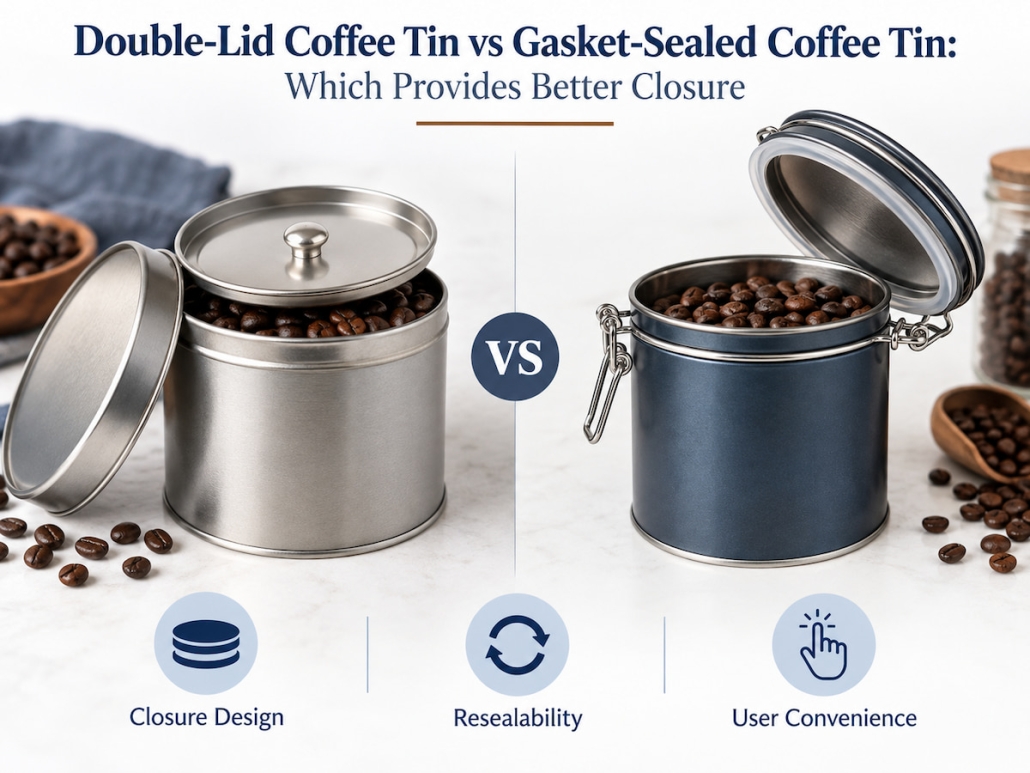
Double-Lid Coffee Tin vs Gasket-Sealed Coffee Tin: Which Provides Better Closure?
The SCA notes that oxygen is the main factor causing roasted coffee to deteriorate (lose flavor), and that storage humidity also affects coffee quality. Therefore, when selecting a coffee can, the seal design is crucial. Two common seal designs are the “double-lid coffee tin” and the “gasket-sealed coffee tin.” The double-lid design creates two barriers between the coffee and the external environment. In contrast, the gasket-sealed design uses a compressible sealing element between the lid and the can body to minimize gaps at the closure.
Don’t choose between these designs based solely on appearance. At TSING, we evaluate and compare these two designs by comprehensively considering sealing performance, reusability, coffee characteristics, manufacturing complexity, and customers’ actual freshness requirements.
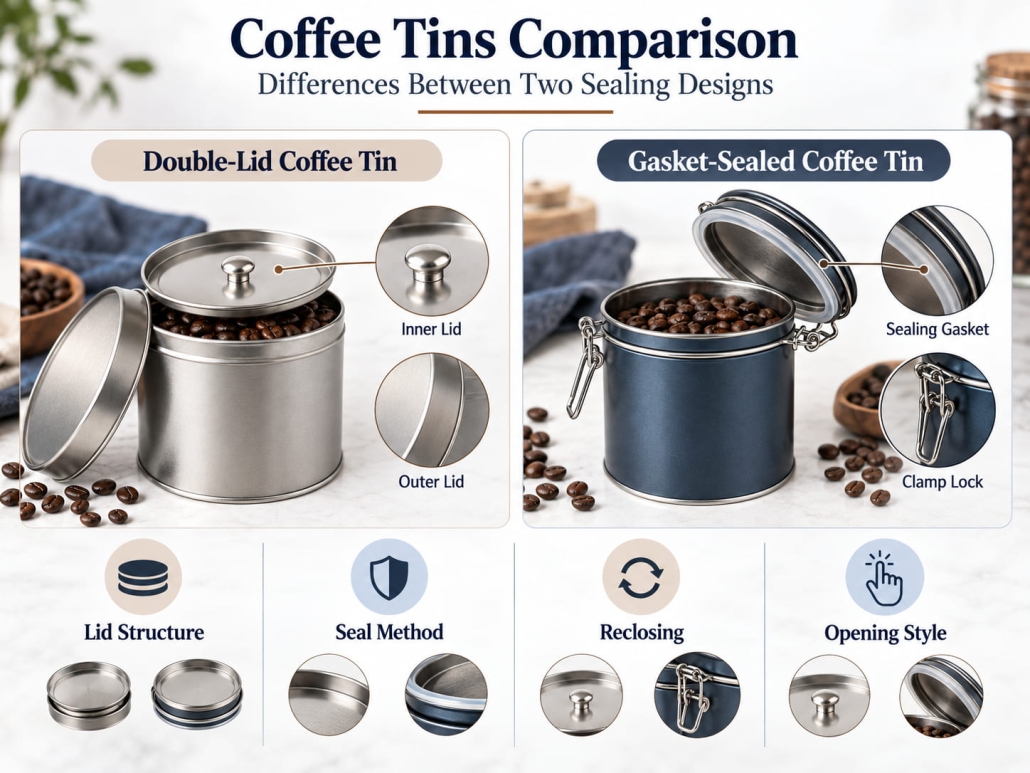
Coffee Tins Comparison: Differences Between Two Sealing Designs
When choosing between a gasket-sealed coffee tin and a double-layer lid design, one cannot simply compare the number of sealing layers. These two sealing designs differ in how they control air exchange; this difference affects not only the can’s resealing stability after repeated openings but also the consumer’s daily user experience.
Therefore, we will compare three aspects: the operating principles of the sealing structures, the ability to maintain sealing performance after repeated use, and whether the opening experience aligns with the target coffee product and brand positioning. These three factors form the basis for evaluating which coffee can structure best suits specific application scenarios.
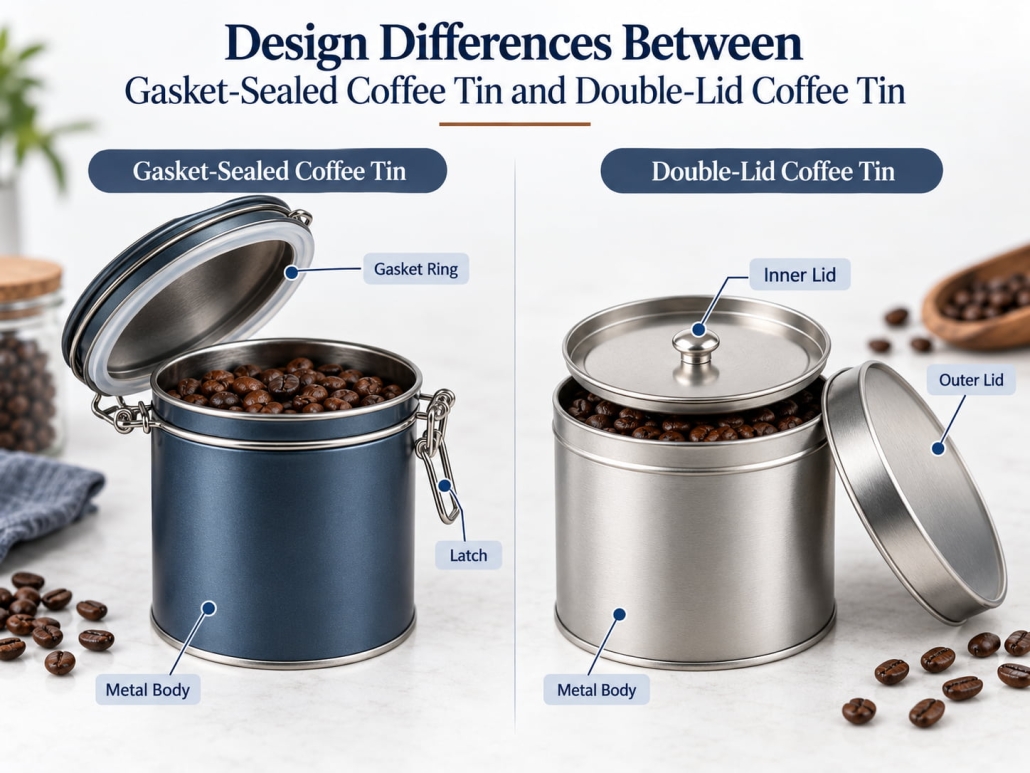
Design Differences Between Gasket-Sealed Coffee Tin and Double-Lid Coffee Tin
Double-lid coffee tins combine an outer lid with an inner lid or a plug-type seal. Their primary advantage lies in creating multiple physical barriers:
Outer lid → Inner lid → Coffee Tin
When the outer lid is opened, the inner seal keeps the coffee isolated from the external environment until the consumer removes it. This structure suits specialty coffee, tea, and gift packaging. However, the double-lid design does not guarantee a completely airtight container. Actual sealing performance still depends on the following factors:
- Lid fit tolerances
- Inner lid fit
- Molding precision
- Contact area
- Repeated opening and closing operations
Sealing coffee tins with a gasket is different. When the lid closes, silicone, elastomers, or other suitable food-grade sealing components compress between the mating surfaces. This compression creates continuous contact around the sealing interface. Effective sealing depends on controlled compression, sealing-surface quality, dimensional tolerances, and the right material choice.
In terms of actual coffee tins:
Double-lid = Additional barrier layer
Gasket-sealed = Controlled compression at the closure
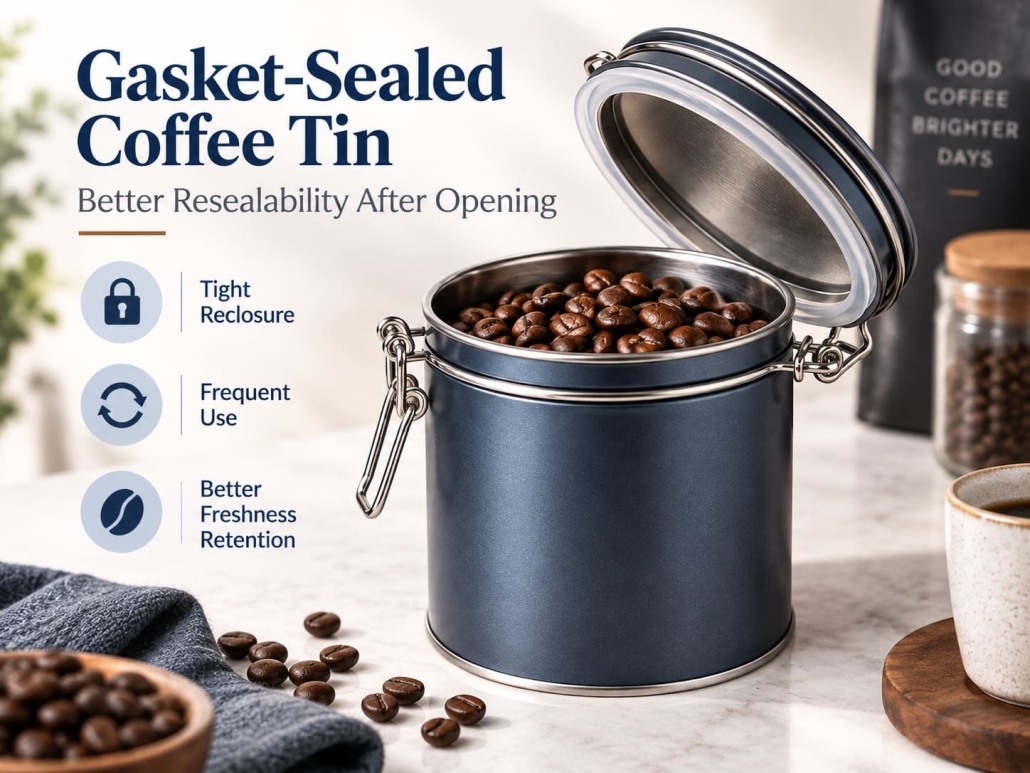
Gasket-sealed coffee tin provide better resealability after opening
Coffee packaging involves two distinct stages of freshness preservation.
The first stage is when the package is unopened. The second stage begins once the consumer opens the package daily. The second stage is often overlooked.
Whenever a consumer opens a large-capacity container, outside air enters and comes into contact with the coffee beans or ground coffee. We should minimize the amount of oxygen entering the container during repeated opening and closing.
For repeated use, gasket-sealed coffee tins offer significant advantages: as long as the sealing material, compression level, and lid geometry are properly designed, the gasket maintains pressure on the sealing surface every time the lid is closed. This makes them suitable for:
- Coffee beans for daily use
- Ground coffee
- High-end specialty coffee
- Coffee that needs to be stored for several weeks after opening
A double-lid design also provides a good seal, as the inner lid acts as an additional barrier. However, its performance depends largely on how tightly the inner lid fits. If repeated use loosens the fit, sealing performance may suffer.
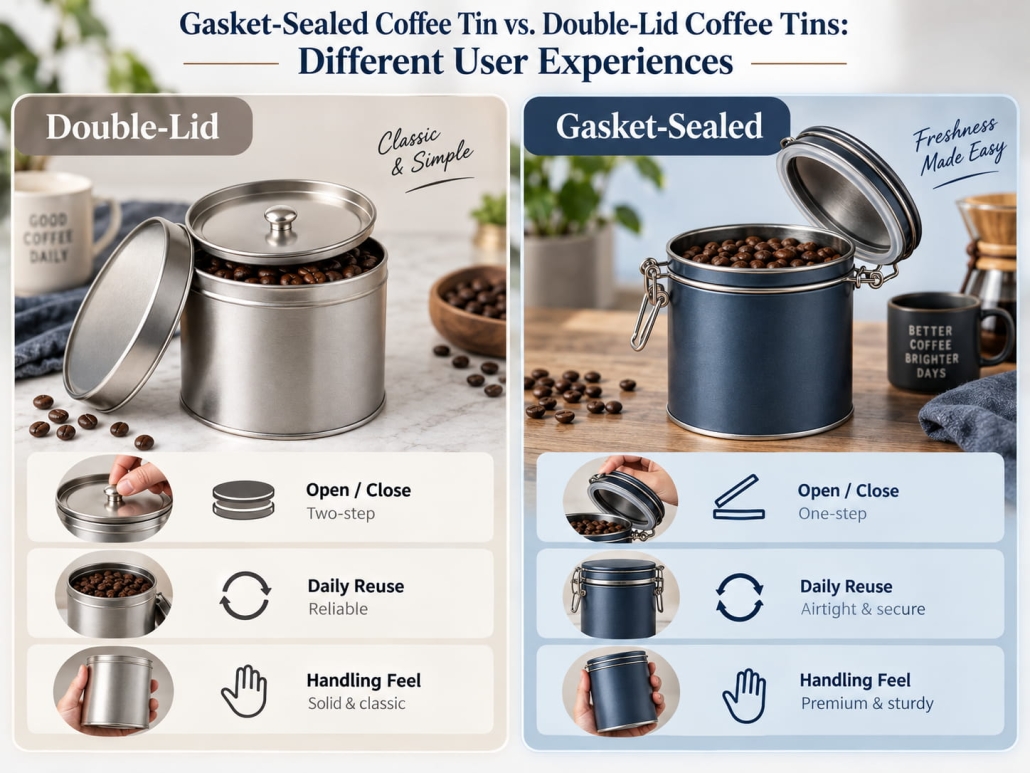
Gasket-Sealed Coffee Tin vs. Double-Lid Coffee Tins: Different User Experiences
While sealing performance matters, packaging must also support the user experience. Double-lid coffee tins create a unique opening process: consumers must first remove the decorative outer lid, then open the inner lid, before accessing the coffee. This design is particularly well-suited for the following brand needs:
- Conveying a traditional, high-end feel
- Gift-quality packaging
- Providing additional physical protection
The double-lid structure also minimizes direct contact between the coffee and the outside environment when the outer lid is briefly removed.
In contrast, gasket-sealed coffee tins achieve a strong seal through a simpler opening process. They suit customers who need frequent daily access and a simple, one-step opening mechanism. So decision-making shouldn’t focus solely on airtightness. For high-end retail packaging, we also comprehensively consider closure performance, ease of use, and brand positioning.
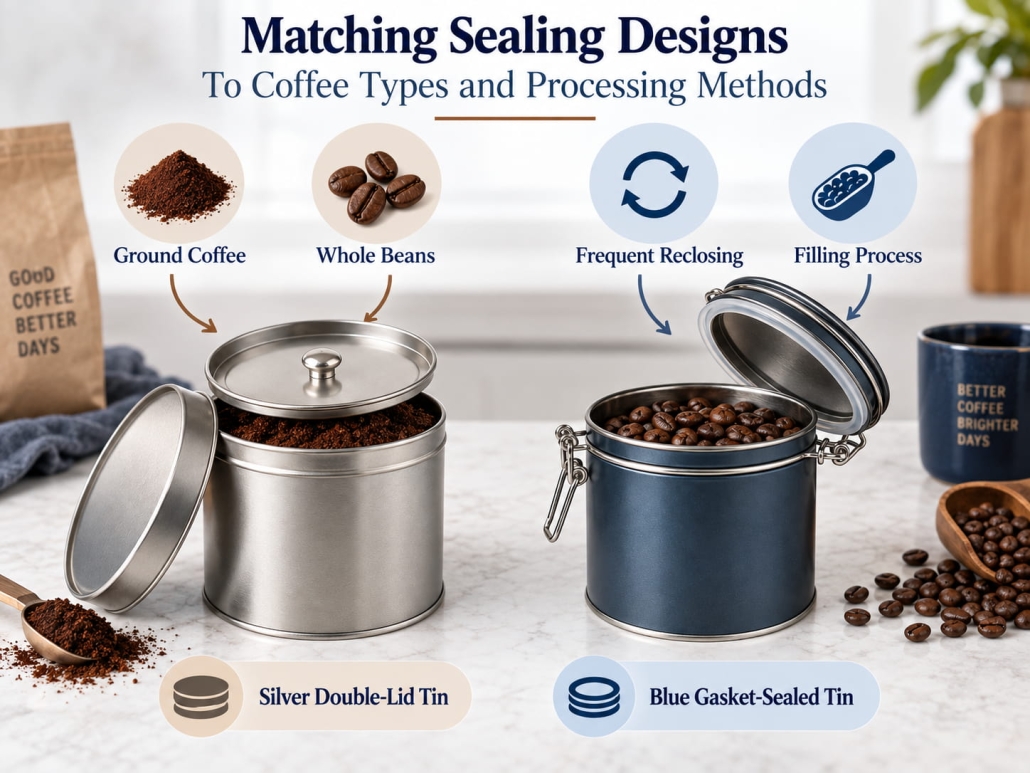
Matching Sealing Designs to Coffee Types and Processing Methods
After comparing the two sealing structures, the next step is to match the design solution to specific coffee products and processing methods. Although gasket-sealed coffee tins offer more reliable resealability, required sealing performance varies based on several factors, such as whether the package contains whole beans or ground coffee, how often consumers open the can, and the time between roasting and packaging.
Therefore, before recommending a sealing design, TSING conducts a comprehensive assessment of the coffee’s form and production process. Ground coffee typically requires higher resealability standards, while freshly roasted whole beans release carbon dioxide (CO₂) continuously after roasting. Consequently, the following two factors must be evaluated:
For Ground Coffee and Applications Requiring Long-Term, Repeated Sealing
Sealing performance is especially critical for ground coffee, as grinding significantly increases its exposed surface area and accelerates the loss of gases and aromatic compounds. Therefore, when handling ground coffee packaging, we typically prioritize solutions with stronger sealing performance that can withstand repeated opening and closing.
Here is a practical selection guide:
| Requirement | Preferred Starting Option |
| Frequent daily opening | Gasket-Sealed Coffee Tin |
| Ground coffee | Gasket-Sealed Coffee Tin |
| Strong repeatable lid compression | Gasket-Sealed Coffee Tin |
| Premium ceremonial opening | Double-Lid Coffee Tin |
| Additional inner physical barrier | Double-Lid Coffee Tin |
| Gift-oriented coffee packaging | Double-Lid Coffee Tin |
A well-designed double-layer lid structure may outperform solutions with poorly designed sealing rings; conversely, if the lid structure cannot ensure even force distribution on the sealing ring, simply adding a silicone ring will not guarantee a good seal.
Therefore, at TSING, the final design must be tested as an integrated system, taking into account factors such as:
Can body + Lid + Sealing ring/inner lid + Dimensional tolerances + Actual repeated-use conditions
At the same time, we ensure the sealing ring material complies with food-contact safety standards; selection should not be based solely on softness or appearance.
The Issue of Gas Release from Freshly Roasted Coffee Must Be Considered
Both designs face a significant limitation: sealing strength alone cannot resolve gas release from freshly roasted coffee.
Coffee beans continue to release carbon dioxide (CO₂) after roasting. The outgassing process is particularly rapid during the first few weeks; studies have also confirmed that roasted green coffee beans continue to release gas. Depending on the customer’s specific requirements, the solutions we can provide include:
- Allowing adequate time for outgassing before filling
- Using inner packaging bags with one-way vent valves inside the can
- Developing other design solutions tailored to the project
Therefore, when communicating with clients, we focus not only on coffee weight and can size but also on the time interval between “roasting and packaging.”
So, which sealing method is better?
For brands that prioritize a secure seal, reusability, and controllable lid sealing, a well-designed coffee tin with a sealing gasket is typically the more suitable choice, as its compression-sealing element acts directly on the joint between the lid and the can body.
For brands that prioritize multi-layered physical structures, premium visual presentation, and a unique opening experience, double-lid coffee tins are the better choice. We recommend following this decision-making process:
Coffee beans or ground coffee → Time between roasting and packaging → Expected shelf life → Frequency of opening → Sealing performance → Brand experience
TSING will then match the appropriate lid structure, tolerance standards, sealing components, and can dimensions based on the above requirements. Therefore, the highest-quality sealed coffee tin does not simply depend on the container structure with the most layers, but rather on whether its sealing design can consistently maintain the level of protection required for the coffee throughout the entire process—from filling and storage to repeated use by consumers.
 Facebook
 Twitter
 Linkedin
