
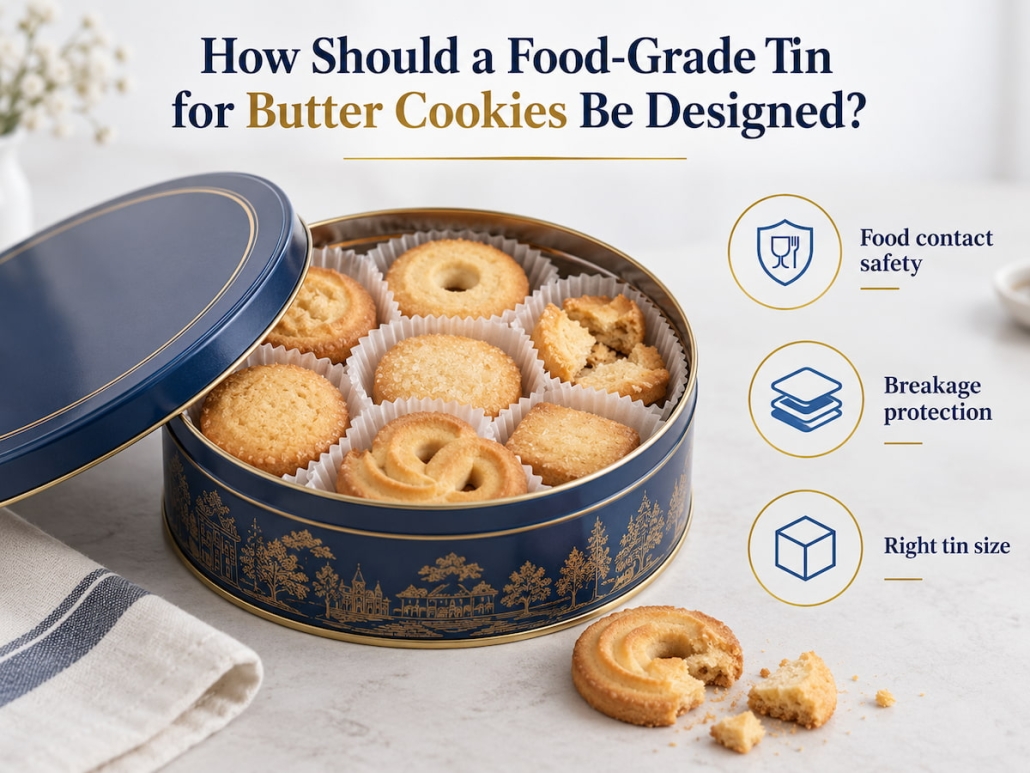
How should a food-grade tin for butter cookies be designed?
Food-grade tin packaging for butter cookies should include four key design elements: an oil-resistant food-contact coating; appropriately sized internal trays or dividers; a sturdy box structure that prevents the cookies from being crushed, deformed, or shaken excessively; and a seal design that helps control air ingress. Additionally, the tin’s dimensions should match the actual size and arrangement of the cookies to ensure they are not crushed or shift excessively during transport. If you need to extend shelf life, consider a sealed inner bag or liner rather than relying solely on the metal lid. These features work together to ensure food-grade tins not only protect the product but also preserve cookie quality.
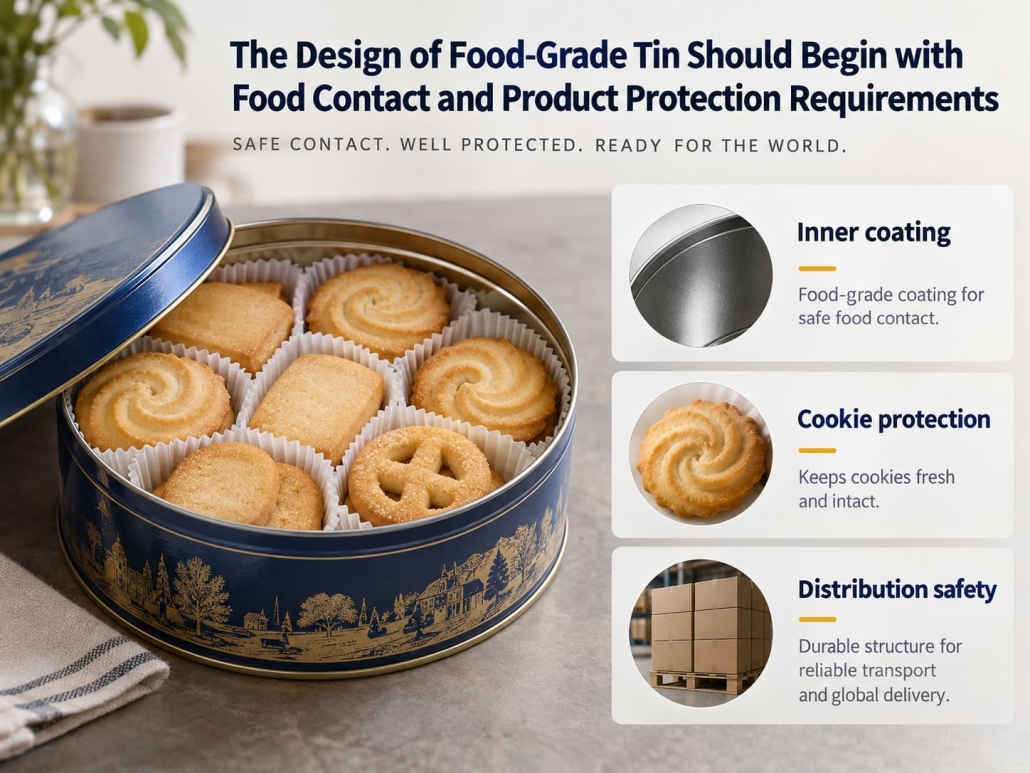
The Design of Food-Grade Tin Should Begin with Food Contact and Product Protection Requirements
For snacks such as butter cookies, the primary consideration in designing food-grade tin should be the interior of the packaging, not external decoration. The tin box must provide a suitable food-contact surface for products containing fats and oils, while also ensuring fragile cookies are not crushed, bumped, or displaced during handling and transport.
From a manufacturing perspective, these requirements are closely interrelated:
1. The interior coating determines how the food-contact surface reacts to contact with butter and fats;
2. Trays or dividers are used to control product movement;
3. The internal dimensions determine whether there is sufficient space to accommodate the cookies.
At the same time, it is important to avoid creating excessive wasted space. Therefore, before finalizing the structure of a butter cookie tin, we evaluate these three key factors.
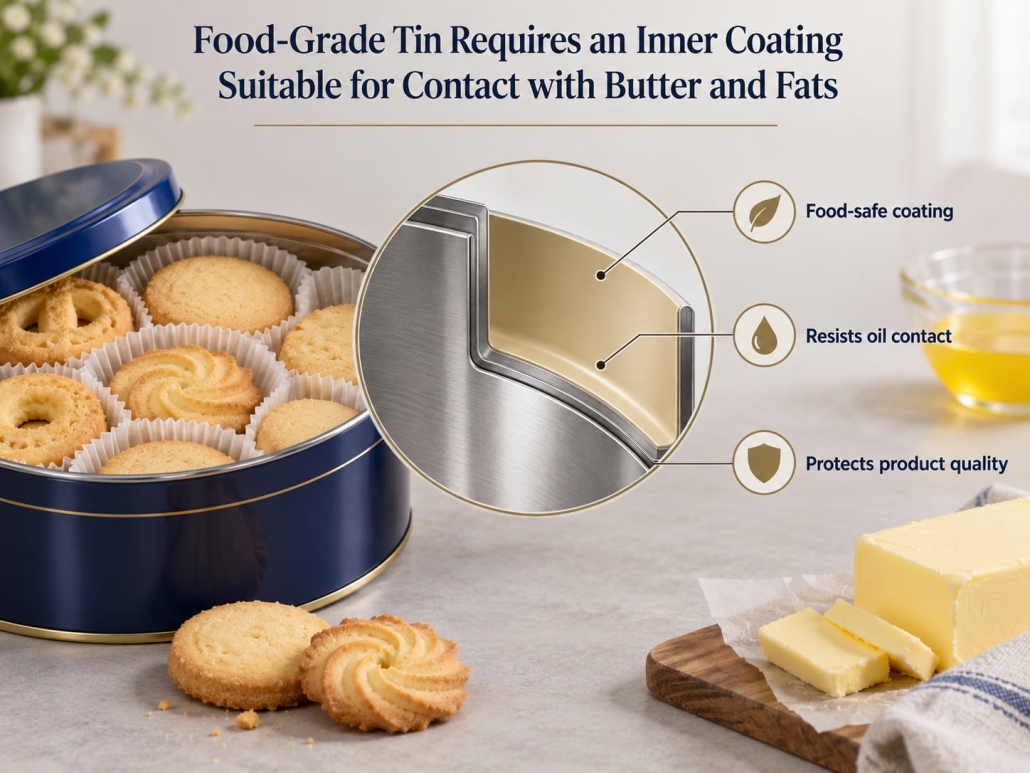
Food-Grade Tin Requires an Inner Coating Suitable for Contact with Butter and Fats
The primary design consideration is not the shape of the tin box, but the material of the surface that actually contacts the cookies.
Butter cookies contain fat; therefore, the inner coating of tin boxes used to package such cookies must comply with regulatory requirements for the intended food contact use and conditions of use. The FDA states that “the compliance of a finished food-contact material depends on the compliance status of the various substances constituting the material and its intended use.” (Source: FDA Food Types & Conditions of Use)
Before production, we verify the following information:
- Whether the cookies come into direct contact with the tin’s inner walls
- Whether paper cups or packaging bags are used to separate the cookies from the metal
- The extent of contact with fats and oils
- The expected shelf life
- Storage temperature
- Certification documents verifying the coating’s compliance for food contact
The coating should maintain a uniform, intact protective layer throughout the tin-forming process. Scratches, exposed metal, insufficient curing, or coating damage during the forming process may compromise the intended food-contact surface performance. Therefore, manufacturers should treat coating selection and process control as essential production specifications for custom food tin, not optional surface-treatment details.
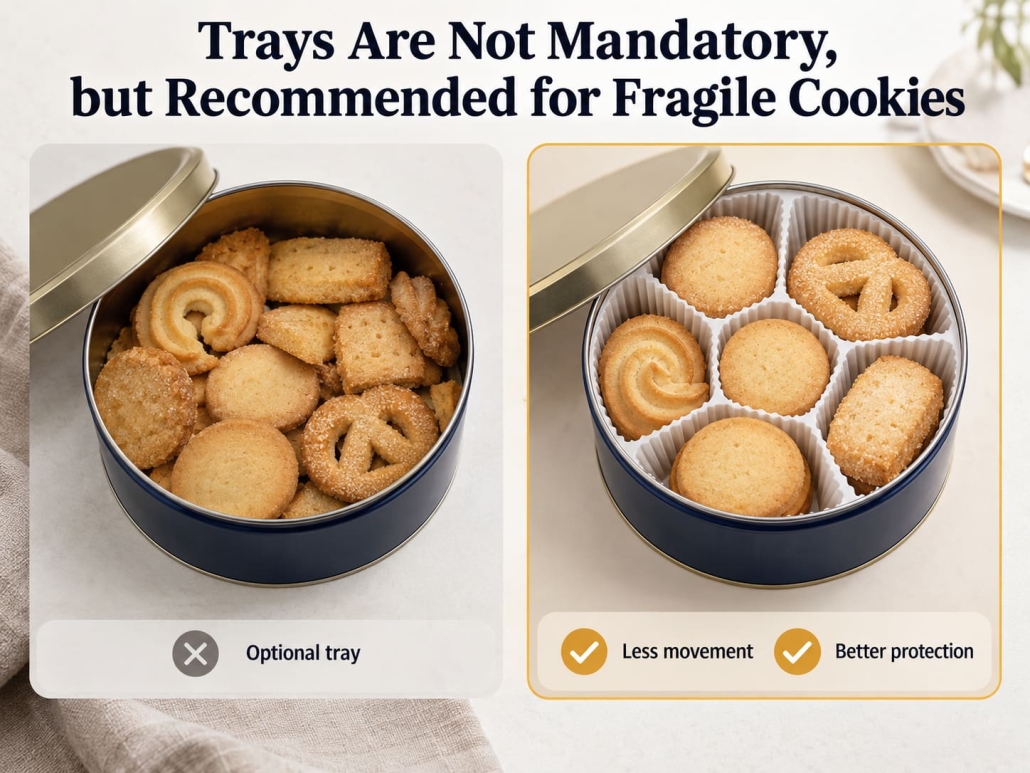
Trays Are Not Mandatory, but Recommended for Fragile Cookies
Not all cookie tin boxes require an internal tray.
When manufacturers individually wrap butter cookies and pack them closely together, the wrapping and packing arrangement may already provide enough separation and protection to keep the cookies from moving or breaking. However, for premium loose-packed cookies, assorted cookies of varying shapes, or products with fragile edges, an internal tray or dividers can provide significant protection. We can design our cookie tins with a compartmentalized interior to accommodate different types of cookies and confectionery products.
- Trays serve three important functions:
- Positioning—holding each cookie in its designated spot.
- Separation—preventing adjacent cookies from bumping into one another.
- Display—keeping the products neatly arranged even after shipping.
For example, when manufacturers loosely pack twelve fragile butter cookies in a large square tin, the cookies may slide around repeatedly during truck transport or international shipping. A twelve-compartment insert limits this movement by absorbing and distributing most displacement forces, reducing the risk of cookie breakage.
For food-grade tin boxes containing butter cookies, the real question is not “Do we need a tray?” but rather “Can the cookies remain in their intended positions without coming into contact with one another or suffering damaging impacts?”
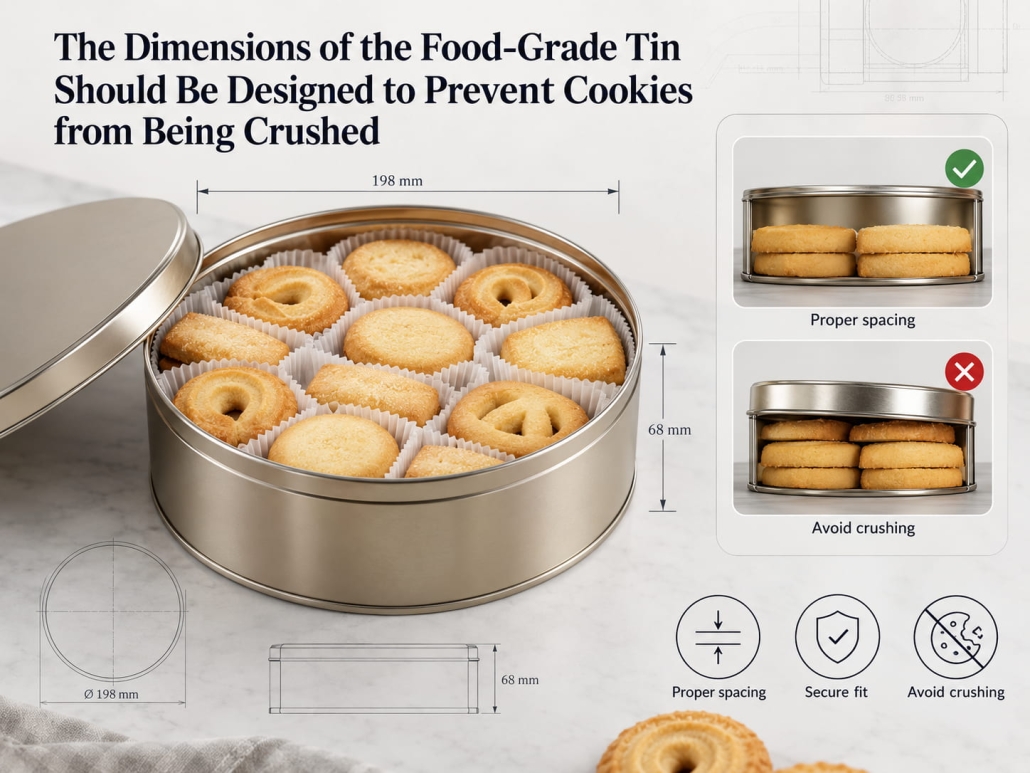
The dimensions of the food-grade tin should be designed to prevent cookies from being crushed
If a tin box is too small, the cookies may be crushed during filling or when the lid is closed; if it is too large, gaps may form, causing the contents to shift and collide during shipping. Therefore, when designing food-grade tin boxes for butter cookies, we carefully consider the actual size and arrangement of the cookies. Key factors include:
- Cookie diameter or length
- Cookie thickness
- Quantity
- Number of layers
- Tray thickness
A tin that is too large can increase internal movement, while one that is too small may damage fragile cookies and candies. For large cookie tins, we also evaluate factors such as tinplate thickness, lid depth, and bottom rigidity. When manufacturing various types of tin boxes for cookies and biscuits, TSING typically uses tinplate about 0.23–0.30 millimeters thick; however, the final thickness should be based on dimensional and structural requirements rather than a single fixed thickness.
Ensuring Products Remain Undamaged and Fresh Through Comprehensive Packaging
Although inner trays can reduce product movement inside the tin, damage cannot be completely prevented if the outer packaging is subjected to repeated impacts, stacking pressure, or inadequate protection during transit. Additionally, butter cookies must retain their crisp texture after packaging and be protected from unnecessary moisture or air exposure.
For this reason, we view product protection as part of the overall packaging design rather than relying solely on the metal can itself. The following design focuses on two key aspects:
1. Reinforcing the packaging to prevent damage during distribution;
2. Selecting an appropriate sealing method or internal barrier layer.
While ensuring product freshness, we objectively evaluate the sealing performance of standard metal lids.
Multiple Damage-Prevention Measures Are Required During Transportation
Damage protection should not be limited to the retail tin itself. A reliable structural design should combine the following elements:
Sturdy tin structure + properly sized inner tray + controlled headspace (top clearance) + protective shipping carton
Therefore, for large-volume custom food tins, we can evaluate the entire packaging process:
Biscuits → Paper cups or inner trays → Tin → Dividers → Outer carton → Pallet (as needed)
Before mass production, brands should test the complete packaging with the product inside, rather than simply evaluating empty tins. The goal is to identify where external forces act on the product and eliminate these potential issues before tens of thousands of tins go into production.
Striking the Right Balance Between Texture and Sealing Performance
Once butter cookies absorb moisture, they are highly prone to losing their characteristic crisp texture. Furthermore, prolonged exposure to oxygen can cause their high fat content to deteriorate in flavor. Therefore, the sealing design of food tins used for butter cookies is critical.
While a tightly fitting food-grade tin lid can reduce uncontrolled air exchange and protect the contents from dust contamination and handling damage, a standard friction-fit metal lid does not guarantee a completely airtight seal. If a longer shelf life is required, we can implement the following combination of solutions:
- Inner-seal lids with enhanced airtightness
- Appropriate sealing gaskets or liners
- Sealed inner pouches
- Individually wrapped cookies
- Moisture-proof inner pouches
The specific solution depends on the required shelf life and filling process.
In many cookie packaging applications, the sealed inner pouch typically serves as the primary moisture barrier. At the same time, the metal tin provides structural protection, light protection, brand display, and resealable storage after opening. This approach is more reliable than relying solely on a decorative metal lid to maintain a seal throughout the entire shelf life.
Designing Tin Cans Suitable for Butter Cookies
Therefore, the correct design process for food-grade tin cans intended for butter cookies is as follows:
Fats and oils contact requirements → Food-grade contact coating → Cookie dimensions → Trays or dividers → Breakage protection → Sealing and internal barrier → Production validation
TSING uses this process because butter cookie packaging must meet multiple requirements at once. A high-quality tin not only protects the food-contact surfaces but also holds each cookie securely in place, withstands the rigors of logistics and transportation, and preserves the texture and appearance consumers expect.
 Facebook
 Twitter
 Linkedin
