
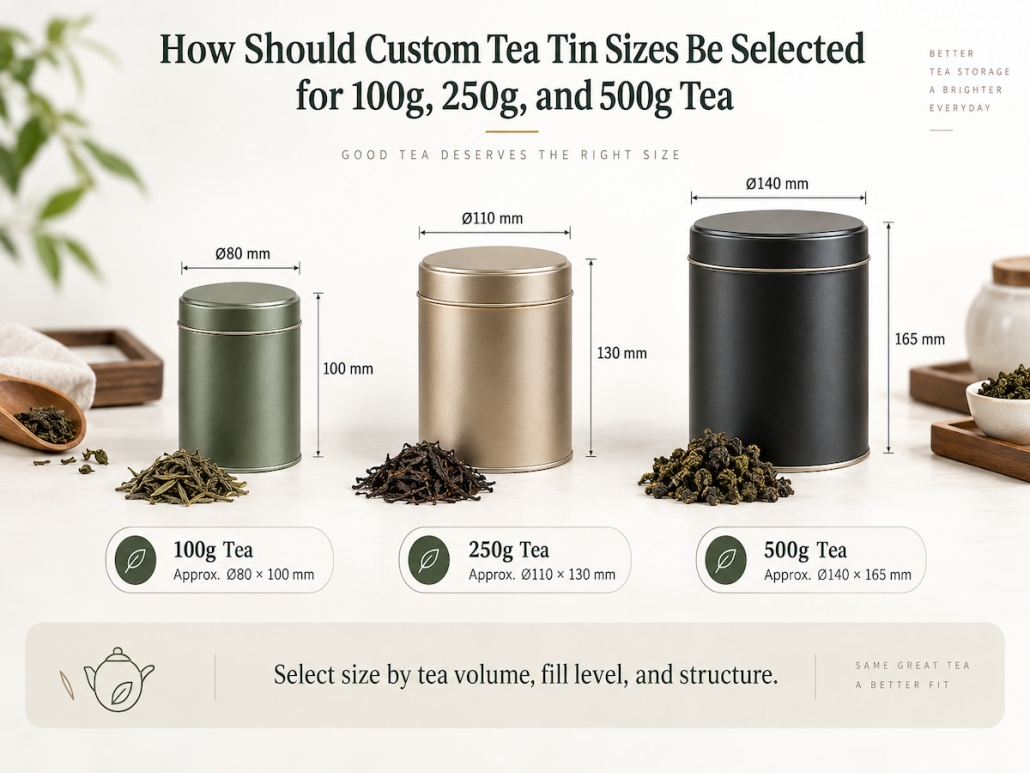
How Should Custom Tea Tin Sizes Be Selected for 100g, 250g, and 500g Tea?
Many customers ask us, “How should we choose the custom tea tin sizes for 100g, 250g, and 500g of tea?”
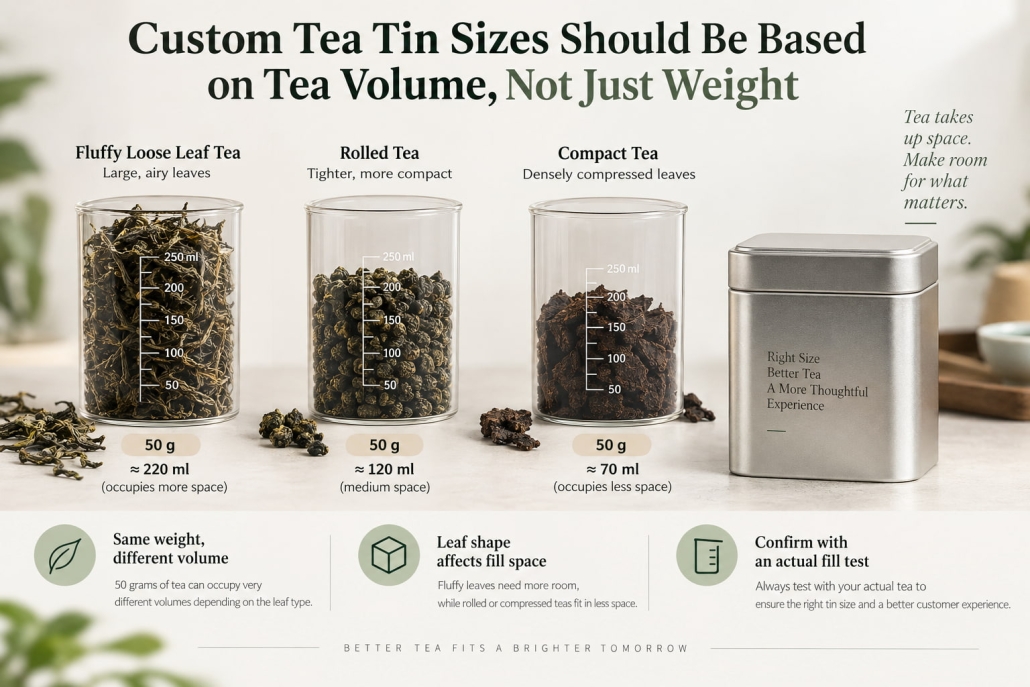
Our answer is: Choosing a custom tea can size based solely on weight may result in an inaccurate package size. Two types of tea that both weigh 100 grams may have vastly different volumes. Research on refined green tea shows that bulk density (apparent density) varies by tea variety and filling method.
Therefore, when determining dimensions, we should comprehensively consider the following factors:
| Net Tea Weight | Recommended Round Tin Internal Size | Equivalent Rectangular Internal Size |
| 100g | Ø80 × 100 mm | 90 × 65 × 85 mm |
| 250g | Ø110 × 130 mm | 120 × 85 × 120 mm |
| 500g | Ø140 × 165 mm | 150 × 110 × 155 mm |
Tea weight + bulk density + headspace (top clearance) + lid structure
For common, moderately dense loose-leaf teas, TSING recommends the following initial dimensions:
The above are reference inner diameter dimensions, suitable for moderately dense loose-leaf teas. Before mass production, we will verify the final mold dimensions using the customer’s actual tea samples.
Custom Tea Tin Sizes Should Be Based on Tea Volume, Not Just Weight
To determine the right custom tea tin size, first convert the tea’s weight into its actual volume. Because bulk density varies by tea type, the required internal volume can differ significantly even for the same weight—whether 100g, 250g, or 500g. You must also reserve sufficient headspace to allow filling and, depending on the situation, allocate space for an inner lid, liner, or sealing mechanism. Therefore, for loose tea of medium density, establish reference dimensions first, then conduct actual filling tests.
The following three size ranges show how to determine custom tea tin sizes for 100g, 250g, and 500g of tea, balancing volume, packaging ratio, and filling efficiency.
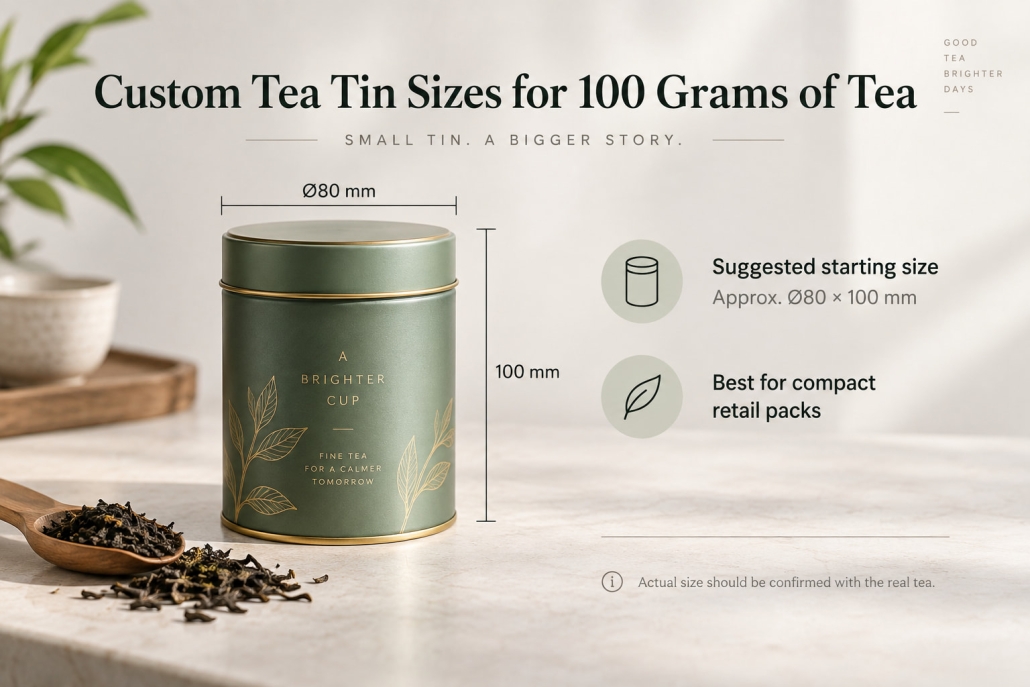
Custom Tea Tin Sizes for 100 Grams of Tea
For standard 100g retail tea products, we recommend the following approximate circular inner dimensions:
Diameter Ø80 mm × Height 100 mm
Before accounting for the lid’s insertion depth or space taken up by internal sealing components, this size provides a cylindrical internal volume of about 500 milliliters.
The corresponding custom rectangular tea can sizes would be approximately:
90 × 65 × 85 mm
This size suits many medium-density loose-leaf teas, offering brands compact retail packaging while supporting filling and storage.
Round tea tins with diameters of 60–80 mm and heights of 60–100 mm are common retail specifications, though they also indicate that the density of whole-leaf tea can vary significantly. However, for extremely bulky tea leaves, the Ø80 × 100 mm size may not be sufficient. In such cases, we will increase the tin’s volume rather than force the tea leaves into the tin to fit a predetermined packaging size.
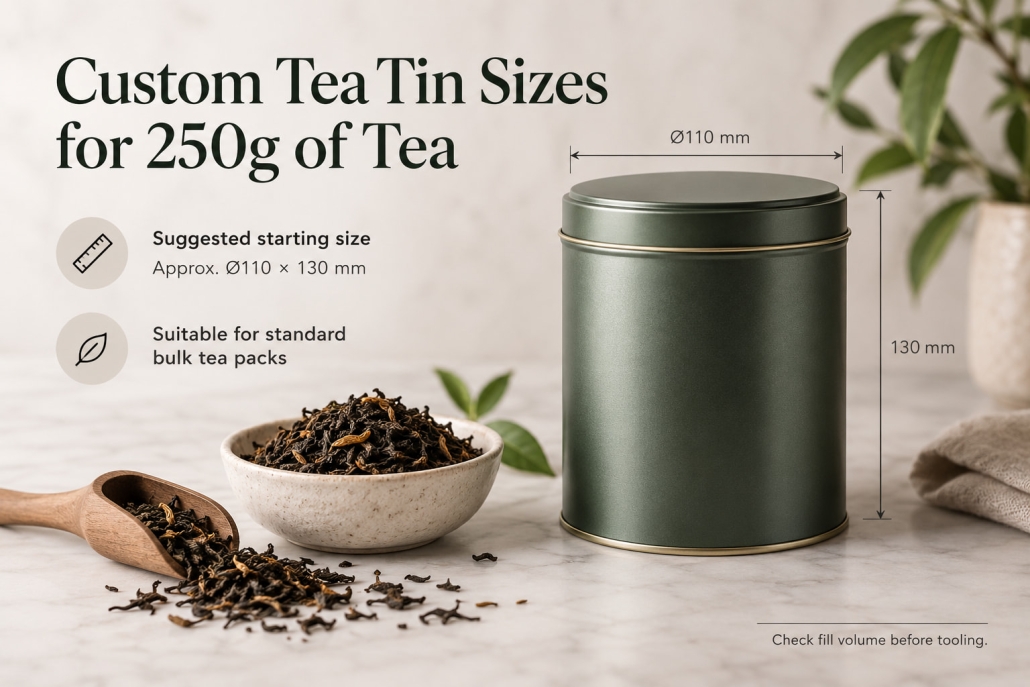
Custom Tea Tin Sizes for 250g of Tea
For retail or gift packaging in the 250g size, a practical dimension is:
Diameter Ø110 mm × Height 130 mm
This provides a total internal volume of approximately 1.24 litres.
An alternative rectangular shape could be:
120 × 85 × 120 mm
This size offers roughly the same usable volume and stacks more easily because of its shape.
The 250g size falls between small retail packaging and large family-size containers. For manufacturers, the key consideration is not simply doubling the dimensions of a 100g tin. Volume changes affect all three dimensions. Therefore, increasing both diameter and height usually yields better packaging proportions than making the tin excessively tall.
Custom Tin Sizes for 500g Tea
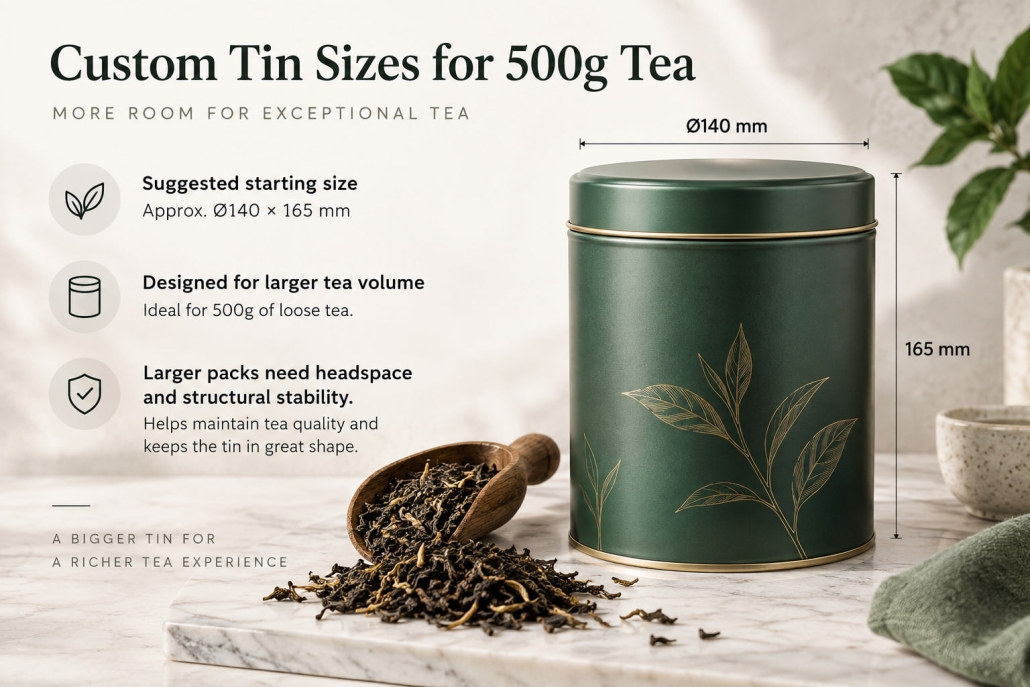
For 500 grams of medium-density loose-leaf tea, a practical size is:
Diameter Ø140 mm × Height 165 mm
This size provides a total internal volume of approximately 2.54 liters.
For rectangular tea tins, TSING recommends starting with dimensions of approximately:
150 × 110 × 155 mm
When the capacity reaches 500g, structural stability becomes particularly important. Because larger tea tins have a greater unsupported wall area and bear a heavier load, we need to evaluate design factors such as tinplate thickness, sidewall rigidity, bottom reinforcement design, lid fit, and stacking load capacity.
TSING typically uses tinplate about 0.23–0.30 mm thick for its tea can products; the specific thickness depends on the product’s dimensions, shape, and structural requirements. Therefore, when increasing the size of a custom tea can, we conduct a structural evaluation simultaneously rather than simply scaling up the design.
Custom Tea Tin Sizes Must Be Verified Based on the Actual Tea Leaves
While the recommended dimensions can serve as a starting point, they should not be treated as final specifications for custom tea tins. Before tooling or mass production, manufacturers must verify how the actual tea leaves fit inside the selected container. The shape of the tea leaves, their bulk density, the filling method, and the space taken up by the inner lid or sealing components all affect the container’s usable capacity.
Therefore, before finalizing the dimensions, TSING conducts a comprehensive assessment of the required headspace and the actual filling results. This approach helps avoid the following two common issues.
Allowing Adequate Headspace to Avoid Excessive Dead Volume
Tea tins should not be filled so tightly that the tea leaves touch the lid. Adequate headspace not only makes filling easier but also reduces the risk of crushing delicate tea leaves when closing the lid or installing internal seals. However, excessive headspace is also undesirable, as it increases:
- Packaging dimensions
- Shipping volume
- Shelf space occupied
- The amount of residual air inside the container
For standard custom tea tin projects, TSING typically starts with a moderate filling allowance and then verifies it using actual tea samples.
The formula for calculating the actual dimensions is as follows:
Required tea can volume = Tea weight ÷ Measured bulk density + Filling allowance. For example, if the measured bulk density of a particular tea is 0.20 g/mL, then:
100 g ÷ 0.20 = 500 mL
We then fine-tune the tea can dimensions based on the required headspace and the space occupied by the inner lid, liner, or sealing system.
Confirmation Through Actual Filling Tests Before Mass Production
The most reliable approach is to send the manufacturer actual tea samples. We recommend following this process:
Tea sample → Determine bulk density → Set target fill weight → Compare with existing molds → Conduct test filling → Check lid fit and headspace → Finalize dimensions.
This is particularly important when deciding whether to use existing molds or develop new ones.
TSING offers custom tea tins in round, rectangular, and other shapes, equipped with a variety of sealing methods, liners, and airtight configurations. For most loose-leaf teas of medium density, the following three initial specifications can serve as reference benchmarks:
100g: Ø80 × 100 mm
250g: Ø110 × 130 mm
500g: Ø140 × 165 mm
Corresponding rectangular specifications are as follows:
100g: 90 × 65 × 85 mm
250g: 120 × 85 × 120 mm
500g: 150 × 110 × 155 mm
Use these dimensions only as a starting point for production, not as a universal guarantee of capacity.
Determining the Final Custom Tea Tin Size
From TSING’s perspective, the correct method for selecting a custom tea can size is straightforward: start with the target weight, calculate based on the tea’s actual volume, allow for appropriate headspace, and verify the results through physical filling tests before mass production. This approach ensures that the produced tea tins are neither too large—which would result in waste—nor too small—which would compress the tea.
 Facebook
 Twitter
 Linkedin
