
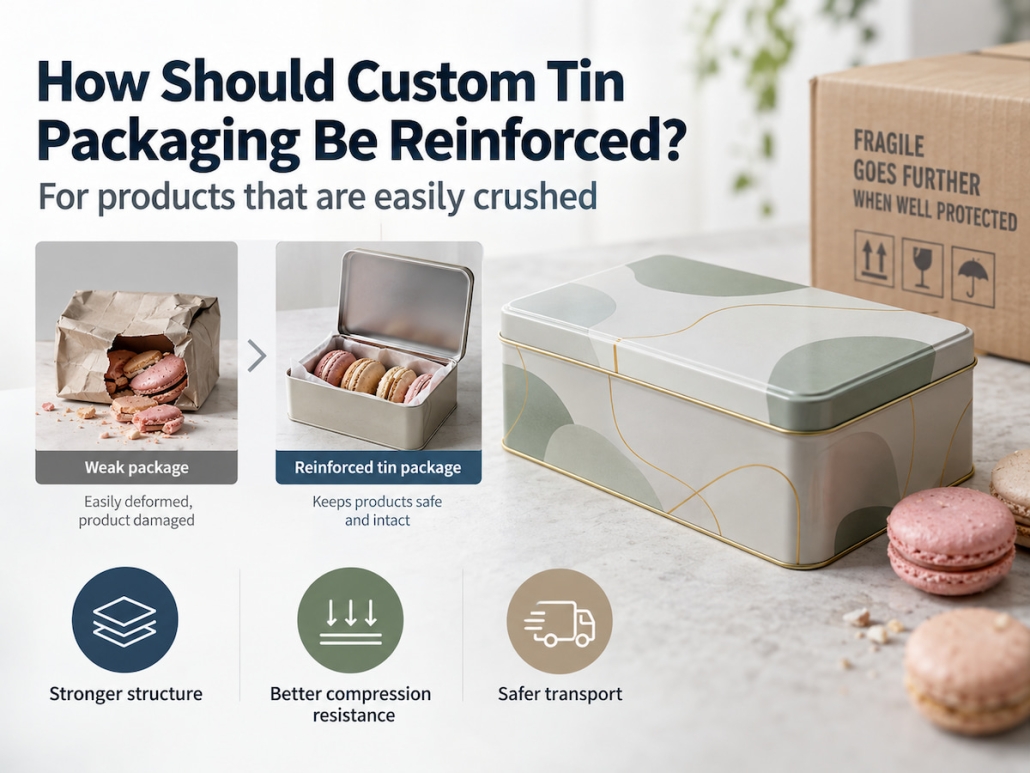
How Should Custom Tin Packaging Be Reinforced for Products That Are Easily Crushed?
For chocolates, cookies, fragile candies, glass ornaments, cosmetics, collectibles, and other fragile items, custom tin packaging alone does not provide sufficient protection. During shipping, even if the tin remains intact, the products inside may still break, shift, or be damaged by impacts against the tin’s sides.
Therefore, effective reinforcement of custom tin packaging must address two key issues simultaneously: external compression forces and internal product movement.
As a professional tin box manufacturer, TSING believes that reinforcement design should comprehensively consider the product’s dimensions, weight, vulnerable areas, stacking conditions, and mode of transportation. Based on these requirements, we can adjust tinplate specifications, optimize metal structural design, develop custom inner trays or dividers, improve lid and edge construction, and optimize export packaging solutions. Our goal is not merely to increase the weight of the custom tin can, but to apply structural support and cushioning protection precisely where the product needs it most.
Design Considerations for Metal Materials and Structures in Reinforcing Custom Tin Packaging
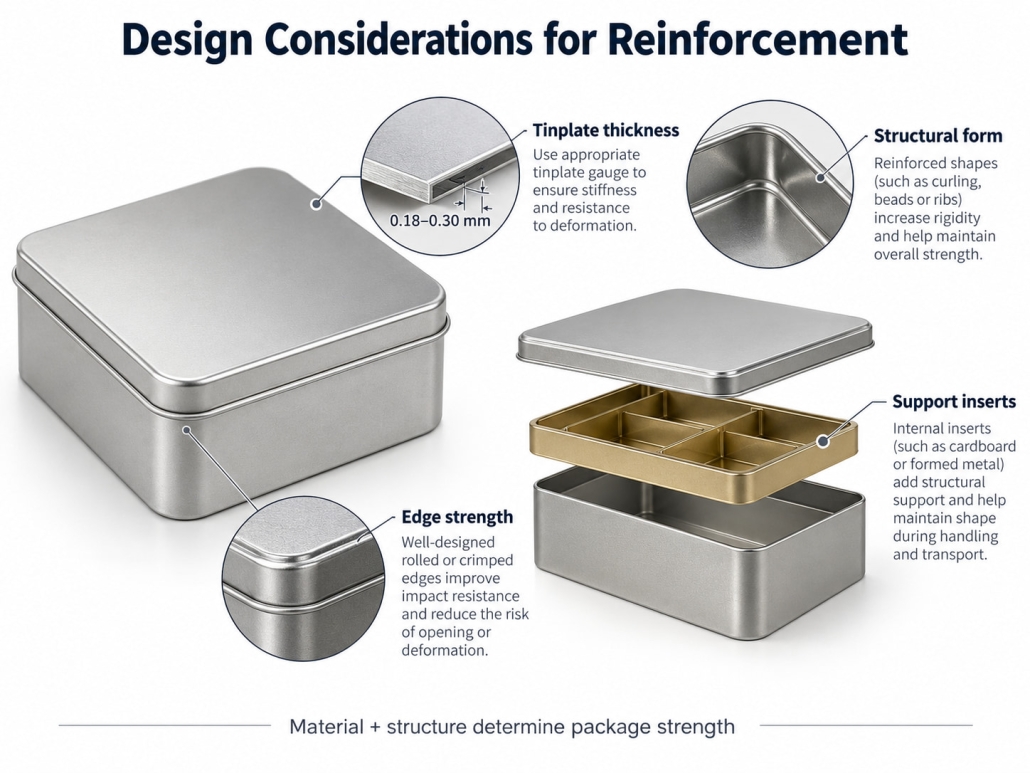
For fragile products, reinforcement solutions should focus on how the packaging bears and distributes forces. Simply increasing tinplate thickness is far from sufficient. Targeted custom tinplate packaging solutions require combining appropriate material strength with structural designs that enhance rigidity, supplemented by internal support structures to prevent product displacement within the container or direct impact.
At TSING, we first assess the product’s weight, dimensions, vulnerable areas, and anticipated transportation loads before determining a specific reinforcement plan. This typically involves three decisions: selecting the appropriate tinplate specifications, optimizing the geometry of the can body and lid, and designing the internal support structure. Through these designs, we can effectively reinforce the packaging to protect both the outer can and the fragile product inside, while avoiding unnecessary material waste or cost increases.
Selecting the Appropriate Tinplate Strength Based on Product Characteristics and Container Dimensions
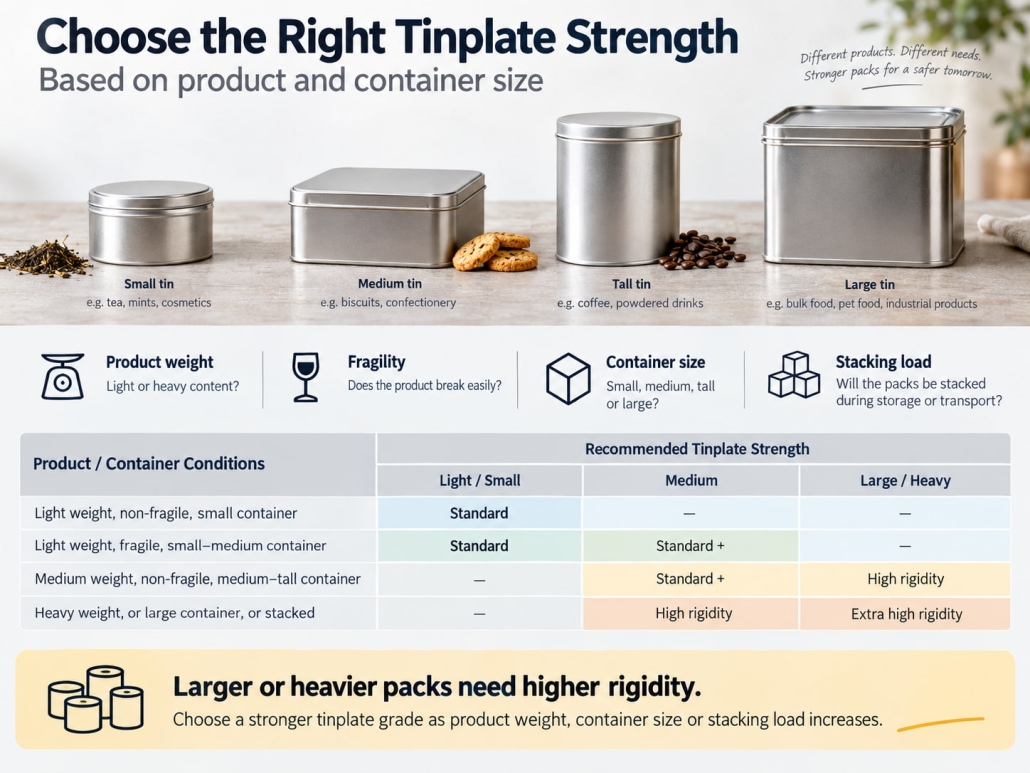
Tinplate thickness is a primary parameter to evaluate, but thicker metal is not always the best solution. When manufacturing various types of tin can packaging, TSING typically uses materials ranging from 0.23 to 0.30 millimeters; specific specifications depend on the tin can’s dimensions, shape, forming process, and application.
When designing tin packaging that requires enhanced strength, we evaluate the following factors:
- Overall dimensions of the tin can
- Product weight
- Unsupported panel areas
- Stacking pressure
- Logistics and transportation conditions
- Required rigidity
Large, flat panels require special attention because they are more prone to deformation than formed curved or irregular surfaces. Sometimes, instead of unquestioningly increasing overall material thickness, you can enhance rigidity by optimizing the structural geometry. This allows for a better balance between product protection, material usage, weight, and cost.
Custom Tin Packaging Can Utilize Geometric Structures to Enhance Rigidity
The strength of metal depends not only on its thickness but also on its shape. For products susceptible to compression damage, TSING can evaluate structural features such as flanged or rolled-edge designs, ribs or raised ridges, precisely controlled fillet radii, and concave or convex lid designs, among others.
For example, embossing shallow ribs on a large lid surface helps reduce lid deformation (deflection) without significantly increasing the tin can’s overall weight. Similarly, rounded corners or well-designed corner structures distribute stress better than large, unsupported flat transition areas.
We support custom die design and a variety of tin can structures, including seamless can bodies, diverse lid structures, embossing processes, and other metal forming solutions. For fragile products, we adhere to the principle of “protection first, decoration second” in our structural design.
Custom Tin Packaging Requires Liners to Prevent Displacement of Fragile Products
For many fragile products, the most critical reinforcement measures actually lie inside the tin. If cookies, chocolates, or delicate jewelry can move freely inside the tin, vibrations during transport may cause them to collide. Simply reinforcing the outer shell of the tin does not fully resolve this issue.
Therefore, TSING can develop custom tin packaging with internal components, such as:
- Plastic trays
- Cardboard liners
- Metal dividers
- Partition structures
Our existing custom solutions include plastic liners designed around the product’s actual dimensions. Take, for example, a tin containing nine delicate chocolates:
If the interior space is empty, the chocolates will shift and collide with one another; however, a nine-cell tray secures each chocolate in a specific position and transfers the impact force from movement to the supporting liner, preventing it from acting directly on the product.
Implement reinforcement designs throughout the sealing and transportation processes
For fragile products, tin cans must remain closed and maintain dimensional stability during handling. If external pressure deforms the lid or body of the can, the packaging may lose its intended seal even if the product remains undamaged.
TSING offers a variety of customizable lid structures, including slip-on lids, hinged lids, insert lids, and other configurations. The best choice depends on the packaging application.
We evaluate factors such as lid overlap depth, closure fit, flanging process, and hinge placement. For fragile products, the entire tin can must maintain geometric stability to ensure the internal cushioning remains in the correct position.
Secondary Packaging and Validation Measures for Custom Tin Packaging
The final protective layer is located on the exterior of the tin can. Even if the custom tin can is well designed, damage may still occur if finished cans are packed loosely in export cartons, leading to mutual impact or excessive stacking pressure. Therefore, for projects involving fragile products, plan transportation arrangements alongside the tin can design.
We implement protective measures based on the product’s surface characteristics and nature, including individual packaging pouches and paper or cardboard dividers. The specific configuration depends on the carton weight, shipping distance, surface treatment processes, and whether the customer fills the cartons before or after international shipment. Before mass production, TSING can also evaluate production prototypes using actual products or samples of comparable dimensions.
Ensuring Safe Transportation Through Appropriate Custom Tin Can Packaging Design
Appropriate selection of tinplate material + optimized geometric structure + secure product positioning + robust sealing structure + ensuring the safety of finished products during transportation.
TSING offers comprehensive customization at every stage—from material selection, mold design, printing, forming, structural solutions, and accessories to production and packaging—and considers all these factors holistically. For customers who need packaging for fragile products, we must first understand more than just the desired dimensions and specifications. We also need to identify the product’s vulnerable areas, structural weaknesses, acceptable displacement limits, and the forces the packaging will withstand. Once we clarify these points, we can apply custom tinplate packaging where it’s needed most.
 Facebook
 Twitter
 Linkedin
