
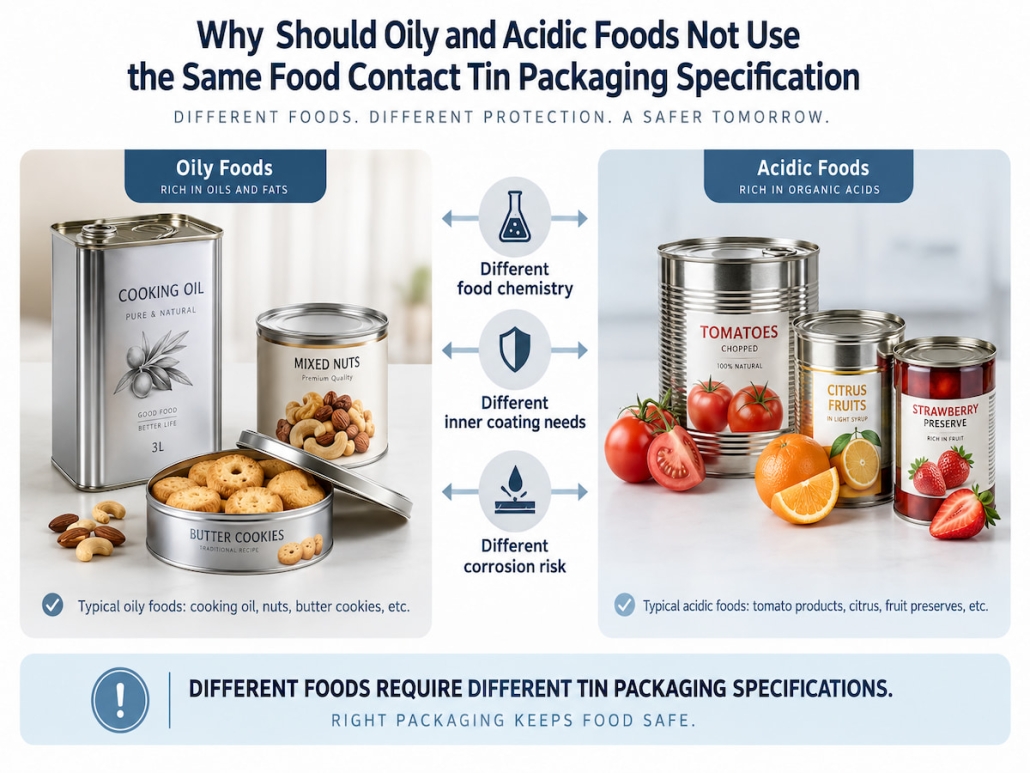
Why Should Oily and Acidic Foods Not Use the Same Food Contact Tin Packaging Specification?
Two products might use metal cans of identical dimensions, tinplate thickness, and even exterior printing, yet still need to meet different specifications for food contact tin packaging.
The reason is simple: oily and acidic foods determine the specific resistance properties required for the inner surface.
Acidic foods subject the packaging to an environment that places extremely high demands on corrosion resistance and the integrity of the coating’s barrier properties. Fats and oils in oily foods interact with organic coatings in different ways, and food contact migration assessments must consider these interactions separately.
For applications involving oily foods, evaluations typically use edible oils or other suitable simulants, whereas assessment methods for water-based and acidic foods differ.
Therefore, professional manufacturers should not approve food contact tin packaging based solely on the claim that the inner coating is labeled “food-grade.” Specific technical specifications must match the actual food product, filling process, shelf life, and conditions of use.
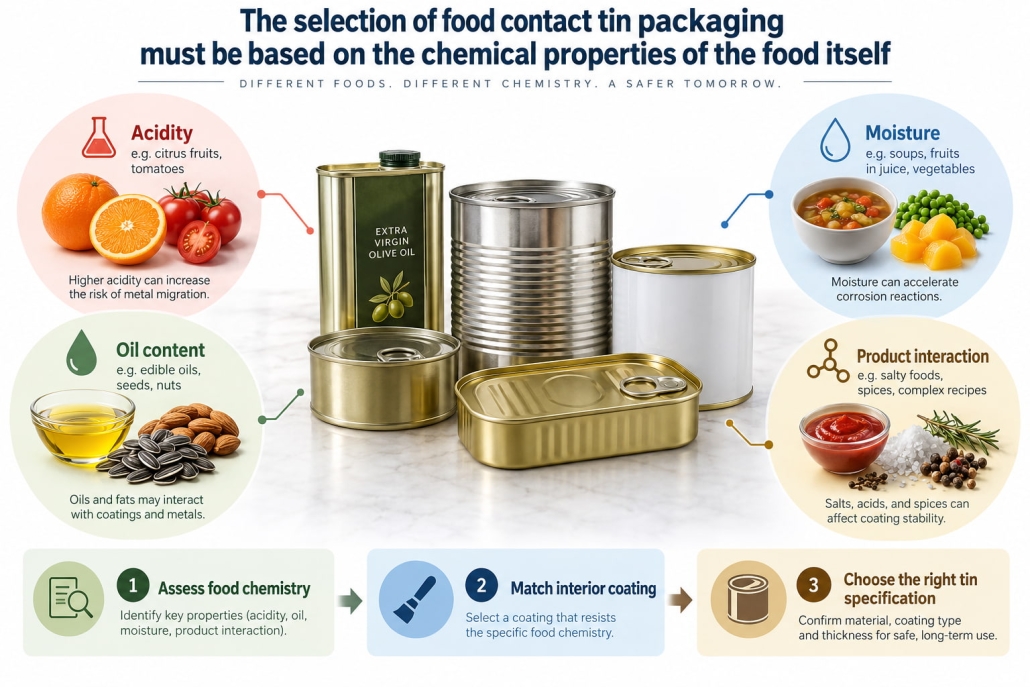
The selection of food contact tin packaging must be based on the chemical properties of the food itself
The most important information when purchasing is not the tin can size, but the food formulation.
When selecting packaging, we need to determine whether the product contains the following components:
- Organic acids
- Free fats
- Salt
- Moisture
- Strongly flavored compounds
- Other potentially corrosive ingredients
The FDA itself categorizes food contact applications into different food categories. Its current food type classification table distinguishes between acidic water-based products, products containing free fats, low-moisture fats, and even dry solids with or without free fats on their surfaces.
This classification system offers important insights for tinplate packaging:
“Food contact” is not a one-size-fits-all application.
Consider the following two products:
| Food | Main Packaging Challenge |
| Tomato-based seasoning sauce | Acid exposure and corrosion resistance |
| Nut or oil-rich seasoning paste | Oil/fat contact and migration compatibility |
Both may require coated tinplate, but you shouldn’t assume they need the same coating system. This principle also applies to custom tin cans for sauces, candies, condiments, oil-containing snacks, candied fruits, and specialty foods.
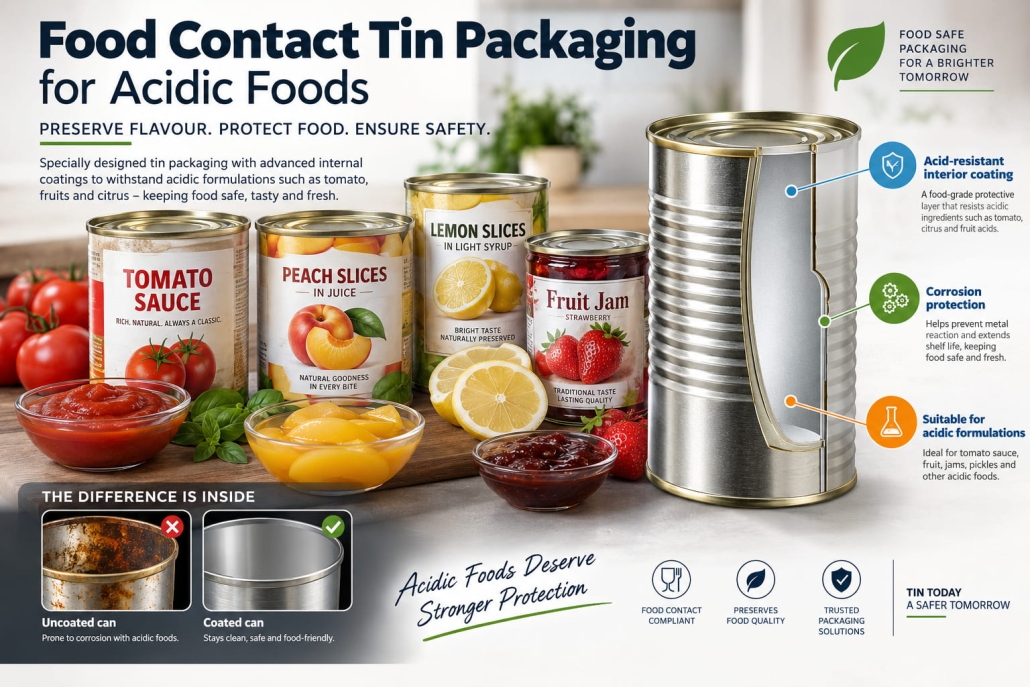
Food Contact Tin Packaging for Acidic Foods
Acidic foods create a more corrosive environment for metal tin packaging, particularly when moisture, salt, organic acids, and long-term storage are involved. Therefore, the inner coating must not only visually separate the food from the metal; it must also maintain an effective barrier between the food and the tinplate throughout the expected shelf life.
For acidic products, we evaluate acid resistance, coating adhesion, and film continuity.
Our recent research on coated tinplate further underscores the importance of food formulations: ingredients such as citric acid, acetic acid, and salt—and even combinations with oily components—can affect coating degradation and tinplate corrosion in different ways. This means that selecting an interior coating solely because it performs well with dry or high-fat products may pose unnecessary risks when the same packaging is used for products with acidic formulations.
TSING’s approach is to first clarify the food’s chemical properties, then select a coating system suitable for the application in terms of both regulatory compliance and technical performance.
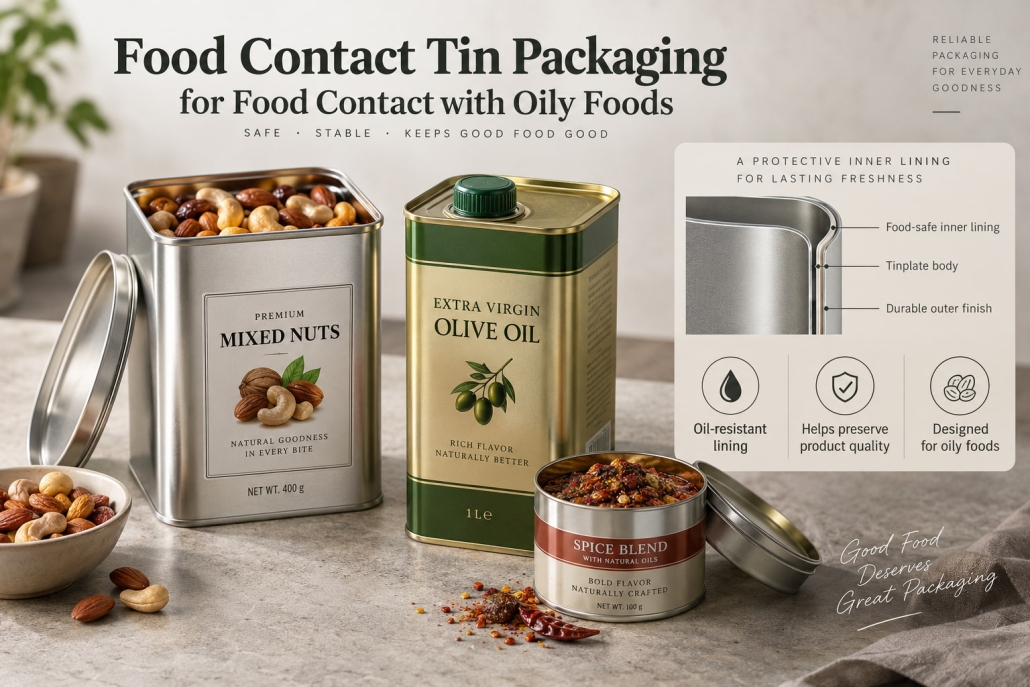
Food Contact Tin Packaging for Food Contact with Oily Foods
Oily foods create a unique food contact environment.
Fats and oils can act as effective media for extracting specific substances from polymer-based food contact materials. Therefore, the FDA recommends using specific oily food simulants when evaluating migration into oily foods.
The FDA’s chemical evaluation guidelines explicitly state that edible oils or other suitable simulants for oily foods may be used for applications involving oily foods. The guidelines also note that migration levels depend, to some extent, on the solubility of the food contact substance in the food.
Therefore, for tin packaging intended for oily foods, we evaluate the coating’s compatibility with fats and oils, as well as its stability during prolonged contact. Relevant products include:
- Fat-rich spice blends
- Nuts
- Fatty candies
- Seasoned sauces
- Oil-immersed products
A key distinction is that excellent acid resistance does not automatically imply suitable migration performance during prolonged contact with oily foods. Conversely, a coating that performs well in terms of oil resistance does not automatically imply sufficient corrosion protection for acidic, water-based formulations.
Matching Food Type, Time, and Temperature
Food type is only one aspect of the specifications.
The FDA also classifies food-contact applications by usage conditions, including hot filling, room-temperature storage, refrigeration, freezing, and high-temperature processing. Therefore, two identical foods—one filled at room temperature and the other requiring heat processing may require different validation conditions.
Consequently, professional tin can packaging specifications should define at a minimum:
- Food ingredients
- Contact surfaces
- Filling temperature
- Processing temperature
- Storage temperature
- Expected contact time
For example, a coating intended for a high-fat, dry food product stored at room temperature should not be automatically considered equivalent to a coating intended for an acidic sauce subjected to high-temperature processing. For this reason, FDA authorizations for food contact materials are tied to specific intended uses and conditions of use, rather than merely a general claim that a material is “FDA-approved.” The regulatory status of a finished food contact material depends on the regulatory basis for its individual components and its intended use.
H2: Validation Should Be Conducted Using the Actual Product Before Mass Production
For purchasers, the safest procurement process is very simple:
Do not start with the tin packaging; start with the food itself.
Before commissioning the production of custom tin cans, the following information should be provided to the supplier:
- Product type and formulation
- Approximate pH value under relevant conditions
- Whether the product contains oils or free fatty acids
- Salt content or other corrosive ingredients
- Filling temperature
- Heat treatment requirements
- Target shelf life and storage conditions
The manufacturer can then select the appropriate tinplate substrate, inner coating, sealing method, and production control parameters based on these requirements. If the product has special chemical properties or stringent shelf-life requirements, consider representative compatibility or migration testing before approving mass production. Acidic foods demand higher corrosion resistance and barrier integrity, while oily foods require a focus on compatibility and migration characteristics when in contact with fats and oils. Additionally, time, temperature, salt content, moisture, and processing methods can further influence specific requirements.
 Facebook
 Twitter
 Linkedin
