
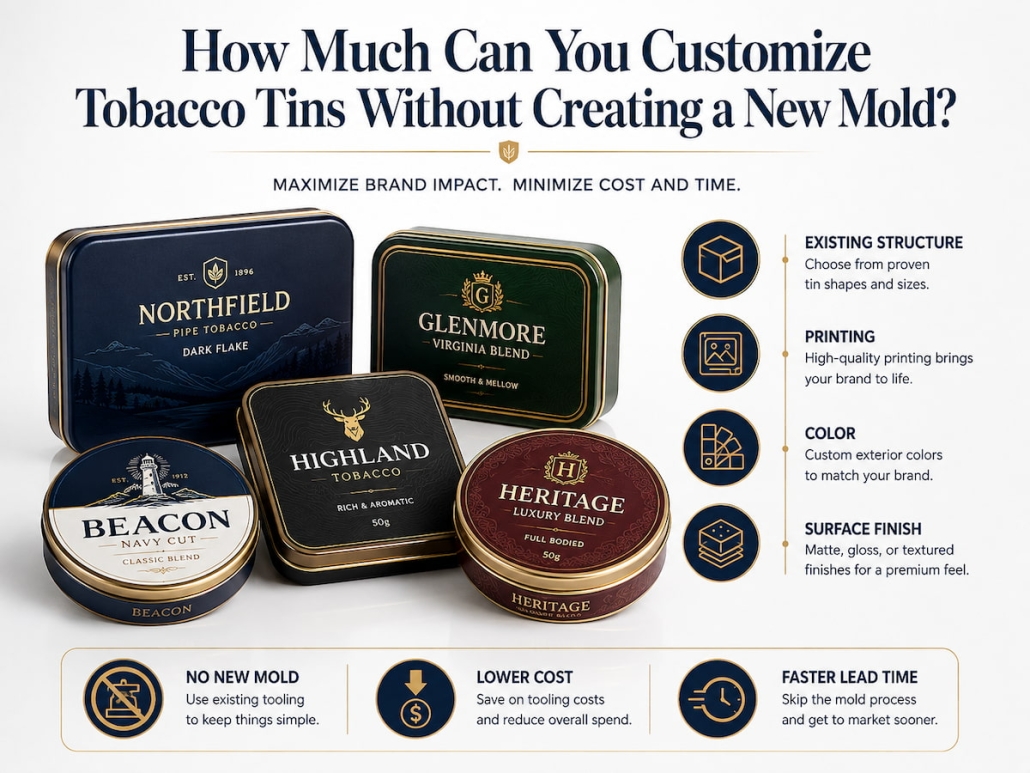
How Much Can You Customize Tobacco Tins Without Creating a New Mold?
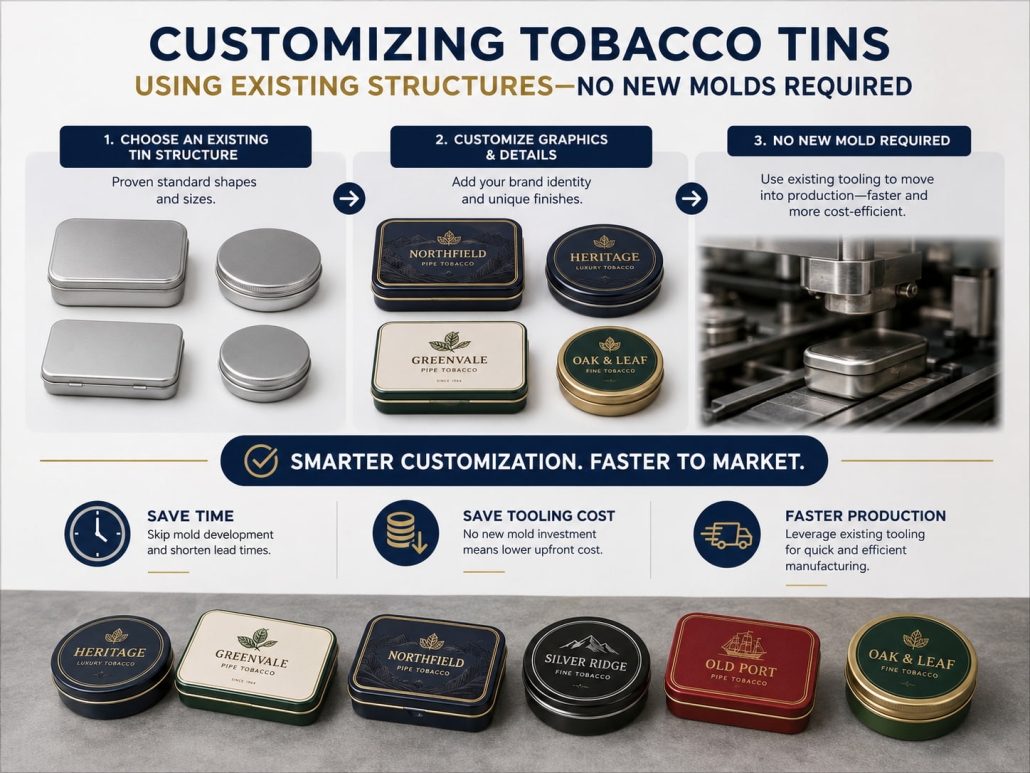
For many tobacco brand clients, the custom packaging they want doesn’t necessarily require developing an entirely new metal structure. If existing metal cans already meet capacity and basic shape requirements, you can often create highly distinctive custom tobacco tins without investing in new can molds. Take TSING as an example: we use existing molds as the structural foundation and create brand differentiation through printing, color, surface treatment, embossing, labeling, and matching internal components. With an extensive mold library, we can provide CMYK/Pantone printing, embossing, labeling, and a variety of surface treatment processes for tobacco tins and other metal packaging.
Customizing Tobacco Tins Using Existing Structures—No New Molds Required
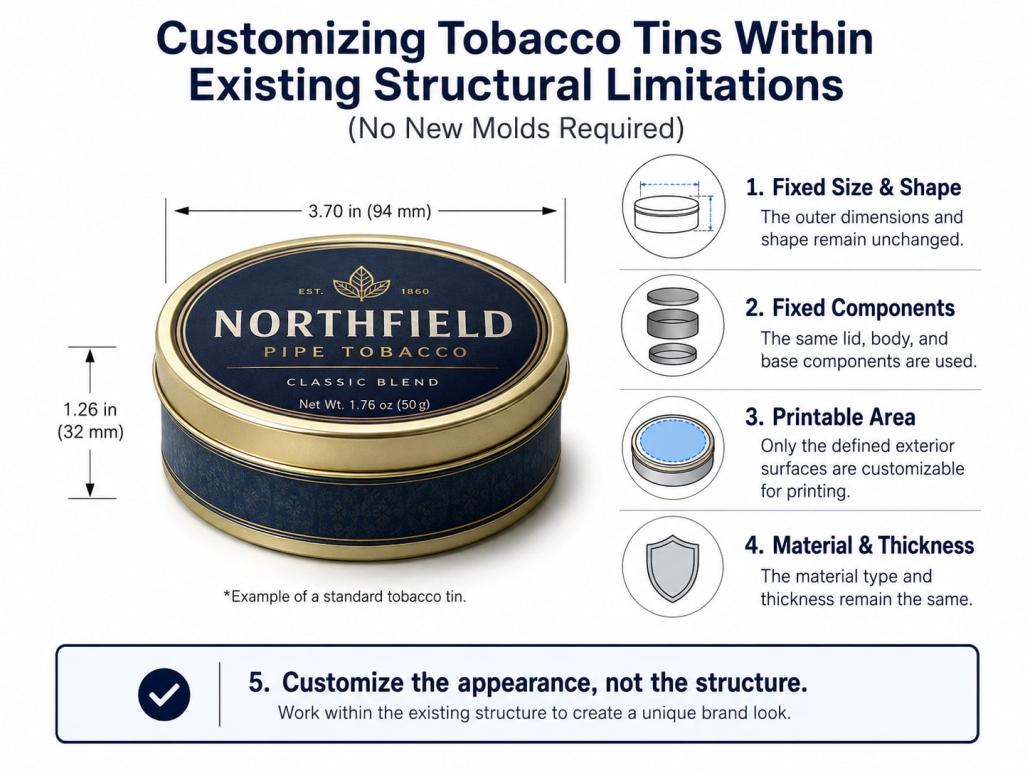
When using existing molds, the primary structural dimensions are predetermined. These dimensions typically include:
- Length and width
- Diameter
- Height or draw depth
- Corner radius
- Fit between the lid and body
- Hinge location
- Geometry of primary edges and seams
For example, if TSING already has a flip-top tobacco tin structure measuring 95 × 60 × 16 mm, the customer can completely transform its visual design while retaining those existing specifications.
However, buyers cannot adjust the tin can dimensions. Any dimensional adjustment that changes the geometry of the formed metal typically requires another set of existing molds with suitable dimensions or the development of a new set of molds. Therefore, we recommend comparing the required product dimensions with the manufacturer’s mold library at the start of the project. For brands with flexible dimensional requirements, selecting the closest matching, proven mold can eliminate a key development step.
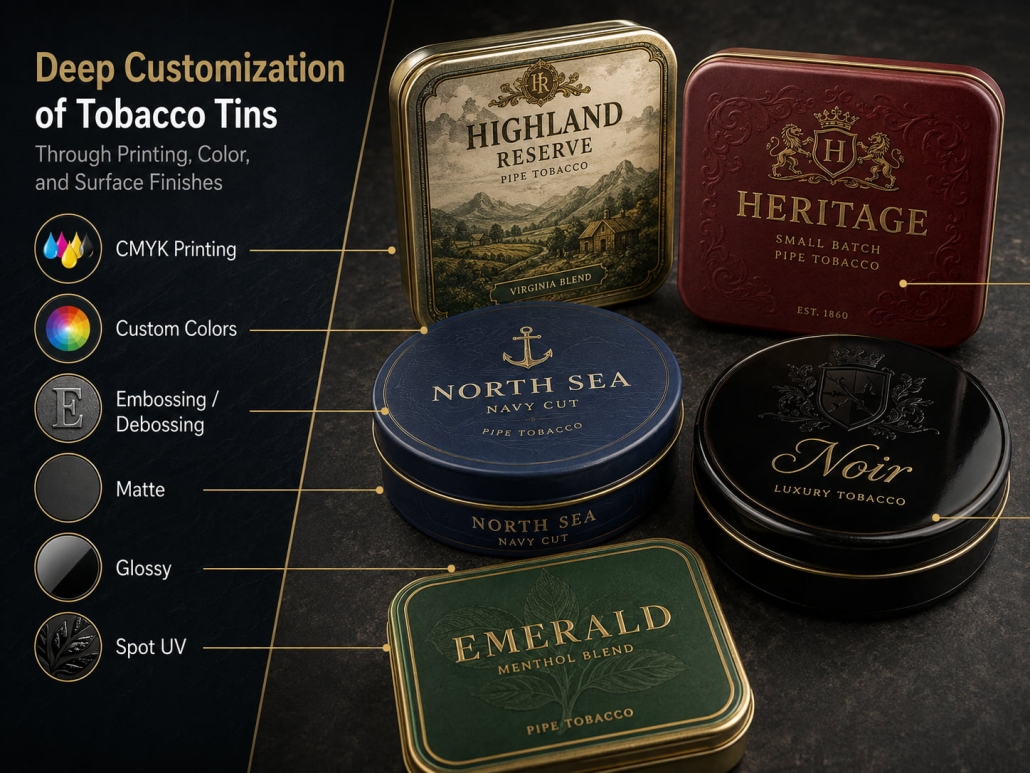
Deep Customization of Tobacco Tins Through Printing, Color, and Surface Finishes
Without altering the tin’s mold, the greatest scope for customization lies in exterior decoration. Tobacco tins with the same structure can achieve completely different visual effects through CMYK full-color printing, Pantone spot colors, matte varnish, glossy finishes, metallic effects, and other techniques.
Our customization solutions include CMYK and Pantone printing, plus decorative finishes such as matte, glossy, brushed, and metallic effects. Our flip-top tobacco tins also support full-color printing and hot stamping. As a result, even a single standard rectangular tobacco tin can be tailored to represent completely different market positioning and stylistic approaches.
Customizing Tobacco Tins Through Embossing, Labels, and Matching Internal Components
Brands can adjust the product’s tactile feel and functional details without replacing the primary molding dies.
Embossing (raised) and debossing (recessed) are excellent examples.
Brands can create raised or recessed logos on the can lids to achieve a more distinctive, high-end feel. However, this typically requires producing separate embossing or stamping dies based on the client’s design artwork.
However, it is important to distinguish one key point:
Customizing an embossing die is entirely different from developing a brand-new die for the tobacco tin body.
Therefore, a project can utilize the manufacturer’s existing can body structure while creating relatively simple, dedicated dies specifically for the logo.
Labels offer even more flexibility, as they generally don’t require developing structural dies. Brands can choose from a variety of label types, such as paper labels, film labels, variable SKU labels, and more.
Customizing Tobacco Tins Within Existing Structural Limitations (No New Molds Required)
Customization methods that do not require new molds have clear limitations. If the desired modifications involve changing the way the metal itself is formed, a new mold is typically required. These include:
- Changing the overall dimensions of the can
- Changing the shape from circular to rectangular
- Significantly altering the radius of the corner fillets
- Increasing or decreasing the draw depth
- Designing new stepped or recessed can structures
- Designing unique, non-standard shapes
TSING offers a variety of can lid solutions, including slip-on, hinged, insert-type, and other lid configurations. However, this doesn’t mean you can arbitrarily pair any lid with an existing can body. Rather, the lid and can body must be structurally compatible. While you can achieve significant aesthetic changes without replacing the can mold, you typically can’t alter the core geometry.
Choosing Between Existing and New Molds Based on Requirements
The final decision should depend on how important structural uniqueness is to the brand.
We recommend using existing molds in the following situations:
- Existing dimensions already meet product requirements
- Development costs for the initial order need to be controlled
- Printing and surface finishes are sufficient to achieve differentiation
Consider developing new molds in the following situations:
- There are strict requirements for precise dimensions
- The can must match another packaging item exactly
- Shape is a core element of brand recognition
- A unique closure design is required
- Expected order volume is sufficient to justify the mold investment
For most buyers, evaluating existing molds is the best way to balance customization depth, mold costs, development cycle, and brand requirements.
 Facebook
 Twitter
 Linkedin
