
How to Plan a 3000+ Piece Bulk Candle Tins Order?
Ordering 3,000 candle tins is very different from purchasing a small number of samples online. With such a large order volume, even seemingly minor choices can affect the entire production process.
For TSING, 3,000 is the standard minimum order quantity, and we can fulfil larger orders through mass production. We have approximately 2,500 molds and support custom printing, surface treatments, embossing, and candle tin production with various structures. For qualifying bulk orders, the fastest lead time is approximately 45 days, though the actual delivery date depends on the specific customization details and order requirements.
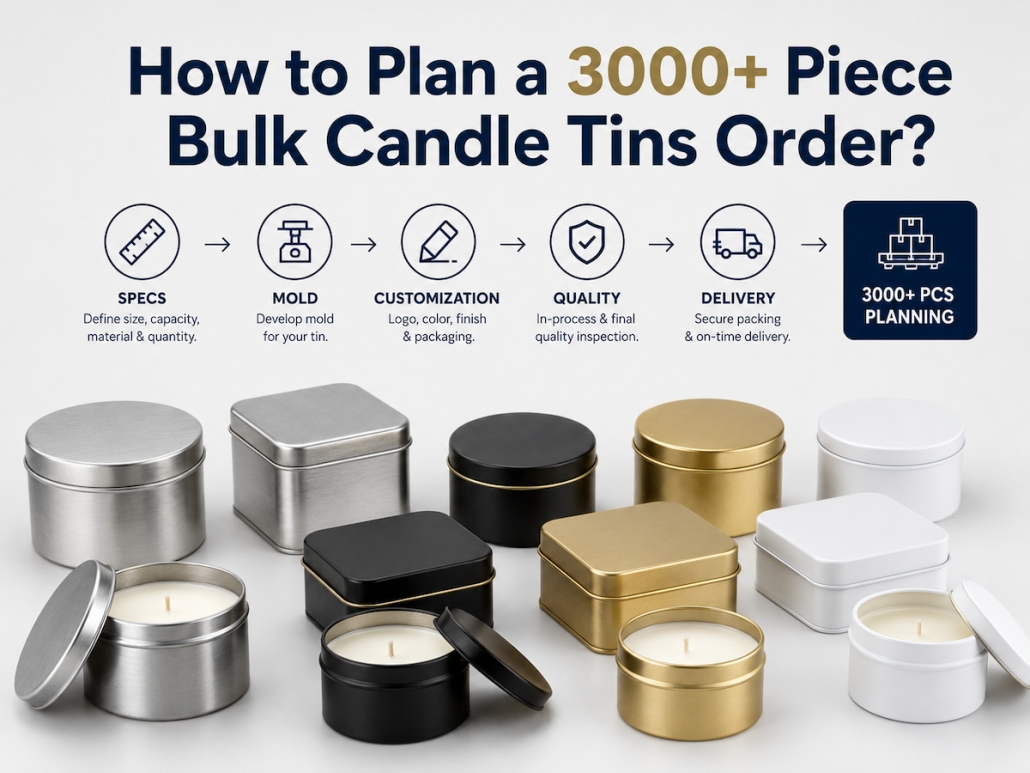
For candle tin manufacturers, the most effective way to plan orders of 3,000 units or more is to make decisions in the correct sequence:
Candle demand → Candle tin specifications → Mold selection → Finishing processes → Sample approval → Mass production → Quality inspection → Packaging and shipping
The following five steps will explain how we manage this process from the perspective of a professional manufacturer.
Pre-production Planning for Candle Tins: First, clarify the product specifications
In many bulk purchasing projects for candle tin containers, a common initial mistake is requesting a quote without first clarifying the container’s specific specifications. Once the tin container manufacturer understands the tin’s intended use and functional requirements, the quote will be more accurate and reliable. Before recommending a specific production solution, TSING typically needs to understand the following information:
- Desired fill weight of the wax
- Approximate volume of the wax
- Candle formula
- Number and size of wicks
- Desired tin diameter and height
- Lid type
- Required interior coating
- Target order quantity
Therefore, brands planning to purchase tin candle containers in bulk are advised to provide one of the following sets of information:
“Target wax fill volume + required headspace” or “Dimensions of existing candle containers + target capacity”
This allows the manufacturer to assess whether the existing tin structure is suitable.
Candle Tins Should Meet the Expected Tinplate Strength Requirements
The tinplate thickness must also match the container dimensions and intended use; one should not unthinkingly select the thickest material available on the market. For many candle applications, TSING typically uses medium-thickness tinplate specifications. Depending on the specific product, tinplate thickness generally ranges from 0.23 to 0.30 millimeters.
The appropriate tinplate thickness depends on the product’s dimensions and forming structure. A well-designed 0.23-millimeter tinplate can outperform a container that uses thicker sheet metal without proper structural reinforcement. For projects involving 3,000 finished products, confirming these specifications early can prevent changes after artwork design or sample production is complete.
Decide Early Whether to Use Existing Molds or Custom Molds
Once the target dimensions have been determined, the next question is:
Should you use existing molds, or do you need to develop new ones?
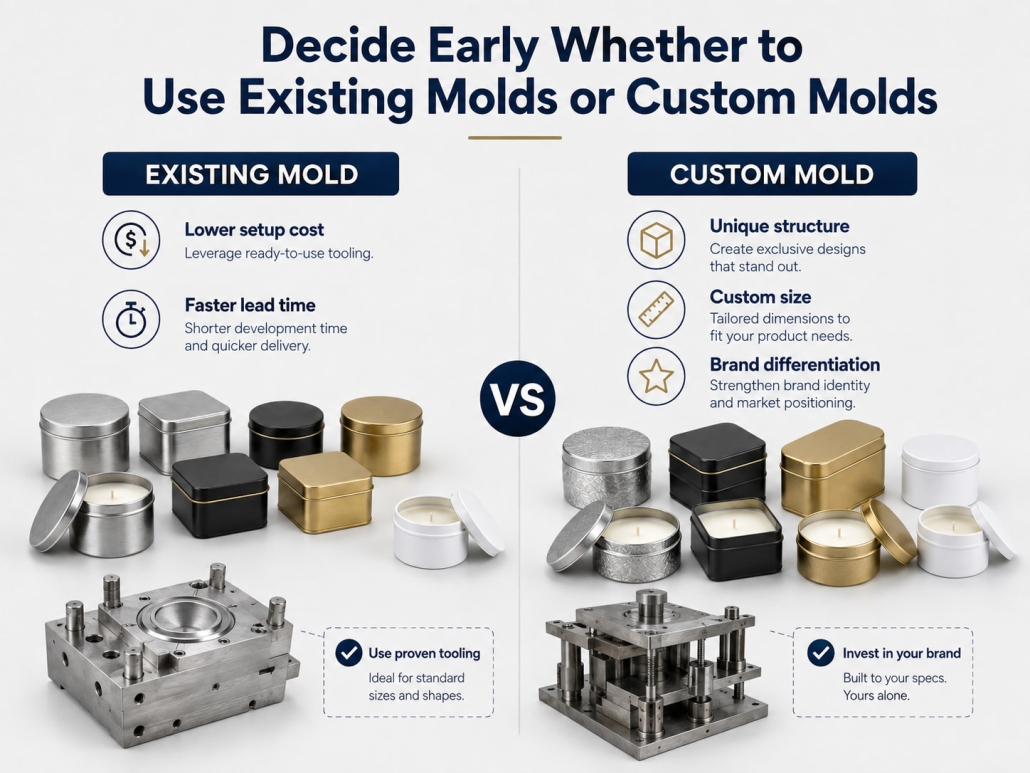
This decision directly impacts project costs and development timelines. We have approximately 2,500 sets of candle tin molds, so many brands can choose from existing tin designs before considering custom molds. For many projects with initial order quantities around 3,000 units, using existing molds is often the most practical choice.
Using existing molds reduces the complexity of candle tin development. It makes sense to use existing molds in the following situations:
- Standard sizes (such as 4 ounces, 6 ounces, 8 ounces, or similar dimensions) are suitable;
- There is a tight time-to-market;
- The buyer wishes to allocate a larger portion of the budget to printing and surface finishes;
- The order is intended to test a new product line;
Using existing molds doesn’t mean buying generic, run-of-the-mill candle tins. It means keeping a proven, reliable metal tin structure while customizing the exterior decoration.
Unified Management of Customization, Quality, and Delivery for Metal Candle Tins
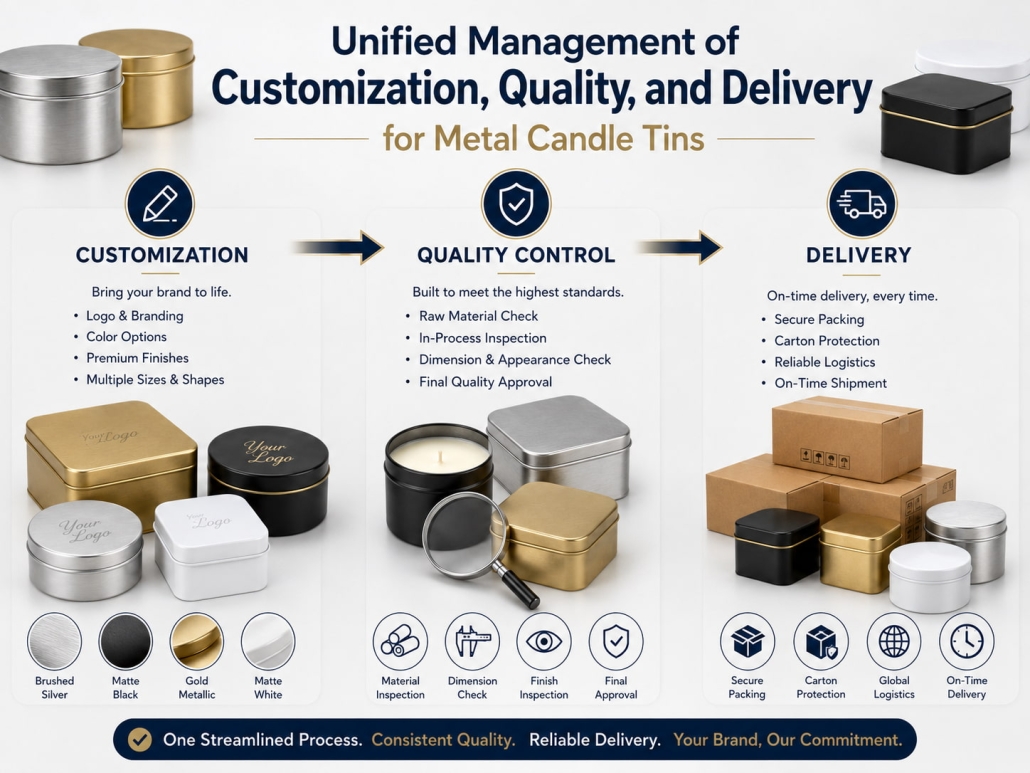
Finalize customization plans for metal candle tins before mass production begins. Once the structure is determined, lock in custom specifications before large-scale production begins. For bulk orders of metal candle tins, common customization decisions include:
- Exterior color
- CMYK or Pantone printing
- Matte or glossy finish
- Metallic texture finish
- Embossed or debossed logo
- Lid design
- Interior coating
TSING’s metal candle tin series currently supports a variety of options, including custom colors, CMYK/Pantone printing, embossing, labeling, and matte, glossy, or other surface finishes.
We recommend tailoring the customization plan to your specific needs. For example:
Standard DTC candle brands:
Matte color + printed logo + standard lid
High-end candle brands:
Custom Pantone color + embossed logo + stylistically coordinated lid
Luxury gift candles:
Metallic finish + embossing + premium secondary packaging
Evaluate metal candle tin pattern designs based on the tin’s actual structure.
Do not approve pattern designs based solely on a flat PDF file. During the metal forming process, the visual appearance of certain areas may change. Key areas include curved side walls, lid edges, rolled seams, and embossed areas. Therefore, we check whether critical text, logos, or intricate patterns are too close to these forming areas. As a result, the sample approval phase is one of the most critical steps in the production process.
Verifying the Functionality of Candle Tins Through Sample Approval
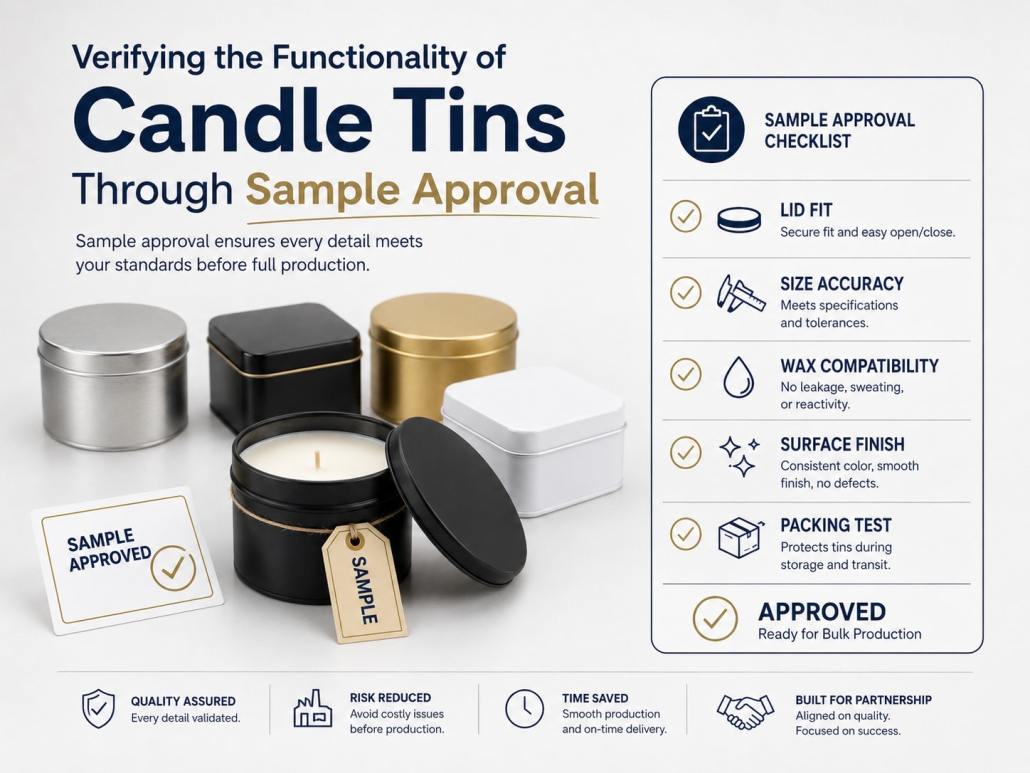
Samples are not merely scaled-down versions of the mass-produced items; they represent the last opportunity to identify and resolve issues before mass production begins. For custom candle tins, sample approval should cover the following three aspects.
1. Candle tin samples should be inspected for appearance:
Inspection items: color, logo size, pattern placement, matte or glossy finish, embossing depth, and surface consistency.
If Pantone color accuracy is strictly required, confirm it using physical metal samples whenever possible, rather than relying solely on screen colors.
2. Verify the structure:
Inspection items: lid fit, opening force, tin dimensions, edge finishing, and bottom stability.
Even a tin with a flawless appearance isn’t successful packaging if the lid is too loose.
3. Testing with Actual Candles:
This is one of the most critical steps. Before ordering 3,000 or 10,000 candle tins, the brand should conduct its own candle compatibility and burn tests using the intended candle components. The tin manufacturer is responsible for the container itself, but the candle’s final performance depends on the finished product. Therefore, before authorizing production, the brand should confirm that the finished candle performs as expected.
Bulk Orders Require Clear Quality, Packaging, and Delivery Plans
The final stage isn’t as simple as “producing 3,000 units.”
Professional bulk orders require the buyer and manufacturer to agree on the inspection, protection, counting, packaging, and shipping methods for the finished tin containers. This is because mass production of candle tins demands a high degree of consistency across the entire batch.
During mass production, key quality control points include:
- Consistency of tinplate material
- Forming precision
- Lid fit
- Surface color
- Print registration accuracy
- Coating quality
- Embossing/debossing consistency
- Presence of scratches and dents
- Quantity accuracy
For candle brands, this consistency is crucial because consumers may display multiple products from the same series side by side. Therefore, mass production focuses not only on whether individual products meet standards but also on whether the entire batch maintains consistency in appearance and performance.
Packaging Solutions for Metal Candle Tins Should Be Finalized Before Shipment
If bulk packaging results in excessive direct contact between metal parts, the metal tins may be damaged. Therefore, TSING’s documentation for metal candle tins includes solutions for high-volume orders, such as protective cardboard boxes, dividers, and palletized shipping. The specific packaging method should depend on the following factors:
- Surface treatment process
- Shape of the tin
- Export destination
- Mode of transportation
- Customer warehouse requirements
Therefore, before shipment, buyers should confirm the following information:
Quantity per carton → Carton dimensions → Carton weight → Pallet requirements → Mode of transportation
Making Bulk Orders for Candle Tins Easier
If buyers can provide complete information from the outset, managing orders exceeding 3,000 units becomes much easier.
Before requesting a formal quote, please have the following information ready:
1. Quantity of candle tins
2. Dimensions or capacity of candle tins
3. Candle specifications
4. Customization requirements
5. Delivery requirements for the candle tins
With these five key pieces of information, the manufacturer can determine whether existing molds are suitable, what production processes are needed, and what additional information is required before quoting. For brands planning to place bulk orders for candle tins, this approach is far more efficient than simply making a vague request such as, “Please provide a quote for 3,000 custom candle tins.”
 Facebook
 Twitter
 Linkedin
