
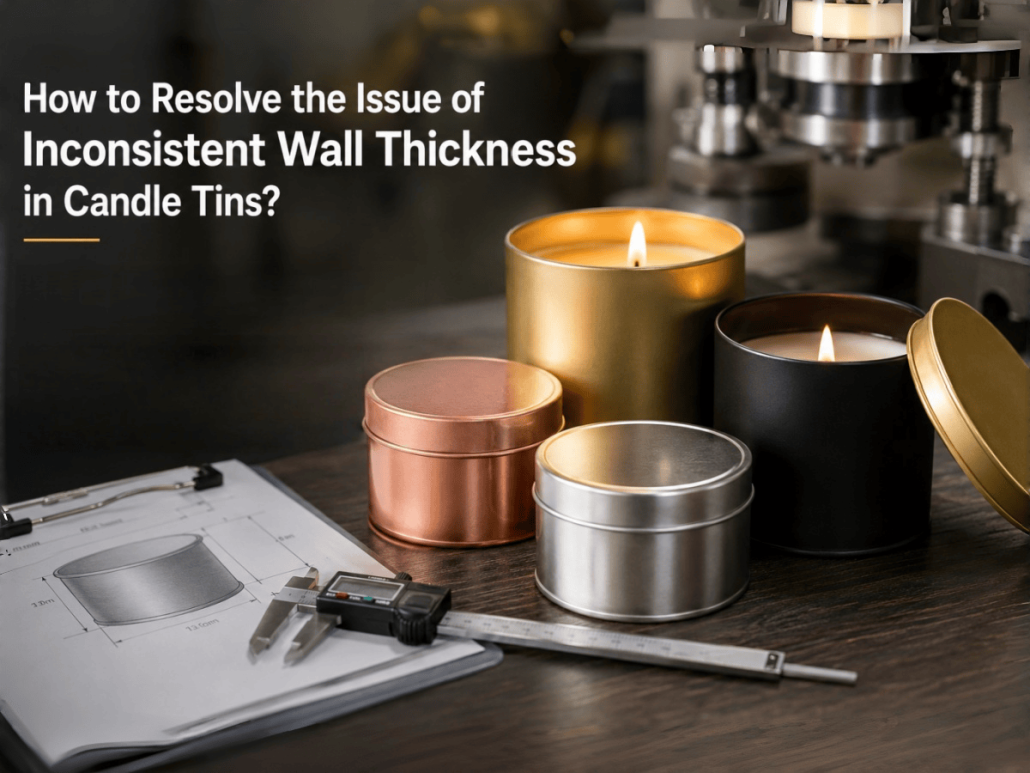
How to resolve the issue of inconsistent wall thickness in candle tins?
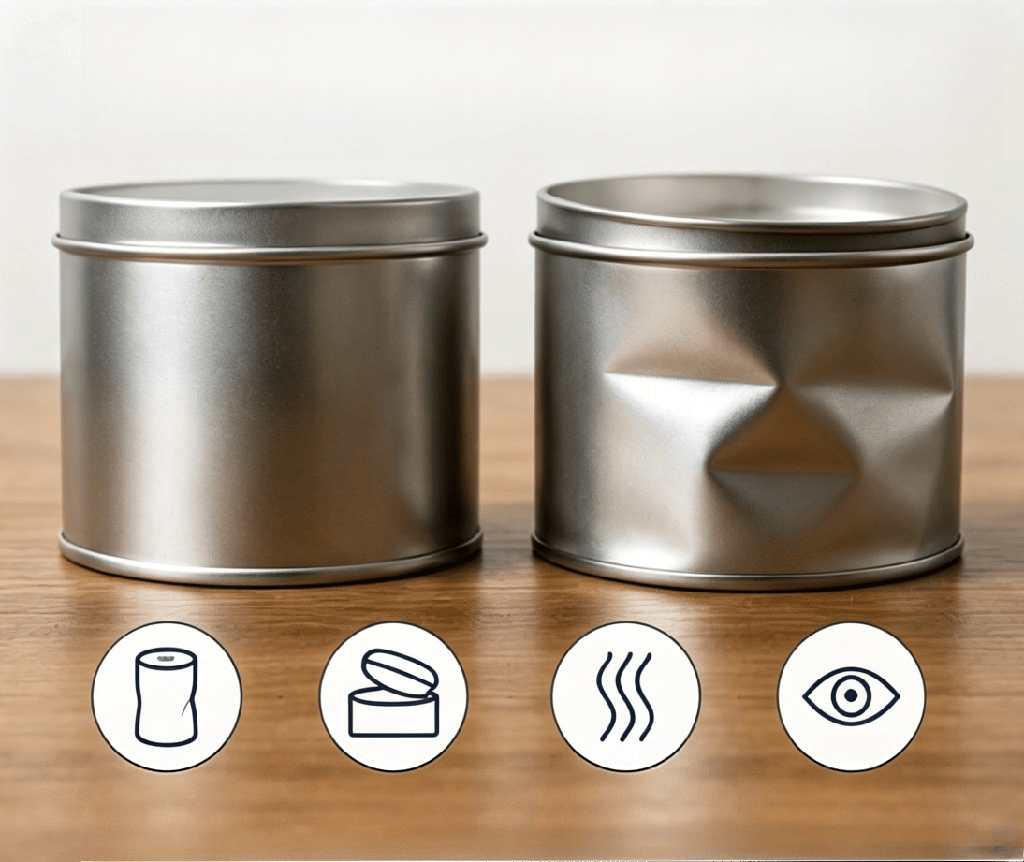
Inconsistent wall thickness in candle tins can affect the tin’s feel, performance during filling, dent resistance, and stability during transportation and storage. When the wall thickness of a candle tin is uneven, these issues often manifest simultaneously. Some tins feel softer to the touch than others, some lids fit loosely, and some candle tins are more prone to deformation when exposed to heat or pressure. In wholesale orders, these variations can lead to inconsistent candle quality.
As a professional tin can manufacturer, we address this issue through process control at every stage of production. We comprehensively manage materials, molds, forming pressure, tensile properties, and inspection procedures to ensure consistent quality in every batch of wholesale candle tins.
What are the implications of inconsistent wall thickness in candle tins?
When the walls of one candle tin are slightly thicker or thinner than another, this variation affects the tin’s forming, sealing, and durability. This difference becomes particularly noticeable when customers compare multiple tins side by side. For candle packaging, visual appeal is a crucial aspect of the experience. If a tin appears slightly warped or feels less sturdy than others, the entire packaging loses its sense of uniformity. This undermines the brand image and may even reduce consumers’ perceived value of the candles. In any retail setting, such minor discrepancies can make the entire product line appear unprofessional.
Main Causes of Uneven Wall Thickness in Candle Tins
To address uneven wall thickness, one must first understand its root causes. In candle tin production, this problem typically arises before the tin is formed. Material quality, process parameters, mold condition, and the drawing process all play a role. If any of these factors deviate, the final wall thickness may be uneven.
Material Variations Pose the First Risk
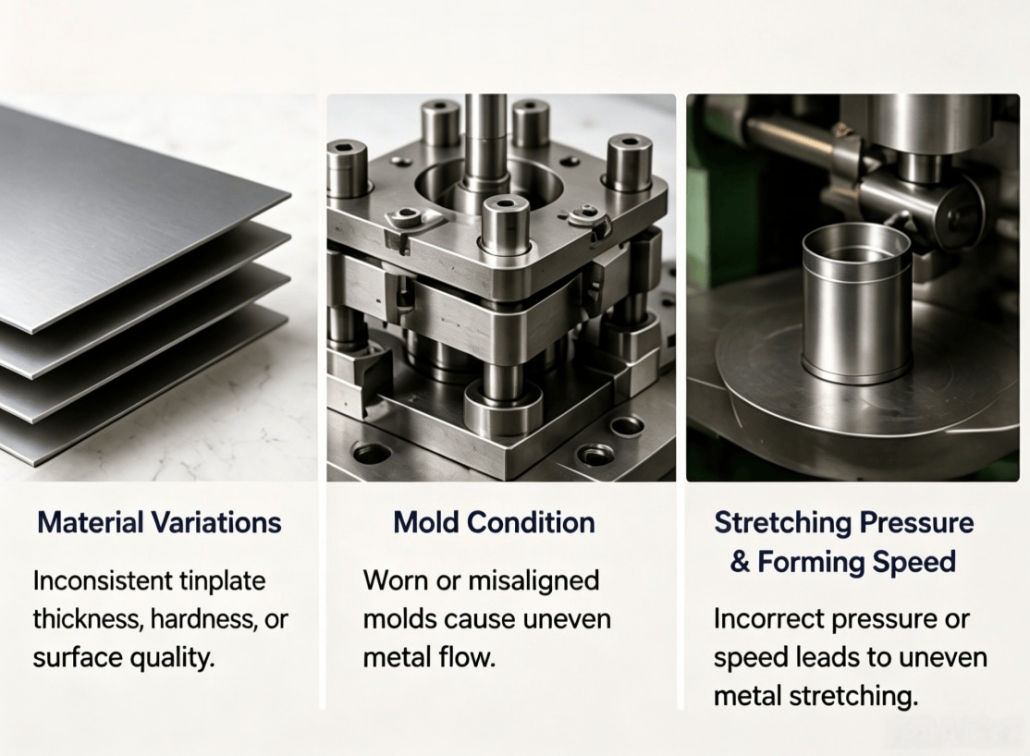
The base material is the starting point for all tin cans. If the tinplate is inconsistent, the finished candle tins will not be uniform either. Differences in material thickness, hardness, or surface quality lead to variations in forming performance during production. This can result in certain areas of the material having better ductility or better shape retention than others. This is why careful material selection for candle tin packaging is essential. A stable base material makes it easier for manufacturers to produce products with consistent wall thickness.
Impact of Mold Condition
The molds or tools used to form candle tins must be extremely precise. If the tools are worn, misaligned, or do not match the design, the metal may not flow evenly during forming, resulting in uneven wall thickness. This issue is particularly pronounced in custom candle tins, as their shapes are often more complex than those of standard tins. If the geometry is poorly designed, certain parts of the tin may be subjected to excessive pressure, while others may not deform sufficiently. This ultimately results in structural inconsistencies that affect both appearance and performance.
The Impact of Stretching Pressure and Forming Speed
The candle tin-forming process also affects wall thickness. If the pressure is too high, certain areas may be overstretched. If the pressure is too low, the shape may not form correctly. If the speed varies too much, the metal may not flow uniformly through the die.
How Does TSING Ensure Uniform Thickness?
As a professional tin can manufacturer, our first step is to control materials. We do not treat tinplate as a generic raw material; instead, we select and validate it based on the product’s structure, forming requirements, and end use. This also provides a more stable foundation for custom candle tins.
Selecting a Tinplate That Meets Forming Requirements
Different candle tins require different material properties. Slim or intricately detailed designs may require one set of material response characteristics, while deeper or sturdier structures may require another. We select the appropriate tinplate based on forming requirements, ensuring the metal can be stretched in a controlled manner. This is because wall thickness consistency largely depends on how the material responds during the drawing process. If the material is too soft, areas of stress concentration may become too thin; if the material is too hard, it may fail to form a smooth, even part. By matching the material to the design, we can mitigate these risks before production begins.
Using Precision Candle tin Dies
Dies are one of the key factors in controlling wall thickness. Even with the correct material, poor-quality dies can still result in uneven wall thickness in candle tins. Therefore, we place great emphasis on the precision, condition, and alignment of the molds. We use precision candle tin molds to help the tin cans deform in the correct direction. These molds support the can’s shape without subjecting the material to uneven stress. When the mold precision is high, the can’s wall thickness remains more uniform. This is especially true for custom candle tins; the more unique the design, the more critical the mold quality becomes.
Controlled Pressure Prevents Uneven Stretching
Once the material and mold are ready, the next challenge is process control. Wall thickness deviations often occur during forming, so we carefully control pressure, speed, and production parameters during manufacturing. The key lies in balance: the candle tin must have sufficient ductility to form the desired shape, but not so much that it overstretches, leading to uneven wall thickness. We fine-tune the process for each candle tin design. Thicker or deeper structures may require different pressure settings than shallower ones. By matching the pressure to the design, we help the tin walls form a more uniform shape.
Ensuring Uniform Wall Thickness for Candle Tins
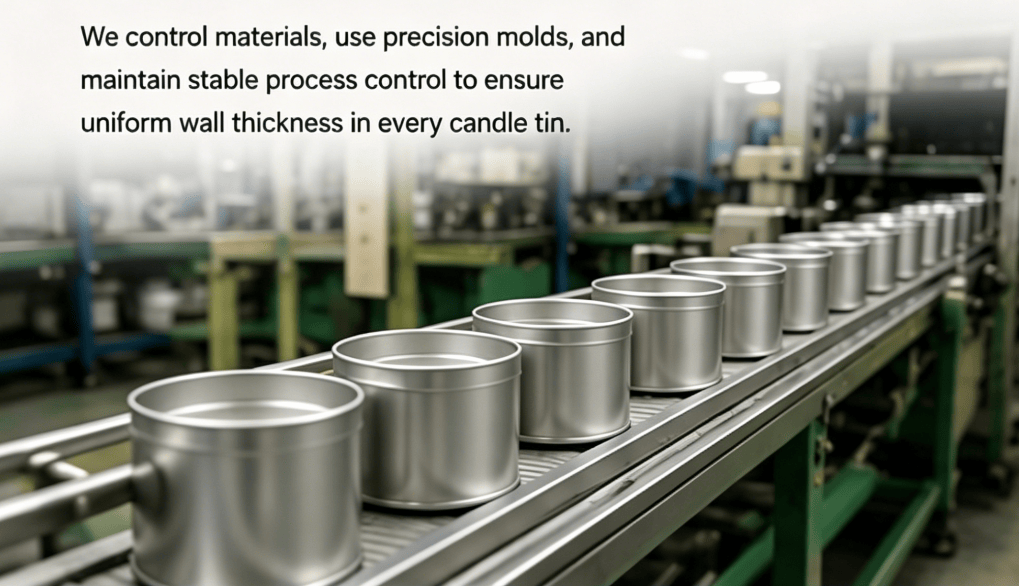
If you are looking for custom candle tins, wall thickness consistency should be one of your top quality considerations. Uneven thickness can affect the product’s appearance, feel, and performance. At TSING, we ensure uniform wall thickness in every batch of candle tins through rigorous material selection, precision mold manufacturing, stable process control, and meticulous inspection.





 Facebook
 Twitter
 Linkedin
