
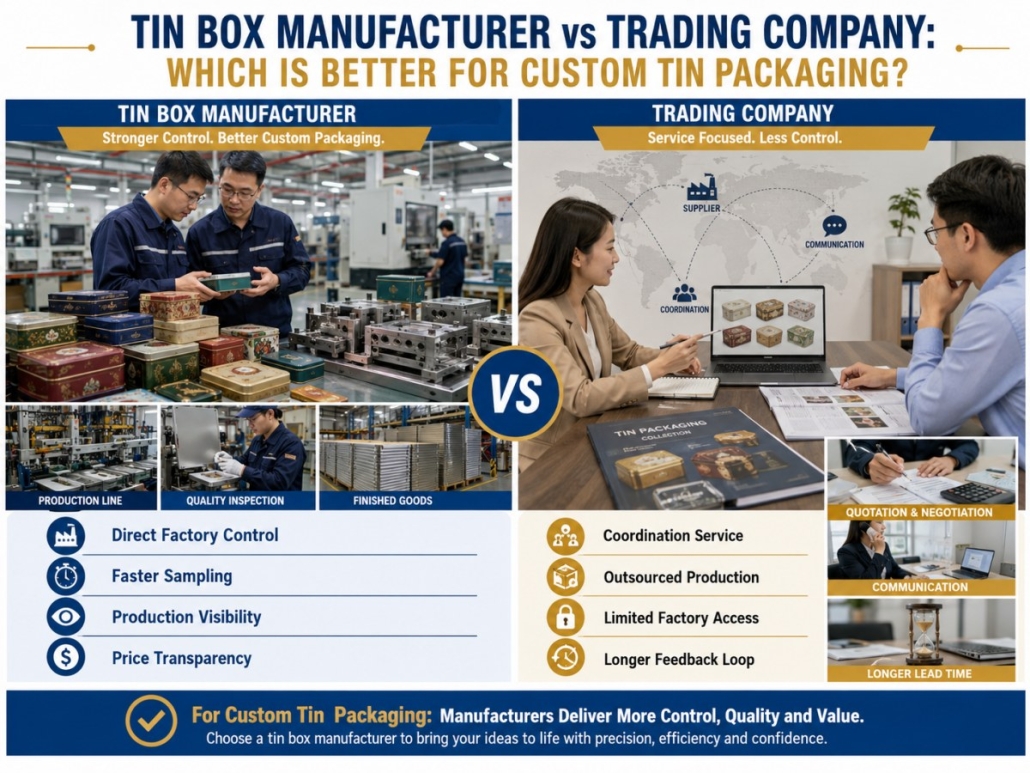
Tin Box Manufacturer vs Trading Company: Which Is Better for Custom Tin Packaging?
When purchasing standard product packaging, the difference between buying directly from a tin box manufacturer and purchasing through a trading company may not be obvious. However, custom tinplate packaging is quite different. Custom tinplate packaging involves numerous steps, including material selection, mold adaptation, printing, forming, and more.
Every additional layer of communication slows down the transmission of these decisions to the production line.
For packaging projects involving custom structures, specialized dies, Pantone spot colors, special surface finishes, strict dimensional requirements, or repeat production, working directly with a tin box manufacturer typically offers greater control and customization capabilities.
The differences between tin box manufacturers and trading companies are evident in seven practical areas: technical communication, die development, customization depth, cost structure, quality control, production responsiveness, and management of long-term repeat orders.
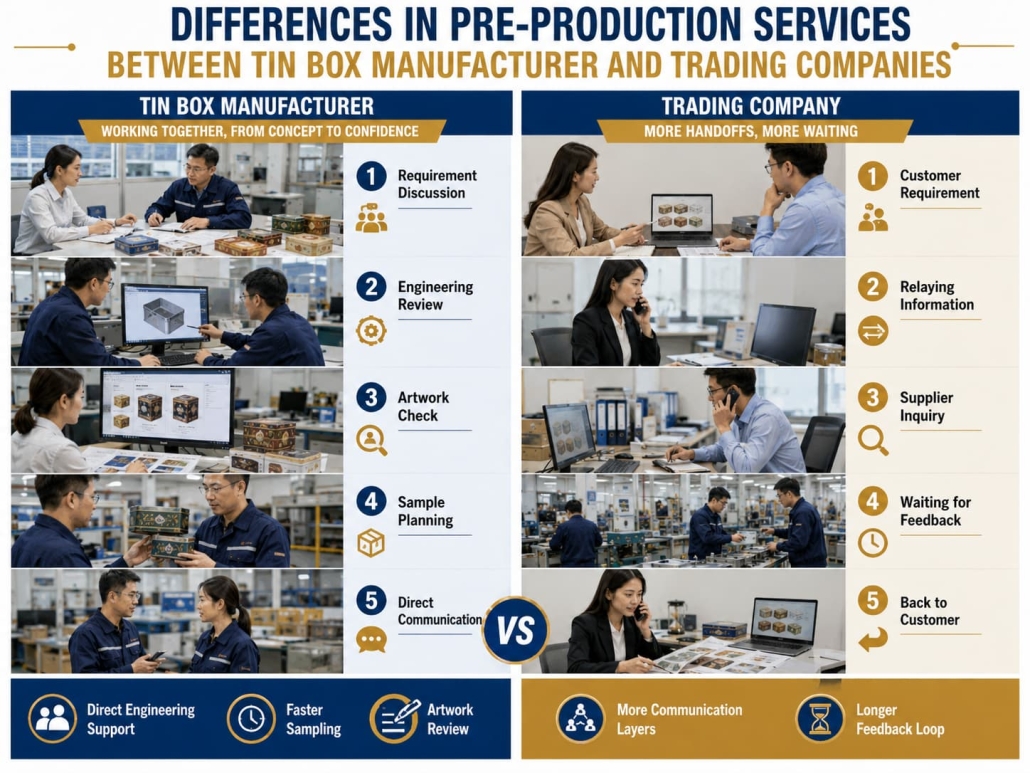
Differences in Pre-Production Services Between Tin Box Manufacturer and Trading Companies
Tin box manufacturers provide more direct technical communication; custom tinplate box projects rarely proceed directly from design drafts to mass production. Before production begins, tin box manufacturers typically need to determine the following:
- Whether existing molds are suitable for the product
- Whether the required embossing depth can be consistently achieved
- Which thickness of tinplate is most appropriate
- How the lid fits with the body
- Whether the design will be printed in CMYK or Pantone
- Which surface finishing process to select?
When working directly with a tin box manufacturer, engineering and production teams can evaluate these issues more closely. Manufacturers can identify and address these technical considerations before mold making or mass production begins.
When working through a trading company, although a technically capable account manager can coordinate these discussions, information typically must pass through intermediate steps:
Buyer → Trading Company → Factory → Trading Company → Buyer
For highly customized projects, multiple rounds of information relay can slow down the revision process and even compromise the accuracy of critical details.
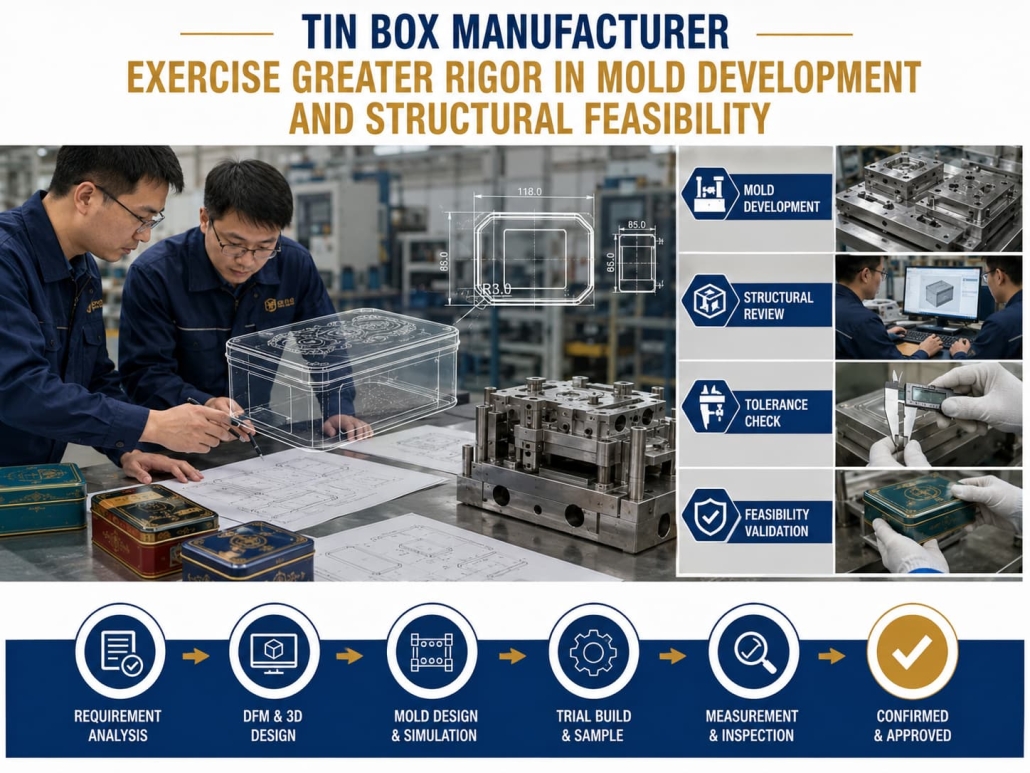
Tin Box Manufacturer Exercise Greater Rigor in Mold Development and Structural Feasibility
The mold largely determines the final geometric shape of a custom tin box.
While buyers may initially focus only on dimensions, professional tin box manufacturers also evaluate draw depth, flange structure, hinge placement, and stacking requirements. At this stage, extensive manufacturing experience helps avoid costly design changes later. Before developing new molds, manufacturers can first verify whether existing molds meet the project’s requirements. If they do not, suppliers can develop new structures based on the product’s actual dimensions and functional requirements.
If existing molds are suitable, buyers may only need to arrange for custom printing and surface finishing; however, if the product requires unique dimensions or an opening mechanism, developing a new mold can help achieve greater brand differentiation. The core advantage lies not merely in the factory “owning the mold,” but in the tin box manufacturer’s ability to thoroughly assess the alignment between the mold structure and actual production capacity before project confirmation.
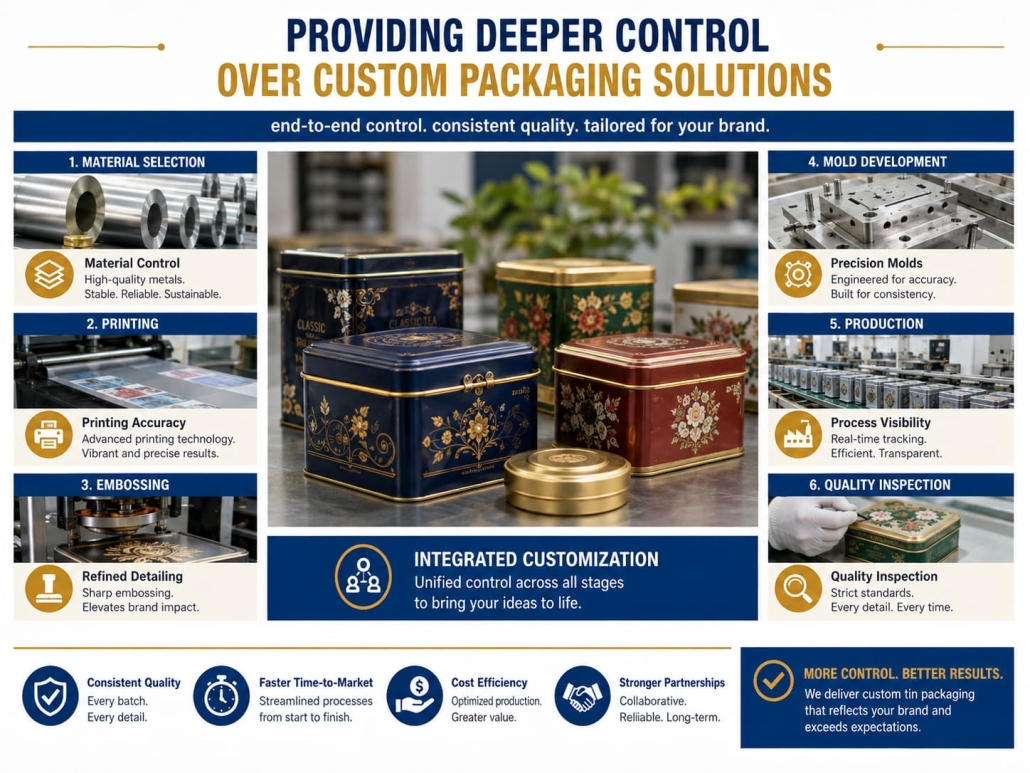
Providing Deeper Control Over Custom Packaging Solutions
Custom tin packaging involves more than simply selecting dimensions and printing a logo. Manufacturers often need to coordinate the following aspects:
Structure:
Round, rectangular, square, cylindrical, or other special shapes
Hinged lids, sliding lids, insert lids, or other lid structures
Seamless one-piece molding or multi-part assembly structures
Appearance and Decoration:
CMYK printing
Pantone spot colors
Matte or glossy surface finishes
Embossing (raised printing) or debossing (recessed printing) techniques
Accessories:
Plastic inserts
Window designs
Carry handles
Other components for specific applications
Tin can manufacturers can treat custom tin can packaging as a comprehensive project, not just a list of decorative options.
A Clearer Cost Structure for Custom Projects
Buying directly from a factory often means lower prices, but price isn’t the most important factor when choosing a manufacturer.
A bigger advantage is cost transparency. The price of custom tin packaging depends on the following factors:
Tin can size
Amount of tinplate used
Order quantity
Mold development
Surface treatment
Embossing process
If buyers can discuss these variables directly with the tin can manufacturer, they can better understand which design decisions drive up costs.
| Option | Main Advantage | Main Cost Consideration |
| Existing mold | Lower development cost | Dimensions may need adjustment |
| New custom mold | Exact structure and stronger differentiation | Additional tooling investment |
For example, suppose a customer wants a unique rectangular tin box. The manufacturer might discover that existing die sizes differ from the customer’s required dimensions by only a few millimeters.
This allows buyers to make substantive decisions about the packaging, rather than simply accepting a final quote. The same logic applies to printing and post-press processing. If a complex decorative process significantly increases costs without delivering commensurate value to consumers, the manufacturer can suggest a simpler alternative that still achieves the desired visual effect. This is also a key distinction between manufacturers and traders.
What Changes Occur During and After Production?
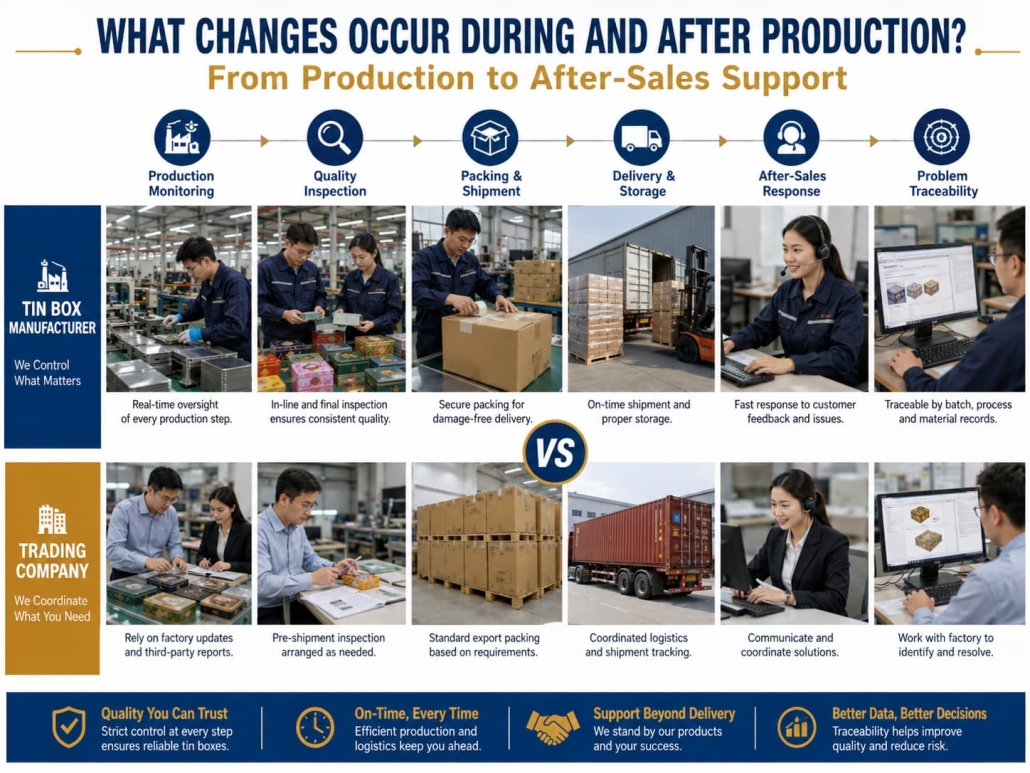
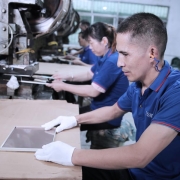
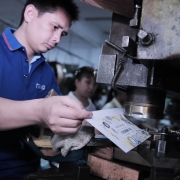
Tin box manufacturers exercise direct quality control over the production process, and this quality control is one of the most significant differentiators in the custom packaging sector.
While finished tin boxes may look simple, meeting customer specifications depends on multiple stages of production.
Tin box production includes steps such as tin sheet cutting, component forming, inspection, cleaning, packaging, and shipping. For custom tin box packaging, inspections may include print consistency, surface scratches, color discrepancies, dimensional accuracy, hinge condition, embossing (raised printing) positioning, and more. The advantage of working directly with a tin box manufacturer is the ability to implement corrective measures at the specific production stage where the defect originated.
Therefore, compared to trading companies, professional tin can manufacturers can enforce strict process controls throughout production.
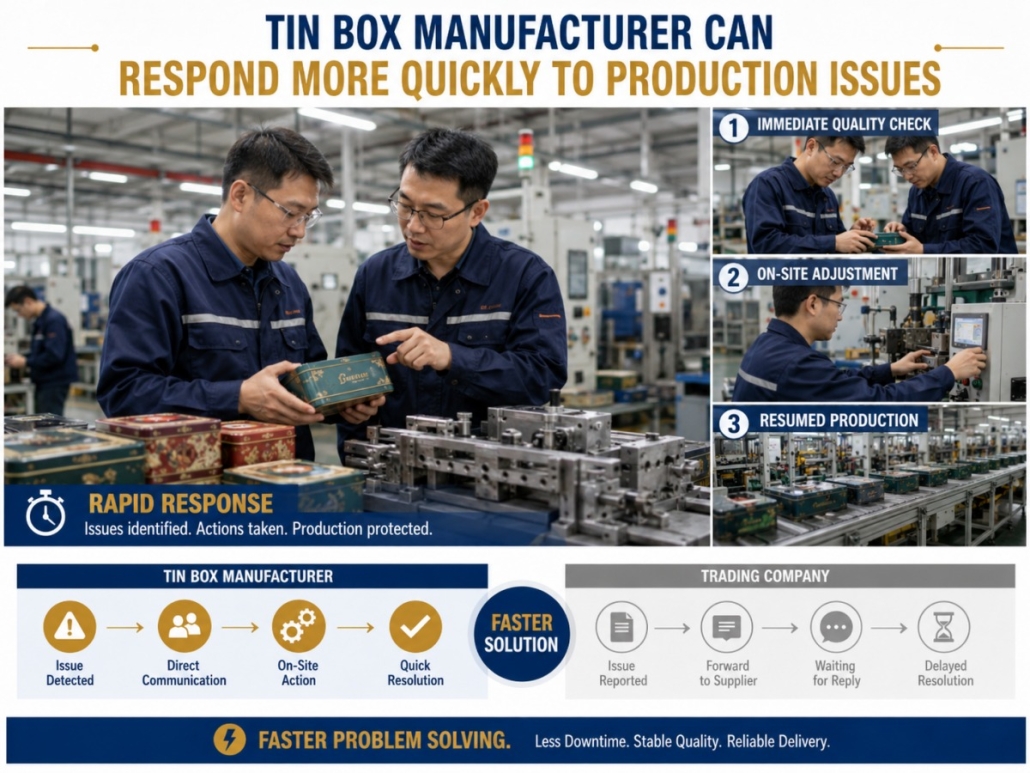
Tin box manufacturer can respond more quickly to production issues
No responsible manufacturer would claim that problems never arise during custom production. The more important question is:
How quickly can the manufacturer identify the root cause and resolve it?
Suppose the first production run reveals that the high-saturation red specified by the client shows a slight color difference after forming compared to the previously approved flat metal sample.
Resolving this issue may require the printing team, quality control team, and project manager to jointly assess the situation and identify the relevant factors. When the supplier is the tin can manufacturer itself, these teams work collaboratively within the same production chain.
If a trading company is involved, technical issues often require repeated communication among all parties before the production team can get authorization to act.
For routine orders, such discrepancies may be negligible; however, for time-sensitive new product launches or highly technical custom tin packaging projects, these differences become very noticeable.
Creating Greater Value for Repeat Orders of Custom Tin Packaging
When a project moves from the initial order to ongoing production, the differences between manufacturers and distributors become especially significant.
Customers typically place repeat orders for the same tinplate packaging under certain circumstances, and tinplate can manufacturers can properly maintain various production reference materials, such as:
- Die specifications
- Approved design artwork
- Pantone color references
- Surface finish requirements
- Embossing locations
- Packaging specifications
- Approved production samples
This helps avoid unnecessary rework during repeat orders. It also makes it easier to expand a controlled product line.
Making the Right Choice Based on Circumstances
For projects where packaging is considered part of the product’s image, working directly with a tin manufacturer typically ensures greater consistency.
Well-established trading companies still have a place in international procurement. They are particularly well-suited when buyers need to consolidate multiple different products, manage multiple factories through a single point of contact, or source categories beyond metal packaging.
However, when procurement needs focus on specialized mold development, precision printing, surface finishes, structural design, quality control, and repeat production, working directly with a tin box manufacturer offers more significant technical advantages.

 Facebook
 Twitter
 Linkedin
