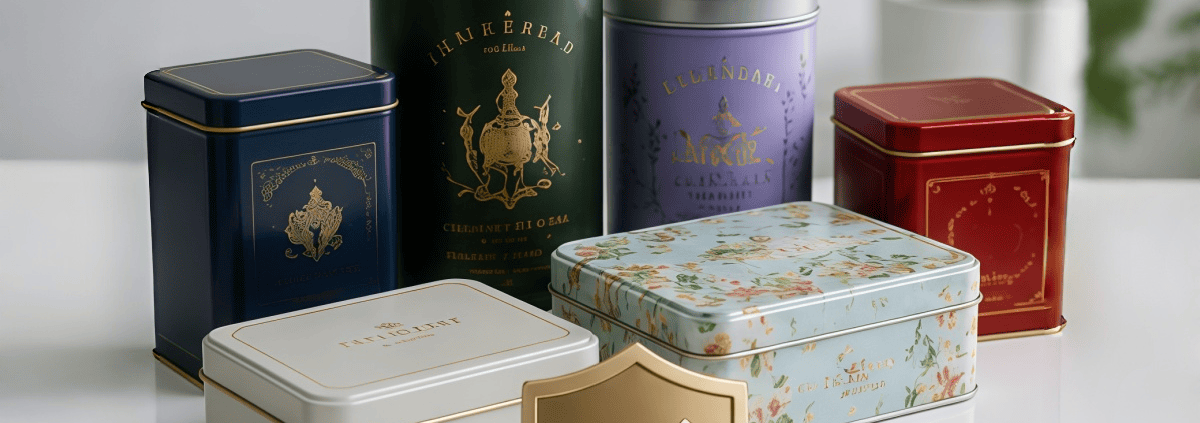
black tins 9-10

Which manufacturing processes ensure that the black tins maintain consistent dimensions and shapes?

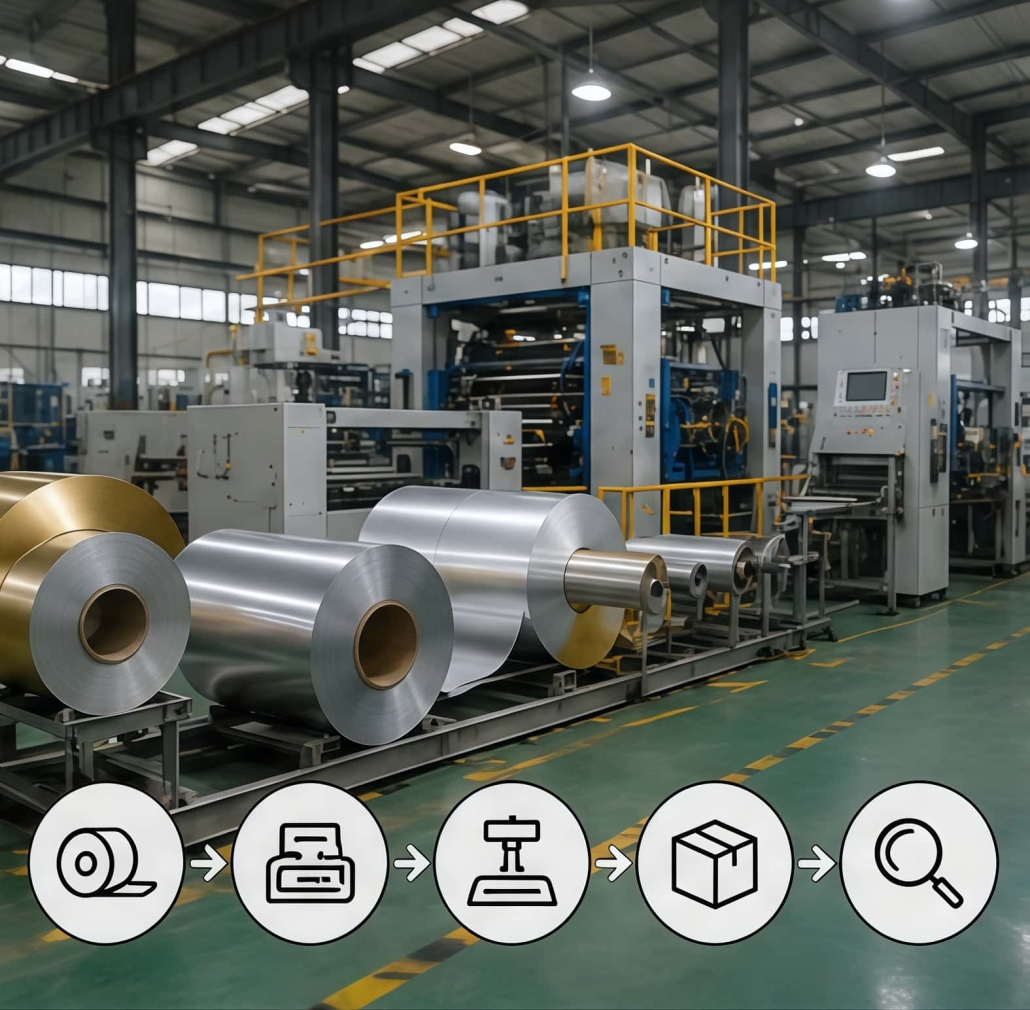
When a black tin can exhibits deformation, misaligned seams, a misaligned lid, or minor surface imperfections, the overall visual consistency is lost, resulting in a poor-quality experience. Therefore, during the production of black tins, we meticulously control every step of the process. Key processes include:

  1. Selecting the appropriate tinplate
  2. Precise cutting
  3. Stamping or deep drawing
  4. Precise trimming and curling
  5. Coating and curing under controlled conditions
  6. Dimensional inspection during production
  7. Proper packaging to prevent damage during transport

These manufacturing processes ensure that the dimensions and shape of the black tins remain consistent.

The Selection of Tinplate Determines the Dimensional Benchmark for Black Tins

As a tin can manufacturer, we select the appropriate tinplate grade, thickness, and temper based on the required structure of the black tin. This is the first step in ensuring the dimensional stability of the finished black tin can. For small black cosmetic cans, candle jars, or food cans, we choose tinplate sheets with suitable stiffness and formability to prevent the can body from deforming, shrinking, or stretching unevenly during production.

We also control the sheet metal’s surface condition before it enters the stamping line, avoiding situations where the tinplate is either too soft or too hard. Therefore, a professional tin can manufacturer uses materials that meet specific specifications rather than relying on standard stock metal. This is the foundation for ensuring consistent quality in the production of black tin cans.

The Selection of Tinplate Determines the Dimensional Benchmark for Black Tins

Precision Cutting to Control Tin Can Shape

The second step is precise cutting. As manufacturers, we cut the sheet metal into precise blanks before stamping or drawing. Even the slightest deviation in blank dimensions can result in issues with the finished black tin can, such as uneven height, misaligned edges, or a lid that doesn’t seal properly.

Precise cutting also ensures stability during the forming process. Clean blanks provide the press with the correct starting point, helping the can body form uniformly. In fact, many shape issues stem from this stage. If the blanking is inaccurate, subsequent processes must compensate for it. Therefore, we control blanking dimensions, edge quality, and sheet positioning before stamping begins to prevent such issues.

Utilizing a Forming Process with Repetitive Shapes

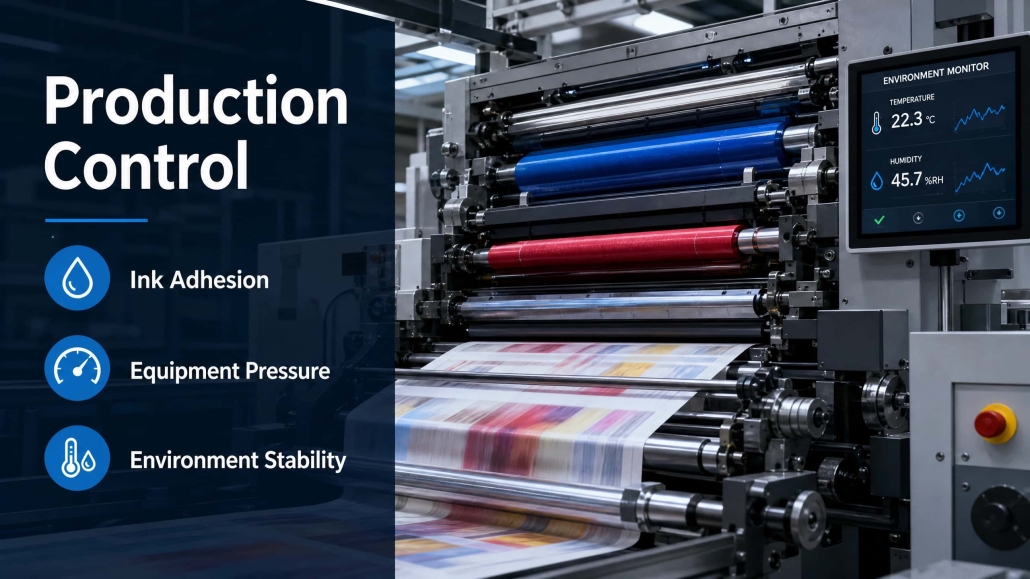
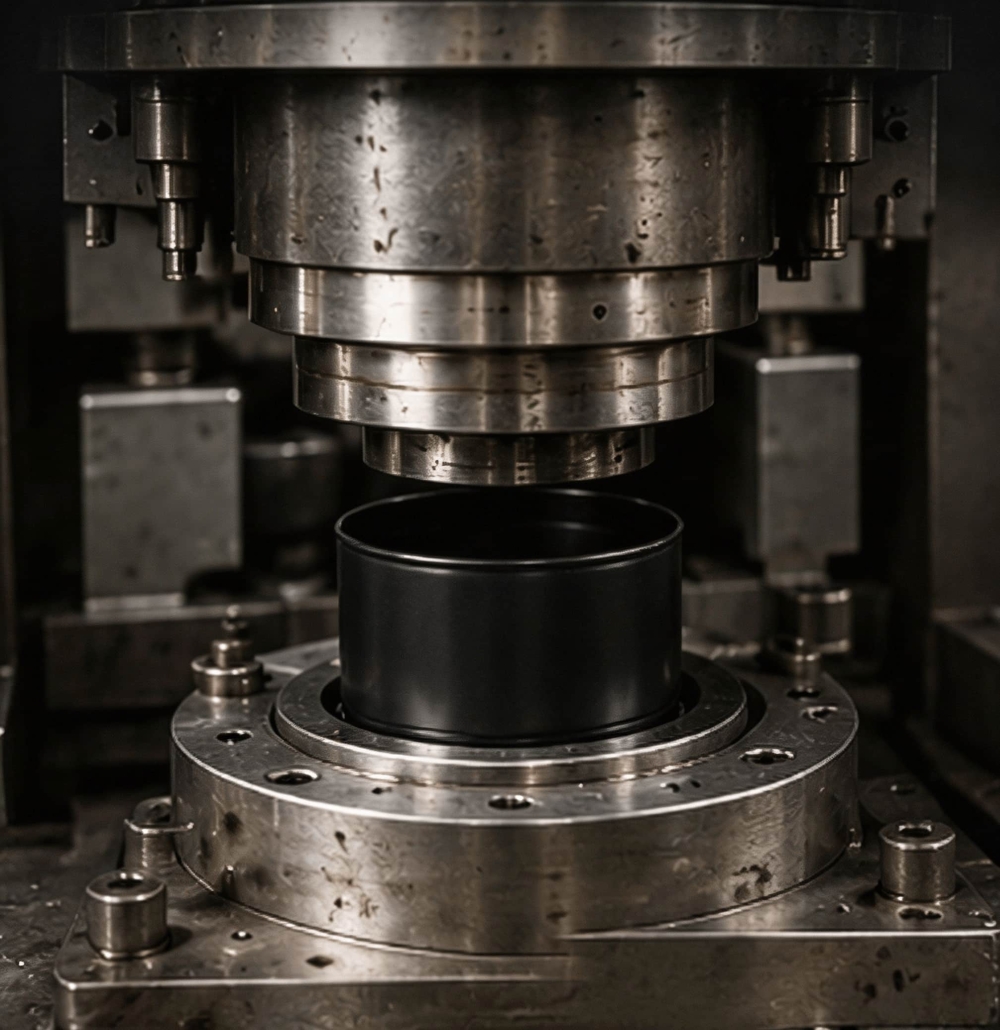
The third process is stamping or deep drawing. In this stage, the flat blank is transformed into the can body, lid, or base. To ensure consistent black tin can stamping, our stamping presses operate at a stable speed, maintain proper stamping pressure, ensure precise die alignment, and employ appropriate lubrication. Throughout the production process, we strictly control pressing parameters to minimize issues such as pressure fluctuations and die misalignment.

Trimming, Flanging, and Beading to Finalize Dimensions

The fourth process is finishing. After forming, the black tins must be trimmed to the appropriate height, then flanged or beaded to complete the edge structure. This step determines the final dimensions. If trimming is uneven, body height will be inconsistent; if flanging is inconsistent, the lid fit will vary as well; for black tin cans, edge quality directly impacts both appearance and functionality. Even if a tin can’s exterior is flawless, if the lid cannot close completely, or if the height of each container varies, this will directly affect the user experience. Therefore, in this process, our goal is not only to ensure that the edges are secure and aesthetically pleasing, but more importantly, to guarantee that the dimensions of the entire batch are completely consistent.

Utilizing a Forming Process with Repetitive Shapes

Coating, Inspection, and Shipping of Black Tins

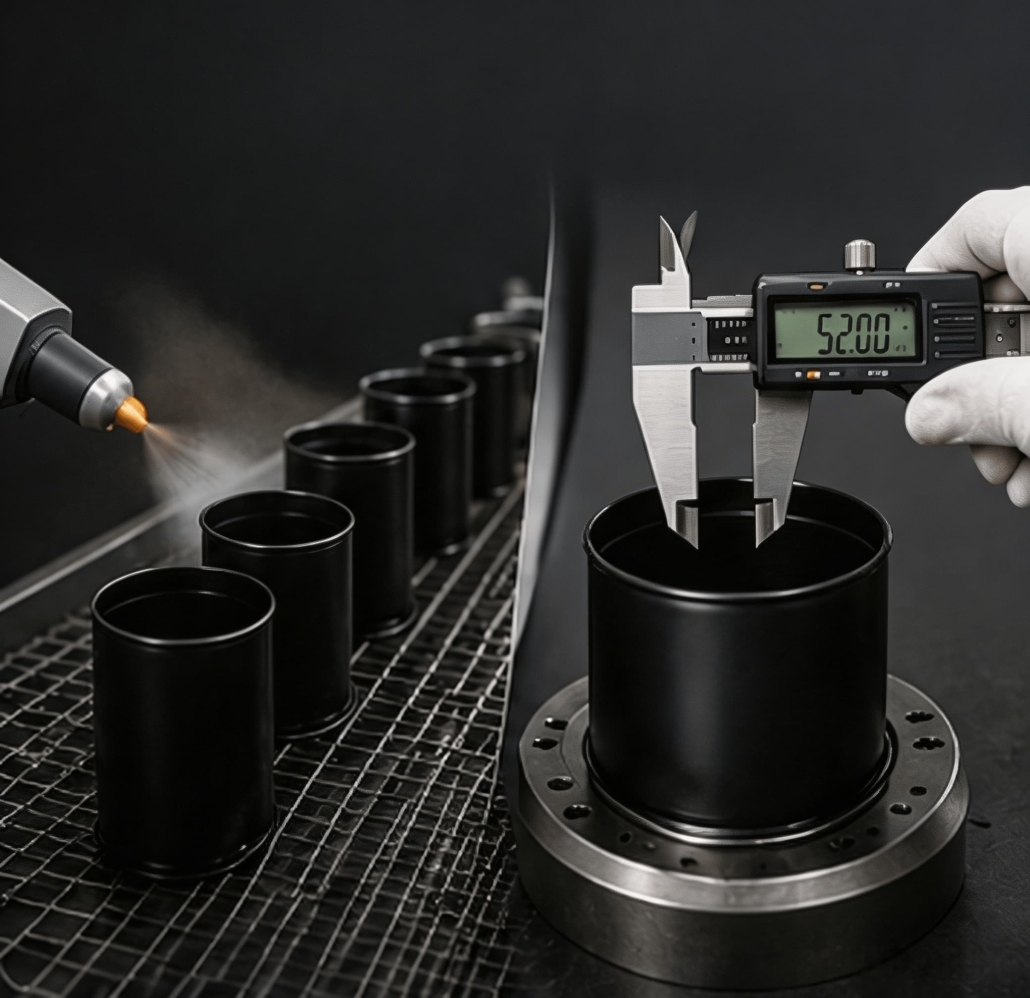
The fifth process is surface coating. Black tins can be coated using spray painting, baking, powder coating, or similar processes. During application and curing, we take great care to avoid tin can deformation caused by excessively thick coatings or high temperatures. To ensure consistency in black tins, we ensure that the surface coating supports the can’s shape rather than altering it.

This is crucial because dark coatings make surface imperfections more visible. If the coating thickness is uneven, the can will appear distorted even if the metal structure is intact. If curing temperatures are not properly controlled, the tin can may experience slight displacement after forming. For black metal cans, this can result in noticeable variations in height, gloss, or edge alignment.

Dimensional Inspection Detects Variations Early

The sixth process is inspection. We measure every batch of black tin cans after forming, after finishing, and before packaging. Inspection criteria include height, diameter, corner symmetry, lid fit, can wall alignment, and overall shape stability. This inspection process helps identify the root cause of any discrepancies. If the issue arises after forming, the press must be adjusted; if it occurs after coating, the curing process must be reviewed. Through this approach, we ensure consistent quality throughout the process, from the start of production to final shipment.

Adding Protective Packaging

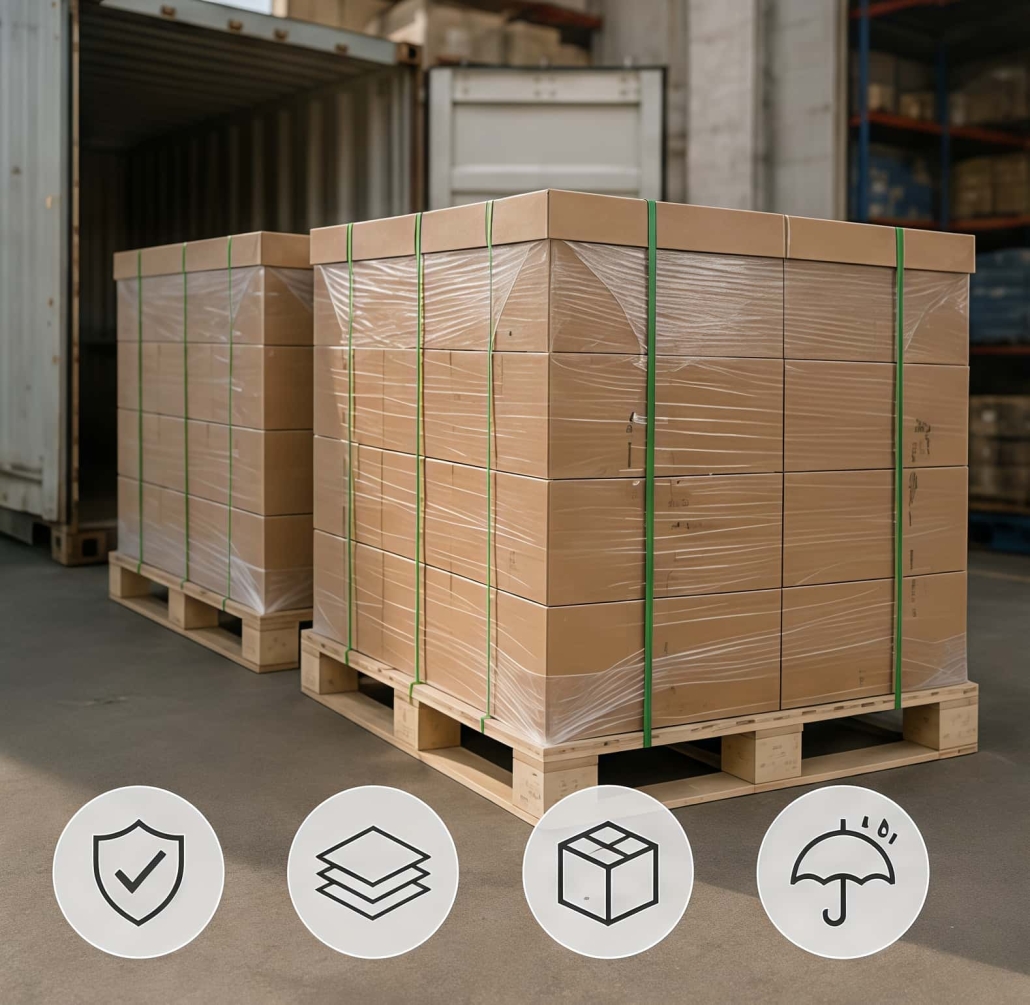
The seventh step is final packaging. Even the finest black tins can become deformed if packaged improperly. Pressure from stacking, poor carton design, or improper handling can cause dents or deformation along the can edges, ultimately affecting the overall quality of the tin cans. We use dividers, cartons, and standardized stacking methods to protect the shape of the tin cans during transportation. We ensure that black tins leave the factory in pristine condition and arrive at the customer’s doorstep as a batch of products with consistent specifications.

Coating, Inspection, and Shipping of Black Tins

Black Tins with Consistent Dimensions and Shape

The key to producing high-quality black tins lies in a strictly controlled production process. When material selection, mold precision, forming technology, surface treatment, and quality management work in perfect harmony, the resulting tin can packaging combines a flawless appearance, excellent structural integrity, and long-term reliability.

custom candle tins 10-8

How Do You Choose the Right Surface Finish for Custom Candle Tins?

Different surface finishes can give candle tins a modern, luxurious, natural, minimalist, festive, or handcrafted look. They also affect the packaging’s resistance to fingerprints, scratches, and shelf wear. When designing custom candle tins, we help clients make selections based on a three-step process: candle formulation, usage scenario, and brand positioning. This is because for candle tins, surface treatments are not merely aesthetic; they also affect heat resistance, scratch resistance, corrosion resistance, print quality, and overall texture.

What Can the Right Surface Treatment Bring to Candle Packaging?

Candle tins serve multiple functions: they protect the candle, support brand promotion, enhance shelf appeal, and influence consumer perception.

The right surface treatment can enhance the following aspects of the user experience:

  • Enhance the perceived value of the product
  • Improve scratch and wear resistance
  • Reduce visible fingerprint marks
  • Improve color consistency
  • Strengthen brand image

Conversely, an inappropriate choice may result in coating damage, fading, poor durability, or packaging that does not align with the candle’s intended market positioning.

Selecting Surface Finishes for Custom Candle Tins Based on Candle Type

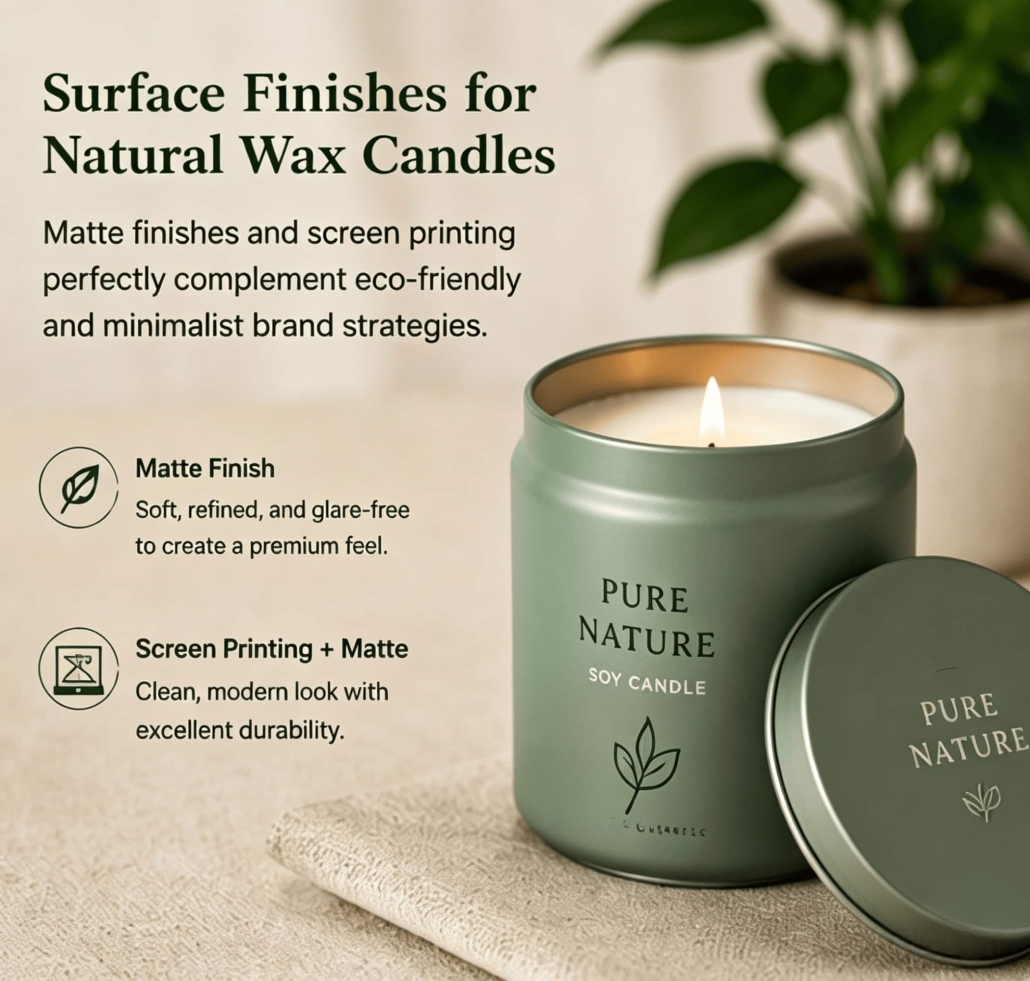
Natural waxes such as soy and coconut are widely used in many yoga studios and are associated with sustainability, healthy living, and a premium home fragrance experience. For these types of products, we typically recommend the following finishes:

Matte Finish:
A matte finish creates a soft, refined appearance that aligns perfectly with eco-friendly and minimalist brand strategies. Additionally, the matte finish reduces glare and lends the product a premium feel.

Screen Printing Combined with a Matte Finish:
Brands seeking strong visual recognition often combine screen-printed logos with a matte coating. This combination creates a clean, modern aesthetic while ensuring excellent durability.

These techniques work exceptionally well because they complement the natural, understated qualities of soy and coconut wax candles.

Natural waxes

 Custom Surface Finishing Techniques for Paraffin Candle Tins

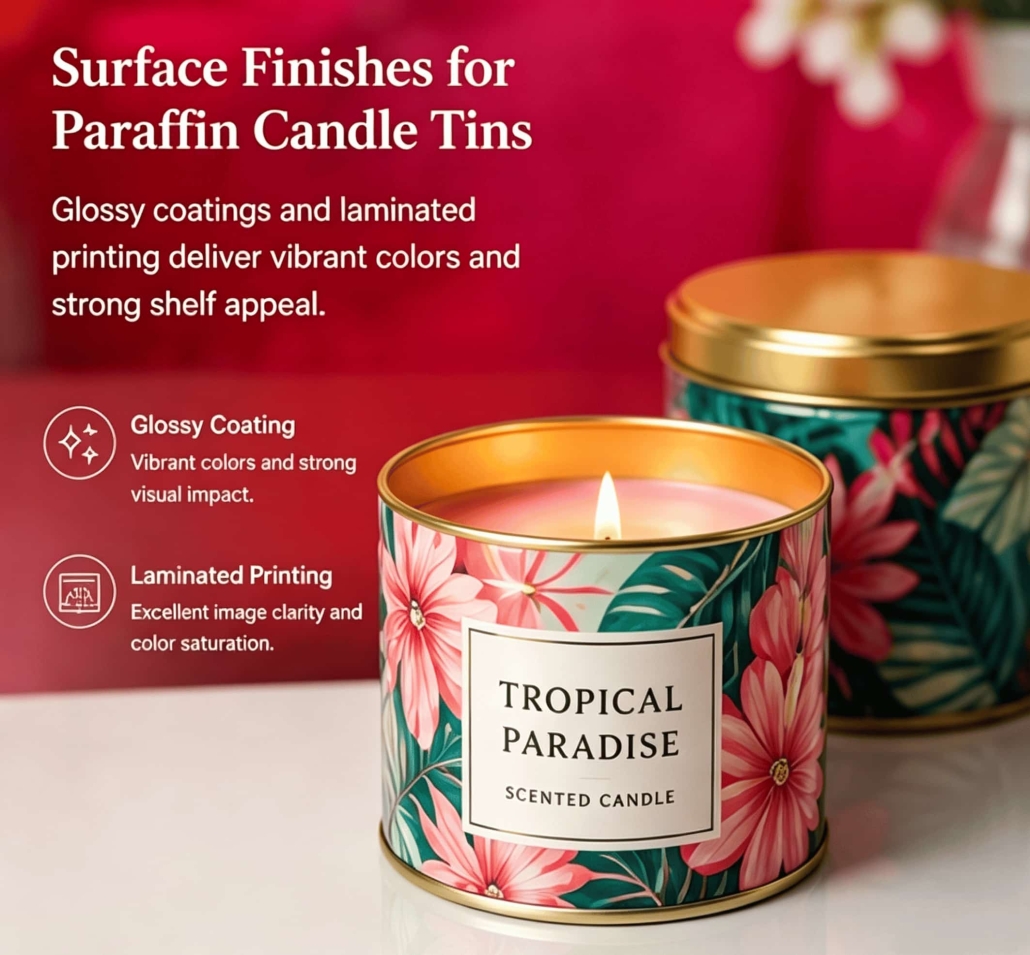
Paraffin candles typically prioritize fragrance diffusion, mass-market appeal, and cost-effectiveness. For these products, suitable processes include:

Glossy Coating:
The glossy finish features vibrant colors and a strong visual impact. This process performs exceptionally well in retail environments where products compete for consumers’ attention.

Laminated Printing:
For brands requiring intricate patterns, seasonal designs, or promotional imagery, laminated printing offers excellent image clarity and color saturation.

These surface-printing techniques enhance the visual appeal of paraffin candles on the shelf while supporting competitive pricing.

Paraffin Candle Tins

Surface Treatment Processes for Candles Containing Essential Oils and High Concentrations of Fragrance

Candles containing high concentrations of essential oils require special consideration. Essential oils and fragrance components may react with certain coatings over time. Therefore, we recommend surface treatment processes that include:

  • Highly chemical-resistant coatings
  • Industrial-grade baking processes
  • Food-grade or solvent-resistant interior coatings

We generally advise clients to avoid using highly vulnerable mirror-finish plating on such products, as the mirror layer is prone to scratches, loss of luster, and localized surface damage over time.

Surface Treatment Processes for Candles Containing Essential Oils and High Concentrations of Fragrance

Selecting Surface Finishes for Custom Candle Tins Based on Application Needs

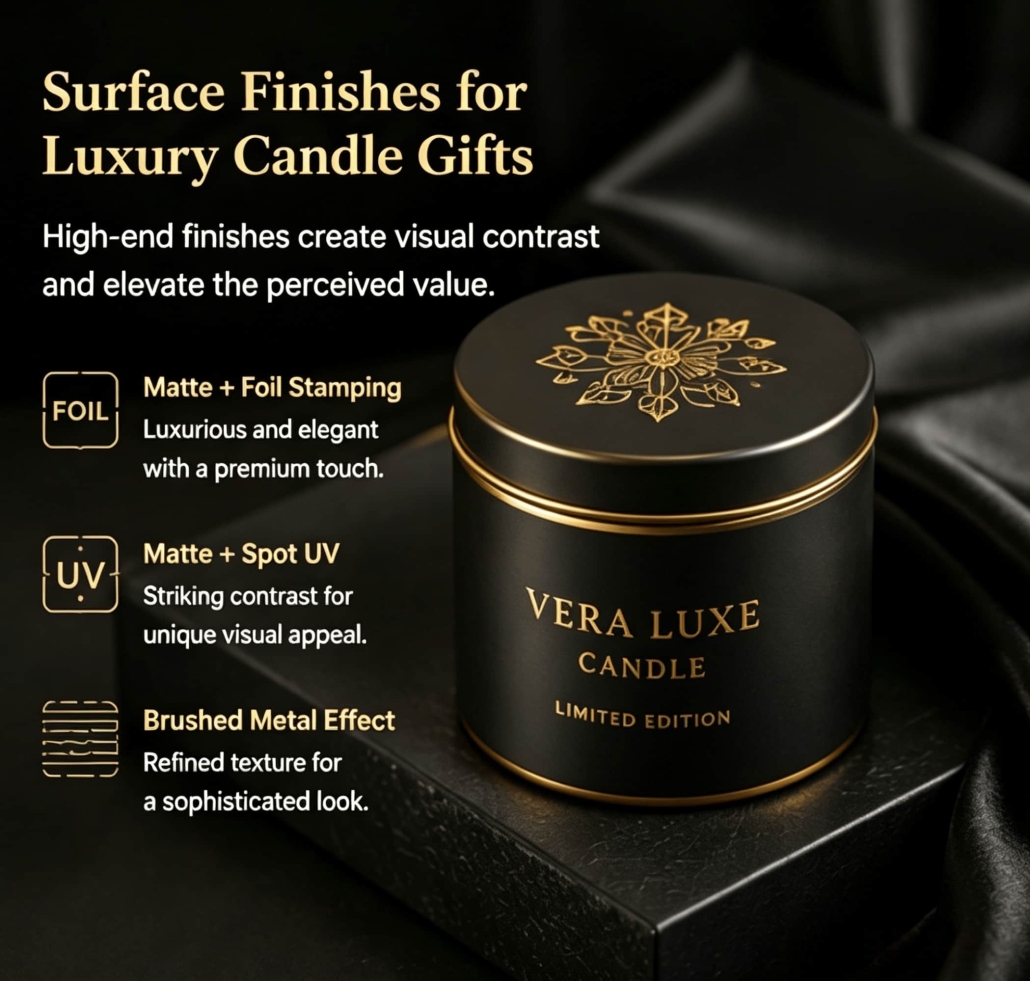
Luxury gifts require packaging that conveys a sense of prestige from the moment it’s opened. Recommended surface finishes include:

  • Matte finish with foil stamping
  • Matte finish with spot UV coating
  • Brushed metal effect

These high-end finishes create striking visual contrasts and enhance the product’s perceived value. Although production costs are higher, they are ideal for holiday collections, limited-edition products, and premium candle gift projects.

Custom Candle Tins for Everyday Consumer Products

For candle products intended for repeat purchases, practicality is often more important than elaborate decoration. Therefore, recommended surface treatments include:

  • Minimalist matte coating
  • Solid-color printing
  • Scratch-resistant protective coating

This approach delivers a clean, uncluttered appearance while ensuring consistent production quality and long-lasting durability.

Candle Tins for Hotels, Spas, and Aromatherapy Brands

Professional fragrance environments prioritize ambiance and visual harmony. For these markets, we typically recommend surface treatments such as:

  • Soft matte finish
  • Satin texture
  • Low-saturation color tones
  • Fine-textured coating

These finishes create a serene, refined appearance that complements luxurious hotel and wellness environments.

Selecting the Optimal Surface Treatment for Custom Candle Tins

We never recommend surface treatments based solely on appearance; instead, we make our selections by comprehensively considering the following factors:

  • Candle type
  • Product positioning
  • Budget requirements
  • Durability needs
  • Regional market preferences

Our design team works closely with clients to ensure every custom candle tin strikes the perfect balance among aesthetics, functionality, durability, and cost-effectiveness. By precisely matching the surface finish to the candle formulation and intended use, brands can maximize user satisfaction.

custom tea tins 2-3

What are some suitable sealing methods for custom tea tins?

The sealing method of a tea tin directly affects the preservation of the tea’s aroma, moisture resistance, and overall quality. In custom tea tins, the lid’s design determines whether the packaging is merely aesthetically pleasing or truly functions as a professional tea tin. Therefore, an ideal sealing method must strike a balance between protection, ease of use, and visual appeal. For this reason, we do not recommend using the same sealing method for all tea products. Different teas have different requirements. Loose-leaf premium teas often require a more refined seal. Packaging for everyday tea tins may prioritize convenience. Meanwhile, gift-packaged tea tins may require a design that combines a high-end feel with reusability.
What is the purpose of a well-designed seal for a custom tea tin?

An appropriate sealing method should offer three key benefits. First, it should effectively block out air and moisture to meet product requirements. Second, it should open and close smoothly to enhance the user experience. Third, it should align with the brand positioning, whether it is high-end, practical, gift-oriented, or for everyday use. Therefore, when designing custom tea tins, we consider the type of tea, storage requirements, the customer’s opening habits, and production specifications.

This is because we understand that tea categories include loose-leaf tea, matcha, herbal tea, tea bags, roasted tea, and gift blends, among others. Each type of tea requires a different storage method. Aroma-sensitive teas need a tighter seal. Some teas require stronger antioxidant protection. Others require packaging that is convenient for daily use. Therefore, our design of the tea tin’s seal always starts with the product itself, rather than the packaging.

Inner Plug Lid: Enhanced Aroma Protection

Among various sealing methods, the inner-seal lid is one of the most effective ways to preserve freshness in custom tea tins. This design adds an inner layer beneath the outer lid, helping minimize contact between the tea and air and thereby better retaining aroma. The inner-seal lid is typically a plastic insert or metal cap located beneath the outer lid. When the outer lid is closed, the inner-seal lid creates an additional barrier between the tea and the surrounding air. This significantly improves the seal compared to using only the outer lid.

We generally recommend inner-seal lids for premium loose-leaf teas, matcha, and specialty tea products, as these teas typically require a more rigorous sealing structure. For high-end custom tea tins, inner-seal lids offer brands a more comprehensive, protective seal.

Points to Note

While inner-stopper lids are an effective solution, they are not always necessary. For teas that are not premium-grade, readily available, or intended for frequent use, a simpler sealing method may be more effective.

Inner Plug Lid Enhanced Aroma Protection

Buckle Lids: Secure and Practical

Buckle lids are another practical sealing option for a custom tea tin. They ensure a secure seal while remaining convenient for daily use. Buckle lids fit more tightly against the tin body, ensuring the package remains sealed during transport and storage while still allowing users to open it easily. In essence, they strike a balance between sealing performance and ease of access. Many customers open the can daily to brew tea. A lid that is too loose can undermine consumer confidence in the product, while one that is too tight may be inconvenient for users. Buckle lids effectively address both of these issues.

We generally recommend tea tins with snap-on lids for settings where convenience is a priority, such as homes, offices, and retail environments. This type of lid is suitable for everyday loose-leaf tea and other tea packaging formats that do not require a stronger seal.

Buckle Lids Secure and Practical

Screw-Top Sealing: Delivering a More Controlled and Superior Sealing Experience

For customers seeking a tighter seal and a more solid opening experience, screw-top lids are the ideal choice for custom tea tins. They are commonly used for high-end tea products to convey a sense of control, precision, and care.

Screw-top lids secure to the tin body by being screwed on tightly, offering a superior seal compared to simple push-on designs. Users can feel the lid engaging with the can, creating a sense of security and refinement. In tea tin packaging, this controlled, tactile interaction enhances the product’s perceived value. It signals to users that the tea is carefully protected and that the packaging design prioritizes attention to detail.

This sealing method is typically suitable for the following scenarios:

1. The tea product is positioned as a premium or specialty tea.
2. The brand aims to enhance consumers’ sense of security.
3. Full opening and closing of the lid is not required.
4. The packaging should appear more refined than standard lids.

Screw-Top Sealing

Hinged Sealing Lids: Convenient and Reusable

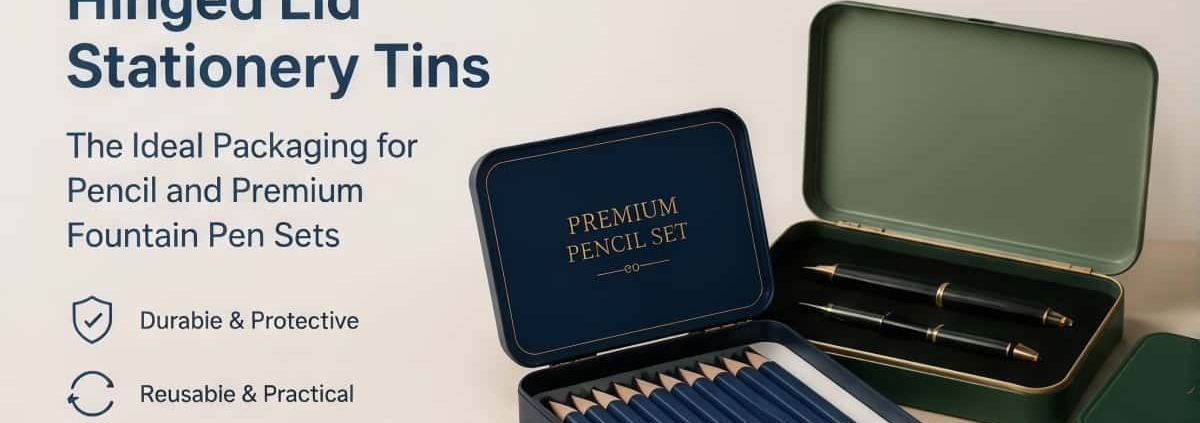
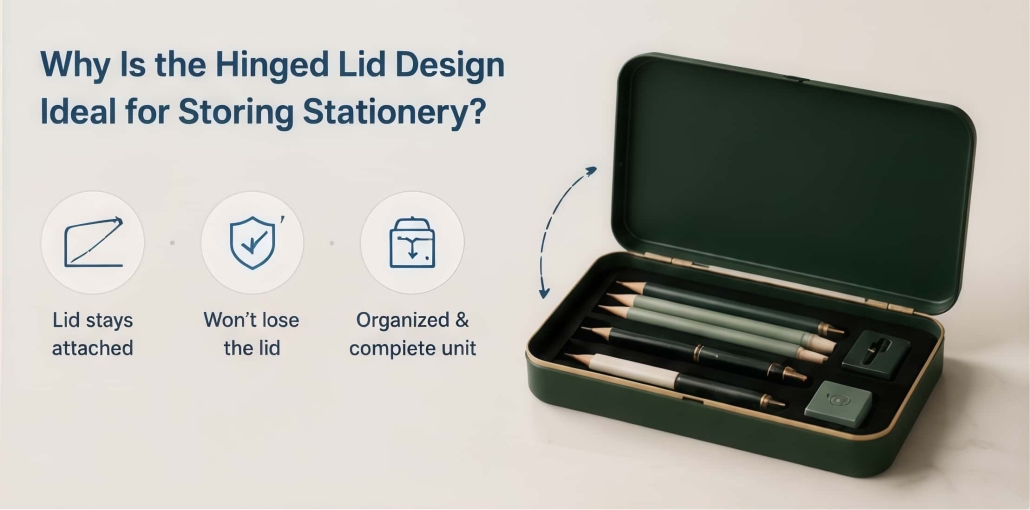
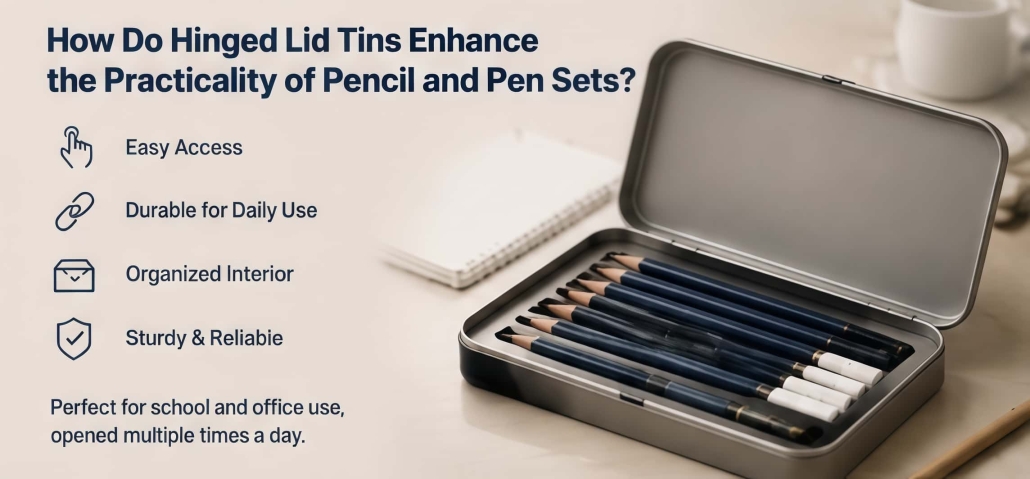
Hinged lids are one of the most common and widely used sealing methods for custom tea tins. Combining convenience with aesthetic appeal, they are particularly suitable for tea packaging that requires easy access and storage. The hinged lid is securely attached to the can body, making it easy to open and close and reducing the risk of loss. This simple advantage is significant in practical use. Customers appreciate this type of packaging for its ease of use and reliability. This design is particularly practical for tea can packaging, especially when the tea needs to be opened repeatedly. The hinged lid facilitates reuse while keeping the can neat and organized.

Many tea products are used as gifts. In such cases, the packaging must not only protect the tea but also be aesthetically pleasing. The hinged lid gives custom tea tins a clean, familiar, and premium look, making them ideal for gift sets and retail displays. One of its greatest strengths lies in its convenience for daily use. It opens and closes smoothly, is effortless to use, and conveys a sense of practicality.

Hinged Sealing Lids

How do we choose the right sealing method for each batch of custom tea tins?

When selecting the appropriate sealing method for custom tea tins, we approach the decision from the customer’s perspective, rather than solely based on design preferences. Before making recommendations, we consider the tea’s characteristics, the customer’s usage habits, market positioning, and production requirements.

First, consider the storage characteristics of the tea

The first question we ask is simple: What freshness-preservation measures does the tea require? If there are high requirements for aroma retention, we will prioritize structures with stronger sealing capabilities. If the tea is consumed daily and requires quick access, we recommend more convenient solutions. Additionally, for premium tea products, we select designs that provide longer-lasting protection.

We typically guide clients as follows:

1. If aroma retention is the top priority, choose an inner stopper lid.
2. If the brand prioritizes practical safety and daily convenience, opt for a snap-on lid.
3. If you want the packaging to convey a more refined, premium feel, choose a screw-top lid.
4. If convenience, reusability, and gift packaging are the most important considerations, please choose a hinged lid.

Selecting the Right Sealing Method to Enhance the Airtightness of Custom Tea tins

The right sealing structure can maintain tea freshness, reinforce brand positioning, and boost customer satisfaction; conversely, the wrong sealing structure may undermine all three. At TSING, we provide recommendations based on the tea’s actual characteristics, market expectations, and the project’s production requirements. Therefore, we recommend inner-seal lids for premium, aroma-sensitive teas; snap-on lids for everyday practical use; screw-top lids for more precise control over tea quality; and hinged lids for ease of use and reusability.

Candle Tins 7-9

How to resolve the issue of inconsistent wall thickness in candle tins?

Inconsistent wall thickness in candle tins can affect the tin’s feel, performance during filling, dent resistance, and stability during transportation and storage. When the wall thickness of a candle tin is uneven, these issues often manifest simultaneously. Some tins feel softer to the touch than others, some lids fit loosely, and some candle tins are more prone to deformation when exposed to heat or pressure. In wholesale orders, these variations can lead to inconsistent candle quality.

As a professional tin can manufacturer, we address this issue through process control at every stage of production. We comprehensively manage materials, molds, forming pressure, tensile properties, and inspection procedures to ensure consistent quality in every batch of wholesale candle tins.

What are the implications of inconsistent wall thickness in candle tins?

When the walls of one candle tin are slightly thicker or thinner than another, this variation affects the tin’s forming, sealing, and durability. This difference becomes particularly noticeable when customers compare multiple tins side by side. For candle packaging, visual appeal is a crucial aspect of the experience. If a tin appears slightly warped or feels less sturdy than others, the entire packaging loses its sense of uniformity. This undermines the brand image and may even reduce consumers’ perceived value of the candles. In any retail setting, such minor discrepancies can make the entire product line appear unprofessional.

What are the implications of inconsistent wall thickness in candle tins

Main Causes of Uneven Wall Thickness in Candle Tins

To address uneven wall thickness, one must first understand its root causes. In candle tin production, this problem typically arises before the tin is formed. Material quality, process parameters, mold condition, and the drawing process all play a role. If any of these factors deviate, the final wall thickness may be uneven.

Material Variations Pose the First Risk

The base material is the starting point for all tin cans. If the tinplate is inconsistent, the finished candle tins will not be uniform either. Differences in material thickness, hardness, or surface quality lead to variations in forming performance during production. This can result in certain areas of the material having better ductility or better shape retention than others. This is why careful material selection for candle tin packaging is essential. A stable base material makes it easier for manufacturers to produce products with consistent wall thickness.

Impact of Mold Condition

The molds or tools used to form candle tins must be extremely precise. If the tools are worn, misaligned, or do not match the design, the metal may not flow evenly during forming, resulting in uneven wall thickness. This issue is particularly pronounced in custom candle tins, as their shapes are often more complex than those of standard tins. If the geometry is poorly designed, certain parts of the tin may be subjected to excessive pressure, while others may not deform sufficiently. This ultimately results in structural inconsistencies that affect both appearance and performance.

The Impact of Stretching Pressure and Forming Speed

The candle tin-forming process also affects wall thickness. If the pressure is too high, certain areas may be overstretched. If the pressure is too low, the shape may not form correctly. If the speed varies too much, the metal may not flow uniformly through the die.

Main Causes of Uneven Wall Thickness in Candle Tins

How Does TSING Ensure Uniform Thickness?

As a professional tin can manufacturer, our first step is to control materials. We do not treat tinplate as a generic raw material; instead, we select and validate it based on the product’s structure, forming requirements, and end use. This also provides a more stable foundation for custom candle tins.

Selecting a Tinplate That Meets Forming Requirements

Different candle tins require different material properties. Slim or intricately detailed designs may require one set of material response characteristics, while deeper or sturdier structures may require another. We select the appropriate tinplate based on forming requirements, ensuring the metal can be stretched in a controlled manner. This is because wall thickness consistency largely depends on how the material responds during the drawing process. If the material is too soft, areas of stress concentration may become too thin; if the material is too hard, it may fail to form a smooth, even part. By matching the material to the design, we can mitigate these risks before production begins.

Using Precision Candle tin Dies

Dies are one of the key factors in controlling wall thickness. Even with the correct material, poor-quality dies can still result in uneven wall thickness in candle tins. Therefore, we place great emphasis on the precision, condition, and alignment of the molds. We use precision candle tin molds to help the tin cans deform in the correct direction. These molds support the can’s shape without subjecting the material to uneven stress. When the mold precision is high, the can’s wall thickness remains more uniform. This is especially true for custom candle tins; the more unique the design, the more critical the mold quality becomes.

Controlled Pressure Prevents Uneven Stretching

Once the material and mold are ready, the next challenge is process control. Wall thickness deviations often occur during forming, so we carefully control pressure, speed, and production parameters during manufacturing. The key lies in balance: the candle tin must have sufficient ductility to form the desired shape, but not so much that it overstretches, leading to uneven wall thickness. We fine-tune the process for each candle tin design. Thicker or deeper structures may require different pressure settings than shallower ones. By matching the pressure to the design, we help the tin walls form a more uniform shape.

Ensuring Uniform Wall Thickness for Candle Tins

Ensuring Uniform Wall Thickness for Candle Tins

If you are looking for custom candle tins, wall thickness consistency should be one of your top quality considerations. Uneven thickness can affect the product’s appearance, feel, and performance. At TSING, we ensure uniform wall thickness in every batch of candle tins through rigorous material selection, precision mold manufacturing, stable process control, and meticulous inspection.

Custom Metal Tins 9-9

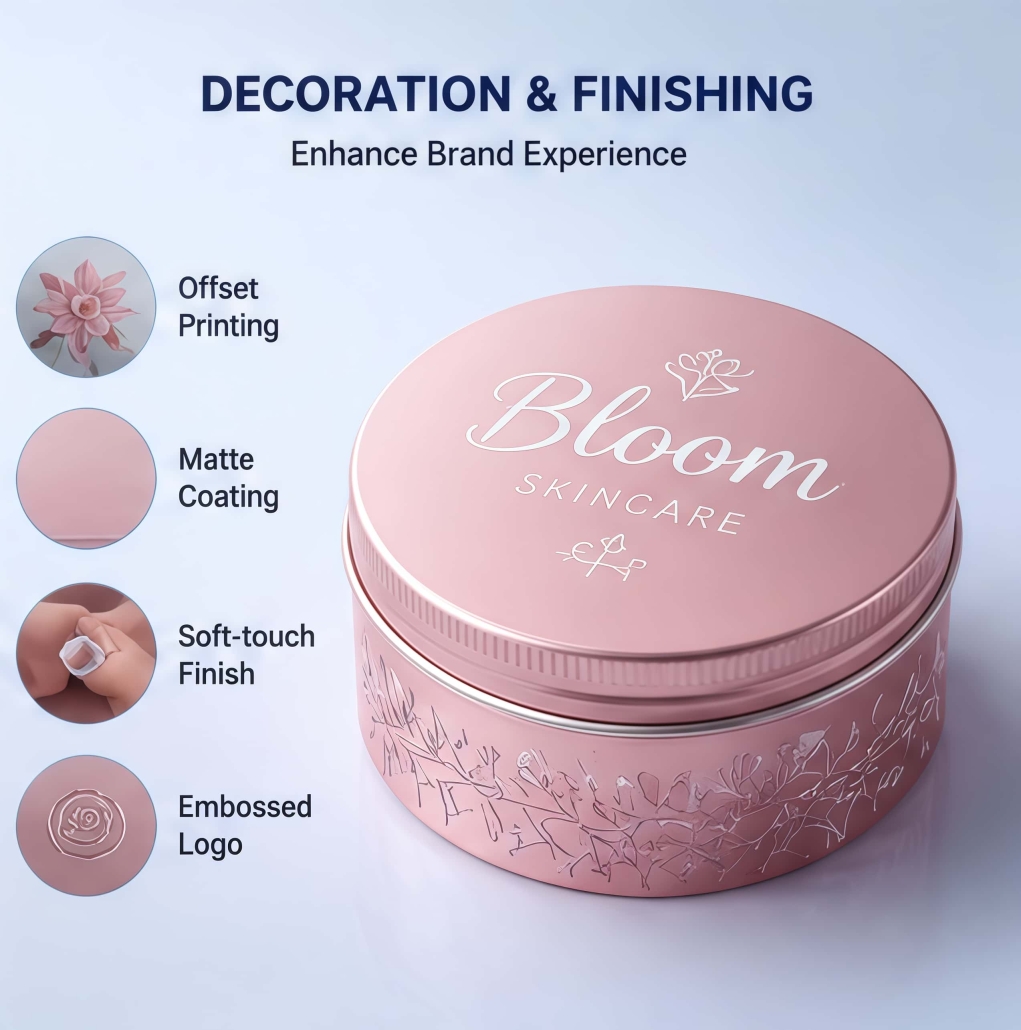
Embossing and Debossing: Creating 3D Texture for Custom Metal Tins

For product packaging that emphasizes texture, a smooth surface is often insufficient to meet customer expectations. When brands choose custom metal tins to hold tea, coffee, candles, or cosmetics, embossing and debossing techniques can create packaging that looks more upscale, feels more substantial, and conveys a sense of quality even before the customer opens it. Packaging is an integral part of the product experience. A custom metal tin with a smooth texture, distinct layers, and meticulous craftsmanship leaves a more lasting first impression than packaging that relies solely on printed graphics. Textured packaging stands out, drawing people in to take a closer look and conveying a sense of careful craftsmanship rather than mass-produced uniformity.

Why do textured surfaces on custom metal tins feel more premium than flat surfaces?

While flat, printed tin cans may look neat, they often lack that eye-catching tactile quality. The addition of texture instantly transforms this experience. Once the surface of a tin can gains depth, the way light reflects off it changes, and the touch can perceive the surface’s subtle undulations. It is this combined visual and tactile experience that gives custom metal tins a more premium feel.

High-end packaging does more than convey information; it creates a unique experience. Textured surfaces make tin cans appear more meticulously crafted, more artisanal, and consequently more valuable. For this reason, many clients who want their metal tins to convey a premium feel from the very first touch often opt for embossing and debossing techniques.

Why do textured surfaces on custom metal tins feel more premium than flat surfaces (1)

How Does Embossing Create a 3D Texture for Custom Metal Tins?

Embossing is one of the most direct ways to create a 3D texture in metal can packaging. It raises selected design elements from the surface, transforming brand logos, borders, icons, and patterns from flat graphics into features with a tangible, three-dimensional feel. This gives custom metal tins a more distinct tactile identity and creates product packaging with a more premium feel.

Embossing makes design elements stand out from the surface

When a design is embossed, specific areas of the metal surface are pressed upward to form raised areas. The result is a raised section that is both visible and tactile. This physical transformation adds depth to the packaging and makes the highlighted elements clearer and more eye-catching.

This is particularly effective for brand logos. A raised logo instantly conveys its prominence. In the design of custom metal cans, this approach is often more effective than simple flat printing, as it embeds design elements into the packaging through a physical process rather than merely applying them to the surface.

Embossing Enhances the Tactile Experience of Custom Metal Tins

One of the greatest advantages of embossing is the unique tactile experience it offers. Customers may not consciously analyze design details, but they can intuitively sense the difference. When holding the packaging, the texture of its surface becomes more captivating. It is precisely this unique tactile quality that creates the premium sensory experience characteristic of metal can packaging. When customers receive a gift in a metal can featuring an embossed logo or pattern, they are more likely to associate the packaging with exquisite craftsmanship.

How Does Embossing Create a 3D Texture for Custom Metal Tins

How Does Debossing Create a Sense of Depth?

The visual effect produced by debossing is the opposite of embossing. Rather than raising the design pattern above the surface, it presses it into the metal. The resulting recessed details convey a more subdued, refined, and often more modern aesthetic. In metal can packaging design, debossing is the ideal choice when clients wish to create a sense of material texture without causing a strong visual distraction.

Pressing Design Patterns Deep into the Metal Tin Body

The debossing process creates recessed shapes on the metal tin’s surface. The finished product features clearly visible indentations that enrich visual depth while maintaining the can’s clean, flowing silhouette. This technique is particularly well-suited for edge embellishments, secondary logos, and decorative patterns intended to complement the overall design rather than overshadow it. For custom metal cans, the embossing process offers brands an alternative way to create a tactile, textured surface while preserving the packaging’s elegant aesthetic.

Creating a Subtle, Luxurious Texture

Some brands do not seek eye-catching, three-dimensional logos; instead, they prefer a soft, understated visual appearance. In such cases, the embossing process creates a sense of depth without overwhelming the eye, resulting in an effect that is serene, precise, and exceptionally refined.

This understated refinement is particularly prized in high-end packaging sectors such as tea, beauty, and skincare products. In these niche markets, measured restraint can often convey a product’s exceptional quality just as effectively as bold extravagance. Debossed designs can lend custom metal tins a more mature, refined, and premium feel.
Debossing

Embossing and debossing are the techniques that best convey texture in custom metal tins

Embossing creates raised details, debossing creates an elegant sense of depth, and gravure printing adds color depth and visual richness. The combination of these two techniques gives custom metal tins a stronger sense of texture and emotional impact. It makes the metal tin packaging appear more refined and valuable. At the same time, it enhances the appeal of custom metal tins.

cigarette tins 9-9

Tinplate or aluminum: Which is better suited for making cigarette tins?

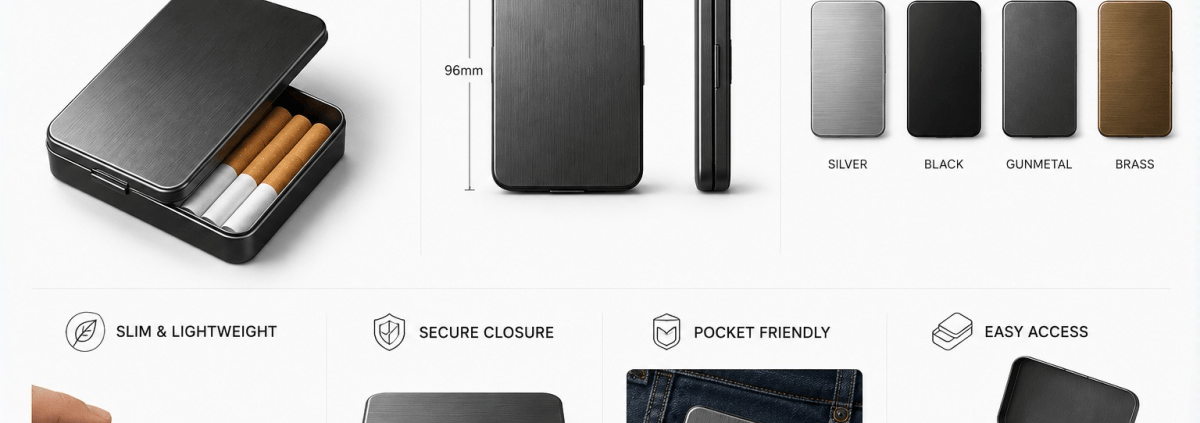
In theory, both materials can be used to manufacture cigarette tins. However, in practical applications, their performance characteristics differ significantly. Tinplate provides cigarette packs with greater rigidity, better shape retention, and better support for intricate surface decorations. Aluminum cigarette packs, on the other hand, are lightweight and stylish but softer in texture and more prone to deformation. For packaging like cigarette packs, where appearance, reusability, and structural precision are paramount, this can compromise the pack’s lifespan and durability.

We will compare these two materials in terms of structure, surface treatment, production efficiency, and long-term value, and explain why tinplate is the more balanced and reliable material choice.

Essential Functions of Cigarette Tins in Practical Use

A cigarette case must protect the cigarettes inside, open and close smoothly, look attractive whether displayed on a shelf or held in hand, and be sturdy and durable enough to withstand repeated use. In many cases, it is also part of the brand image. For this type of packaging, rigidity is crucial. If the shell bends too easily or develops dents, it loses its premium feel, and the perceived value of the product decreases; if the lid becomes loose after repeated use, the packaging’s reliability declines. These issues directly impact the user experience.

Tinplate cans have a sturdier structure, better shape retention, and a more premium feel

If your goal is to produce a cigarette tin that feels reliable and resists deformation, tinplate offers a clear advantage. This is one of the primary reasons TSING has chosen tinplate as its main material.

Tinplate maintains a crisp shape throughout production and use

Cigarette tins must retain their shape, with clean, neat edges, a lid that fits perfectly, and a stable exterior. Tinplate meets these requirements because it has the rigidity necessary for precise forming. When we manufacture cigarette tins using tinplate, the tins resist deformation better both during production and after the product reaches the customer, offering excellent stability. In contrast, aluminum is softer. Although aluminum can also be formed, it typically does not retain the sharp, defined edges of tinplate.

Tinplate maintains a crisp shape throughout production and use

Delivering a More Solid Tactile Experience

Before judging the appearance of packaging, consumers often touch it first. A cigarette case should feel sturdy in the hand, open effortlessly, and close securely. Tinplate imparts a more substantial tactile quality to the packaging, thereby enhancing its perceived value. This is one reason why premium brands often prefer metal cigarette cases made from tinplate. Consumers perceive this packaging as durable. This sensation helps elevate the product’s perceived value and conveys a sense of craftsmanship.

Easier to customize without compromising the rigidity of the cigarette tin

Another practical advantage of tinplate is that it allows for personalization without sacrificing too much strength. Techniques such as embossing, debossing, printed patterns, coatings, and custom lid details can all be effectively applied to tinplate substrates. This allows us greater freedom to create distinctive, custom cigarette tins while maintaining the can’s structural integrity. For brands seeking to create unique cigarette tin cases, tinplate offers a perfect balance of customization, premium feel, and durability. Tinplate makes achieving this balance easier.

Easier to customize without compromising the rigidity of the cigarette tin

Aluminum Has Certain Limitations

Aluminum is not without its merits. Certain properties make it quite attractive for specific product packaging applications. However, when it comes to cigarette tins, their limitations become impossible to ignore.

Aluminum tins are lighter, but that is not the primary requirement for cigarette tins

The most obvious advantage of aluminum is its light weight. It is lighter than a tinplate, offering a significant advantage in portability. However, cigarette cases are not products that can win in the market based solely on their lightweight. Most buyers want packaging that feels durable and high-quality. In this context, being too light can actually backfire. If the case feels too thin or too easily bent, it will appear low-value. At TSING, we’ve found that many clients prioritize the feel of the cigarette pack over its weight.

Aluminum is softer and more prone to visible deformation

One of aluminum’s biggest drawbacks is its softness. Softer materials are more prone to dents, and these dents quickly become apparent on small metal cases. This poses a problem for packaging designed to achieve a sleek, refined appearance. Cigarette tin cases frequently pass through many hands and may be placed in pockets, bags, drawers, or on display shelves. If the material is prone to deformation, the packaging loses its aesthetic appeal, which can undermine the brand image even if the product inside is high-quality. Tinplate cases perform better in this regard because they are structurally sturdier. These cases can withstand the various bumps and knocks of daily use.

It should be noted that aluminum can also be used for certain cigarette tin cases and is not entirely impractical. However, if you seek excellence in all aspects of a cigarette tin—including structure, surface finish, durability, customization, and a premium feel—tinplate offers distinct advantages.

Aluminum is softer and more prone to visible deformation

Tinplate is the most suitable material for cigarette tins

At TSING, we choose tinplate as our primary material because it delivers the best overall performance for cigarette tins. It maintains a crisp shape, is easy to customize, offers reliable surface finishes, and better preserves the tin’s appearance over time. Additionally, it allows us to produce cigarette tins that feel substantial and are reusable—exactly what many brands require. While aluminum may serve a purpose in certain specific applications, tinplate is the more comprehensive choice.

leak-proof metal containers 1-1

Customized Leak-Proof Metal Containers: Meeting Diverse Leak-Proof Packaging Need

Different products have varying requirements for packaging seal integrity and leak resistance; products that require aroma protection differ from those that require antioxidant protection. Liquid products also have different packaging requirements than fine powders. Even for two products within the same category, improvements may be needed in terms of sealing performance, cap feel, or internal protection. Therefore, in such cases, customers typically opt for customized leak-proof metal containers. We view leak-proof packaging as a holistic system and design the structural and sealing performance of leak-proof metal containers for specific products and requirements.

Why Can’t Generic Metal Containers Provide Optimal Sealing for Every Product?

A lid suitable for dry tea may not be sufficient to seal a paste-like product. A simple metal can may look clean and high-end, but it may fail to prevent oxidation. A deep-drawn can body may be ideal for liquids, but it is unnecessary for dry products that only need to retain their aroma.

This is why customization is essential. Different products require different forms of support, and leak-proof metal containers must reflect these differences. If the packaging is too simple, the product may be compromised; if it is too complex, buyers will end up paying for features that offer no added value. The optimal packaging solution lies somewhere in between: it must be specific enough to solve practical problems while remaining practical enough to ensure stability in mass production.

Why Can’t Generic Metal Containers Provide Optimal Sealing for Every Product

How do we match leak-proof metal containers design with product requirements?

At TSING, we do not view leak-proof performance as a single function, but rather as a structural decision. Therefore, we categorize packaging solutions into distinct structural designs, ensuring each type meets the sealing requirements of its specific product category. This enables us to recommend the most suitable metal cans to our clients.

Inner Stopper Lid Structure, Suitable for Aroma-Sensitive Products

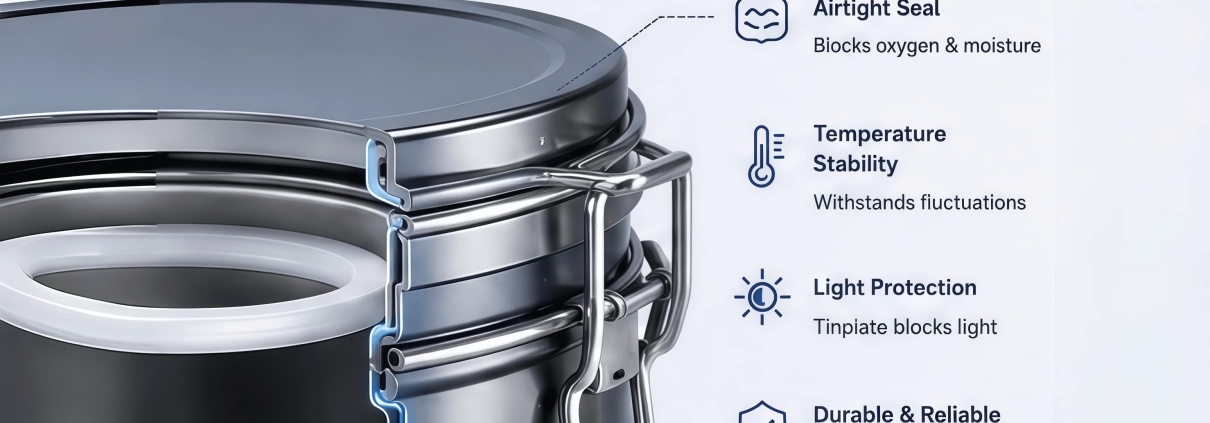
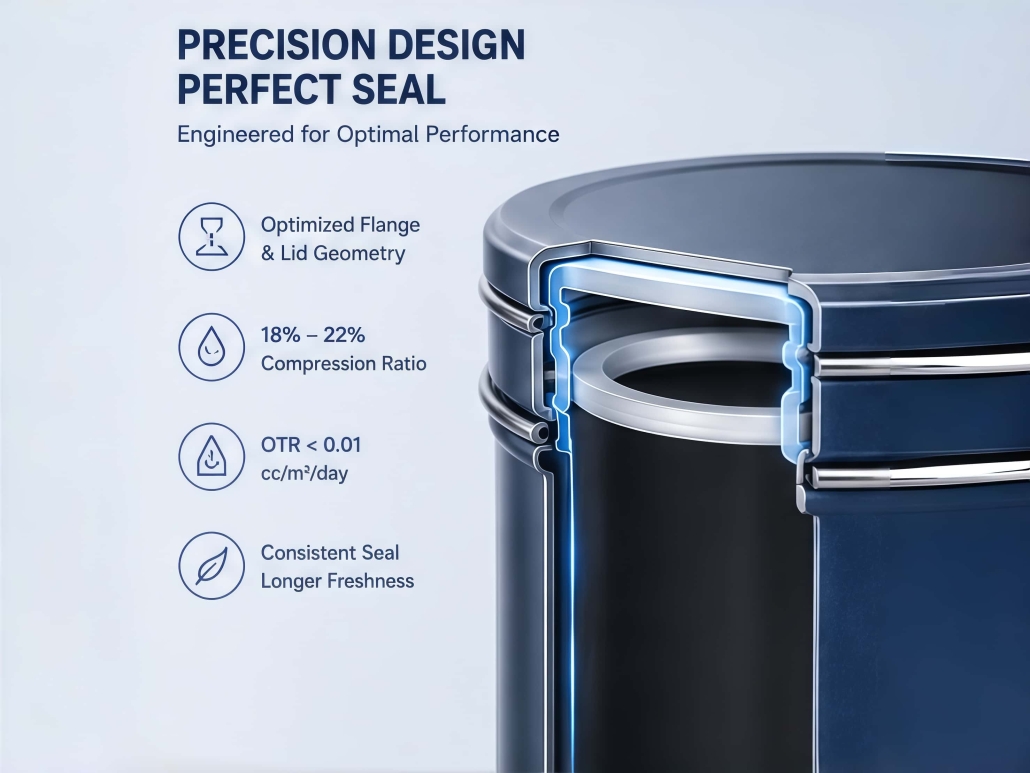
The inner stopper lid structure is one of the most effective methods for enhancing the sealing performance of aroma-sensitive products. This design incorporates an inner stopper (typically made of plastic) or a metal inner lid beneath the outer lid. The outer lid provides the primary sealing function and aesthetic appeal, while the inner stopper creates an additional barrier between the product and the external environment.
This structure is particularly suitable for matcha, premium teas, coffee beans, and other products where aroma retention is critical. While these products may not require a completely airtight liquid container, they do require superior air-tightness compared to standard lids. Inner-seal lids help retain aroma for longer, maintaining product freshness and enhancing customer satisfaction.

Inner Stopper Lid Structure, Suitable for Aroma-Sensitive Products

Sealing Gaskets and Liner Technologies for Oxidation Control

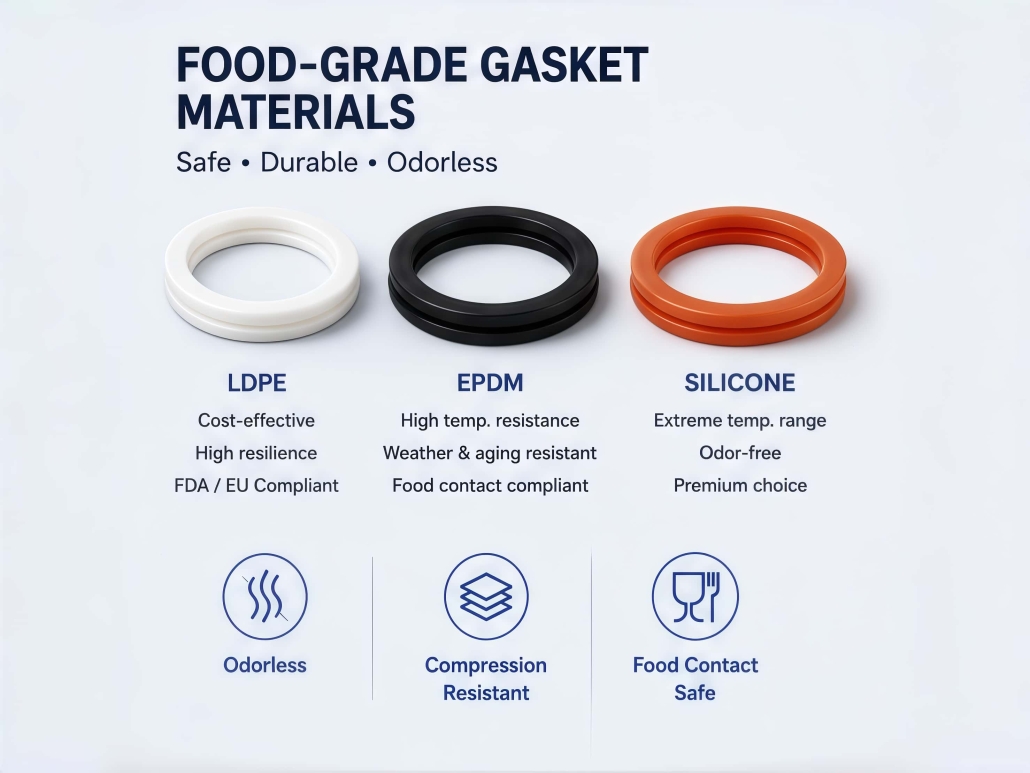
The second key design involves sealing gaskets or liner technologies. This approach involves inserting PVC gaskets, silicone rings, or EPE liners into the inner surface of the lid of a leak-proof metal container. The liner creates a tighter contact surface between the cap and the container, thereby improving the seal and reducing the likelihood of air exchange or leakage. This sealing technology is ideal for specific product categories that require protection against oxidation, moisture, or minor leakage. It not only prevents visible spills but also slows the degradation of quality caused by environmental exposure.

Sealing Gaskets and Liner Technologies for Oxidation Control

Seamless Deep Drawing for Liquids and Fine Powders

The seamless deep-drawing process is one of the most reliable options for leak proof metal container construction. This process forms the entire container body by directly deep drawing a single sheet of metal, thereby eliminating weld seams at the bottom and side walls.

Liquids exert pressure on every weak point in the packaging. Even the smallest structural gaps can allow fine powders to leak out. Seamless tins reduce these risks by eliminating the most common pathways for side leakage. Therefore, deep-drawn metal cans are often the best choice for products requiring a stronger seal. This construction also improves consistency. When the body of the package is made from a single piece of material, we can better control the shape, wall thickness, integrity, and seal alignment. This makes the packaging more reliable during production and more stable during transportation.

gold-candle-tins-2

The Neck-In Process: Achieving a Tighter Fit

The neck-in process, also known as an inward-tapered structure, is another leak-proof structural option. In this design, the rim of the can gradually tapers inward, creating a tighter fit between the lid and the body. This increases friction, making the lid feel tighter when closed. The primary advantage of this design lies in the quality of contact. A tighter-fitting lid typically improves the overall seal and provides a more secure feel. This structure is suitable for products that require a cleaner, more premium appearance while enhancing sealing performance. This includes dry goods, creams, and other products that require a precise seal.

The Neck-In Process

Customized Leak-Proof Metal Containers Structures Meet Diverse Packaging Needs

Different products require different leak-proof strategies, but the goal remains consistent: to protect the product and ensure reliable packaging. Inner-seal lid structures help preserve aroma. Sealing gaskets and liners help prevent oxidation and leakage. Seamless deep-draw forming eliminates the risk of side leakage. A widened neck design improves lid fit and grip. As a tin can manufacturer, we utilize these customized structures to provide our customers with a variety of leak-proof metal containers.

deep-drawn tin cans 1

Why are deep-drawn tin cans better suited for packaging fine powders and liquid products?

The forming process of tin cans determines their ability to protect the contents and ensure stability during use. Unlike packaging that relies on multiple assembled components, deep-drawn tin cans are formed from a single sheet of metal. This process creates a smooth, seamless can body with fewer seams and fewer weak points. For products such as fine powders and liquids, packaging with fewer seams and a more stable shape provides superior protection. Deep-drawn metal cans also offer brands greater flexibility in product positioning. Whether it’s high-end cosmetic powders, specialty dry powders, artisanal liquids, or high-value concentrates, all can benefit from this sturdy, durable, and premium-feeling packaging.

Deep-Drawn Tin Cans Reduce Risks at the Source

One of the greatest advantages of the deep-drawn tin can is the reduction in seams. Every seam on the packaging can become a weak point. While this may be inconsequential for some solid products, in powders and liquids, fine particles can escape through gaps, and liquids can seep through seams over time. A seamless or nearly seamless structure minimizes these risks from the outset.

Why Are Deep-Drawn Tin Cans Particularly Effective for Fine Powders?

Fine powders are one of the more specialized product categories in the packaging industry. They are lightweight, prone to contamination, and often difficult to seal completely. Additionally, they require extra care during filling and storage. Compared to packaging formats with multiple seams or inconsistent wall thickness, deep-drawn tin cans are more effective at addressing these challenges.

Fine Powders Benefit from a Tighter Seal

Fine powder products are extremely susceptible to packaging defects, even minor ones. If the container has weak corners, an imperfect seal, or unstable side walls, the product is more likely to spill, leak, or absorb moisture. Deep-drawn tin cans help solve this problem because their continuous metal body reduces potential leak points.

This is particularly important for products such as cosmetic powders, specialty food powders, herbs, dry powder supplements, seasoning blends, and other fine-particle substances. These products require more than just simple storage; they need containers that can maintain their appearance, texture, and performance. The deep-drawn structure helps meet all three of these requirements.

The smooth inner walls of deep-drawn tin cans make filling and cleaning more convenient.

Fine powders may leave residue during filling or use. The smooth, deep-drawn inner walls make the cans easier to fill and empty. This is a practical advantage for both manufacturers and end users. It reduces waste during production and enhances customer convenience.

Smoother inner walls also reduce the likelihood of powder accumulating in corners or seams. For fine powders, product residue accumulating in hard-to-reach crevices can affect product appearance and user satisfaction. Deep-drawn metal tins help minimize such issues.

Why Are Deep-Drawn Tin Cans Particularly Effective for Fine Powders

Why Are Deep-Drawn Tin Cans More Reliable for Liquid Products?

Liquid products place higher demands on packaging performance. They exert constant pressure on the container, lid, and liner. If the packaging is not strong enough, it can lead to leaks, deformation, or product loss. Deep-drawn tin cans are better suited for packaging these products because they form a more stable, shatter-resistant can body.

The Fewer Seams in Deep-Drawn Tin Cans, the Fewer Leak Paths

Liquid products require reliable packaging. Seams, folds, and misaligned joints all increase the risk of leakage. Deep-drawn cans are made from a single piece of metal, thereby reducing these risks. By using a more robust can body, manufacturers can lower the overall risk. This is a significant advantage for many metal cans designed to hold liquids. Deep-drawn tin cans have a more robust body structure, making them easier to control within packaging systems.

Why Are Deep-Drawn Tin Cans More Reliable for Liquid Products

Superior structural stability under pressure

The pressure exerted by liquids on packaging differs from that of dry goods. Temperature fluctuations, shaking during transport, and long-term storage all place stress on the container. Deep-drawn tin cans, with their more uniform body, are less prone to deformation and can therefore better withstand these stresses. For products requiring long-term storage or transport across different climates, stable packaging helps protect product integrity and reduces the risk of deformation.

Easier to Use with Internal Coatings and Lining Systems

Liquid products typically require internal coatings or liners that are compatible with the product formulation. Deep-drawn tin cans provide a simpler structural foundation for such products. Because the can body is more uniform, liners can be applied more consistently, reducing interruptions. In sectors such as personal care products, specialty food ingredients, and other liquid products, material compatibility must be strictly controlled. The robust structural base of deep-drawn tin cans supports the internal protective layers. This is one reason deep-drawn metal cans are frequently chosen for packaging high-demand liquid products.

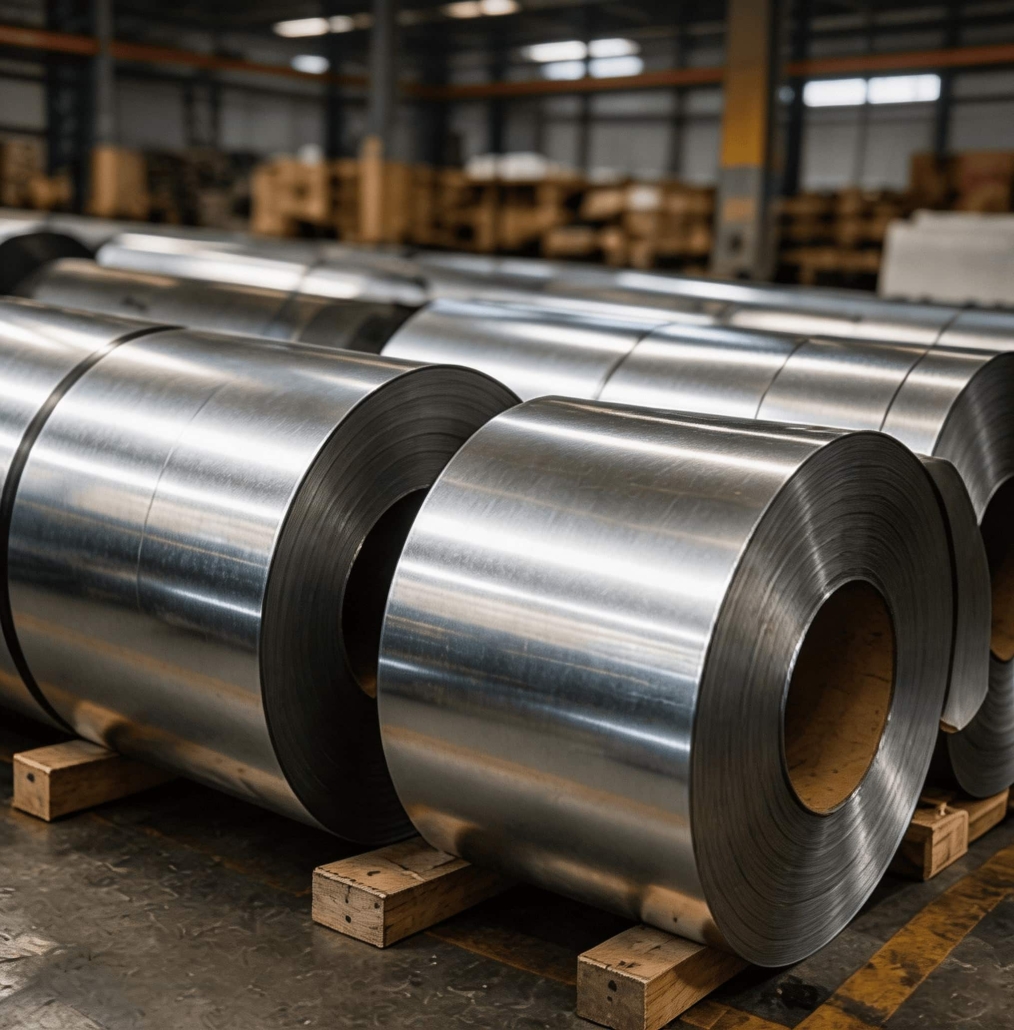
Packaging that Balances Protection, Precision, and Visual Presentation

Compared with many other product types, fine powders and liquids place higher demands on packaging. They require sealing, stability, cleanliness, and reliable visual presentation. Deep-drawn tin cans meet these requirements with their smoother, sturdier, and more uniform structure.

Hidden Procurement Costs To Avoid When Ordering Wholesale Candle Tins

Hidden Procurement Costs To Avoid When Ordering Wholesale Candle Tins

The actual cost of wholesale candle tins extends far beyond the product itself; it also includes molds, sample production, color calibration, packaging methods, shipping costs, communication time, and financial losses resulting from hidden defects. Some of these costs exist even before production begins, while others only arise after the order is delivered, when the customer discovers that the candle tins do not meet expectations.
For candle brands, packaging is an integral part of the product experience. A candle tin is not merely a container; it influences appeal, gift value, customer experience, and even repeat purchases. If the packaging falls short in these areas, the business will be indirectly affected. Therefore, when placing an order, you need to know how to avoid these hidden procurement costs.

Hidden Costs in Wholesale Candle Tins Exist Before Production Begins

Many buyers believe that costs are calculated only after the factory begins producing candle tins. In reality, however, hidden costs often arise much earlier. Stages such as procurement planning, design coordination, sample approval, and technical specifications can all incur expenses if not managed properly.
A common issue is unclear project specifications. If the buyer fails to confirm dimensions, surface finishes, lid styles, print layouts, or intended usage scenarios, the factory must spend extra time clarifying the order. This time may not appear on the cost breakdown, but it still impacts the project’s overall cost. Delays, revisions, and repeated communication all put pressure on the timeline.

Another early cost is poor product compatibility. If the selected candle tins do not match the wax fill weight, candle diameter, wick placement, or the desired burning experience, the client may need to adjust the formula or redesign the packaging. This adds new production and sample-creation costs.

When clients place bulk orders for candle tins without clear packaging requirements, they often end up paying more for subsequent modifications that could have been avoided.

Unclear Processes Can Make Sample Development Very Expensive

If a buyer requests samples of multiple wholesale candle tins without a clear decision in mind, each modification adds time and cost. If the supplier fails to manage the process properly, sample costs can quickly escalate.

A good sample production process should answer one question: Is this design suitable for the product and brand? If the answer is yes, production can proceed. If the answer is no, the candle tin manufacturer should explain what needs to be modified and why. However, if the buyer continually requests minor revisions without a clear objective, the project may get bogged down in unnecessary back-and-forth.

Therefore, we always recommend that candle brands define their target aesthetic and functional requirements as early as possible. A targeted sample production process saves time, reduces waste, and lowers the risk of having to redo molds or reprint designs.

Unclear Processes Can Make Sample Development Very Expensive

Material, Surface Finish, and Structural Choices Impact Wholesale Candle Tins Costs

Once a project enters the production planning phase, the next area where hidden costs can easily arise is the specification selection. Many buyers assume that all candle tins function similarly. In reality, material thickness, coating type, surface treatment complexity, and structural design all significantly impact price.


Material, Surface Finish, and Structural Choices Impact Wholesale Candle Tins Costs (1)

The Material Thickness of Wholesale Candle Tins Affects Price and Performance

Tinplate thickness is one of the simplest examples of hidden cost factors. Thinner materials may lower the quoted price, but they also increase the risk of dents, deformation, and damage to the product’s appearance. If the tinplate is damaged during shipping or handling, the customer’s financial loss will far exceed the initial savings.

On the other hand, choosing excessively strong material will drive up costs without adding actual value. The key is not to purchase the thickest material available, but to select the appropriate material based on candle size, shipping conditions, and brand positioning. High-end candle brands may require sturdier, more durable tins, while mass-market product lines may require more cost-conscious bulk candle tins.

The complexity of surface finishes affects actual wholesale costs

Surface finishing processes are another area prone to hidden costs. Finishes such as matte, gloss, metallic, embossing, debossing, spot UV, and printing all have different production requirements. Some finishes may seem simple, but the actual setup and inspection workload required may exceed the buyer’s expectations. If a client requests a high-end finish without understanding the production costs, the final quote may increase after the design is finalized. If the buyer is not prepared for this, it becomes a hidden cost.

The complexity of surface finishes affects actual wholesale costs

Structural design may incur additional mold costs

Candle tins come in various shapes, including round and rectangular. Some feature special lids, rolled edges, or internal structures. While more complex designs may enhance brand appeal, they also increase mold or setup costs. This is one of the most easily overlooked aspects of wholesale candle tin procurement. Buyers may focus solely on the visual design, overlooking that unique structures require additional production preparation. If these costs are not discussed early on, the final order price may exceed expectations.

How Does TSING Help Buyers Avoid Hidden Costs?

At TSING, we believe the best way to control hidden costs is to eliminate uncertainty early on. Before production begins, we help clients clarify order details, select appropriate materials and structures, plan surface treatments correctly, and prepare for logistics and shipping.

Specifications are clarified before production begins

We first confirm the project’s key details: dimensions, candle fill weight, lid style, surface finish, printing requirements, packaging method, and delivery expectations. This prevents unnecessary revisions and reduces the risk of cost overruns later in the process. For bulk candle tins, this clarity allows us to manufacture based on the client’s actual needs rather than guesswork. This saves time and keeps costs under control.

Open Communication on Factors Affecting Wholesale Candle Tins Pricing

We do not hide cost factors from our clients. If a design proposal increases mold costs, material usage, printing complexity, or shipping volume, we explain this honestly. This transparency helps buyers make more informed decisions. This approach also helps build trust. Clients understand exactly what they are purchasing and why.

Our designs balance production efficiency with shipping convenience.

Our goal is not merely to produce aesthetically pleasing candle tins, but to create packaging that functions efficiently within the actual supply chain. This includes carton efficiency, stacking stability, and protection during transit. We factor these elements into our packaging design, allowing clients to save money without compromising on appearance. This is the value we strive to deliver.

How Does TSING Help Buyers Avoid Hidden Costs

The best procurement approach is transparency, not unexpected costs

At TSING, we help buyers avoid these surprises by making the entire communication process transparent. We believe that candle tins should enhance brand image, protect the candles, and stay within budget. When buyers partner with a manufacturer that communicates clearly and produces responsibly, bulk purchasing candle tins becomes a more predictable and profitable investment.

airtight tea tin 3-3

How can a British tea brand boost sales by using custom-printed airtight tea tins?

British consumers often associate tea with cultural elements such as ritual, tradition, and elegance. In many cases, the airtight tea tins are the first point of contact between the customer and the brand. Therefore, the packaging serves not only to protect the contents but is also an integral part of the product experience.

A British tea brand we worked with faced this challenge precisely:

Their blended black tea was of excellent quality, yet sales growth had slowed significantly. While the tea itself was widely praised, the packaging failed to convey the premium image the brand hoped to project to consumers. Additionally, the existing paper packaging was ineffective at preventing moisture and air from entering, resulting in the tea’s herbal aroma gradually fading during storage.

To address this issue, we designed a custom-printed airtight tea tin solution for this client. This packaging enhances the tea’s freshness, elevates its sense of luxury, and more effectively repositions the product within the premium tea market.

How to Design Airtight Tea Tins That Boost Both Freshness and Sales?

At the project’s inception, we approached the challenge from two angles:

  • Freshness Preservation
  • Premium Brand Positioning

The packaging needed to better preserve the blended black tea while simultaneously elevating the product’s perceived quality in the market, both visually and emotionally.

Rather than treating these goals as separate objectives, we designed a airtight tea tin that allows these two functions to reinforce one another.

Design of the Airtight Tea Tins

Blended black tea is highly sensitive to air exposure and moisture penetration. Even minor environmental factors can gradually diminish the aroma’s intensity during storage and transportation. Therefore, we incorporated a double-seal lid design.

Many brands underestimate the impact of aroma longevity on consumer perception. However, with blended black tea, aroma is often one of the first indicators consumers associate with freshness and quality. Compared to the paper packaging the client previously used, the double-seal structure significantly enhances protection. It minimizes the tea’s exposure to external air, improves seal reliability, and helps maintain the tea’s sensory quality during transportation and shelf storage.

How to Design Airtight Tea Tins That Boost Both Freshness and Sales

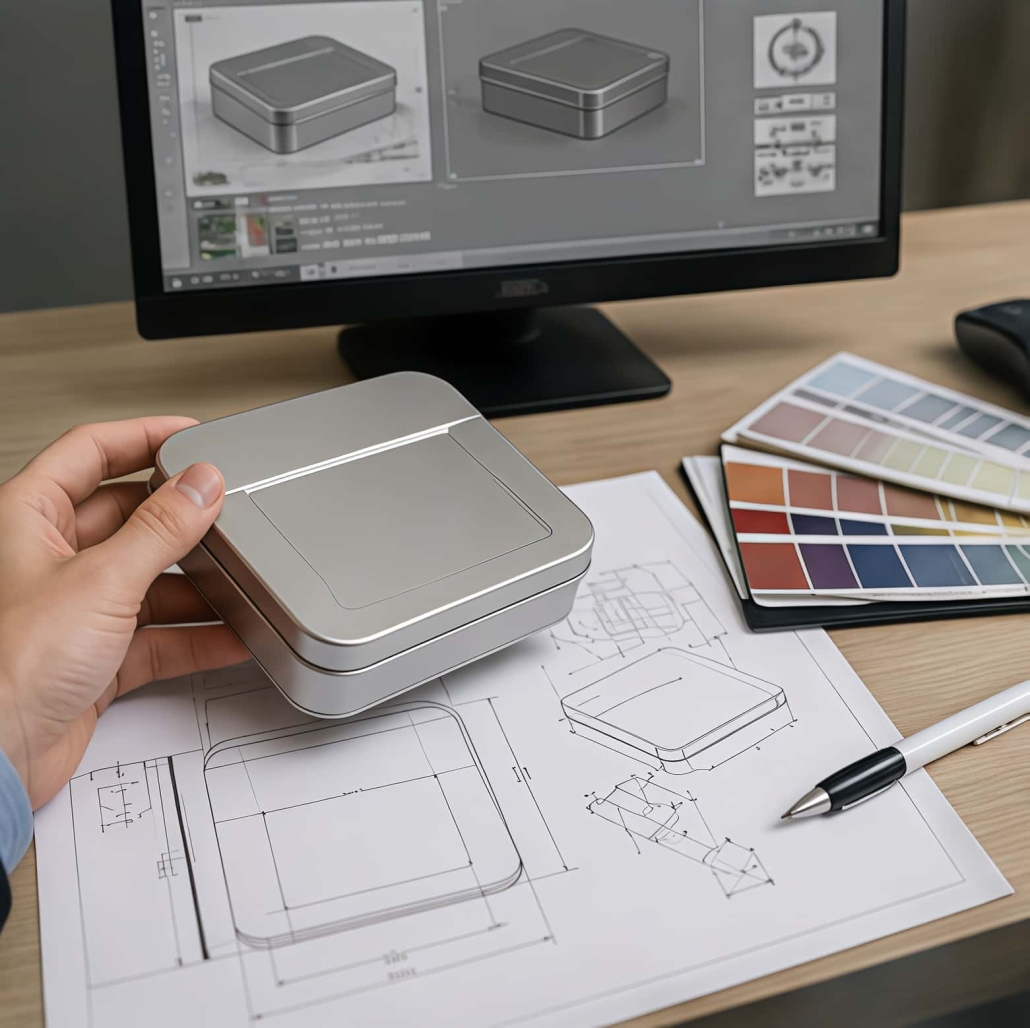
Embossed Logos and Pantone Color Charts Enhance Brand Recognition for Airtight Tea Tins

Embossing creates a three-dimensional effect that flat printing cannot achieve. It allows logos and design details to engage customers not only visually but also through physical interaction via touch.

This tactile interaction is particularly important in high-end tea packaging.

Customers typically associate textured finishes and embossed details with exquisite craftsmanship and superior manufacturing quality. These subtle physical characteristics influence how people perceive the product as a whole.

For the client, embossed branding helped reposition their blended black tea series as a more refined, premium product. The tins are no longer merely ordinary packaging but have become collectible and display-worthy items. Tea tins featuring embossed branding continue to reinforce brand exposure long after the initial purchase. In this sense, the packaging becomes an integral part of the customer’s lifestyle environment.

Embossed Logos and Pantone Color Charts Enhance Brand Recognition for Airtight Tea Tins

The use of Pantone color matching enhances brand consistency.

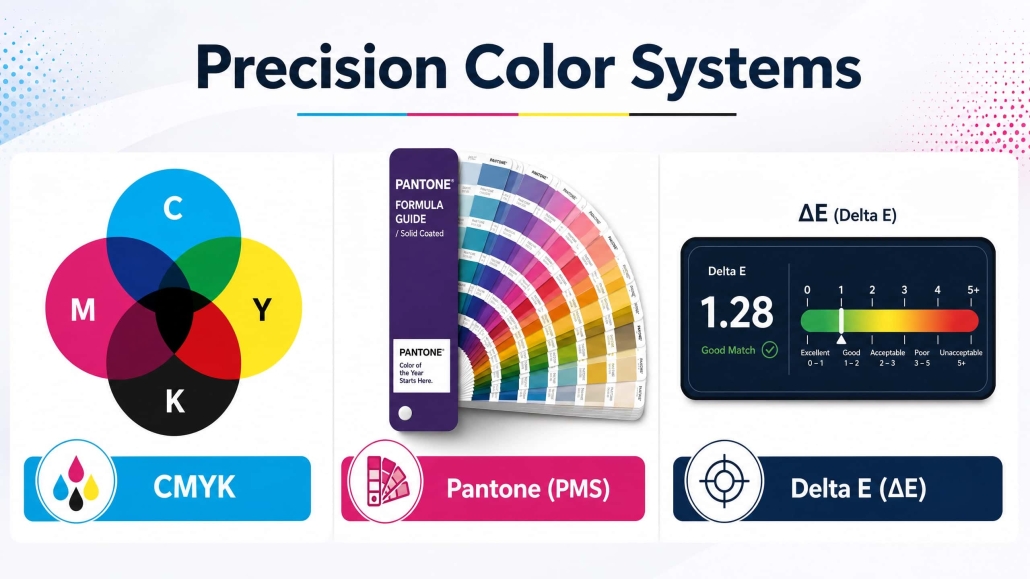
To further strengthen the brand image, we developed a print design for the tea tins that matches the Pantone color system. By carefully aligning the packaging colors with the client’s existing brand identity, we helped create a more unified and premium product line image. The blended black tea products no longer appear isolated from one another; instead, they form part of a carefully designed, premium collection. For this British tea brand seeking to enter the high-end retail market, this visual consistency is crucial. The premium market favors brands that appear meticulously crafted and exquisitely refined. The surface finishes, which match Pantone colors, further reinforce this impression.

The use of Pantone color matching enhances brand consistency

Changing Market Positioning to Boost Sales

The most critical question in any packaging project is whether the packaging can actually increase sales. After switching from paper packaging to custom-printed airtight tea tins, this brand saw significant improvements in both customer perception and sales growth.

One of the first noticeable changes was a substantial increase in the product’s perceived value.

Customers began to view the blended black tea as a more luxurious, gift-worthy, trustworthy, and refined tea brand. This reveals a key truth in the high-end consumer market: when product quality is already strong, superior packaging can greatly elevate customers’ perception of the product. The use of airtight tea tins elevated this tea into a more complete luxury experience. Customers no longer viewed it as ordinary black tea in simple packaging, but rather as a thoughtfully designed, high-quality product.

Sales Exceeded Expectations by 95%

Following the launch of the new packaging, overall sales exceeded expectations by 95%.

For the client, this result confirmed that packaging is not merely a supplementary element of the product, but a direct driver of product growth.

The new packaging delivered improvements in:

Shelf visibility
Perception of luxury
Freshness experience
Customer confidence
Gift appeal

These comprehensive improvements created stronger commercial competitiveness in the premium tea market.

Importantly, this growth did not alter the tea’s formula. The existing herbal blend remained unchanged. What changed was customers’ perception of the product and their sensory experience.

This is one reason why premium packaging often delivers a substantial return on investment. It unlocks the inherent value of the product—a value that had previously failed to be effectively communicated to the market.

320% Growth in the Same Product Line Compared to Paper Packaging

The most striking result is evident when directly comparing the new tea tins with the previous paper packaging. Sales in the same product line increased by 320%.

This improvement highlights the powerful influence of packaging on purchasing psychology in the premium food category. The original paper packaging inadvertently undermined the product’s performance in two ways:

1. Reduced freshness protection
2. Lower perceived value

Once both issues were addressed simultaneously, customer response changed dramatically.

Consumers immediately noticed:

  • Stronger shelf presence
  • Better presentation
  • Improved aroma retention
  • A more luxurious appearance
  • Enhanced gift-giving appeal

For this British tea brand, this was not merely a packaging upgrade, but a successful repositioning in the premium market.

Creating Long-Term Value for the Brand

For British tea brands, sales growth often depends not only on flavor or ingredients, but also on whether the packaging creates long-term value for the brand. In this case, the custom-printed, airtight tea tins provided the brand with superior protection for its blended black teas, showcased its premium image, and established a deeper connection with consumers.

The old paper packaging limited the brand’s growth, while the new airtight tins unlocked its full potential. Sales exceeded expectations by 95%, and sales of the comparable product line grew by 320% compared to the previous packaging. When packaging enhances both functionality and consumer perception, it can transform the entire brand’s positioning.